
OTP Morning Brief: European new car sales continued to rise
Related content
OTP Morning Brief: US producer price index came in above expectations, yet the US 10-year Treasury yield still declined
Western European equities continued to advance despite ongoing pressure on the technology sector. Wall Street indices also rebounded, recovering some ground after Wednesday’s sell-off. Healthcare was the standout performer on both sides of the Atlantic. Eurozone industrial production declined by 0.5% month-on-month in August. In the US, the producer price index accelerated to 6.3%, delivering another upside surprise in inflation developments. US retail sales increased by 0.8% compared to August. The US 10-year Treasury yield declined by more than 10 basis points. The long end of the Hungarian government bond yield curve also declined by 7-9 basis points. In Hungary, August wage data will be released today, while in the US, September industrial production figures are due.
OTP Morning Brief: US CPI data came in above expectations
European equity markets advanced, supported by strong results from ASML and the outstanding performance of the healthcare sector. US equity markets came under pressure following higher-than-expected September CPI data. The annual CPI rate accelerated to 3.7%, driven primarily by a surge in gasoline prices, while core CPI rose by 0.3% month-on-month, supported by higher housing costs and rising transportation service prices. Oil prices rose amid escalating tensions in the Middle East and the impact of the IEA's oil market report. US Treasury yields retreated after an initial increase, driven by Fed commentary, while European bond yields generally moved higher. The US macro calendar will be busy today, with investors focusing on September retail sales and producer price index data, as well as the New York Fed Manufacturing Index, weekly jobless claims, and business inventories. August industrial production data from the euro area will be released today.
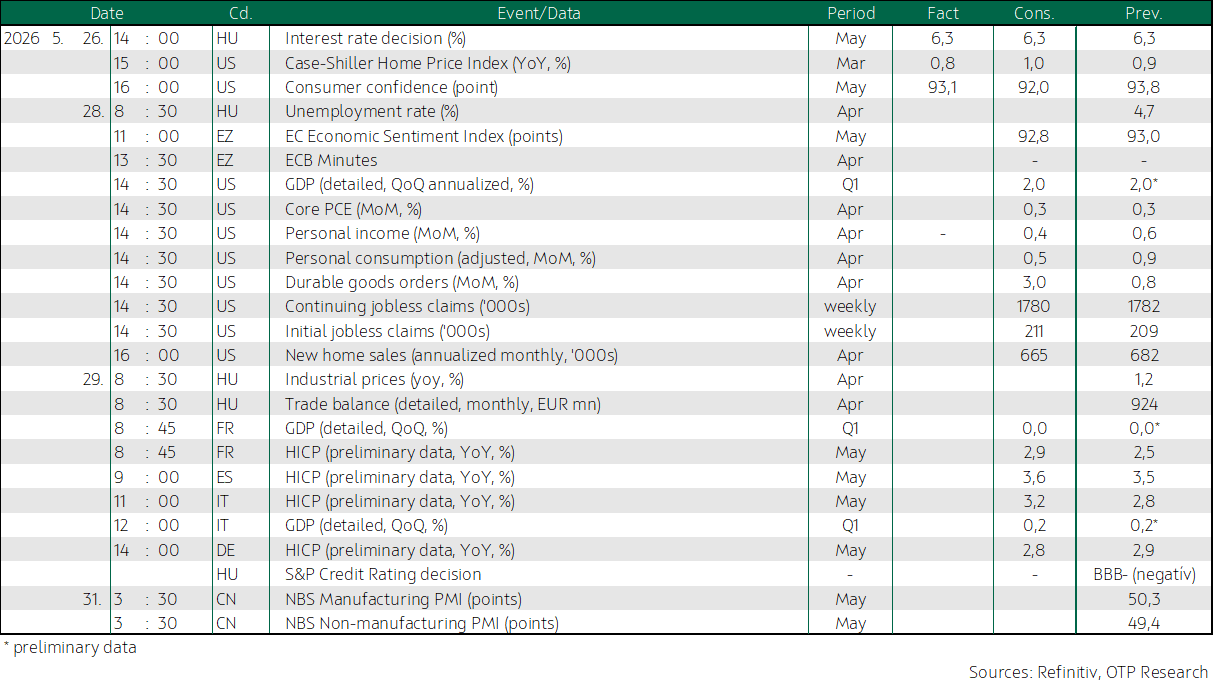
Western European indices closed mixed as uncertainty over the Iran conflict persists, while new car sales in the EU continued to rise.US indices mostly moved higher; Tuesday’s momentum in semiconductor stocks eased somewhat; Meta shares rose. Developed market long-term yields barely moved, while Hungarian yields fell; there was no clear direction in regional FX markets. Today brings the European Commission’s economic sentiment index and the minutes of the ECB’s latest rate-setting meeting. In the US, releases include CPI, GDP, housing, household consumption and income, as well as order book data. Hungary will publish unemployment figures.
Western European indices closed mixed as uncertainty over the Iran conflict persists, while European new car sales continued to rise
Western European equity markets closed mixed on Wednesday, as investors assessed military developments in the Middle East and declining oil prices. Market sentiment continued to be shaped by the evolution of the Iran conflict. Earlier in the week, progress in peace talks was reported, however tensions intensified after US forces—according to their statement acting in self-defense—carried out strikes in southern Iran against missile launch positions and naval units.
On the corporate front, AkzoNobel’s share price saw a significant surge, rising nearly 19.5% after the company rejected a joint takeover bid from Nippon Paint and Sherwin-Williams, and reiterated its support for a planned merger with Axalta. The automotive sector also delivered strong performance, supported by expanding new car sales in the EU: new passenger car registrations rose 5.1% year-on-year in April, marking the third consecutive monthly increase, although moderating from March’s 12.5%. Growth continues to be driven by strong demand for electric and other electrified vehicles, further reinforced by tax incentives and subsidy schemes across major European markets. The share of fully electric cars climbed to 19.7% of total sales in the first four months of the year, up from 15.3% a year earlier. The four largest markets showed a mixed picture: sales increased in Germany (+2.7%), Italy (+11.6%), and Spain (+8.4%), while France recorded a slight 0.3% decline. Overall, the EU new car market grew by 4.2% in the first four months of the year despite ongoing geopolitical tensions.
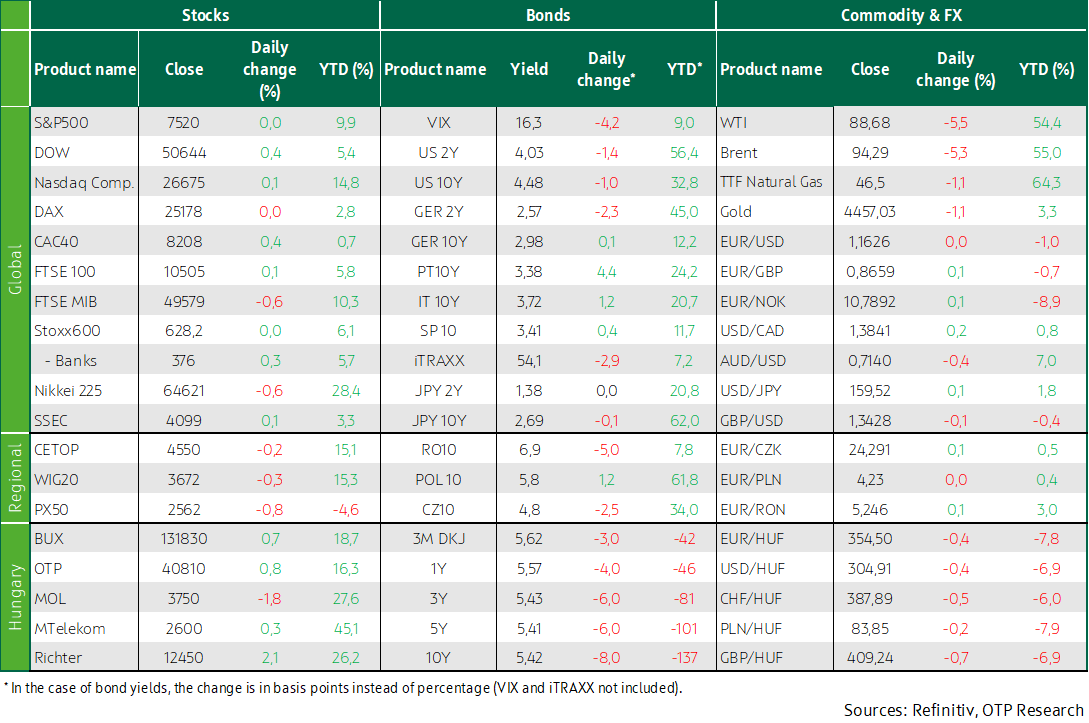
Regional indices declined yesterday, with the exception of the BUX: among domestic blue chips, only MOL shares fell, while the other three stocks moved higher.
US indices mostly moved higher; Tuesday’s momentum in semiconductor stocks eased somewhat; Meta shares rose
US equity markets mostly moved higher on Wednesday with modest moves, as momentum in semiconductor stocks eased. The Dow Jones was supported by a notable decline in oil prices, following reports from Iranian state media that the country is committed to a swift restoration of commercial traffic through the Strait of Hormuz. However, the White House dismissed the report as unfounded.
Within the technology sector, semiconductor manufacturers delivered mixed performance. Micron shares—following Tuesday’s more than 19% surge—closed with a more moderate gain of around 3.6%, while Intel and Qualcomm declined by 1.4% and 6.2%, respectively. In recent periods, memory chipmakers have become key beneficiaries of rising demand for artificial intelligence, although some market participants have pointed to stretched valuations and risks stemming from the sector’s cyclical nature. JPMorgan shares fell 2.4% after the CEO signaled that the bank could spend up to $20 billion on acquisitions in the coming years. Meta shares rose 3.7% following reports that the company plans to introduce subscription-based services across its Meta AI chatbot as well as Facebook, Instagram, and WhatsApp.
Developed market long-term yields barely moved, while Hungarian yields declined; regional FX markets lacked a clear direction
Despite conflicting reports on peace talks between Iran and the US, confidence in global capital markets strengthened further regarding a swift agreement. Oil prices declined by an additional 5%, with Brent crude falling to around $94 per barrel. No significant macroeconomic data were released. Bond and FX markets in developed economies reacted only modestly, with yields barely moving; the 10-year US Treasury yield closed at 4.5%, while the German equivalent ended below 3%. The EURUSD pair also showed little change from Tuesday’s 1.163 level.
There was no clear direction in regional FX markets yesterday: the Czech koruna weakened, the zloty traded sideways, while the forint strengthened to around 354.5 against the euro. In bond markets, the communication from the MNB’s rate-setting meeting—released after Tuesday’s benchmark fixing—triggered a decline in yields, with the segment of the curve beyond one year falling by 5–10 basis points, effectively flattening around the 5.4% level in the government bond market.
Today, the Government Debt Management Agency (ÁKK) will offer 3-, 5-, and 10-year fixed-rate bonds at auctions, with announced volumes of HUF 20bn, HUF 20bn, and HUF 25bn, respectively.
Today's highlights
Asian indices were in decline this morning, while oil prices rose again after US forces once more struck targets in Iran deemed to threaten their security, prompting Iran to retaliate by targeting US air bases.
Today, the European Commission will release its economic sentiment index, alongside the minutes of the ECB’s latest rate-setting meeting. In the US, CPI, GDP, housing data, as well as household consumption and income figures will be published, along with durable goods orders and the usual Thursday initial jobless claims. Hungary will release unemployment data.
Get more out of your investments!
Global Markets Services
OTP Global Markets offers a broad range of services in the field of local and international money and capital markets.
Read morePrivate Banking Services
Personal care and expertise with OTP Private Banking, along with the knowledge, security, and innovations of a multinational banking group.
Read more