
OTP Morning Brief: Winds blowing from the Strait of Hormuz shaped the sentiment on developed stock and bond markets
Related content
OTP Morning Brief: US producer price index came in above expectations, yet the US 10-year Treasury yield still declined
Western European equities continued to advance despite ongoing pressure on the technology sector. Wall Street indices also rebounded, recovering some ground after Wednesday’s sell-off. Healthcare was the standout performer on both sides of the Atlantic. Eurozone industrial production declined by 0.5% month-on-month in August. In the US, the producer price index accelerated to 6.3%, delivering another upside surprise in inflation developments. US retail sales increased by 0.8% compared to August. The US 10-year Treasury yield declined by more than 10 basis points. The long end of the Hungarian government bond yield curve also declined by 7-9 basis points. In Hungary, August wage data will be released today, while in the US, September industrial production figures are due.
OTP Morning Brief: US CPI data came in above expectations
European equity markets advanced, supported by strong results from ASML and the outstanding performance of the healthcare sector. US equity markets came under pressure following higher-than-expected September CPI data. The annual CPI rate accelerated to 3.7%, driven primarily by a surge in gasoline prices, while core CPI rose by 0.3% month-on-month, supported by higher housing costs and rising transportation service prices. Oil prices rose amid escalating tensions in the Middle East and the impact of the IEA's oil market report. US Treasury yields retreated after an initial increase, driven by Fed commentary, while European bond yields generally moved higher. The US macro calendar will be busy today, with investors focusing on September retail sales and producer price index data, as well as the New York Fed Manufacturing Index, weekly jobless claims, and business inventories. August industrial production data from the euro area will be released today.
The Islamic Revolutionary Guard Corps threatened to retaliate after the US carried out what it described as “self-defense strikes” on Iranian missile launch sites and boats around the Strait of Hormuz. Tuesday's session was dominated by a negative sentiment on the leading European stock markets, as all major indices fell except the FTSE100. In the CEE region, the BUX was the best performer, while the Hungarian blue-chips closed mixed. The S&P and NASDAQ closed at new highs, as a favorable earnings season and optimism surrounding AI offset concerns over the unresolved conflict in the Middle East. Brent oil rose by more than 3%. Long-term yields rose inEurope and fell overseas. In line with expectations, the MNB Monetary Councilleft the key interest rate unchanged at its yesterday's meeting. Hungary'slong-term yields fell. News of the Middle East conflict could move marketsagain today. Donald Trump is holding a cabinet meeting at the White House today.
Trading on Tuesday unfolded in a negative mood across major European stock exchanges, while the BUX rose
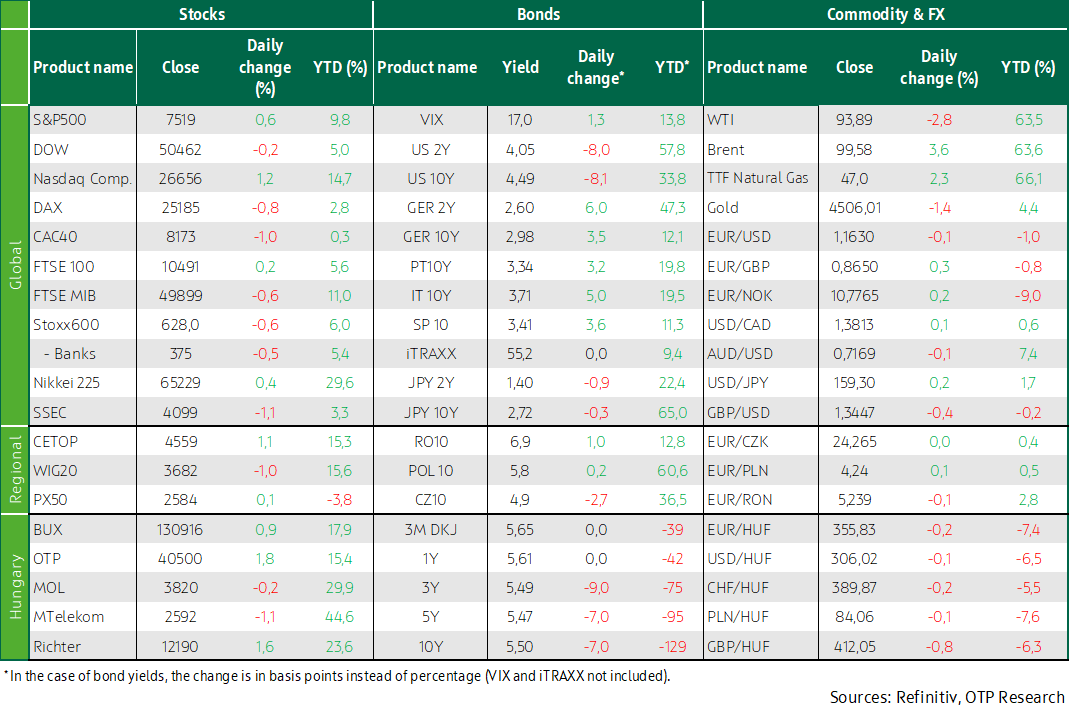
Major European stock markets mostly closed Tuesday in negative territory, overshadowed by the still unproductive US–Iran talks. The Islamic Revolutionary Guard Corps threatened retaliation after the United States carried out what it described as “self-defense strikes” against Iranian missile launch sites and vessels near the Strait of Hormuz—actions the Iranian foreign ministry said demonstrate the US administration’s “malice and hypocrisy” toward Iran. Meanwhile, intense fighting continues between Israel and Lebanon, the other two key parties to the conflict, with Israel pushing ever deeper into Lebanese territory. Alongside concerns over global oil supply, expectations of European rate hikes were further reinforced by ECB Governing Council member Isabel Schnabel, who stated that the central bank should raise rates in June even if an Iranian peace agreement is reached.
The Stoxx 600 fell by 0.6% after hopes tied to a potential peace had previously driven the pan-European index close to record highs. Apart from the slightly higher UK FTSE 100, major European indices moved lower. Among largely declining sectors, carmakers underperformed, as Ferrari’s 8.4% drop dragged the sector; investors reacted negatively to the unveiling of the company’s first fully electric model. It is also worth noting BP’s 4% decline after the firm dismissed its chairman with immediate effect.
Among CEE markets, the BUX delivered the strongest performance, rising by 0.9%. Hungary’s blue chips closed mixed, with OTP and Richter managing to post gains.
The decline in European natural gas prices seen last week extended into Monday, but Tuesday’s pessimistic trading brought a rise, with prices climbing by more than 2% to 47 EUR/MWh.
The S&P 500 and the NASDAQ closed at new highs; semiconductor manufacturers performed strongly, while Brent crude prices rose
The S&P 500 and the NASDAQ closed at new record highs on Tuesday, the first trading session after the long weekend, as optimism around artificial intelligence, a strong earnings season, and robust profit outlooks offset concerns related to the Middle East conflict. Gains were led by semiconductor manufacturers, with Micron standing out as it soared 19%, lifting its market capitalization above $1 trillion for the first time after UBS raised its price target from $535 to $1,625. Aerospace stocks also performed well after Elon Musk-owned SpaceX announced last week its planned IPO, which could take place as early as June. Qualcomm shares rose 4.5% following a Bloomberg report that the company had reached an agreement with TikTok owner ByteDance to supply chips, while the Philadelphia Semiconductor Index climbed 5.5% to an all-time high.
Brent crude rose by more than 3%, returning close to the $100 per barrel mark as recent optimism about Middle East peace faded. In contrast, WTI declined by nearly 3% compared to last Friday’s level.
Long-term yields declined in the US while risingin Europe; in line with expectations, the MNB’s Monetary Council left thepolicy rate unchanged at yesterday’s meeting; domestic long-term yields fell
The 10-year US Treasury yield declined from last week’s near one-and-a-half-year peak of around 4.7% to below 4.5% by yesterday. In Europe, despite some rise, yields remained well below earlier highs, with the 10-year German Bund yield holding below 3%. The dollar retained its strength, with EUR/USD closing just above 1.16.
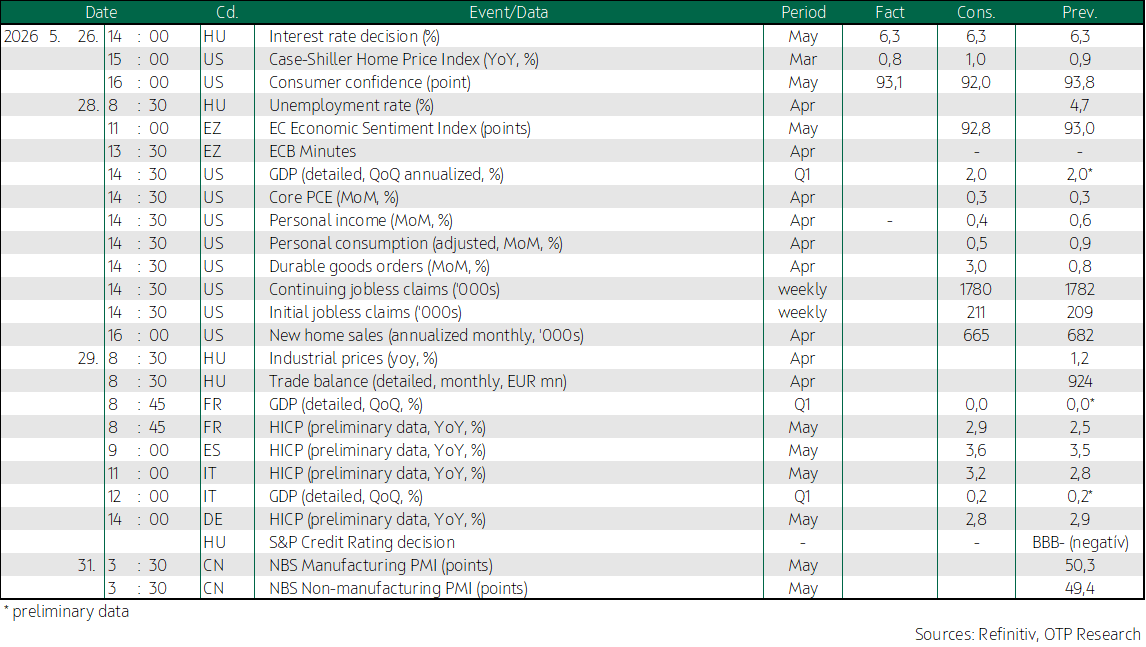
There was no meaningful movement in CEE region currencies, with the forint remaining below 356 against the euro. Domestic benchmark yields declined by close to 10 basis points to around 5.5%. At its policy meeting yesterday, the MNB’s Monetary Council left the base rate unchanged at 6.25%, in line with expectations. At the same time, the tone of both the statement and the press conference was more dovish than previously, suggesting that low CPI, a declining country risk premium, and a strong forint have increased the central bank’s room to cut rates. As a result, government bond yields dropped by a further nearly 10 basis points during the press conference. Demand was subdued at the three-month T-bill auction, where the announced HUF 30 billion was sold at an average yield of 5.68%.
Today's highlights
Mixed movements were seen this morning across Asia-Pacific stock markets, as investors weighed news related to the Middle East conflict that had driven European and Wall Street trading the previous day. South Korea’s KOSPI and Japan’s Nikkei 225 climbed to new highs, while the Hang Seng and the Shanghai Composite remained in negative territory heading into the close.
Futures point to a mixed opening in Europe, while indicating a positive start in the US.
News related to the Middle East conflict may continue to drive markets today. The US and Iran are currently working on a declaration of intent, but disagreements over wording related to Iran’s nuclear program and sanctions have stalled progress toward a memorandum of understanding. According to US Secretary of State Marco Rubio, drafting the agreement could still take several days. Iranian state media has described the ongoing talks in Qatar as broadly positive. Meanwhile, Donald Trump is holding a cabinet meeting at the White House today.
Get more out of your investments!
Global Markets Services
OTP Global Markets offers a broad range of services in the field of local and international money and capital markets.
Read morePrivate Banking Services
Personal care and expertise with OTP Private Banking, along with the knowledge, security, and innovations of a multinational banking group.
Read more