
OTP Morning Brief: Bond yields at new highs in advanced economies
Related content
OTP Morning Brief: US producer price index came in above expectations, yet the US 10-year Treasury yield still declined
Western European equities continued to advance despite ongoing pressure on the technology sector. Wall Street indices also rebounded, recovering some ground after Wednesday’s sell-off. Healthcare was the standout performer on both sides of the Atlantic. Eurozone industrial production declined by 0.5% month-on-month in August. In the US, the producer price index accelerated to 6.3%, delivering another upside surprise in inflation developments. US retail sales increased by 0.8% compared to August. The US 10-year Treasury yield declined by more than 10 basis points. The long end of the Hungarian government bond yield curve also declined by 7-9 basis points. In Hungary, August wage data will be released today, while in the US, September industrial production figures are due.
OTP Morning Brief: US CPI data came in above expectations
European equity markets advanced, supported by strong results from ASML and the outstanding performance of the healthcare sector. US equity markets came under pressure following higher-than-expected September CPI data. The annual CPI rate accelerated to 3.7%, driven primarily by a surge in gasoline prices, while core CPI rose by 0.3% month-on-month, supported by higher housing costs and rising transportation service prices. Oil prices rose amid escalating tensions in the Middle East and the impact of the IEA's oil market report. US Treasury yields retreated after an initial increase, driven by Fed commentary, while European bond yields generally moved higher. The US macro calendar will be busy today, with investors focusing on September retail sales and producer price index data, as well as the New York Fed Manufacturing Index, weekly jobless claims, and business inventories. August industrial production data from the euro area will be released today.
Moderate rise in Western Europe. Wall Street indices fell by 0.7–0.8% on Tuesday. Yields continued to rise across developed bond markets. The 10-year US yield is approaching 4.7%, while the 30-year stands near 5.2%. A European Commission negotiating delegation arrived in Budapest to discuss the release of EU funds. This morning, the Hungarian Central Statistical Office (KSH) will publish data on March earnings. Investors are watching Nvidia’s report.
Moderate rise in Western Europe
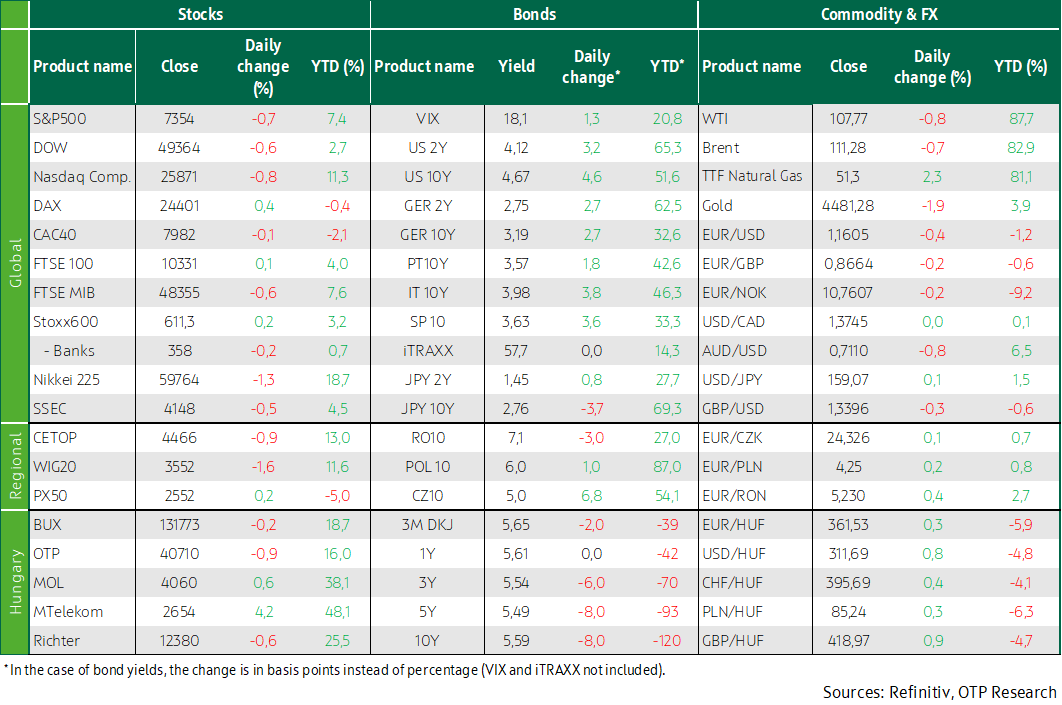
On Tuesday, the STOXX 600 rose by 0.2%, while the DAX closed 0.4% higher. The CAC 40 and the FTSE 100 were broadly flat. Reflecting caution, defensive sectors led the gains, with both the food & beverage and healthcare indices increasing by more than 1.5%. Oil prices declined by around 1%, with Brent still remaining above USD 110 per barrel.
European semiconductor stocks gave back part of their recent gains: Infineon fell by more than 2.5%, while ASMI declined by over 1%. In contrast, among software companies, SAP surged by 6%, and Dassault Systemes rose by 2.8%. Lagercrantz surged 8.2% after the Swedish industrial holding reported fourth-quarter results that exceeded expectations. Saab advanced 4.4% as Sweden is expected to purchase naval frigates worth more than USD 4 billion from France, capable of integrating the company’s weapon systems. Germany’s Hensoldt and Rheinmetall closed up by 8.2% and 3%, respectively.
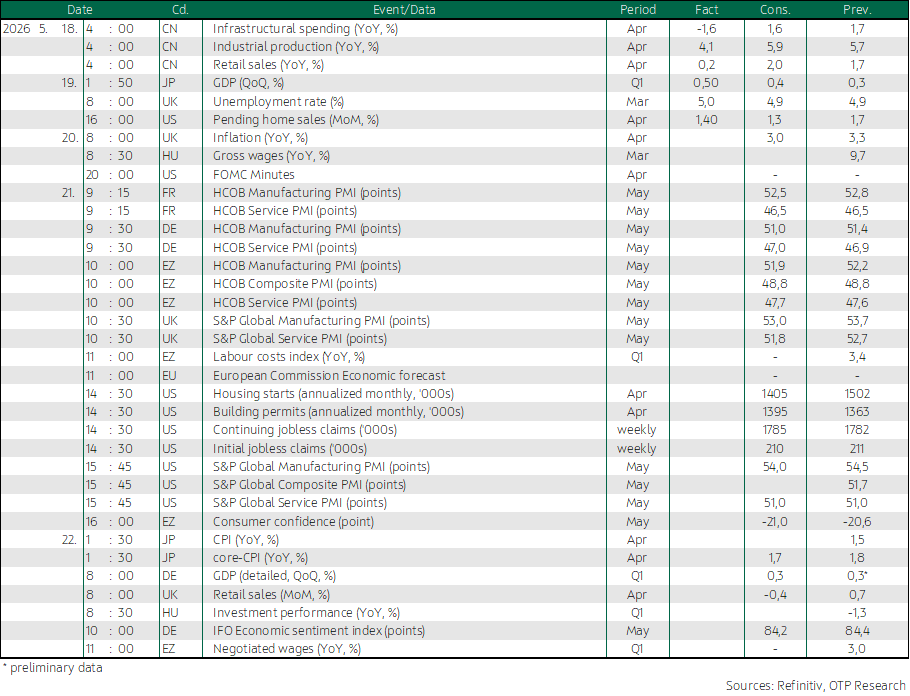
In the United Kingdom, the unemployment rate rose to 5% in March, instead of the expected stagnation, coming in 0.1 percentage points above the analyst consensus.
On Monday, a European Commission negotiating delegation arrived in Budapest. During the week, talks will be held with the government on the release of EU funds. Given the August 31 deadline, the Recovery and Resilience Facility (RRF) and REPowerEU funds (EUR 6.5 billion in grants and EUR 3.9 billion in concessional loans) are likely to be the most urgent issues.
In the region, Poland’s WIG20 fell by 1.6%. The BUX declined by 0.2%, while the Czech PX50 rose by 0.2%.
Equity indices fell overseas
The major US indices fell by 0.6–0.8% on Tuesday. Technology and communication services were the main drags on performance. Similarly to Europe, defensive sectors – including healthcare – held up better.
In recent periods, interest rate expectations in the US have shifted higher. Based on market pricing – according to FedWatch data – not only have rate cut expectations towards the Fed been fully priced out by the end of 2027, but the market is already pricing in a 25 basis point hike by early 2027. Rising rate expectations could put increased pressure on technology stocks whose valuations rely heavily on more distant future cash flows. A key question is how the new central bank chair, Kevin Warsh—known for his more orthodox stance and support for balance sheet tightening—will balance his own views with President Donald Trump’s expectations for rate cuts. Meanwhile, no clear resolution is emerging regarding the conflict with Iran, which is fuelling CPI concerns. Bond markets have responded with rising yields, while the tech-heavy Nasdaq Composite underperformed on Wall Street.
Pending home sales rose by 1.4% month-on-month, coming in above expectations. At the same time, rising mortgage rates—driven by the conflict with Iran—are weighing on the US housing market. The average rate on a 30-year fixed mortgage increased from 5.98% before the war to above 6.3%.
Yields continued to rise across developed bond markets
Yields continued to rise across developed bond markets, as the Strait of Hormuz remains closed, intensifying physical oil shortages and rising CPI pressures. The 10-year US yield is approaching 4.7%, while the 30-year stands near 5.2%, the latter close to a two-decade high. Germany’s 10-year government bond yield increased more moderately but is nearing 3.2%, its highest level in the past 15 years. Amid the negative sentiment, the dollar strengthened notably by 0.5%, reaching around 1.16 against the euro.
The forint weakened by 0.3% against the euro, slipping below the 362 level, while the zloty lost 0.2% and the koruna declined by 0.1%. Government Debt Management Agency (ÁKK) reference yields, recorded in the early afternoon, fell by 6–8 basis points, with the 10-year dropping to 5.6%, although yields started to rise again by the evening. At the three-month T-bill auction, HUF 40 billion worth of securities were sold amid solid demand, with an average yield of 5.7%.
Today, the Government Debt Management Agency (ÁKK) will offer HUF 30 billion in six-month T-bills, while proposing HUF 15–15 billion of 2033/C and 2038/A bonds at switch auctions in exchange for securities maturing this year and next.
Today's highlights
Heading into the close, Japan’s Nikkei is down 1.3%, while Korea’s KOSPI is falling by 2.9%. The SSEC is lower by 0.5%, and the Hang Seng is down 0.6%.
Today, April CPI data is due from the United Kingdom. In Hungary, the Hungarian Central Statistical Office (KSH) will publish figures on March earnings. Among quarterly corporate releases, Nvidia’s results are likely to attract the most attention.
Get more out of your investments!
Global Markets Services
OTP Global Markets offers a broad range of services in the field of local and international money and capital markets.
Read morePrivate Banking Services
Personal care and expertise with OTP Private Banking, along with the knowledge, security, and innovations of a multinational banking group.
Read more