
OTP Morning Brief: The technology sector led the charge on US stock markets
Related content
OTP Morning Brief: US producer price index came in above expectations, yet the US 10-year Treasury yield still declined
Western European equities continued to advance despite ongoing pressure on the technology sector. Wall Street indices also rebounded, recovering some ground after Wednesday’s sell-off. Healthcare was the standout performer on both sides of the Atlantic. Eurozone industrial production declined by 0.5% month-on-month in August. In the US, the producer price index accelerated to 6.3%, delivering another upside surprise in inflation developments. US retail sales increased by 0.8% compared to August. The US 10-year Treasury yield declined by more than 10 basis points. The long end of the Hungarian government bond yield curve also declined by 7-9 basis points. In Hungary, August wage data will be released today, while in the US, September industrial production figures are due.
OTP Morning Brief: US CPI data came in above expectations
European equity markets advanced, supported by strong results from ASML and the outstanding performance of the healthcare sector. US equity markets came under pressure following higher-than-expected September CPI data. The annual CPI rate accelerated to 3.7%, driven primarily by a surge in gasoline prices, while core CPI rose by 0.3% month-on-month, supported by higher housing costs and rising transportation service prices. Oil prices rose amid escalating tensions in the Middle East and the impact of the IEA's oil market report. US Treasury yields retreated after an initial increase, driven by Fed commentary, while European bond yields generally moved higher. The US macro calendar will be busy today, with investors focusing on September retail sales and producer price index data, as well as the New York Fed Manufacturing Index, weekly jobless claims, and business inventories. August industrial production data from the euro area will be released today.
Western European markets rose, while no resolution is in sight to the US–Iran conflict; euro area industrial production came in below expectations, GDP growth was in line with the preliminary reading, and employment slowed as expected. US indices closed mixed, with the technology sector performing the best; US producer prices rose more than expected. Developed market long-term yields were mixed; the dollar strengthened against the euro, the forint weakened following the MNB’s decision, and domestic bond yields fell. Today, UK and Polish GDP data will be released. In the United States, alongside the usual weekly initial jobless claims figures due on Thursday, retail sales and business inventory data will also be published.
Western European markets rose, while no resolution is in sight to the US–Iran conflict; euro area industrial production came in below expectations, GDP growth was in line with the preliminary reading, and employment slowed as expected
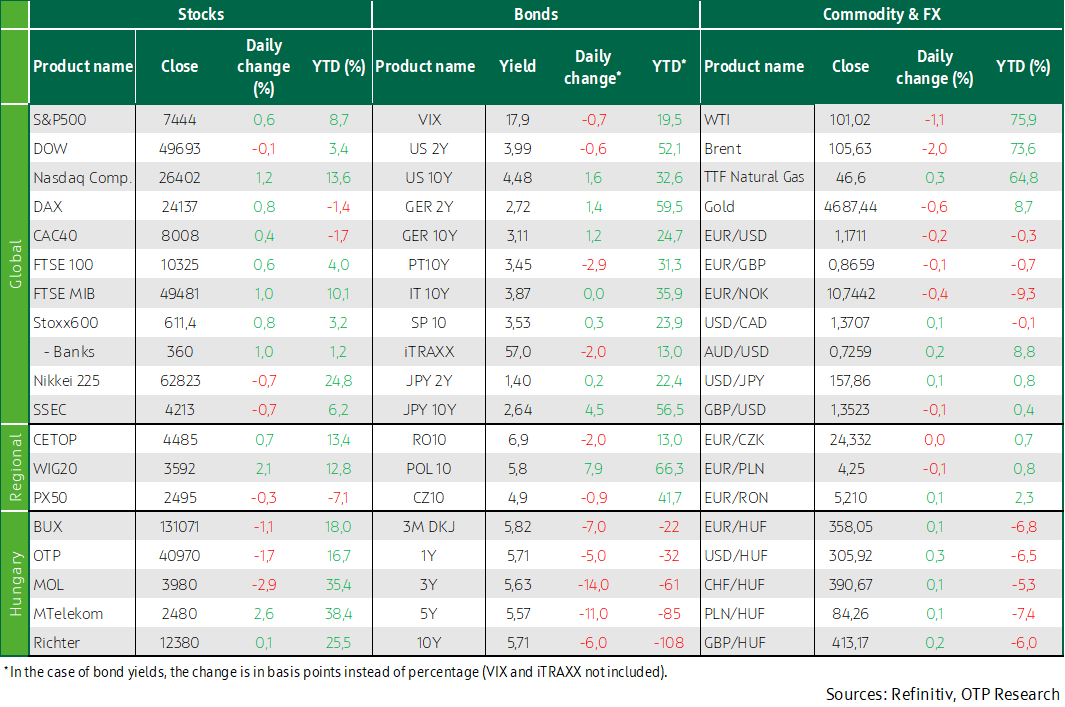
Leading European equity indices rose on Wednesday: the Stoxx 600 index climbed by around 0.8%, with most sectors trading in positive territory. The UK government bond market was initially reassured after Prime Minister Keir Starmer signaled he would remain in office despite pressure to resign; however, uncertainty increased again during the day following press reports suggesting he may soon face an internal party challenger. Siemens announced that it delivered better-than-expected profit in Q1 and will launch a 6 billion euro multi-year share buyback program; its share price rose by 0.8%. Market sentiment continued to be shaped by the lack of a quick resolution to the US-Iran conflict, while the focus gradually shifted toward the upcoming Trump- Hszi Csin-ping meeting, where alongside trade issues, the situation regarding Iran could also be on the agenda.
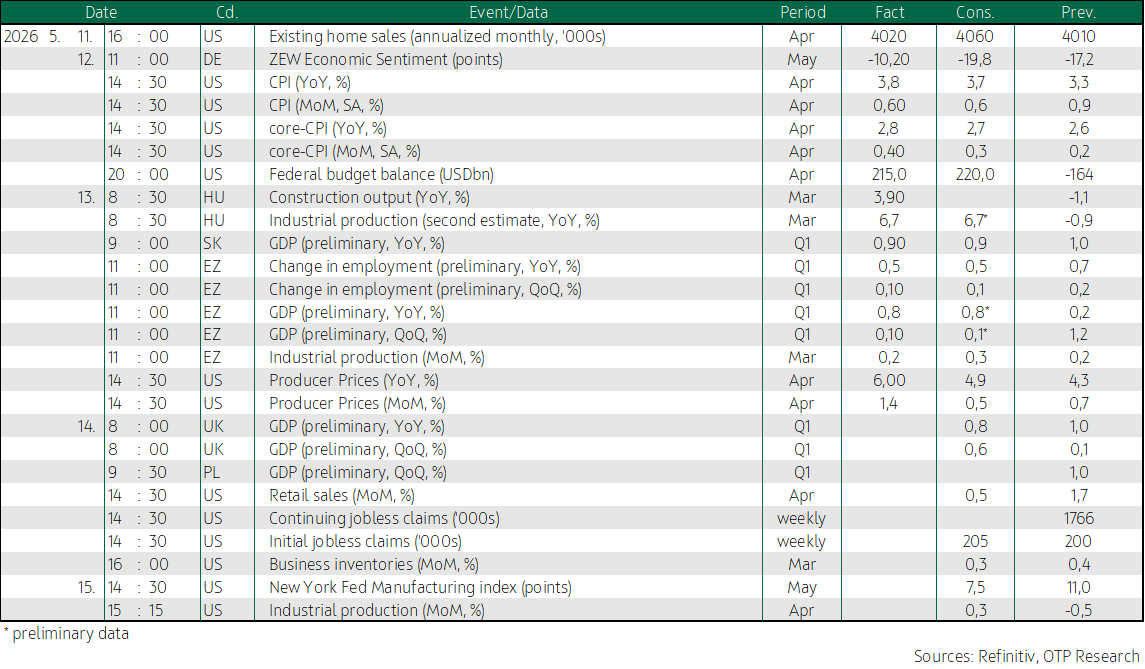
Recent data from the euro area paint a subdued and slightly weaker-than-expected economic picture. Industrial output in March grew by 0.2% month-on-month, matching the February reading but falling short of the 0.3% increase expected by the market. There is significant divergence across countries: Germany recorded a 1.2% decline compared to the previous month, while France (+1.0%), Italy (+0.7%) and especially Spain (+2.4%) posted growth. On an annual basis, industrial production fell by 2.1%, coming in worse than the market expectation of -1.7%.
Euro area GDP growth in Q1 came in at 0.1%, in line with the preliminary estimate, marking the weakest pace since Q2 2025. The slowdown was primarily driven by energy supply disruptions, as the Middle East conflict disrupted oil and LNG shipments, resulting in rising CPI risks and more restrictive monetary policy expectations. Performance across major economies was also mixed: France stagnated quarter-on-quarter, the Netherlands and Italy posted modest growth (0.1% and 0.2%, respectively), Germany saw a slight acceleration (+0.3%), while Spain continued to outperform (+0.6%). On an annual basis, GDP growth slowed to 0.8% from 1.3% in the previous quarter.
Euro area employment increased by 0.1% quarter-on-quarter in Q1, in line with market expectations, but marking a slowdown from 0.2% in the previous quarter. This represents the 20th consecutive quarter of growth, continuing to signal the resilience of the labor market, albeit with moderating momentum. At the country level, employment growth remained strong in Spain (+0.3%, though slowing from 0.8% in the previous quarter), while in Germany it declined for the third consecutive quarter (-0.1%). On an annual basis, employment growth slowed to 0.5%, the weakest pace since 2021, indicating that higher energy prices and the weak growth environment are beginning to weigh on labor market expansion as well.
Regional indices closed mixed yesterday: the Warsaw index rose, while the Budapest and Prague indices declined. Among Hungarian blue chips, MTelekom and Richter advanced, while the other two stocks fell. Incoming data from the Hungarian economy for March painted a mixed picture. Construction output grew by 3.9% year-on-year, marking a meaningful rebound after the 1.1% decline in February; growth was supported by both buildings (+4.4% after +1.7%) and civil engineering works (+3.0% after -7.7%). At the same time, for Q1 as a whole, the sector’s performance was still 4.2% below the level seen a year earlier. In contrast, industrial production showed a notably strong picture: adjusted for working days, it expanded by 3.7% year-on-year, representing a meaningful turnaround after the 0.9% decline in February. For Q1 as a whole, industrial output increased by 1% year-on-year.
US indices closed mixed, with the technology sector performing the best; US producer prices rose more than expected
US indices delivered a mixed performance on Wednesday, as strength in the technology sector offset data showing higher-than-expected producer inflation: the S&P 500 and Nasdaq rose, while the Dow Jones declined. Market moves were clearly dominated by technology and semiconductor stocks, supported by persistent growth expectations linked to AI and their role as a perceived safe haven amid geopolitical uncertainty. Tech stocks were also supported by news that the head of Nvidia attended the Trump-Hszi meeting, boosting hopes for potential positive developments regarding access to the Chinese market, while investors continued to closely monitor geopolitical events and their impact on CPI.
US producer prices surged by 1.4% month-on-month in April, marking the largest increase since March 2022, following a 0.7% rise in March and significantly exceeding the 0.5% market expectation; the increase was primarily driven by a 2% rise in goods prices, with gasoline prices soaring by 15.6% due to higher oil prices related to the Iran conflict, while prices for jet fuel, diesel, vegetables, and industrial chemicals also increased; service prices also rose significantly by 1.2% (the fastest pace since March 2022), mainly due to a 3.5% increase in wholesale margins for machinery and equipment, while transportation, retail, and legal service costs also moved higher; on an annual basis, producer prices rose by 6.0%, the highest level since the end of 2022, exceeding the 4.9% market expectation and accelerating from the upwardly revised 4.3% in March.
Developed market long-term yields were mixed; the dollar strengthened against the euro, the forint weakened following the MNB decision, and domestic bond yields fell
Although the situation in the Middle East did not improve and the strait remains closed, oil prices corrected lower by 1-2% yesterday after several days of gains; despite this, bond markets closed mixed after the April increase in producer prices exceeded expectations by around 1 percentage point in both Germany (6.3% year-on-year versus 5.3%) and the US (6.3% year-on-year versus 4.3%); other macroeconomic data, including euro area Q1 GDP and employment figures, did not deliver surprises; the German 10-year yield edged down slightly but still remains nearly 10 basis points above the 3% psychological level, while the US 10-year yield rose by 2 basis points and is approaching 4.5%; the dollar strengthened by a quarter percent against the euro, with EURUSD moving toward 1.17.
In the regional FX market, the Czech koruna was flat against the euro, the zloty strengthened by 0.2%, while the forint weakened by 0.6% to around the 358.5 level after the MNB lowered the yield on its FX swap tender providing FX liquidity from 5.75% to 5.25% in the morning, down to the lower bound of the forint overnight interest rate corridor; instruments reflecting the expected policy rate path, including interest rate swaps and government bond yields, also fell, typically by around 10-15 basis points; reference yields published by the Government Debt Management Agency declined by 5-10 basis points, with the 10-year yield falling to 5.75%.
Today, the Government Debt Management Agency will offer three-, five-, and ten-year bonds in amounts of HUF 15 billion, HUF 20 billion, and HUF 20 billion, respectively.
Today's highlights
Asian indices were mixed this morning ahead of the meeting between the US and Chinese presidents, where discussions are expected to focus primarily on trade issues; Donald Trump arrived in Beijing accompanied by executives from major technology companies; Samsung’s share price rose after previously declining due to strike threats.
Today, UK and Polish GDP data will be released; in the United States, alongside the usual weekly initial jobless claims figures due on Thursday, retail sales and business inventory data will also be published.
Get more out of your investments!
Global Markets Services
OTP Global Markets offers a broad range of services in the field of local and international money and capital markets.
Read morePrivate Banking Services
Personal care and expertise with OTP Private Banking, along with the knowledge, security, and innovations of a multinational banking group.
Read more