
OTP Morning Brief: In the afternoon, negative news again arrived from Iran, and stock markets turned downward
Related content
OTP Morning Brief: US producer price index came in above expectations, yet the US 10-year Treasury yield still declined
Western European equities continued to advance despite ongoing pressure on the technology sector. Wall Street indices also rebounded, recovering some ground after Wednesday’s sell-off. Healthcare was the standout performer on both sides of the Atlantic. Eurozone industrial production declined by 0.5% month-on-month in August. In the US, the producer price index accelerated to 6.3%, delivering another upside surprise in inflation developments. US retail sales increased by 0.8% compared to August. The US 10-year Treasury yield declined by more than 10 basis points. The long end of the Hungarian government bond yield curve also declined by 7-9 basis points. In Hungary, August wage data will be released today, while in the US, September industrial production figures are due.
OTP Morning Brief: US CPI data came in above expectations
European equity markets advanced, supported by strong results from ASML and the outstanding performance of the healthcare sector. US equity markets came under pressure following higher-than-expected September CPI data. The annual CPI rate accelerated to 3.7%, driven primarily by a surge in gasoline prices, while core CPI rose by 0.3% month-on-month, supported by higher housing costs and rising transportation service prices. Oil prices rose amid escalating tensions in the Middle East and the impact of the IEA's oil market report. US Treasury yields retreated after an initial increase, driven by Fed commentary, while European bond yields generally moved higher. The US macro calendar will be busy today, with investors focusing on September retail sales and producer price index data, as well as the New York Fed Manufacturing Index, weekly jobless claims, and business inventories. August industrial production data from the euro area will be released today.
After two days of declines, oil prices started to rise again yesterday afternoon. Leading Western European indices turned lower into the afternoon. Germany’s industrial order backlog surged by 5% month on month in March. Retail sales volumes in the euro area declined on a monthly basis for the third consecutive month. Hungarian retail sales data for March delivered a major positive surprise. The Czech central bank left the policy rate unchanged. Wall Street indices fell to a lesser extent than their European counterparts. US productivity growth slowed to 0.8% quarter on quarter. A court ruled against President Trump’s global 10% tariffs. Positive election-related sentiment persisted in the domestic FX and bond markets, while developed-market yields tended to rise. The Hungarian Central Statistical Office publishes April CPI data this morning, while key labor market data arrive from the US.
After two days of declines, oil prices started to rise again yesterday afternoon
During the day on Thursday, oil prices appeared set to record their third consecutive daily decline. Markets were pricing in the rising probability of a US–Iran agreement, with the two sides moving toward an interim deal that would, in the short term, result in a formal end to hostilities, while postponing the resolution of disputed issues – particularly Iran’s nuclear program – to a later stage. An analysis published in the press in late April by Columbia University’s Center on Global Energy Policy noted that due to the US blockade of the Strait of Hormuz, oil inventories in Iran are increasing by around 1.7 million barrels per day, broadly in line with normal export volumes. This could push Iran toward an agreement, as at such a pace storage capacity would be filled in roughly 20 days, potentially forcing oil wells to be shut in and even risking damage to them. However, oil prices started to rise again yesterday afternoon as several adverse headlines emerged. According to these, Iran considers US demands to reopen the strait unrealistic and would even introduce a new protocol for vessels transiting the strait. In addition, a CIA report leaked suggesting that the Persian country could withstand the maritime blockade economically for as long as three to four months. Moreover, despite the previously announced ceasefire, exchanges of fire also occurred between the parties. As a result, the oil price decline was reversed in the afternoon, and equity markets also lost momentum.
Leading Western European indices turned lower into the afternoon
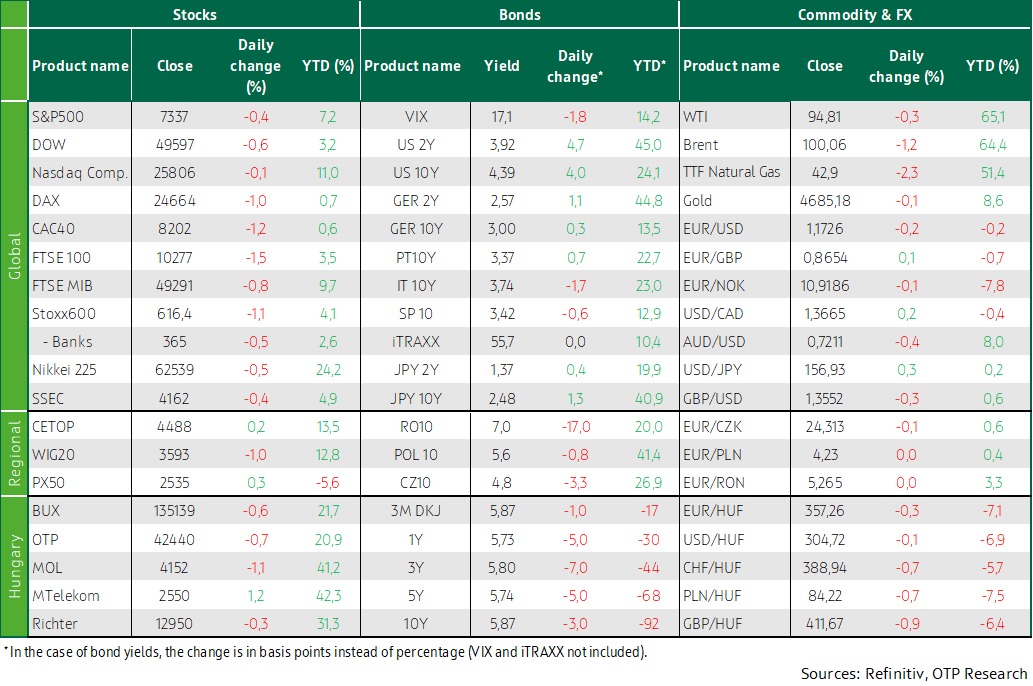
Leading Western European indices gave back part of Wednesday’s gains on Thursday. The STOXX 600 fell by 1.1%, the DAX declined by 1.0%, the CAC 40 dropped 1.2%, and the FTSE 100 slid 1.5%. The indices turned lower during the afternoon as oil prices started to rise.
Shell’s Q1 profit of USD 6.9 billion – supported by the Middle East conflict’s oil price–boosting effects – exceeded the analyst consensus of USD 6.4 billion. The company raised its dividend by 5%, while cutting its quarterly share buyback program to USD 3.0 billion from USD 3.5 billion. The share price fell by 2.9% on Thursday. Beverage maker Campari’s stock plunged by 14.5% after its Q1 revenue missed expectations. Its peers, Diageo and Pernod Ricard, also slipped by more than 2%. Defense sector stocks declined by 2.7%, with Rheinmetall down 6.9% after the German company published its Q1 results and announced that it had submitted an offer to acquire German Naval Yards Kiel. Siemens Healthineers shares fell 4.7% after the medical technology company lowered its full-year outlook. By contrast, Henkel rose by 3.3% after its Q1 sales figures met expectations.
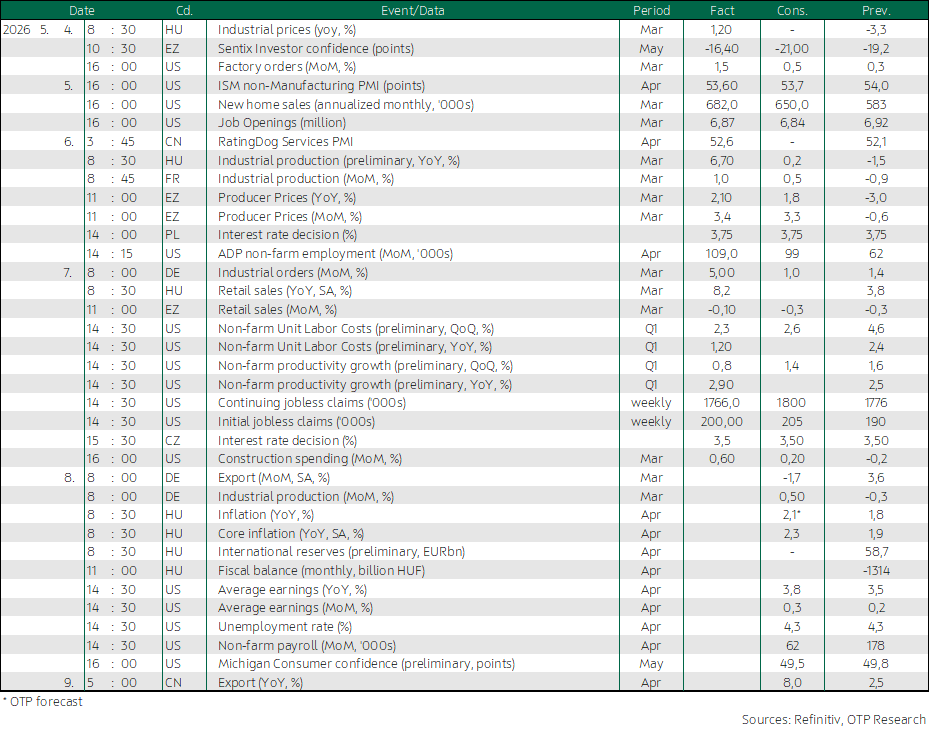
Germany’s industrial order backlog surged by 5% month on month in March 2026, marking a sharp acceleration from the February figure, which was revised to 1.4%, and coming in well above the 1% consensus. This suggests that companies may have been building up inventories amid fears of supply disruptions stemming from the Iran war. Although the March month-on-month retail sales figure of -0.1% was better than expected, retail sales volumes in the euro area have now declined on a monthly basis for the third consecutive month. Among product categories, fuel sales fell the most, down 1.6%, reflecting skyrocketing prices driven by the Middle East conflict. On Thursday, ECB Executive Board member Isabel Schnabel said she sees a disconnect between record-high equity market valuations and the risks facing the global economy, including the negative effects of the Middle East conflict. Schnabel, who is widely regarded as hawkish, emphasized CPI risks in her remarks.
Domestically, the March retail sales data delivered a major positive surprise. Retail volumes, adjusted for calendar effects, surged by 8.2% year on year, while growth stood at 1.9% compared with February. In March, turnover at fuel stations rose sharply by 20.6%, likely reflecting supply-security concerns and stockpiling at the regulated price. Non-food retail sales also contributed significantly to overall retail growth, rising by 8.4% year on year, a magnitude similar to that seen in fuels. Pre-election transfers may also have played a role in the strong figures. Taken together with the also unexpectedly robust March industrial output (+6.7% year on year), a clearer picture is emerging of the drivers behind above-expectations Q1 GDP growth (+1.7% year on year).
Among Hungarian blue chips, MOL kicked off the Q1 earnings season today. The domestic oil company materially missed expectations with adjusted EBITDA of USD 626 million. While the upstream segment delivered a strong performance amid oil prices rising in March, downstream results were weighed down by one-off factors, including the early-year shutdown of the Druzhba pipeline and capacity losses at the Danube Refinery following the October fire. The company, however, left its full-year financial targets unchanged.
In the region, the BUX fell by 0.6%, while Poland’s WIG 20 declined by 1.0%. The Czech PX 50 managed to rise by 0.3%. As expected, the Czech central bank left its policy rate unchanged at 3.5%.
Wall Street indices fell to a lesser extent than their European counterparts
On Thursday, the S&P 500 fell by 0.4%, the Dow Jones declined by 0.6%, and the Nasdaq Composite slipped by 0.1%.
Shares of US-listed Arm Holdings plunged by more than 10%, as concerns over securing components needed for the company’s new artificial intelligence chip overshadowed the positive earnings outlook. Intel and Advanced Micro Devices each fell by around 3%, partially giving back gains recorded earlier in the week. Datadog shares skyrocketed by 31% after the cloud-based monitoring provider raised its full-year profit forecast. McDonald’s, meanwhile, fell short of Wall Street expectations in terms of US sales growth; however, it beat quarterly expectations on both revenue and profit, leaving the share price broadly flat. Whirlpool shares declined by 12% after the household appliance maker missed Q1 revenue expectations and suspended its dividend.
The number of people filing initial unemployment claims rose by slightly less than expected last week. On a quarter-on-quarter basis, growth in non-farm labor costs slowed to 2.3% from 4.6% in Q4. Using the same metric, productivity growth eased from 1.6% to 0.8%.
On Thursday, the US Court of International Trade ruled against the latest globally applied 10% tariffs introduced by President Donald Trump, finding that the broad, across-the-board duties could not be justified under a 1970s trade law. The plaintiff small businesses argued that the new tariffs represent an attempt to circumvent a Supreme Court ruling that had struck down the Republican president’s tariffs imposed under the so-called IEEPA.
Positive election-related sentiment persisted in the domestic FX and bond markets
The two-day oil price decline was not followed by a breakthrough in Iran, and while energy prices posted a sharp intraday drop, they started to rise again in the afternoon. Among macro data, euro-area retail sales came in strong, rising by 1.2% year on year, while US data were mixed: initial unemployment claims remained low last week, and both labor cost growth and productivity increased less than expected in Q1. Ultimately, as oil prices corrected higher, bond yields rose, with the ten-year US Treasury yield up 4 basis points to 4.4%, while the ten-year German yield climbed back above the psychologically important 3% level. The dollar strengthened slightly against the euro, pushing EURUSD down to around 1.173.
In domestic markets, positive election-related sentiment also persisted, supported by the fact that after previously strong industrial production data, retail sales also rose markedly in March. Later in the afternoon, Bloomberg reported that according to Kurali Zoltán, Vice Governor of the MNB, the strong forint increases the central bank’s policy space, and a rate cut could already be put on the agenda of the Monetary Council in June, in parallel with the release of the new CPI forecast. While the zloty and the koruna strengthened only marginally, the forint rose with renewed momentum to a four-year high around the 355 level, before correcting to around 357 by the end of the day. At the one-year T-bill (DKJ) auction, the announced HUF 30 billion tranche was sold amid solid demand at an average yield of 5.82%. Demand was also strong at the five- and ten-year government bond auctions, especially for the ten-year maturity: bids amounted to nearly HUF 50 billion for the shorter bond and HUF 100 billion for the longer one, with the Government Debt Management Agency selling close to HUF 80 billion in total across the two papers. Benchmark government bond yields published by the debt agency declined further by around 5 basis points to levels not seen since early 2024, with the ten-year yield closing around 5.85%.
Today's highlights
Asian indices are in negative territory heading into the close. The Nikkei is down 0.5%, the KOSPI has fallen 0.6%, the SSEC is lower by 0.4%, while the Hang Seng is down 1.1%.
The Hungarian Central Statistical Office publishes April CPI data this morning. In our view, CPI may have accelerated to 2.1% from 1.8% in March. In addition, April budget balance figures and data on international reserves are due from Hungary. Germany will release March export and industrial production data. In the United States, following Wednesday’s ADP report – which, with a reading of 109,000, pointed more to labor market resilience – the BLS will publish April changes in non-farm payrolls today. Updates on average earnings and the unemployment rate will also be released in the US. Moreover, the University of Michigan’s preliminary May consumer sentiment index is due. Finally, China will publish April export growth on Saturday morning.
Get more out of your investments!
Global Markets Services
OTP Global Markets offers a broad range of services in the field of local and international money and capital markets.
Read morePrivate Banking Services
Personal care and expertise with OTP Private Banking, along with the knowledge, security, and innovations of a multinational banking group.
Read more