
OTP Morning Brief: The Middle East conflict continued to escalate, deteriorating investor sentiment
Related content
OTP Morning Brief: US producer price index came in above expectations, yet the US 10-year Treasury yield still declined
Western European equities continued to advance despite ongoing pressure on the technology sector. Wall Street indices also rebounded, recovering some ground after Wednesday’s sell-off. Healthcare was the standout performer on both sides of the Atlantic. Eurozone industrial production declined by 0.5% month-on-month in August. In the US, the producer price index accelerated to 6.3%, delivering another upside surprise in inflation developments. US retail sales increased by 0.8% compared to August. The US 10-year Treasury yield declined by more than 10 basis points. The long end of the Hungarian government bond yield curve also declined by 7-9 basis points. In Hungary, August wage data will be released today, while in the US, September industrial production figures are due.
OTP Morning Brief: US CPI data came in above expectations
European equity markets advanced, supported by strong results from ASML and the outstanding performance of the healthcare sector. US equity markets came under pressure following higher-than-expected September CPI data. The annual CPI rate accelerated to 3.7%, driven primarily by a surge in gasoline prices, while core CPI rose by 0.3% month-on-month, supported by higher housing costs and rising transportation service prices. Oil prices rose amid escalating tensions in the Middle East and the impact of the IEA's oil market report. US Treasury yields retreated after an initial increase, driven by Fed commentary, while European bond yields generally moved higher. The US macro calendar will be busy today, with investors focusing on September retail sales and producer price index data, as well as the New York Fed Manufacturing Index, weekly jobless claims, and business inventories. August industrial production data from the euro area will be released today.
Risk aversion intensified across global markets after the conflict in the Middle East escalated again, oil prices surged, and Donald Trump once more threatened tariff hikes against European automakers, triggering broad-based declines in European equities. At the same time, the Sentix sentiment index came in stronger than expected in May. US equity markets were also under pressure, bond yields edged higher, the dollar strengthened, and regional currencies weakened (with EUR/HUF moving above 365). Asian markets also declined.
Today, attention will be focused on US economic data.
European markets declined amid Middle East uncertainties, while European automakers once again came under pressure due to Trump’s tariffs
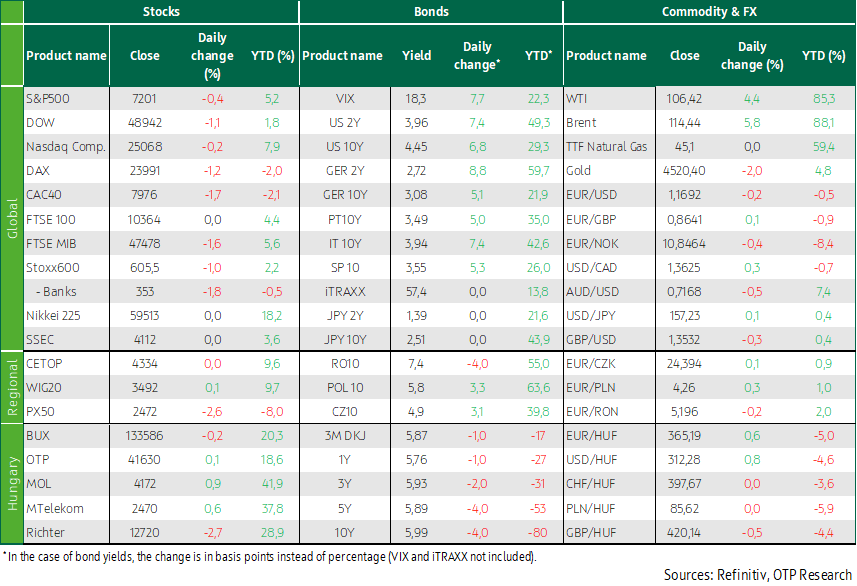
European equities fell again on Monday as fighting in the Middle East intensified once more, pushing oil prices sharply higher, while investors assessed the prospect of consecutive ECB rate hikes this year. Among the major indices, the CAC 40 declined 1.7%, the DAX fell 1.6%, while the FTSE slipped just 0.1%. As a result, the pan-European STOXX 600 index closed 1.0% lower, with most sectors ending in negative territory. Euro-area bank stocks suffered particularly heavy losses, dropping 2.7%, marking their largest one-day decline in more than six weeks. Automaker shares weakened 2.1% after US President Donald Trump announced late on Friday that tariffs on cars and trucks imported from the European Union would be raised to 25% this week from the previously agreed 15%, citing the EU’s alleged failure to meet its commitments. The EU has rejected the US accusations, while a majority of member states—particularly Germany—are urging the bloc to swiftly finalize and implement its own legislative measures, namely cutting US industrial import tariffs, in order to avoid further punitive actions. On the back of the news, shares of major manufacturers were sold off, including Mercedes (-3.4%), Volkswagen (-2.8%), and BMW (-2.4%). Among individual stocks, Thyssenkrupp fell 1.8% after the German industrial group suspended talks on the sale of its steel business to India’s Jindal Steel.
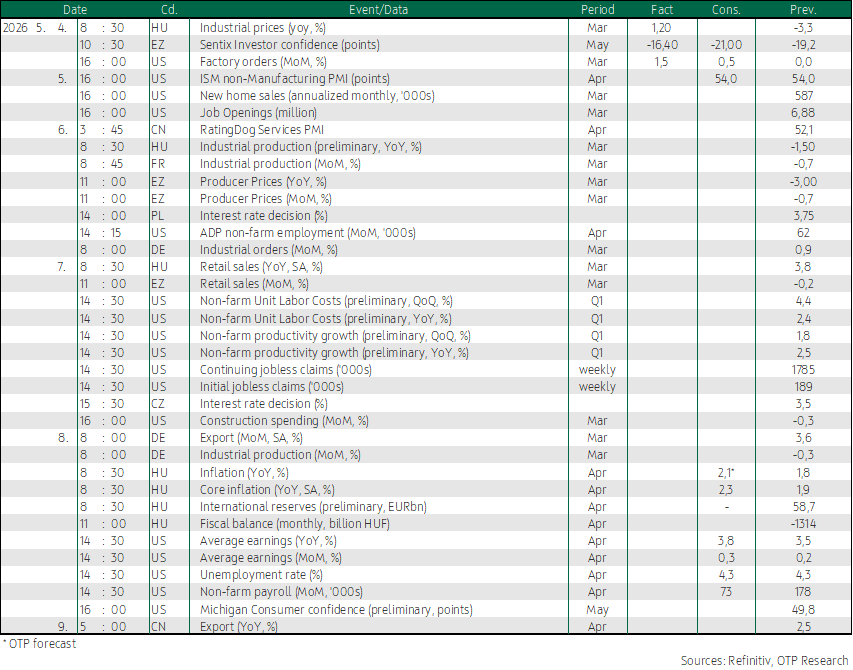
The Sentix euro-area investor sentiment index improved more than expected in May (-16.4 points versus -21.0 expected, after -19.2 in April), suggesting that markets are pricing in fewer adverse effects from the Iranian conflict. At the same time, Germany remained particularly weak (-30.9 points after -27.7 in April), and although both the euro area expectations and current conditions indices rose, they remain in negative territory, indicating that recession risks persist.
CEE equity indices painted a mixed picture: the PX 50 plunged 2.6%, the BUX posted a more modest 0.2% decline, while the WIG 20 edged slightly higher. Among Hungarian blue chips, Richter’s 2.7% drop and Mol’s 0.9% gain stood out, the latter supported by higher oil prices. According to data from the Hungarian Central Statistical Office (KSH), industrial producer prices in March 2026 were 1.2% higher on average than a year earlier and 3.9% higher than in the previous month.
The Middle East conflict escalated once again after Trump launched his “Project Freedom” military operation, leading to declines in US stock markets
The balance in the Middle East war tilted once again toward escalation after Donald Trump announced a naval operation dubbed “Project Freedom” on Monday, aimed at reopening the Strait of Hormuz. The operation, however, failed to deliver an immediate improvement in maritime traffic and instead triggered Iranian military retaliation: several commercial vessels were hit by drone and missile strikes, an oil terminal caught fire in the United Arab Emirates, and Iran expanded its maritime control zone, according to a statement by the Islamic Revolutionary Guard Corps. At the same time, Washington reported the destruction of six Iranian fast attack boats and the successful passage of two cargo ships, claims that were denied by Iran.
Rising tensions pushed major indices lower, with the Nasdaq down 0.2%, the S&P falling 0.4%, and the Dow declining 1.1%, meaning both the Nasdaq and the S&P retreated from their record highs set on Friday. Ten of the S&P 500’s eleven sector indices closed lower, led by the materials sector with a 1.6% decline, followed by a 1.2% drop in industrials. In contrast, the energy sector rose 0.9%. Shares of GameStop fell 10%, while eBay climbed roughly 5% after the video game retailer proposed acquiring the online marketplace for around USD 56 billion in a cash-and-stock deal. FedEx shares dropped 9.1%, and United Parcel Service fell 10.5%, after Amazon announced the launch of “Amazon Supply Chain Services,” opening up its logistics network to other companies. Palantir shares rose 1.4% ahead of the release of its quarterly earnings report after the market close.
Brent crude oil futures surged 5% on Monday to USD 114 per barrel, the highest level since mid-2022, as tensions in the Middle East escalated sharply. Meanwhile, WTI prices rose 4.4% to above USD 106 per barrel.
Global risk aversion pushed bond yields higher and weighed on regional currencies
Bond yields edged higher again, with 10-year yields rising by around 5 basis points in both the US and Europe. The US 10-year yield approached 4.45%, while the German 10-year moved close to 3.1%. The dollar strengthened by a quarter of a percent against the euro, with EURUSD slipping below 1.17.
Heightened risk aversion driven by rising oil prices weighed on regional currencies: the Czech koruna weakened by 0.1%, the zloty by 0.3%, and the forint by 0.6% against the euro, with EUR/HUF moving above the 365 level. In the domestic government bond market, reference yields—set in the early afternoon—declined compared to Thursday’s levels by 1–2 basis points in the segment up to three years and by around 5 basis points at longer maturities, reflecting further yield declines on Thursday followed by a modest rebound yesterday. The 10-year yield fell below 6%. Demand was strong at the DKJ switch auction, where the Government Debt Management Agency (ÁKK) accepted more than HUF 50 billion out of bids totaling close to HUF 70 billion.
Today's highlights
Asian equities declined on Tuesday as oil prices eased, although they remained above USD 100 per barrel. Investors also paid close attention to the yen after the Japanese currency briefly surged in the previous session, fueling renewed speculation about fresh FX market intervention by Tokyo. The MSCI’s broadest index of Asia-Pacific equities excluding Japan fell 0.3%.
Today, attention will be focused on data coming out of the US, including the ISM non-manufacturing PMI, new home sales, and March labor market data. In addition, companies such as AMD, HSBC, and Pfizer are scheduled to report earnings.
Today, the Government Debt Management Agency (ÁKK) is offering HUF 30 billion worth of three-month Treasury bills (DKJ).
Get more out of your investments!
Global Markets Services
OTP Global Markets offers a broad range of services in the field of local and international money and capital markets.
Read morePrivate Banking Services
Personal care and expertise with OTP Private Banking, along with the knowledge, security, and innovations of a multinational banking group.
Read more