
OTP Morning Brief: The Fed left its policy rate unchanged
Related content
OTP Morning Brief: US producer price index came in above expectations, yet the US 10-year Treasury yield still declined
Western European equities continued to advance despite ongoing pressure on the technology sector. Wall Street indices also rebounded, recovering some ground after Wednesday’s sell-off. Healthcare was the standout performer on both sides of the Atlantic. Eurozone industrial production declined by 0.5% month-on-month in August. In the US, the producer price index accelerated to 6.3%, delivering another upside surprise in inflation developments. US retail sales increased by 0.8% compared to August. The US 10-year Treasury yield declined by more than 10 basis points. The long end of the Hungarian government bond yield curve also declined by 7-9 basis points. In Hungary, August wage data will be released today, while in the US, September industrial production figures are due.
OTP Morning Brief: US CPI data came in above expectations
European equity markets advanced, supported by strong results from ASML and the outstanding performance of the healthcare sector. US equity markets came under pressure following higher-than-expected September CPI data. The annual CPI rate accelerated to 3.7%, driven primarily by a surge in gasoline prices, while core CPI rose by 0.3% month-on-month, supported by higher housing costs and rising transportation service prices. Oil prices rose amid escalating tensions in the Middle East and the impact of the IEA's oil market report. US Treasury yields retreated after an initial increase, driven by Fed commentary, while European bond yields generally moved higher. The US macro calendar will be busy today, with investors focusing on September retail sales and producer price index data, as well as the New York Fed Manufacturing Index, weekly jobless claims, and business inventories. August industrial production data from the euro area will be released today.
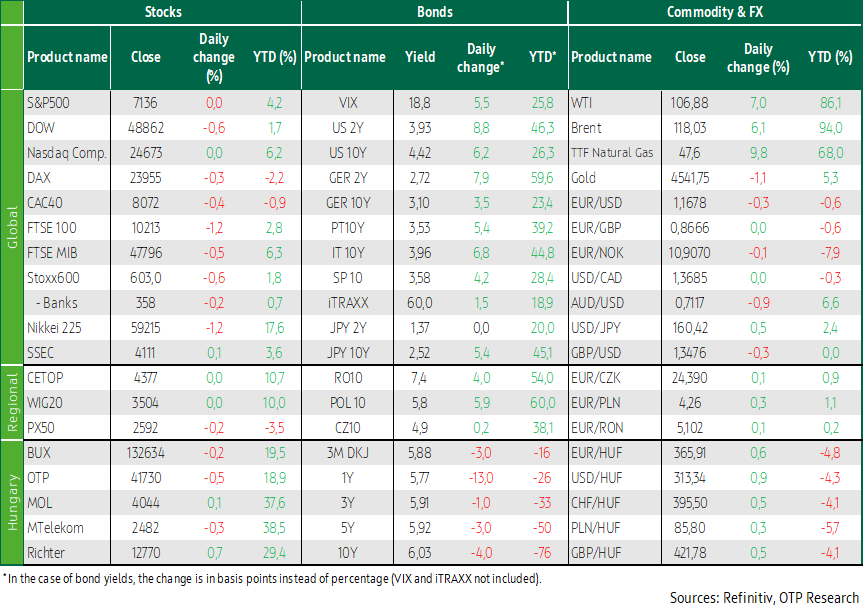
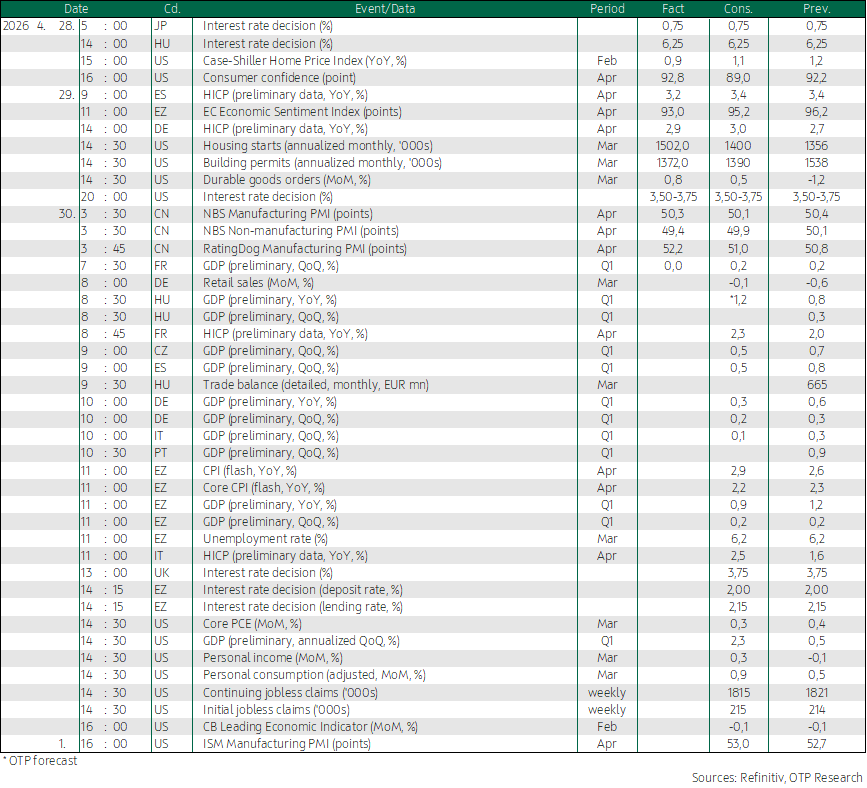
European indices weakened yesterday; the euro area’s ESI economic sentiment index fell for the third consecutive month; German inflation picked up slightly less than expected in April; and the market reacted mixedly to earnings reports from European banks released yesterday. U.S. stock markets closed mixed on Wednesday; the Fed left its policy rate unchanged as expected; housing starts rose more than anticipated, while the number of building permits issued declined; in March, the value of new orders for durable goods rose following the previous month’s contraction. Earnings were reported by Alphabet, Amazon, Meta, and Microsoft. Developed market bond yields rose on Wednesday; the dollarstrengthened against the euro, while regional currencies weakened. Today’sdata-heavy calendar will be primarily focused on European and U.S. GDP andinflation figures, as well as the interest rate decisions of the ECB and theBank of England.
European indices weakened yesterday; the euro area’s ESI economic sentiment index declined for the third consecutive month; German inflation picked up slightly less than expected in April; and the market reacted mixedly to earnings reports from European banks released yesterday
European equity markets weakened yesterday as investors assessed another wave of corporate earnings and weighed the implications of the United Arab Emirates’ unexpected exit from OPEC. The pan-European Stoxx 600 index closed 0.6% lower, with most sectors and major exchanges ending the day in negative territory. Reactions in the banking sector were mixed: UBS shares rose 3.6% after the bank reported first-quarter net profit of USD 3 billion, beating market expectations, while Deutsche Bank shares fell 1.8% despite posting a €2.17 billion profit—above the analyst consensus (€2.01 billion)—as higher-than-expected provisions dampened investor sentiment. Santander also outperformed, with profit from core operations rising above expectations and the stock closing up 1%. Outside the banking sector, Adidas shares soared 8.3% after first-quarter results beat expectations, supported by double-digit growth in revenue and operating profit. In the technology sector, Tuesday’s media reports related to OpenAI also urged caution among investors, suggesting that the company had fallen short of its internal revenue and user growth targets.
In April, the euro area’s ESI economic sentiment index declined for the third consecutive month, falling to 93 points, its lowest level since November 2020, and coming in well below the market consensus of 95.2; the deterioration in the outlook was driven by rising concerns over the escalation of the conflict involving Iran. Sentiment weakened across all sectors, with the sharpest decline seen among consumers (-20.6 points after -16.4 in March) and in services (0.9, down from 4.1). At the same time, the inflation expectations index surged by 5.6 points to 49.1, the highest level since April 2022, while the index tracking expectations for industrial producer prices soared by 10.2 points to 31.1, marking a more than three-year high.
According to preliminary data, Germany’s annual inflation rate rose to 2.9% in April from 2.7% in March, coming in slightly below market expectations of 3.0%, while marking the highest reading since January 2024. The increase was primarily driven by a faster rise in energy prices, which climbed 10.1% year on year, linked to the effects of the conflict involving Iran. At the same time, food inflation rose from 0.9% to 1.2%, while service price inflation eased from 3.2% to 2.8%. Core inflation declined to 2.3%, its lowest level since June 2021.
Most regional indices declined yesterday: the Warsaw index was the only one to finish flat, while the Budapest and Prague indices fell. Among Hungarian blue chips, MOL and Richter shares rose, while the other two stocks declined.
U.S. stock markets closed mixed on Wednesday; the Fed left its policy rate unchanged as expected; housing starts rose more than anticipated, while the number of building permitsissued declined; in March, the value of new orders for durable goods rose following the previous month’scontraction. Alphabet, Amazon, Meta, and Microsoft reported earnings
U.S. equity markets closed mixed on Wednesday. Sentiment was shaped by the fact that oil prices surged again following reports related to a U.S. blockade targeting Iranian ports, while the Fed left its policy rate unchanged, in line with expectations, in the 3.5–3.75% range. At the same time, Fed policymakers appeared the most divided since 1992, as they weighed the stagflationary impact of the conflict involving Iran and the risks stemming from uncertain economic prospects. Among the four dissenting votes alongside eight supporters, Stephen Miran, in line with his usual stance, would have favored further rate cuts, while the other three FOMC members would have accepted holding rates steady but disagreed with the statement’s wording, which they felt pointed to potential future easing. WTI crude prices soared around 7% to near USD 107 per barrel, while Brent rose 6.1% to USD 118, after media reports suggested that Washington is preparing for a longer-term maritime blockade against Iran and rejected Tehran’s proposal to reopen the Strait of Hormuz. Several major technology companies reported after the close. Microsoft posted better-than-expected revenue and earnings, but despite the positive results, its shares—having underperformed recently—continued to fall in after-hours trading. Meta shares declined after the company released mixed results: revenue exceeded expectations, but both capital spending and the number of active users fell short of forecasts due to internet outages linked to Iran and restrictions on WhatsApp in Russia. Amazon shares also edged lower despite reporting revenue and profit well above expectations. Alphabet was the sole gainer after the earnings releases, as the company’s cloud division revenue skyrocketed, rising 63% year on year.
In March, U.S. housing starts surged by 10.8% month on month to an annualized rate of 1.502 million, the highest level since December 2024, and well above market expectations of 1.4 million, indicating that builders ramped up activity despite affordability challenges, supported by elevated prices. By contrast, building permits, a forward-looking indicator, fell 10.8% month on month to 1.372 million, the lowest level since August 2025, following an 11% increase in February; the decline was driven mainly by a sharp drop in permits for buildings with five or more units (-23.5%). Overall, the data suggest that the housing market may stabilize in the short term, as builders seek to attract buyers through incentives, although uncertainty related to the conflict involving Iran, higher material costs, and elevated mortgage rates continue to pose downside risks.
In March, the value of new orders for U.S. durable goods rose by 0.8% month on month, rebounding from a 1.2% decline in the previous month and slightly exceeding market expectations of 0.5%. The data suggest that, despite heightened uncertainty stemming from the conflict involving Iran, skyrocketing energy prices and global supply disruptions, industrial demand proved resilient in certain areas. Growth was driven mainly by a 3.7% increase in orders for computers and electronic products, in line with strengthening investment related to AI, while orders also rose for machinery, fabricated metal products, electrical equipment, and the traditionally volatile transportation equipment category.
Developed market bond yields rose on Wednesday; the dollarstrengthened against the euro, while regional currencies weakened
Yesterday, investors in bond and currency markets across developed economies focused on developments in the Middle East alongside the Fed. As positions regarding the Strait of Hormuz failed to converge, oil prices surged to fresh four-year highs, while European gas prices rose by a similar magnitude. As expected, the Fed left its policy rate unchanged, and Jerome Powell announced that he will remain a member of the Board of Governors after the end of his term as chair. In Europe, Spain’s harmonised inflation rate came in as expected, while German inflation increased less than anticipated. As has become typical in this oil market environment, bond yields rose and the dollar strengthened. The 10-year U.S. Treasury yield jumped 8 basis points to approach 4.45%, long-term euro area yields climbed by around 5 basis points, and the German 10-year yield moved back above 3.1%. The dollar appreciated by 0.3% against the euro, with EUR/USD falling to 1.167.
Regional currencies weakened yesterday, with the Czech koruna depreciating by around 0.1%, the zloty by 0.3%, and the forint by 0.5%, with the latter approaching the 366 level. Domestic bond yields, however, declined by 2–4 basis points, with the 10-year yield edging back toward the 6% level.
Today, the Hungarian Government Debt Management Agency (ÁKK) is offering three-, five- and ten-year bonds in amounts of HUF 15 billion, HUF 20 billion and HUF 20 billion, respectively.
Today's highlights
Asian indices were under pressure this morning, following a further surge in oil prices. China’s manufacturing PMIs came in above expectations, while the services sector PMI fell short of forecasts.
Today, preliminary GDP and inflation figures will be released from Europe, alongside the euro area’s unemployment rate, Germany’s retail sales data, and Hungary’s foreign trade balance. The ECB and the Bank of England will also hold policy-setting meetings. In the United States, in addition to the usual weekly initial jobless claims, data on inflation, GDP, household income and consumption, as well as the leading index, will be published.
Get more out of your investments!
Global Markets Services
OTP Global Markets offers a broad range of services in the field of local and international money and capital markets.
Read morePrivate Banking Services
Personal care and expertise with OTP Private Banking, along with the knowledge, security, and innovations of a multinational banking group.
Read more