
OTP Morning Brief: Stock markets surged following the U.S.–Iran ceasefire agreement
Related content
OTP Morning Brief: US producer price index came in above expectations, yet the US 10-year Treasury yield still declined
Western European equities continued to advance despite ongoing pressure on the technology sector. Wall Street indices also rebounded, recovering some ground after Wednesday’s sell-off. Healthcare was the standout performer on both sides of the Atlantic. Eurozone industrial production declined by 0.5% month-on-month in August. In the US, the producer price index accelerated to 6.3%, delivering another upside surprise in inflation developments. US retail sales increased by 0.8% compared to August. The US 10-year Treasury yield declined by more than 10 basis points. The long end of the Hungarian government bond yield curve also declined by 7-9 basis points. In Hungary, August wage data will be released today, while in the US, September industrial production figures are due.
OTP Morning Brief: US CPI data came in above expectations
European equity markets advanced, supported by strong results from ASML and the outstanding performance of the healthcare sector. US equity markets came under pressure following higher-than-expected September CPI data. The annual CPI rate accelerated to 3.7%, driven primarily by a surge in gasoline prices, while core CPI rose by 0.3% month-on-month, supported by higher housing costs and rising transportation service prices. Oil prices rose amid escalating tensions in the Middle East and the impact of the IEA's oil market report. US Treasury yields retreated after an initial increase, driven by Fed commentary, while European bond yields generally moved higher. The US macro calendar will be busy today, with investors focusing on September retail sales and producer price index data, as well as the New York Fed Manufacturing Index, weekly jobless claims, and business inventories. August industrial production data from the euro area will be released today.
Europe and the U.S. both closed with solid gains, long-term yields fell, and rate-hike expectations eased. The travel sector and mining stocks were the biggest winners, while energy stocks declined amid a roughly 15% drop in oil and gas prices. However, by this morning markets have turned uncertain again: Asian markets, as well as European and U.S. futures, are mostly in decline due to conflicting news about the ceasefire. Beyond developments related to Iran, it will be worth watching domestic international reserve data today, while in the U.S. the Fed’s closely monitored February core PCE inflation figure will be released. From Western Europe, German industrial production will be the most notable, and within the region the Polish rate decision will also be important to follow.
European stock markets surged after the U.S.–Iran ceasefire agreement
U.S. President Donald Trump and Iran, with Pakistan mediating, agreed to a temporary two-week ceasefire, which significantly eased fears of a global energy market shock. As geopolitical risks receded, oil and gas prices fell by around 15%, rate-hike concerns diminished, bond yields declined, risk appetite increased, and equity markets rose sharply. Europe’s “fear gauge,” the STOXX volatility index, fell below 25 points for the first time in more than three weeks.
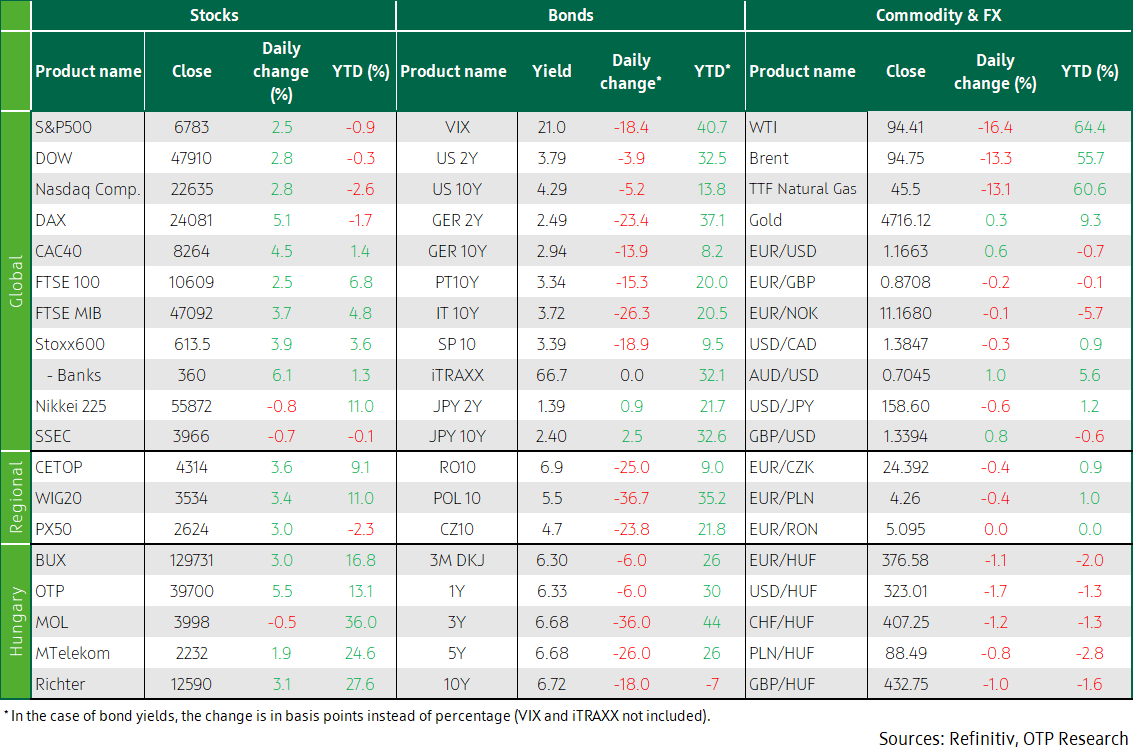
European stock markets opened with strong gains yesterday, as global investors welcomed news of the conditional ceasefire between the United States and Iran. Supported by the improved sentiment, major European indices saw substantial increases: the STOXX 600 rose by 3.9%, the FTSE 100 by 2.5%, the DAX by 5.1%, and the CAC 40 by 4.5%. By sector, the biggest winners were automotive (+5.3%), mining (+5.2%), and travel (+7%). Airlines were the top performers, with their shares gaining more than 10%. European macro data had little impact, but it is worth noting that eurozone retail sales growth slowed from 2.1% to 1.7%, while the construction confidence index deteriorated further.
Regional indices also closed strongly higher: the BUX and the Prague Stock Exchange rose by 3%, while Poland’s WIG gained nearly 3.4%. Among Hungarian blue chips, only MOL fell (-0.5%), while Magyar Telekom rose 1.9%, Richter 3.1%, and OTP closed with a 5.5% gain.
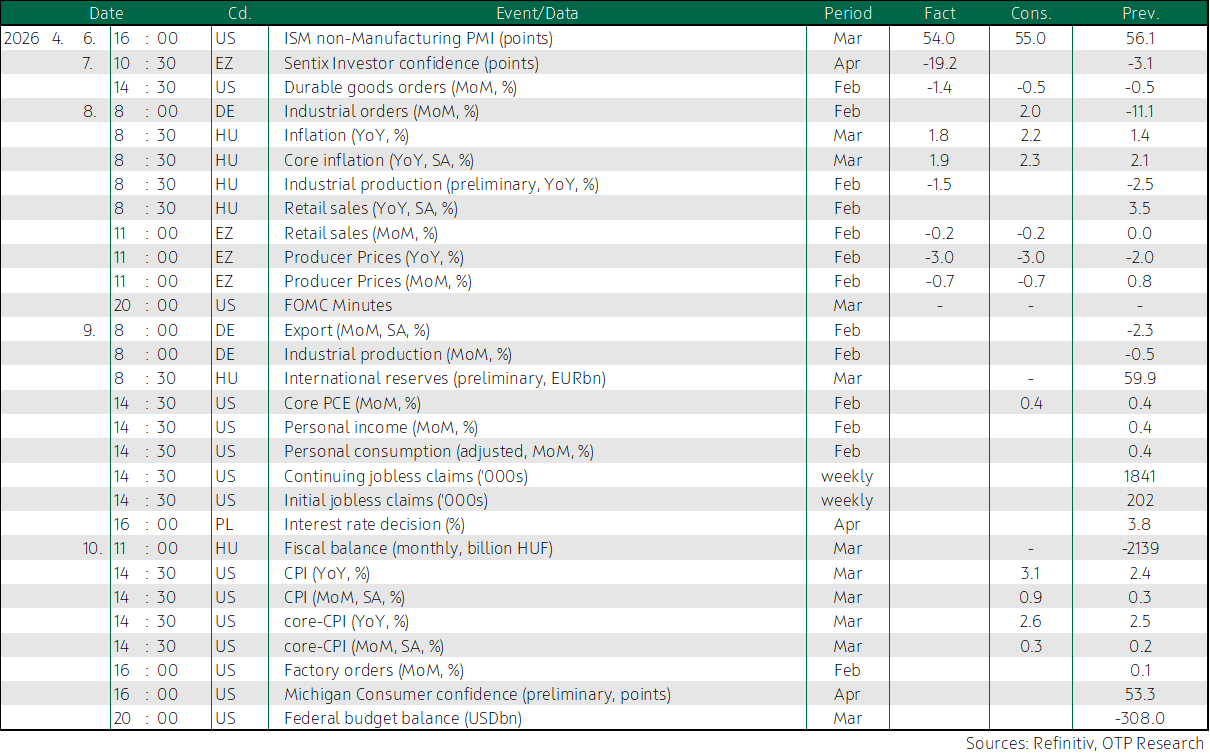
Hungarian March inflation came in well below expectations: headline inflation was 1.8% (vs. market consensus 2.2% and OTP’s 2.0%). Core inflation slowed from 2.1% to 1.9%. The stronger-than-expected figure was partly due to non-durable goods and partly to processed food prices.
Hungarian retail sales grew by 3.8% year-on-year in February 2026, slightly accelerating from the 3.5% pace seen in the previous two months. Month-on-month growth, however, slowed from 0.5% to 0.4%. Industrial production data for February 2026 also came out: output fell by 1.5% year-
on-year, an improvement from January’s 2.5%, but still showing no meaningful turnaround, Hungarian industry has yet to move sustainably off its low point.
U.S. markets also rallied strongly on ceasefire news
Following the announcement of the U.S.–Iran ceasefire, U.S. markets surged yesterday as well: the Dow and the Nasdaq rose by 2.8%, the S&P 500 gained 2.5%. Of the S&P 500’s eleven main sectors, eight rose at least 2%, led by industrials. Energy stocks — hurt by falling oil prices — were the only losers, dropping 3.7%. Sectors hit hard since the start of the war saw a strong rebound: commercial airlines +5.7%, travel and leisure +5.2%, homebuilders +4.9%. Delta Air Lines gained 3.8% despite a weaker-than-expected Q2 profit forecast. The company declined to update its annual guidance due to uncertainty linked to the Iran conflict. Delta’s competitors also rallied: Southwest Airlines rose 6.7%, United Airlines 7.9%.Among cruise operators, Carnival gained 11.2% and Norwegian Cruise Line 7.6%.
Rate-hike expectations eased, long-term yields declined
The ceasefire significantly lowered rate-hike expectations and pushed down bond yields — though primarily in Europe. In the United States, unchanged interest rates until late 2026 remain the most likely scenario. In Europe, markets now expect only two 25-basis-point hikes, down from the previously anticipated three to four. The U.S. 10-year yield ended unchanged at 4.3%, while the German yield fell by 15 basis points to around 2.9%. French and Italian long-term yields dropped by 20–30 basis points.Improved sentiment weakened the dollar notably: EURUSD rose by 0.6%, surpassing 1.165.
Regional currencies also strengthened significantly: the Czech koruna and the zloty by 0.5%, the forint by 1.3%, reaching a 2.5-year high vs. the euro, with EURHUF approaching 376.Hungarian rate-hike expectations also eased sharply: instead of the previously priced four to five 25-basis-point hikes, markets priced in only one yesterday. Domestic government bond yields also fell substantially: longer-term reference yields were down by 15–30 basis points, with the 10-year yield dropping to around 6.7%. The better-than-expected inflation figure likely contributed to the move.
Today's highlights
However, by this morning sentiment has deteriorated, as cracks quickly emerged in the fragile ceasefire, which pushed oil prices higher again and reminded investors that the inflationary consequences may remain with us for a long time. On the one hand, the Strait of Hormuz has not reopened yet; on the other hand — although the U.S., Israel and Iran did not attack each other — Israel again struck Lebanon yesterday, and Iran launched rockets at several Gulf states. As a result, U.S. crude oil futures rose by 2.8% to 97 dollars per barrel, while Brent increased by 2.1% to 96.7 dollars. Among equity markets, Japan’s Nikkei is down 0.8% after yesterday’s 5.4% jump, and the SSEC is falling by 0.7%. On Wall Street, S&P 500 futures and Nasdaq futures are both down 0.2% as Wednesday’s rally faded. Pointing to a mixed European open, EUROSTOXX 50 futures are up 0.1%, DAX futures are down 0.3%, while FTSE futures have risen by 0.5%.
From Hungary, today the MNB’s international reserve data will be released, while from overseas the Fed’s closely watched February core PCE inflation figure arrives. From Western Europe, German industrial production will be the most notable, and within the region it will also be worth following the Polish rate decision.
Get more out of your investments!
Global Markets Services
OTP Global Markets offers a broad range of services in the field of local and international money and capital markets.
Read morePrivate Banking Services
Personal care and expertise with OTP Private Banking, along with the knowledge, security, and innovations of a multinational banking group.
Read more