
OTP Morning Brief: After six weeks, Wall Street indices closed the week higher
Related content
OTP Morning Brief: US producer price index came in above expectations, yet the US 10-year Treasury yield still declined
Western European equities continued to advance despite ongoing pressure on the technology sector. Wall Street indices also rebounded, recovering some ground after Wednesday’s sell-off. Healthcare was the standout performer on both sides of the Atlantic. Eurozone industrial production declined by 0.5% month-on-month in August. In the US, the producer price index accelerated to 6.3%, delivering another upside surprise in inflation developments. US retail sales increased by 0.8% compared to August. The US 10-year Treasury yield declined by more than 10 basis points. The long end of the Hungarian government bond yield curve also declined by 7-9 basis points. In Hungary, August wage data will be released today, while in the US, September industrial production figures are due.
OTP Morning Brief: US CPI data came in above expectations
European equity markets advanced, supported by strong results from ASML and the outstanding performance of the healthcare sector. US equity markets came under pressure following higher-than-expected September CPI data. The annual CPI rate accelerated to 3.7%, driven primarily by a surge in gasoline prices, while core CPI rose by 0.3% month-on-month, supported by higher housing costs and rising transportation service prices. Oil prices rose amid escalating tensions in the Middle East and the impact of the IEA's oil market report. US Treasury yields retreated after an initial increase, driven by Fed commentary, while European bond yields generally moved higher. The US macro calendar will be busy today, with investors focusing on September retail sales and producer price index data, as well as the New York Fed Manufacturing Index, weekly jobless claims, and business inventories. August industrial production data from the euro area will be released today.
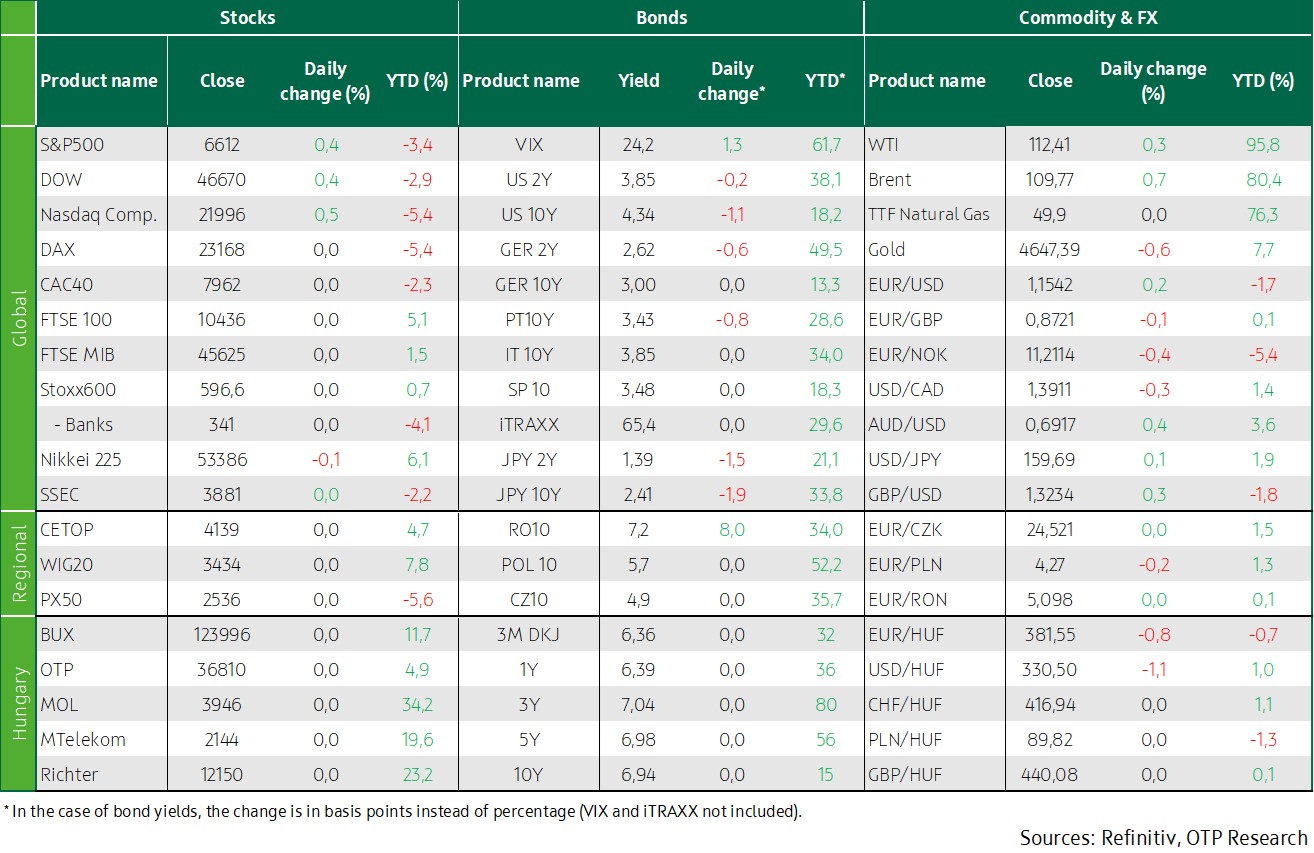
In his speech on Wednesday evening, President Trump did not outline a clear strategy for reopening the Strait of Hormuz. Oil prices jumped sharply on Thursday following Trump’s speech, which raised the risk of escalation. Iran rejected the United States’ proposal for an immediate ceasefire. Ahead of the holidays, the STOXX 600 closed the week up 3.7%. After six weeks, Wall Street indices posted a positive week again. US stock markets were open and trading already on Easter Monday. President Trump plans to increase the military budget by USD 500 billion in 2027. US non-farm payrolls rose by 178,000 in March, while the unemployment rate declined to 4.3%. US wage growth slowed to 3.5%. Overall, bond yields declined last week. The March domestic inflation data will be released on Wednesday morning. In the US, February core PCE data are due on Thursday, followed by the March CPI release on Friday.
The STOXX 600 closed the week ahead of the holidays with a 3.7% gain
On the last trading day before the holidays, Thursday, major European indices opened sharply lower after President Trump’s speech on Wednesday evening unsettled investors awaiting a resolution to the Middle East conflict. Trump spoke simultaneously of an imminent victory and of tough strikes against Iran expected in the coming weeks. Moreover, the president failed to outline a clear strategy for reopening the Strait of Hormuz, instead appearing to leave the issue largely to countries with direct interests there. By the end of the day, equity indices had mostly recovered. The STOXX 600 closed down just 0.2%, finishing the shortened week with a 3.7% gain. On Thursday, the DAX fell 0.6% and the CAC 40 declined 0.2%, while the FTSE 100 managed to rise 0.7%. European technology stocks dropped 1%, while the banking sector index slid 1.2%. Among individual stocks, Stellantis gained 4.1% after Bloomberg reported that the automaker is in talks with its Chinese partner, Zhejiang Leapmotor Technology, about manufacturing electric vehicles in Canada.
Brent crude climbed nearly 8% on Thursday, pushing prices to around USD 109 per barrel. On Monday, the rally continued more moderately, with prices rising by a further 0.7%. In addition to the Middle East conflict, oil prices are being driven higher by the suspension of exports from Russia’s main Baltic Sea port, Ust-Luga, following Ukrainian drone attacks. The Druzhba pipeline, which supplies Hungary and Slovakia, has also been out of operation since January. As Ukrainian drones simultaneously target export infrastructure and domestic refineries, Russia’s oil pipeline system is becoming saturated, forcing some oil fields to curb production.
On Thursday, the BUX fell by 0.25%, but still ended the week with a gain of nearly 2%. In the region, Poland’s WIG20 rose 0.9%, while the Czech PX50 declined by 0.7% on the last trading day of the week.
Most European stock exchanges were closed on Easter Monday.
After six weeks, Wall Street indices closed the week higher
U.S. stock indices closed mixed with modest moves on Thursday. Over the four-day trading week as a whole, the S&P 500 gained 3.4%, the Dow Jones rose 3.0%, and the Nasdaq Composite advanced 4.4%. This marked the first profitable week after six weeks of losses. Tesla underperformed expectations in terms of vehicle deliveries for the January–March period, as the expiration of U.S. tax credits for electric vehicle purchases weighed on demand. Following the report, the stock plunged 5.4% on Thursday. The sell-off continued on Monday for the world’s largest automaker by market capitalization.
In the U.S., trading resumed on Monday. On Easter Monday, all three major indices advanced by around 0.4–0.5%. Stocks in the travel and leisure sector, aerospace and defense, as well as homebuilders, outperformed the broader market. Shares of Soleno Therapeutics jumped 32.3% after Neurocrine Biosciences agreed to acquire the rare-disease drug developer in an all-cash deal.
Iran rejected a U.S. proposal for an immediate ceasefire and the reopening of the Strait of Hormuz, insisting instead on a definitive end to the war. The rejection followed increasingly hawkish ultimatums from President Trump, which included threats to destroy bridges and power plants. On Friday, Donald Trump called for a 10% cut in non-defense spending in the 2027 fiscal year, while proposing to increase the military budget by USD 500 billion.
According to the Bureau of Labor Statistics (BLS) of the U.S. Department of Labor, nonfarm payroll employment increased by 178,000 in March, marking the largest monthly gain since December 2024, after a downwardly revised decline of 133,000 in February. Economists surveyed by Reuters had expected an increase of just 60,000 following the previously reported February decline of 92,000. Job growth was led by the healthcare sector, which added 76,000 positions, as 35,000 workers returned to their jobs after the conclusion of a strike. While the unemployment rate fell to 4.3% from 4.4% in February, this was largely due to 396,000 people exiting the labor force. On a year-on-year basis, wages rose by 3.5%, the slowest pace since May 2021, following February’s 3.8% increase. Meanwhile, the ISM services purchasing managers’index declined to 54 in March, coming in below expectations.
Concerns surrounding private credit remain on the agenda. Blue Owl Capital reported last week that it had received redemptions of historic proportions and, making use of provisions in its fund rules, imposed limits on withdrawals. Other major players, including Ares Management, Apollo Global, Blackstone and KKR, as well as the private credit operations of banks such as Morgan Stanley, J.P. Morgan and Goldman Sachs, have also introduced caps on redemptions.
Overall, bond yields declined last week
At the start of last week, confidence strengthened that the world was moving closer to ending the war against Iran and avoiding a looming oil supply disruption. However, this optimism was dashed by a speech from Donald Trump on Wednesday, after which oil prices surged sharply again on Thursday. Despite this, bond yields ultimately declined overall across developed markets. The U.S. 10-year Treasury yield fell from around 4.4% to just above 4.3%, while the German 10-year yield dropped from around 3.05% to below 3.0%.Markets currently expect the ECB to raise its key policy rate from 2.0% to 2.75% this year in three steps. By contrast, the Federal Reserve is expected to leave its policy rate target range unchanged at 3.5–3.75%. The EUR/USD exchange rate jumped from 1.145 to above 1.16 at the beginning of last week before retreating to around 1.15 by the end of the week. Over the long weekend, oil futures prices rose after Tehran rejected Donald Trump’s proposal, prompting the U.S. president to threaten strikes against Iranian energy facilities and bridges. As a result, U.S. bond yields edged higher by a few basis points yesterday, with the 10-year yield moving to around 4.35%, while the dollar weakened and EUR/USD moved closer to the 1.155 level.
On March 24, the Monetary Council of the Hungarian National Bank (MNB) left its key policy rate unchanged at 6.25%, in line with expectations, while raising its inflation forecast and reaffirming its commitment to achieving the inflation target. Although expectations for rate hikes have eased slightly across the region, market pricing continues to factor in three 25-basis-point tightening steps for this year. In the region, long-term government bond yields generally moved higher on Friday due to Thursday’s rise in oil prices, but declined over the week as a whole—by around 10 basis points in the Czech and Polish markets, and by 30–40 basis points domestically—pushing the Hungarian 10-year yield below 7%. The forint also clearly outperformed its regional peers. While the Czech koruna was broadly flat against the euro last week and the zloty strengthened only modestly (by less than half a percent), the forint appreciated from around 390 per euro to 384 by Friday, and further to 381 during illiquid trading yesterday.
Today, the Government Debt Management Agency (ÁKK) is offering three-month Treasury bills, with an announced amount of HUF 20 billion.
Today's highlights
In China, the RatingDog services PMI fell to 52.1 in March from 56.7 in February. This marked a pullback from the indicator’s 33-month high in February, with the decline larger than expected.
As trading in Asia approaches the close, stock indices are mostly posting moderate declines. The Nikkei is down 0.1%, while the Hang Seng has slipped 0.7%. The KOSPI and the SSEC are near flat.
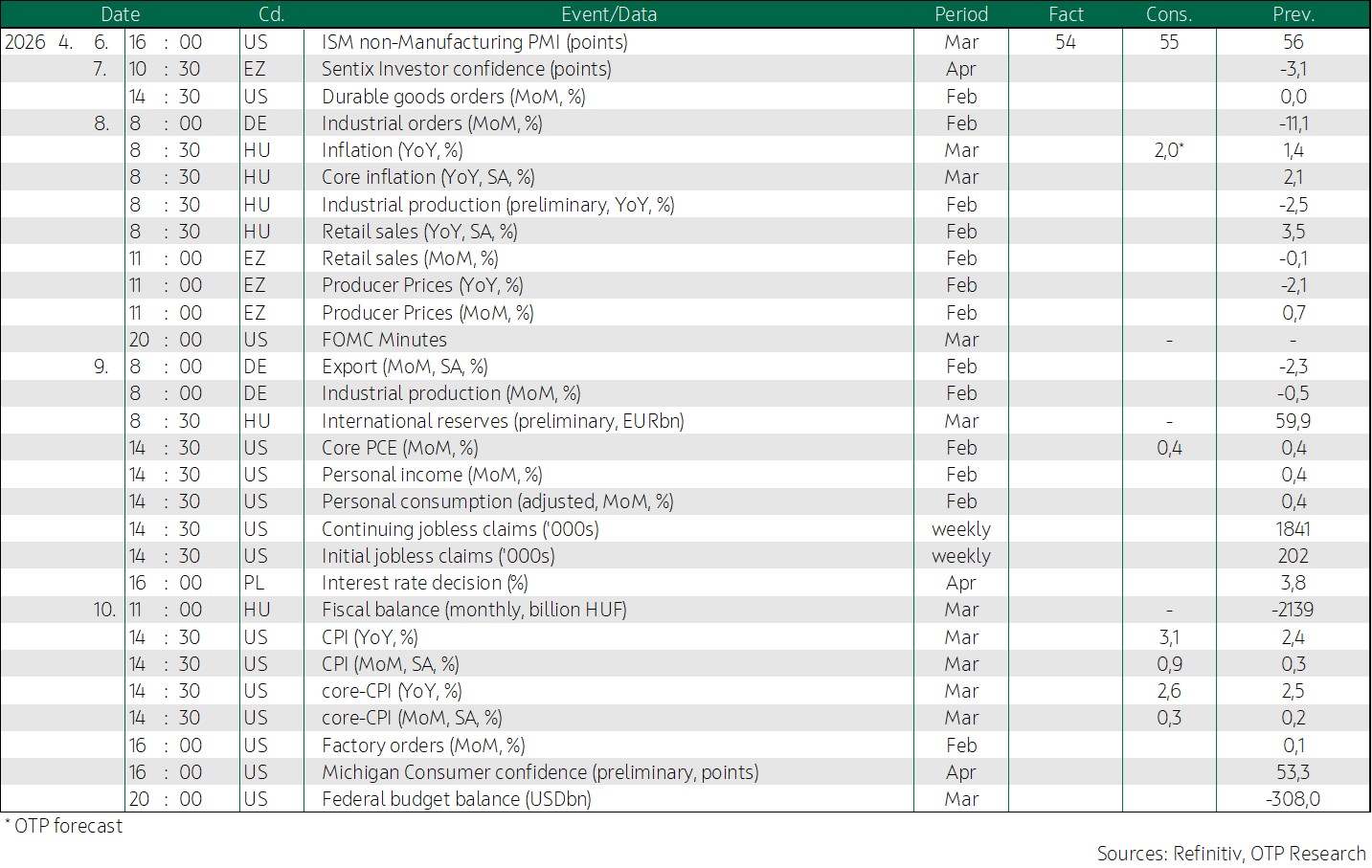
Domestically, the most anticipated macroeconomic release of the week will be March inflation, to be published by the Hungarian Central Statistical Office (KSH) on Wednesday morning. Our own forecast suggests that the pace of price growth may have accelerated to 2.0% from 1.4% in February, while Bloomberg’s market consensus stands at 2.2%. February data on industrial production and retail sales will also be released on Wednesday. In the euro area, February retail sales figures are due on the same day. Following a 0.1% month-on-month decline in January, we expect a 0.3% rebound in February, which would keep the annual growth rate close to 2%. Today will also see the release of the first April confidence indicator, the Sentix index. Another key data point from Europe will be German industrial production for February, scheduled for publication on Thursday morning. Recently, between October and December, annual growth edged back into slightly positive territory and manufacturing confidence indicators improved, providing some grounds for optimism. As a result, February could deliver modest month-on-month growth following the weak January reading (-0.5% m/m).
U.S. inflation data for March will be released on Friday, already reflecting the impact of the Middle East conflict–driven surge in energy prices. According to expectations, the headline index may have risen by 0.9% month on month, up from 0.3% in February, while core inflation is seen accelerating more moderately to 0.3% after 0.2% in the previous month. The Middle East conflict has pushed global crude oil prices up by more than 50%, as a result of which the nationwide average retail price of gasoline in the United States has exceeded USD 4 per gallon for the first time in more than three years. The core PCE price index, due on Thursday, registered a month-on-month increase of 0.4% in both December and January—twice the pace consistent with the Fed’s 2% inflation target—and expectations are that February showed a similar reading.
The Polish central bank will hold a rate setting meeting on Thursday. After cutting the policy rate by 25 basis points to 3.75% in early March, analysts expect the bank to leave rates unchanged at the April meeting.
Get more out of your investments!
Global Markets Services
OTP Global Markets offers a broad range of services in the field of local and international money and capital markets.
Read morePrivate Banking Services
Personal care and expertise with OTP Private Banking, along with the knowledge, security, and innovations of a multinational banking group.
Read more