
OTP Morning Brief: Once again, Donald Trump’s words moved the markets
Related content
OTP Morning Brief: US producer price index came in above expectations, yet the US 10-year Treasury yield still declined
Western European equities continued to advance despite ongoing pressure on the technology sector. Wall Street indices also rebounded, recovering some ground after Wednesday’s sell-off. Healthcare was the standout performer on both sides of the Atlantic. Eurozone industrial production declined by 0.5% month-on-month in August. In the US, the producer price index accelerated to 6.3%, delivering another upside surprise in inflation developments. US retail sales increased by 0.8% compared to August. The US 10-year Treasury yield declined by more than 10 basis points. The long end of the Hungarian government bond yield curve also declined by 7-9 basis points. In Hungary, August wage data will be released today, while in the US, September industrial production figures are due.
OTP Morning Brief: US CPI data came in above expectations
European equity markets advanced, supported by strong results from ASML and the outstanding performance of the healthcare sector. US equity markets came under pressure following higher-than-expected September CPI data. The annual CPI rate accelerated to 3.7%, driven primarily by a surge in gasoline prices, while core CPI rose by 0.3% month-on-month, supported by higher housing costs and rising transportation service prices. Oil prices rose amid escalating tensions in the Middle East and the impact of the IEA's oil market report. US Treasury yields retreated after an initial increase, driven by Fed commentary, while European bond yields generally moved higher. The US macro calendar will be busy today, with investors focusing on September retail sales and producer price index data, as well as the New York Fed Manufacturing Index, weekly jobless claims, and business inventories. August industrial production data from the euro area will be released today.
Markets were once again driven by news related to the Iran war on Wednesday. President Trump suggested that the United States could bring the conflict to an end even without an agreement with Iran. Oil prices eased toward $100 on Wednesday. The sharp rally in Asian markets was followed by a rebound in Europe. The German 10-year yield fell below 3%, while the Hungarian 10-year yield dropped below 6.9%. The U.S. equity indices continued to rise on Wednesday. U.S. retail sales rebounded in February. The ADP reported a 62,000 increase in employment, and the ISM manufacturing PMI climbed to a nearly four-year high in the United States. Hungary’s government deficit amounted to 4.7% of GDP in 2025. The U.S. March labour market report is due on Friday. Market sentiment turned by Thursday morning following remarks by Donald Trump.
European stock markets rose sharply on Wednesday
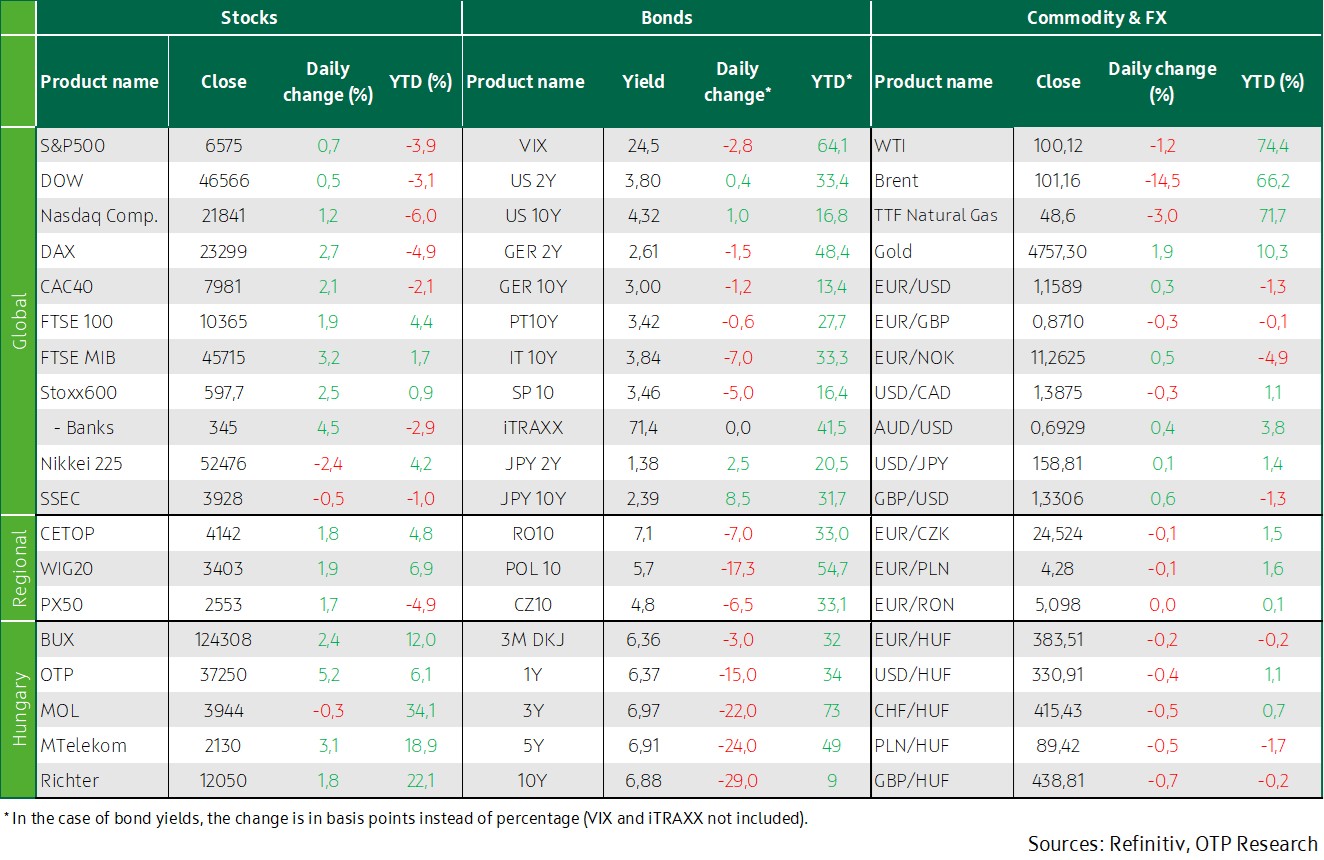
Markets were once again primarily driven by news related to the Iran war on Wednesday. President Trump indicated that the United States could bring the conflict to an end even without an agreement with Iran, potentially within weeks. He stated that the U.S. has ensured that Iran does not possess nuclear weapons and that targeted strikes could still be carried out in the future if necessary. A key question, however, is how a withdrawal—one that does not guarantee fully free and toll-free passage through the Strait of Hormuz—would affect energy prices. Against this backdrop, the sharp rally in Asian markets was followed by a rebound across Europe. The STOXX 600 gained 2.5%, the DAX rose 2.7%, the CAC 40 advanced 2.1%, and the FTSE 100 climbed 1.85%. European equities were led higher by the defense sector (+5.9%) and banking stocks (+4.5%). At the same time, with oil prices retreating toward the USD 100 level, the energy sector fell by 2.5%. European TTF natural gas prices declined by 3%, slipping back below EUR 50/MWh.
The decline in oil prices provided a boost to airline stocks, with shares of Air France KLM and Lufthansa jumping by 8.9% and 8.0%, respectively. Among individual stocks, the UK-based Babcock International Group gained 9.5% after reaching an agreement with the UK Ministry of Defence on a six-month bridging contract.
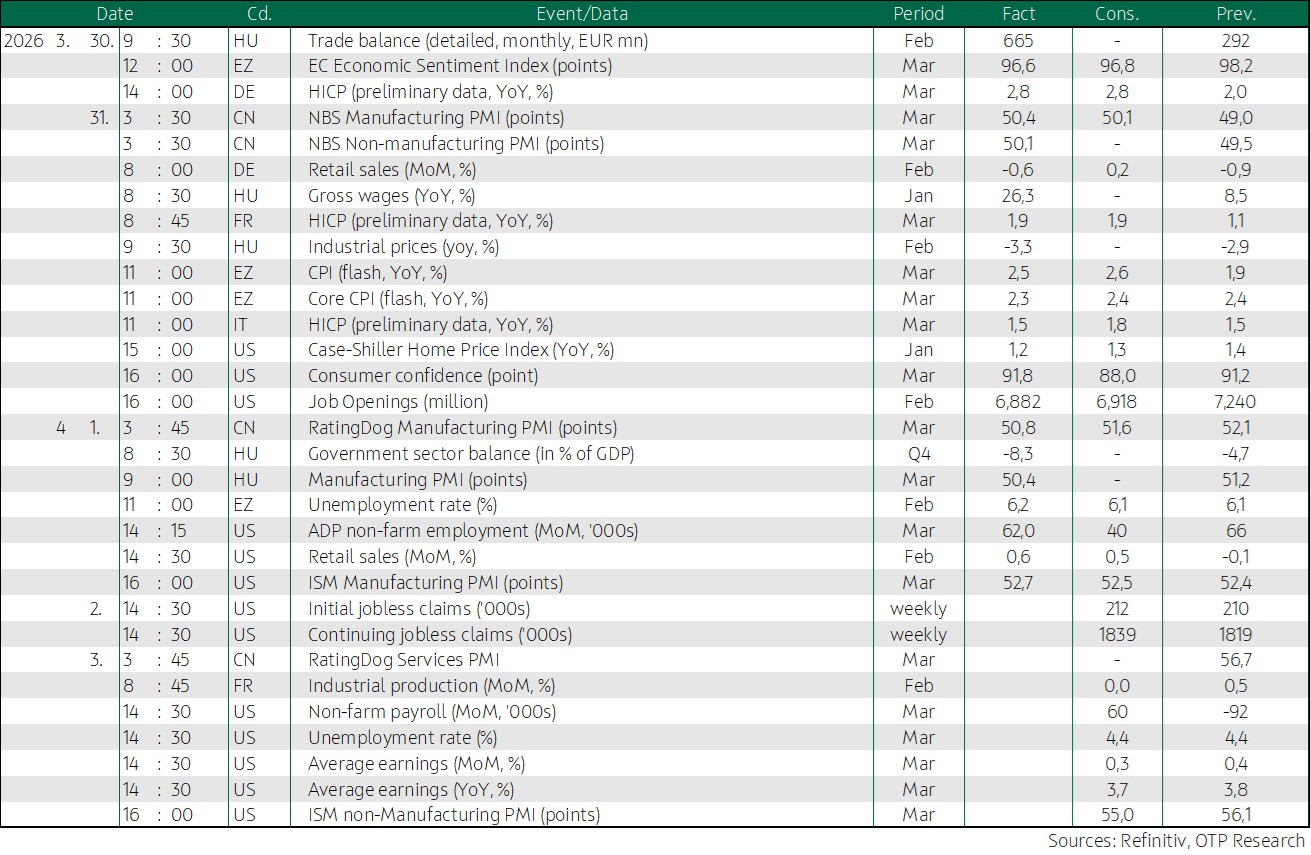
The euro area’s unemployment rate came in at 6.2% in February, 0.1 percentage points higher than expected. At home, Hungary’s Central Statistical Office (KSH) published data on the government sector balance for 2025 on Wednesday. In line with the preliminary financial accounts previously released by the National Bank of Hungary (MNB), the deficit amounted to 4.7% of GDP in 2025.
The BUX closed a strong session with a gain of 2.4%. Among blue chips, OTP led the rally, rising by 5.2%, followed by Magyar Telekom, which advanced 3.1%. MOL ended the day in negative territory, slipping by 0.3%. In the region, Poland’s WIG20 climbed 1.9%, while the Czech PX index rose by 1.7%.
U.S. equity indices continued to climb yesterday
Although to a lesser extent than on Tuesday, U.S. equity indices continued to move higher on Wednesday. The S&P 500 rose by 0.7%, the Dow Jones gained 0.5%, and the Nasdaq Composite advanced 1.2%. Major technology stocks rallied, with Alphabet climbing 3.4%, while Meta and Amazon rose by more than 1%.
Shares of Eli Lilly rose by 3.8% after the U.S. Food and Drug Administration (FDA) approved the pharmaceutical company’s weight-loss pill, which will be marketed under the brand name Foundayo. Intel announced that it will repurchase the 49% stake in its Irish manufacturing facility for USD 14.2 billion. Intel had previously sold it to Apollo Global Management. Demand for Intel’s products is being supported by the growing emphasis on inference—responding to user queries—following the training phase of the AI revolution. Intel shares gained 8.8% on Wednesday. Meanwhile, Nike’s stock plunged 15.5% to a ten-year low after the sportswear maker guided for a sharp decline in fourth-quarter sales.
The ADP reported a 62,000 increase in employment in the United States in March, exceeding expectations of around 40,000. It is important to note, however, that ADP figures often do not move in line with the official labor market data due on Friday. Following weak readings in the previous two months, retail sales rebounded in February, posting a month-on-month increase of 0.6%, slightly above market expectations.
The ISM reported on Wednesday that its manufacturing purchasing managers’ index rose to 52.7 in March from 52.4 in February. This is the highest level since August 2022 and marks the third consecutive month the index has remained above 50, signaling an expansion in economic activity. Part of the increase in the headline index was likely driven by a lengthening of supplier delivery times, which under normal circumstances points to a strong economy and rising demand. In this case, however, slower deliveries are more indicative of supply chain disruptions. Within the ISM survey, the supplier deliveries sub-index increased to 58.9 from 55.1 in February. Readings above 50 indicate slower delivery times.
The German 10-year yield fell below 3%, while the Hungarian 10-year yield dropped below 6.9%
Energy prices declined yesterday amid easing tensions in the Middle East, helping to alleviate inflationary and interest rate hike concerns. The U.S. 10-year Treasury yield ultimately moved little and remained above the 4.3% level, while European government bond yields fell, with the German 10-year yield slipping below 3%. As risk appetite strengthened, the euro appreciated against the dollar, with EURUSD rising toward the 1.16 level.
There was no meaningful movement in regional FX markets: the zloty, the Czech koruna and the forint remained broadly stable against the euro, with EURHUF hovering around 383. Domestic interest rate hike expectations, however, eased materially. Hungarian government bond yields fell significantly by 20–30 basis points, pushing the entire yield curve below 7%, while the 10-year yield declined to below 6.9%.
Today, the Government Debt Management Agency (ÁKK) is offering 3-, 5- and 10-year bonds, with announced volumes of HUF 10bn, HUF 15bn and HUF 25bn, respectively.
Today's highlights
Hopes for a swift end to the Middle East war had already faded by Thursday morning after U.S. President Donald Trump, in a long-anticipated speech, signalled the possibility of more aggressive strikes against Iran. According to the president, military operations are set to intensify over the next two to three weeks. Alongside a renewed rise in oil prices, Asian markets are falling on Thursday morning. Approaching the close, the Nikkei is down 2.4%, the KOSPI 4.1%, the SSEC 0.5%, and the Hang Seng 1.1%.
Today, the usual weekly jobless claims data are due from the United States. On Friday, the U.S. March labor market report will be released. The recent pattern may continue: following the strong increase in January and the sharp decline in February, a rebound in non-farm payroll growth could occur. That said, the expected figure of around 60,000 would still be well below the roughly 200,000 gains typical in more normal times, as well as the around 100,000 increases seen in recent years. The market is expecting the unemployment rate to remain unchanged and wage growth to stay strong. In China, the March services PMI from RatingDog is scheduled to be published on Friday.
On Good Friday, U.S. stock markets and most European indices will be closed. On Monday, U.S. markets reopen, while European markets mostly return on Tuesday. We will be back with the next Morning Brief on Tuesday, April 7.
Get more out of your investments!
Global Markets Services
OTP Global Markets offers a broad range of services in the field of local and international money and capital markets.
Read morePrivate Banking Services
Personal care and expertise with OTP Private Banking, along with the knowledge, security, and innovations of a multinational banking group.
Read more