
OTP Morning Brief: There have been signs of a de-escalation of the Middle East conflict
Related content
OTP Morning Brief: US producer price index came in above expectations, yet the US 10-year Treasury yield still declined
Western European equities continued to advance despite ongoing pressure on the technology sector. Wall Street indices also rebounded, recovering some ground after Wednesday’s sell-off. Healthcare was the standout performer on both sides of the Atlantic. Eurozone industrial production declined by 0.5% month-on-month in August. In the US, the producer price index accelerated to 6.3%, delivering another upside surprise in inflation developments. US retail sales increased by 0.8% compared to August. The US 10-year Treasury yield declined by more than 10 basis points. The long end of the Hungarian government bond yield curve also declined by 7-9 basis points. In Hungary, August wage data will be released today, while in the US, September industrial production figures are due.
OTP Morning Brief: US CPI data came in above expectations
European equity markets advanced, supported by strong results from ASML and the outstanding performance of the healthcare sector. US equity markets came under pressure following higher-than-expected September CPI data. The annual CPI rate accelerated to 3.7%, driven primarily by a surge in gasoline prices, while core CPI rose by 0.3% month-on-month, supported by higher housing costs and rising transportation service prices. Oil prices rose amid escalating tensions in the Middle East and the impact of the IEA's oil market report. US Treasury yields retreated after an initial increase, driven by Fed commentary, while European bond yields generally moved higher. The US macro calendar will be busy today, with investors focusing on September retail sales and producer price index data, as well as the New York Fed Manufacturing Index, weekly jobless claims, and business inventories. August industrial production data from the euro area will be released today.
Both the United States and Iran have signalled an easing of tensions. Key European and US indices, as well as stock markets in the CEE region, climbed. Headline inflation accelerated sharply in the eurozone in March, while core inflation slowed on an annual basis. In March, WTI rose by 51% and Brent by 63%. Developed economies’ bond yields fell, and the euro strengthened against the dollar. Domestic bond yields fell. The forint strengthened against the euro. The Hungarian Central Statistical Office (KSH) will publish the government sector’s fourth-quarter balance today. In the eurozone, February’s unemployment rate will be released. In the United States, the ADP Institute will release its March employment data, and the ISM Institute’s March manufacturing index, as well as retail sales data for February, will be released.
Major European stocks rose on Tuesday; significant losses built up throughout March
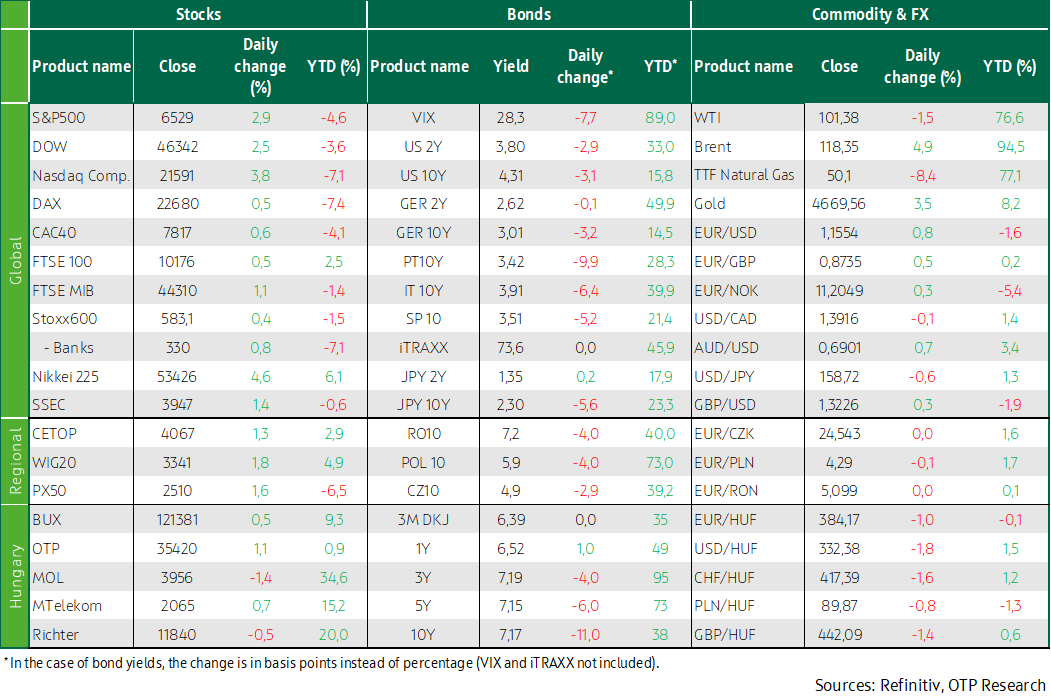
Tuesday’s trading brought a cautious rise on key Western European stock markets, but for March as a whole, this still meant heavy monthly losses—the worst in four years—accumulated in the shadow of the Middle East conflict. The pan-European Stoxx 600 rose 0.4% on the last trading day of March, while for the month as a whole, it fell 8%. Tuesday’s relief was primarily due to a comment by Donald Trump, who said he is prepared to end military operations even if the Strait of Hormuz remains closed. Investors, however, remain cautious, as this would not be the first statement pointing toward de-escalation in the past four weeks that has failed to bring a resolution.
Most of the Stoxx 600 sector indices rose, with the best performance coming from the basic resources sector (+2.3%). Among individual stocks, UBS is worth highlighting, as it rose 4% after the Financial Times reported that Swiss lawmakers had assured the lender that they would ease capital requirements; this news boosted the entire financial sector, which rose nearly 2%. Unilever shares fell 7.3% after the company reported that it is in advanced stages of talks to merge its food business with McCormick (-7.0%). Alstom shares jumped 5.4% after the train maker announced that it had won an $800 million contract for a multinational system.
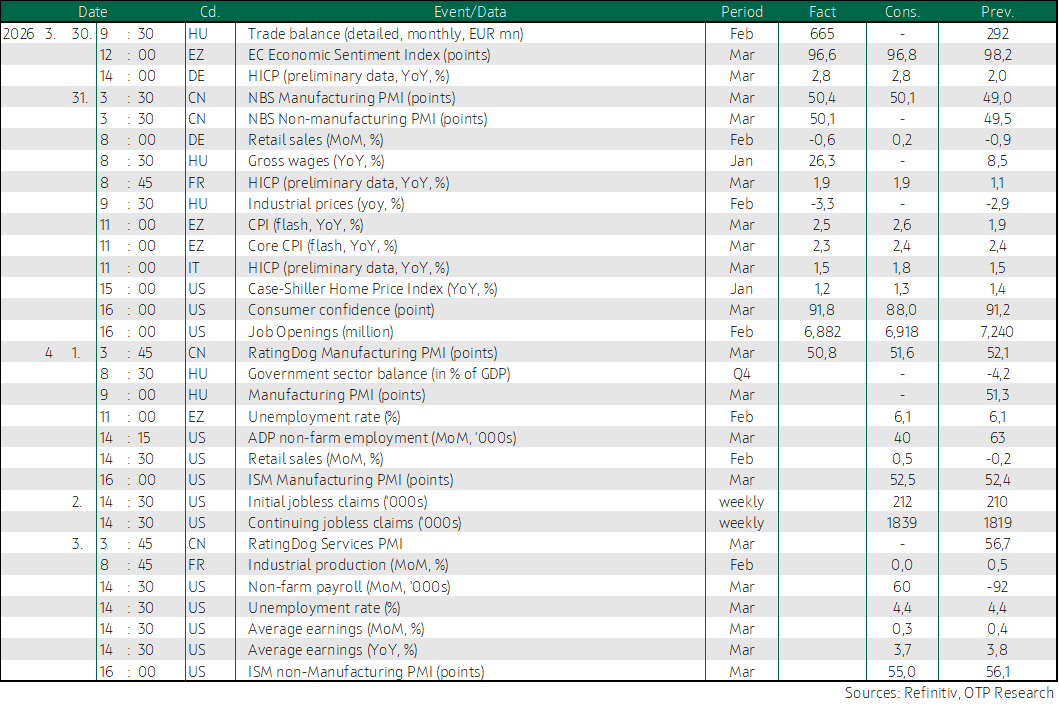
Headline inflation in the eurozone accelerated by 1.2% MoM and by 2.5% YoY in March; the surge was almost entirely driven by higher fuel prices. Meanwhile, core inflation moderated from 2.4% to 2.3% YoY, mainly due to a slowdown in services inflation (from 3.4% to 3.2%), which, however, may rise later due to second-round effects of rising energy prices. Following the release of the data, market pricing regarding the ECB’s interest rate path for this year remained unchanged, with a 75-basis-point hike expected by year-end. Retail sales in Germany fell sharply MoM (-0.6%) in February, following a significant decline in January, instead of the expected modest expansion.
Stocks in the CEE region also rose yesterday, the BUX lagging behind with a 0.5% gain. Hungarian blue chips closed mixed. Looking at March as a whole, the region’s stock markets also fell; the BUX dropped by 4.1%.
According to data from the Hungarian Central Statistical Office (KSH), average gross earnings rose by 26.3% in January. Behind this unusually high figure is the six-monthly “service premium” (the so-called “firearms money”) paid to members of the army and the law enforcement personnel in January, which accounts for 18 percentage points of the increase.
The price of European TTF natural gas fell by just over 2% yesterday but still remained above 50 EUR/MWh.
Wall Street indices rose; Brent and WTI prices rose by more than 50% in March
Investors' optimism on Wall Street was fueled by Donald Trump's comments pointing toward a de-escalation of the Middle East conflict, as well as an unconfirmed report that Iranian President Masoud Pezeshkian was open to ending the war with security guarantees. Earlier, however, U.S. Secretary of Defense Pete Hegseth warned Tehran that the conflict could escalate if no agreement is reached. Tech giants—including Nvidia (+5.6%), Alphabet (+5.1%), and Meta (+6.7%)—led the major indices higher, driving the NASDAQ up 3.8%. Semiconductor manufacturers also performed well, while energy stocks fell despite rising oil prices. For the month of March as a whole, we saw declines of around 5% on the major Wall Street indices.
CoreWeave rose 12% after the company secured an $8.5 billion loan to expand its artificial intelligence infrastructure. Marvell Technology rose 12.8% after Nvidia invested $2 billion in the company.
The March consumer confidence index showed a slight increase instead of the expected decline. According to data released yesterday, the number of job openings in the United States fell more than expected in February, and hiring sank to a low not seen in nearly six years. While the incoming data reinforced concerns about labor market stability, it did not affect interest rate expectations for this year. The market continues to expect the Fed to keep the base rate unchanged for the rest of the year.
Indications of a de-escalation in the Middle East conflict helped drive down the price of WTI, which fell by 1.5% to around $101; in March, it had risen by 51%, a rise not seen since May 2020. Brent continued to rise yesterday, with prices climbing nearly 5%. In March, Brent crude prices rose 63%, marking a monthly jump not seen since 1988.
Developed economies’ bond yields fell; the euro strengthened against the dollar; the forint strengthened against the euro
Yesterday, almost everything pointed to a decline in inflation fears, expectations of interest rate hikes, and long-term yields. Not only the United States but also Iran expressed a willingness to end the war, causing oil prices to fall from their previous highs. In addition, eurozone inflation rose less than expected, while consumer and services inflation declined, and German retail sales were weak. In the United States, a decline in the number of job openings and voluntary quits pointed to a further cooling of the labor market. The US 10-year bond yield fell by 5 basis points to 4.3%, and a similar decline occurred in Europe across the German, French, and Italian bond markets, with the 10-year German yield closing at 3% again. Due to the return of risk appetite, the euro strengthened by 0.8% against the dollar, with the EUR/USD rising to around 1.155.
Although the exchange rates of the zloty and the Czech koruna barely changed against the euro, the forint strengthened by 1% to the 384 level. Expectations of regional interest rate hikes also eased, and bond yields fell. In the domestic bond market, yields on three- to five-year bonds fell by 5 basis points, while longer-term yields fell by 10 basis points; the 10-year yield returned to around 7.1%. Amid subdued demand, the ÁKK sold the announced HUF 20 billion worth of three-month DKJ at an average yield of 6.44%.
Today's highlights
Optimistic investor sentiment dominated trading this morning on stock markets across the Asia-Pacific region, with all major indices moving higher. In addition to news pointing toward an easing of the conflict in the Middle East, investors were encouraged by South Korea’s sharp jump in exports in March and Japan’s Tankan business confidence index, which showed improvement in Q1. In China, however, RatingDog’s March manufacturing purchasing managers’ index fell more than expected, though it remained in expansionary territory. Trading in the crude oil market opened higher today. Index futures point to a positive opening in both Europe and the US.
The Hungarian Central Statistical Office (KSH) will publish the government sector’s fourth-quarter balance today.
From the eurozone, February’s unemployment rate is due, which is expected to have remained at 6.1%, its historic low.
In the United States, the ADP Institute will publish its March employment data, which, according to market expectations, will show a more modest increase in employment compared to February, but it is important to note that the ADP data does not correlate with the official statistics due on Friday, where expectations are that the sharp decline in February will be followed by a rebound in March. The ISM Institute’s March manufacturing index is also due, with the market expecting it to remain roughly at the same level as the previous month; however, rising input prices will eventually have to leave their mark on manufacturing performance. Retail sales may show a jump in February following the weak data from the previous two months. This data is also very important in terms of growth expectations, as AI investments or not, household consumption is the engine of U.S. economic growth.
Get more out of your investments!
Global Markets Services
OTP Global Markets offers a broad range of services in the field of local and international money and capital markets.
Read morePrivate Banking Services
Personal care and expertise with OTP Private Banking, along with the knowledge, security, and innovations of a multinational banking group.
Read more