
OTP Morning Brief: Energy prices surged due to the Iranian escalation, while European stock markets fell sharply
Related content
OTP Morning Brief: US producer price index came in above expectations, yet the US 10-year Treasury yield still declined
Western European equities continued to advance despite ongoing pressure on the technology sector. Wall Street indices also rebounded, recovering some ground after Wednesday’s sell-off. Healthcare was the standout performer on both sides of the Atlantic. Eurozone industrial production declined by 0.5% month-on-month in August. In the US, the producer price index accelerated to 6.3%, delivering another upside surprise in inflation developments. US retail sales increased by 0.8% compared to August. The US 10-year Treasury yield declined by more than 10 basis points. The long end of the Hungarian government bond yield curve also declined by 7-9 basis points. In Hungary, August wage data will be released today, while in the US, September industrial production figures are due.
OTP Morning Brief: US CPI data came in above expectations
European equity markets advanced, supported by strong results from ASML and the outstanding performance of the healthcare sector. US equity markets came under pressure following higher-than-expected September CPI data. The annual CPI rate accelerated to 3.7%, driven primarily by a surge in gasoline prices, while core CPI rose by 0.3% month-on-month, supported by higher housing costs and rising transportation service prices. Oil prices rose amid escalating tensions in the Middle East and the impact of the IEA's oil market report. US Treasury yields retreated after an initial increase, driven by Fed commentary, while European bond yields generally moved higher. The US macro calendar will be busy today, with investors focusing on September retail sales and producer price index data, as well as the New York Fed Manufacturing Index, weekly jobless claims, and business inventories. August industrial production data from the euro area will be released today.
The attacks on energy infrastructure in the Persian Gulf triggered a new energy-price shock, which sent European equities tumbling; the BUX outperformed thanks to Mol’s gains. Overseas markets also declined: in addition to rising energy prices, the Fed’s Wednesday communication worried investors. Despite the initial large movements, international yields barely changed by the close; in contrast, domestic long-term yields rose significantly. The euro strengthened against the dollar, while the forint gained against the euro. By this morning, energy prices are falling and stock markets are edging higher, after a group of developed countries expressed in a joint statement on Thursday evening their willingness to help ensure stability in energy markets.
The attacks on energy infrastructure in the Persian Gulf triggered a new energy-price shock, which sent European stock markets tumbling; the BUX outperformed thanks to Mol’s gains
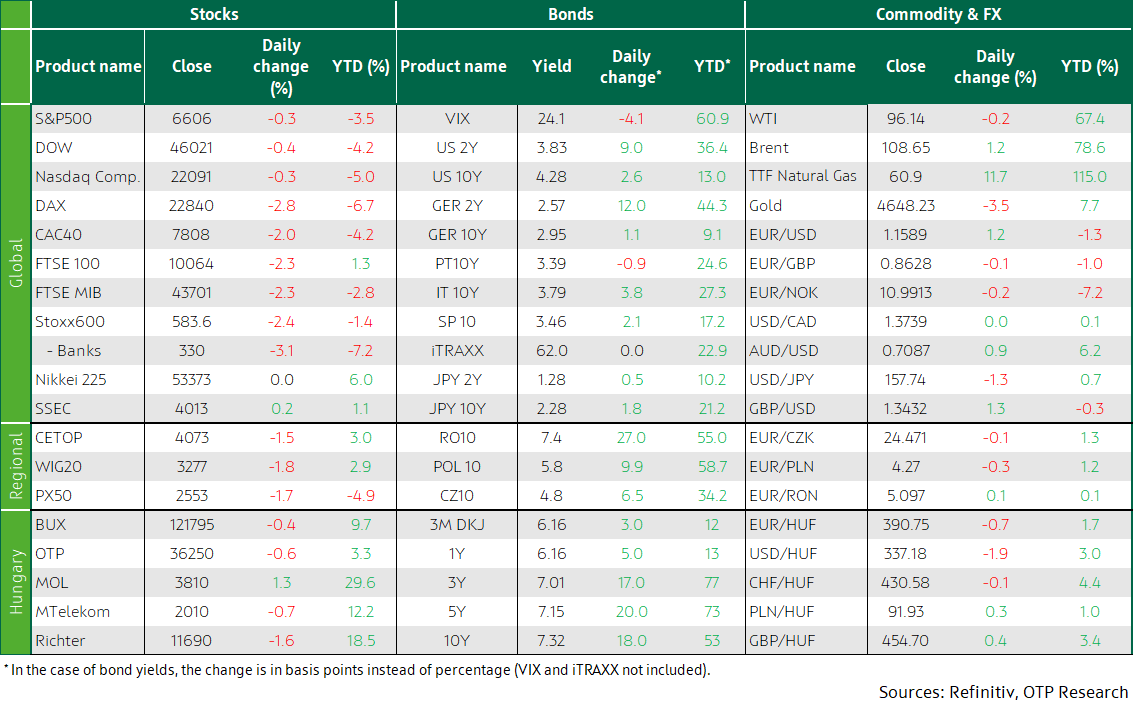
Thursday’s trading session on European stock markets was dominated by the latest escalation in geopolitical tensions and the resulting uncertainty, with indices closing at their lowest levels since December. A negative mood prevailed from the early hours, after the Middle Eastern conflict spread to key energy infrastructure: Iran attacked energy facilities in Qatar, Saudi Arabia, Kuwait, Iraq, and the United Arab Emirates following Israel’s strike on the major South Pars gas field.News of the attacks on gas fields and terminals sent shockwaves through the markets early in the day: natural gas prices jumped to 68 euros, while Brent crude surged sharply toward 120 dollars per barrel. Although some calm returned by the close, Brent still finished above 108 dollars and TTF above 60 euros.
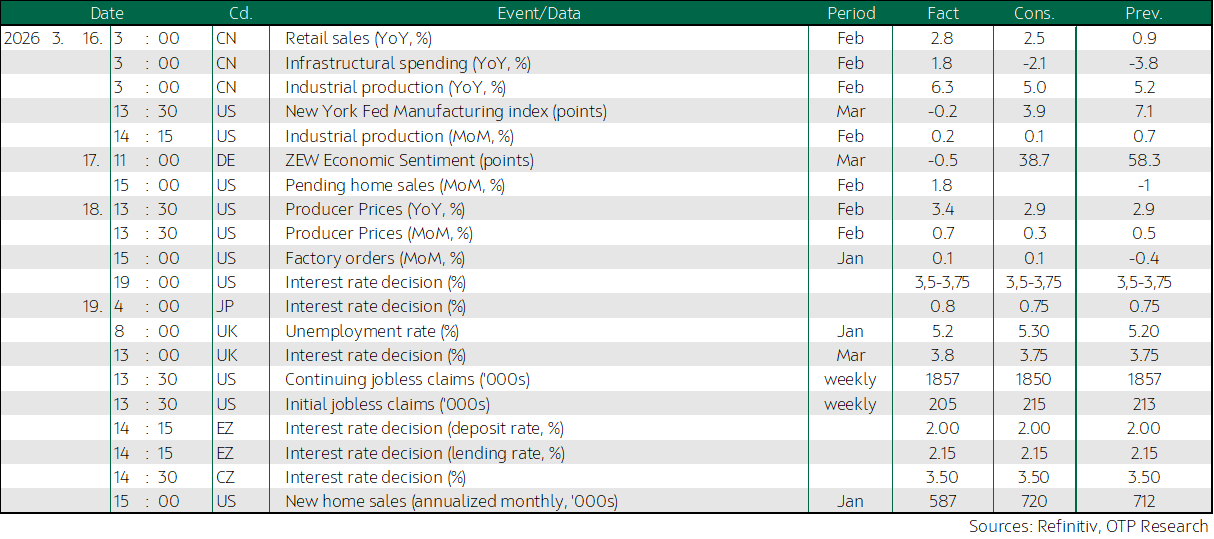
In this tense environment, central bank decisions also failed to provide meaningful reassurance. Although both the European Central Bank and the Bank of England kept their key interest rates unchanged, as expected, Christine Lagarde’s commentary urged caution among investors. The ECB downgraded its growth outlook (to 0.9% from the previous 1.2%), while raising its inflation forecast for 2026 to 2.6% (from 1.9%), which intensified fears of stagflation. Reports suggest that the ECB could begin discussing a rate hike as early as April, with a potential tightening move in June
The performance of the major indices clearly reflected investor pessimism. The STOXX and FTSEMIB closed down 2.3%, the DAX fell 2.8%, and the CAC40 ended 2.0% lower—driven primarily by weakness among energy-intensive industrial companies. In fact, every sector except energy finished the day in the red. Mining companies fell 4.3% as gold prices continued their downward trajectory. Europe’s volatility gauge, the V2TX index, strengthened for the second consecutive session.
Most Central European stock markets followed the negative Western European trend. The regional CETOP index fell by roughly 1.5%, underscoring the general lack of investor confidence. The Warsaw Stock Exchange (-1.8%) and the Prague market (-1.7%) came under significant pressure as investors began withdrawing capital from emerging markets toward perceived safer assets. In this environment, the BUX was considered a notable outperformer, closing with only a 0.4% decline. The Hungarian market was supported by Mol (+1.3%), as soaring oil and gas prices directly boosted the stock’s valuation. OTP held up relatively well amid the international banking sell?-off: although it closed down 0.6%, its loss was far smaller than that of its European peers (-3.1%). Richter and Magyar Telekom were the biggest laggards, falling 1.6% and 0.7%.
U.S. markets also declined: in addition to rising energy prices, the Fed’s Wednesday communication worried investors
U.S. markets also closed in negative territory, primarily due to declines in Micron Technology and Tesla, as inflation concerns driven by surging oil prices made investors pessimistic about the prospects for future interest rate cuts. Investors also focused on Federal Reserve Chair Jerome Powell’s Wednesday evening warnings that the economic outlook remains uncertain amid the U.S.–Israeli war with Iran, which has sent energy prices soaring and fueled inflation fears. According to CME FedWatch, interest rate futures indicate that traders see little chance of a rate cut before mid-2027. The S&P 500 and the Nasdaq fell by 0.3%, while the Dow Jones declined by 0.4%. Eight of the eleven S&P 500 sector indices closed lower, with the materials sector posting the largest decline at 1.5%, followed by a 0.9% drop in consumer discretionary.
Micron Technology fell 3.8% after the memorychip maker’s quarterly forecast failed to impress investors, despite the stock having risen 56% this year due to strong AI-related demand. Tesla dropped 3.2%, partly due to the U.S. National Highway Traffic Safety Administration expanding its investigation into 3.2 million Tesla vehicles equipped with the Full Self-Driving driver-assistance system, amid concerns that the system may fail to detect or properly warn drivers under poor visibility conditions.
Despite the initial large swings, international yields changed little by the close; in contrast, domestic long-term yields rose significantly. The euro strengthened against the dollar, while the forint gained against the euro
Despite the initial large movements, U.S. and German yields eventually returned to levels close to those seen the day before yesterday, with the 10-year U.S. Treasury yield remaining near 4.25% and the German 10-year yield near 2.95%. The ECB’s decision supported the euro, which strengthened by about 1% against the dollar, pushing the EUR/USD close to 1.16.
The forint almost fully recovered Wednesday’s losses, appreciating by 1% from the 394 level to around 390.5. At the ÁKK’s three-, five- and ten-year bond auctions, demand was very weak for the two shorter maturities, with only HUF 6 bn and HUF 10 bn sold instead of the planned HUF 15 bn each. In contrast, demand for the ten-year bond was adequate, and the ÁKK sold twice the planned HUF 20 bn. Auction average yields already reflected higher levels, but reference yields rose by another 20 basis points, bringing the ten-year yield back to around 7.3%.
The selling pressure has returned to the CEE region’s currency markets. Unsurprisingly, the Czech koruna (CZK) weakened the least (-0.1%), the zloty (PLN) by 0.4, and the forint by 1.3% (sending the EUR/HUF near 394). Benchmark bond yields barely changed, as they were fixed in the early afternoon, masking Wednesday’s increase that followed the drop on Tuesday afternoon; the 10Y yield remained near 7.15.
Today’s highlights
Oil prices are falling, and Asian stock markets as well as European and U.S. futures are edging higher, after the United Kingdom, France, Germany, Italy, the Netherlands and Japan—following earlier hesitation—issued a joint statement late Thursday expressing their readiness to contribute to appropriate efforts to ensure safe passage through the Strait of Hormuz and to protect civilian infrastructure.
Get more out of your investments!
Global Markets Services
OTP Global Markets offers a broad range of services in the field of local and international money and capital markets.
Read morePrivate Banking Services
Personal care and expertise with OTP Private Banking, along with the knowledge, security, and innovations of a multinational banking group.
Read more