
OTP Morning Brief: The sentiment turned bearish on Thursday
Related content
OTP Morning Brief: US producer price index came in above expectations, yet the US 10-year Treasury yield still declined
Western European equities continued to advance despite ongoing pressure on the technology sector. Wall Street indices also rebounded, recovering some ground after Wednesday’s sell-off. Healthcare was the standout performer on both sides of the Atlantic. Eurozone industrial production declined by 0.5% month-on-month in August. In the US, the producer price index accelerated to 6.3%, delivering another upside surprise in inflation developments. US retail sales increased by 0.8% compared to August. The US 10-year Treasury yield declined by more than 10 basis points. The long end of the Hungarian government bond yield curve also declined by 7-9 basis points. In Hungary, August wage data will be released today, while in the US, September industrial production figures are due.
OTP Morning Brief: US CPI data came in above expectations
European equity markets advanced, supported by strong results from ASML and the outstanding performance of the healthcare sector. US equity markets came under pressure following higher-than-expected September CPI data. The annual CPI rate accelerated to 3.7%, driven primarily by a surge in gasoline prices, while core CPI rose by 0.3% month-on-month, supported by higher housing costs and rising transportation service prices. Oil prices rose amid escalating tensions in the Middle East and the impact of the IEA's oil market report. US Treasury yields retreated after an initial increase, driven by Fed commentary, while European bond yields generally moved higher. The US macro calendar will be busy today, with investors focusing on September retail sales and producer price index data, as well as the New York Fed Manufacturing Index, weekly jobless claims, and business inventories. August industrial production data from the euro area will be released today.
In Europe, stock indices retreated from Wednesday’s peaks, labour cost growth slowed further. US indices fell, the labour market showed signs of stabilization. Bond yields did not move much on Thursday. Oil prices rose amid Middle East worries. Donald Trump threatened Iran again. Asia’s stock markets declined today. Japan’s inflation was in line with expectations.
Europe’s stock indices retreated from Wednesday’s peaks, labour cost growth has slowed
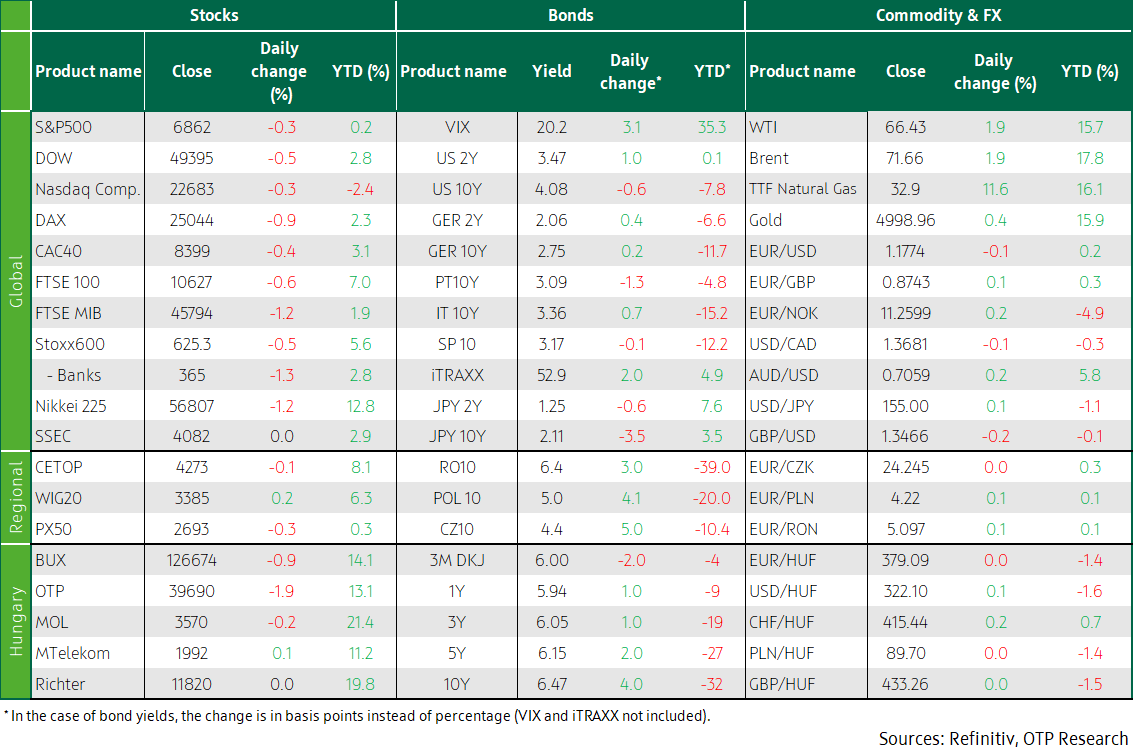
On Thursday, European stock markets reversed sharply from Wednesday's record highs. Germany’s DAX (-0.9%), the UK’s FTSE 100 (-0.6%), and France’s CAC (-0.4%) all declined, leaving the Stoxx 600 half a percent off the all-time high hit on Wednesday. The food sector added 1.6%, benefiting from Nestlé's 3.9% jump after the Swiss company reported better-than-expected fourth-quarter sales growth and announced plans to sell its ice cream business. In contrast, the raw materials sector fell, dragged down by the mining sub-sector in particular, as Rio Tinto dived 3.7% after the world's largest iron ore producer reported weaker-than-expected, stagnant annual results owing to lower iron ore prices. Among individual stocks, Airbus nose-dived 6.8% as the world's largest aircraft manufacturer lowered its aircraft production target, blaming its engine supplier Pratt & Whitney.
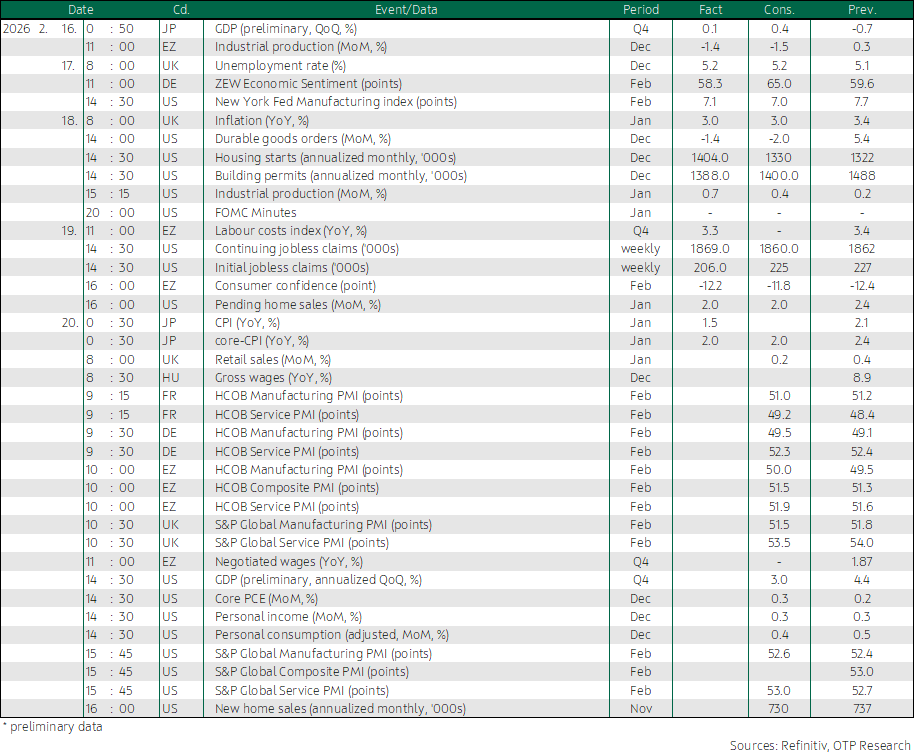
In the fourth quarter, labour costs in the eurozone grew by 3.4% year-on-year, supported by the accession of Bulgaria. A more consistent measure, excluding the new member, would have shown 3.3% increase, in a further slowdown from the 3.4% growth posted in the third quarter, indicating that labour costs and thus inflationary pressures are easing. Contrary to the news that broke on Wednesday about the ECB President’s early resignation, Christine Lagarde assured her colleagues that she remains committed to her work, implicitly refuting previous reports.
In the unsupportive international sentiment, the CEE region’s markets also headed lower. Czechia’s PX 50 (-0.3%) and Hungary’s BUX (-0.9%) slipped, while Poland’s WIG20 nudged 0.2% higher by the end of the day. One reason for the Hungarian index’s drop was OTP’s 1.9% loss.
US indices declined, the labour market showed signs of stabilization
In America, indices suffered smaller losses: the S&P 500 and the Nasdaq eased by 0.3% each, and the Dow closed half a percent lower. Of the various sectors, financials lost 0.9%, partly owing to a decline in private equity funds after Blue Owl Capital (5.9%) decided to sell USD 1.4 billion in assets and freeze redemptions of one fund, in order to manage debt. Consumer staples (-0.4%) showed a more subdued decline; Walmart’s stock price dropped by 1.4% after new CEO John Furner began his leadership with a cautious 2027 financial forecast and announced a USD 30 billion share buyback program. The US-based Boeing descended 2.2%, following its French rival.
Initial jobless claims fell by a stronger-than-expected 23,000, to 206,000 in the week ended 14 February, whereas analysts had forecast 225,000. Economists said that Thursday's data indicated stabilization in the labour market; this is consistent with the statements in the Fed's minutes released on Wednesday. The U.S. trade deficit widened sharply in December due to rising imports, and is set to hit a record high in 2025, suggesting that Trump's tariffs have not been effective in improving the trade balance, which has been a cited as a reason.
Brent crude futures rose to 71.5 USD/barrel on Thursday, their highest since early August 2025, as escalating tensions between the United States and Iran threatened supply from the Middle East. According to reports citing government officials, the US may soon launch a military operation in the Middle East, while Israel is urging regime change in Tehran. The uncertainty in the Middle East also threatens LNG shipments; natural gas futures rose by 3%.
Bond yields barely moved on Thursday
Bond and currency markets were rather idle on both sides of the Atlantic on Thursday. The yield on the ten-year dollar bond remained below 4.1%, and that on the German Bund is still less than 2.75%. The EUR/USD traded slightly below 1.18 after Wednesday's significant dollar appreciation.
Although the forint strengthened against the euro after the opening, the EUR/HUF eventually returned to around 379 by Thursday evening. There was strong demand at the ÁKK’s auction of 3Y, 5Y, and 10Y bonds: total bids exceeded HUF 350 billion for the amounts on offer (HUF 20bn, 25bn, and 25 billion, respectively), and the ÁKK sold a total of about HUF 190 billion worth of government securities. The average yields exceeded Wednesday's reference yields by a few basis points. This contributed to the fact that the previous yield drop was followed by a minor pick up yesterday: Hungarian government bonds’ benchmark yields upped by 1-4 basis points, and the 10Y one approached 6.5% once again.
Today’s highlights
Asia’s stock markets fell on Friday, and the dollar was on track for its biggest weekly gain in four months, while the increase in the USA's military presence in the Middle East created tension in the already uncertain markets. On Thursday, President Donald Trump warned Iran to reach agreement on the nuclear programme in 10-15 days, or else 'very bad things' will happen. Tehran threatened to retaliate against US military bases in the region if it is attacked.
Japan's Nikkei fell 1.2% today. Hong Kong's Hang Seng dropped by 0.6% on the first trading day after the Lunar New Year holiday, with selling pressure mostly affecting e-commerce and technology stocks. In Japan, the inflation rate rose by 1.5% in January, while core inflation grew by 2.0% YoY, in line with analysts' expectations.
Several key data points are due out today. First, the Fed's closely watched core PCE, which best captures national inflation trends, will be released. Based on the components of the already known consumer and producer price index, which are also factored in, the index may have accelerated significantly, by up to 0.4% month-on-month in December. That would bring the annual index to 3.0%, significantly exceeding the 2% target. The fourth-quarter GDP data will also be published today, even if with some delay; the AtlantaFed's actual estimate is 3.7%, while the median expectation in a Refinitiv poll was 3.0% (MoM, annualized). Even the latter, lower, 3% fourth-quarter figure would bring the annual expansion rate above 2% in 2025. Separately, purchasing managers' indices (PMIs) will be released for several countries.
Get more out of your investments!
Global Markets Services
OTP Global Markets offers a broad range of services in the field of local and international money and capital markets.
Read morePrivate Banking Services
Personal care and expertise with OTP Private Banking, along with the knowledge, security, and innovations of a multinational banking group.
Read more