
OTP Morning Brief: Greenland issue weighs on Europe's markets
Related content
OTP Morning Brief: US producer price index came in above expectations, yet the US 10-year Treasury yield still declined
Western European equities continued to advance despite ongoing pressure on the technology sector. Wall Street indices also rebounded, recovering some ground after Wednesday’s sell-off. Healthcare was the standout performer on both sides of the Atlantic. Eurozone industrial production declined by 0.5% month-on-month in August. In the US, the producer price index accelerated to 6.3%, delivering another upside surprise in inflation developments. US retail sales increased by 0.8% compared to August. The US 10-year Treasury yield declined by more than 10 basis points. The long end of the Hungarian government bond yield curve also declined by 7-9 basis points. In Hungary, August wage data will be released today, while in the US, September industrial production figures are due.
OTP Morning Brief: US CPI data came in above expectations
European equity markets advanced, supported by strong results from ASML and the outstanding performance of the healthcare sector. US equity markets came under pressure following higher-than-expected September CPI data. The annual CPI rate accelerated to 3.7%, driven primarily by a surge in gasoline prices, while core CPI rose by 0.3% month-on-month, supported by higher housing costs and rising transportation service prices. Oil prices rose amid escalating tensions in the Middle East and the impact of the IEA's oil market report. US Treasury yields retreated after an initial increase, driven by Fed commentary, while European bond yields generally moved higher. The US macro calendar will be busy today, with investors focusing on September retail sales and producer price index data, as well as the New York Fed Manufacturing Index, weekly jobless claims, and business inventories. August industrial production data from the euro area will be released today.
The pressure over Greenland dragged down Western Europe’s stock indices on Monday. The EU is to hold emergency summit on Thursday. Mol may buy the majority stake in Serbia’s NIS oil company. There was a trading holiday in the USA yesterday. Gold and silver continued to soar amid geopolitical risks. There was quiet trading in bond markets. China ran a record high trade surplus of USD 1.2 trillion in 2025, its GDP grew by 5% last year. Early election seems likely in Japan, the prime minister's expansionary plans gave another boost to bond yields.
Western European indices fell on Monday
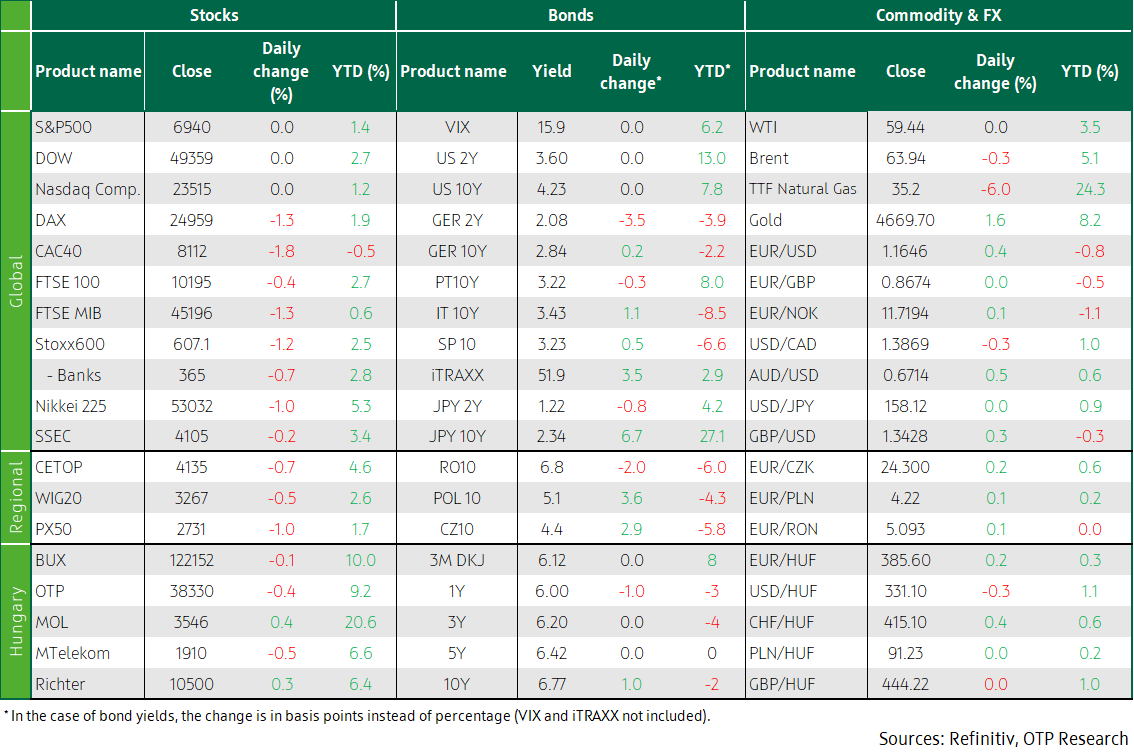
Increasing pressure from the USA to acquire Greenland weighed on European trading on Monday. The STOXX 600 slid 1.2%. In Europe, the major carmakers started the day with a sharp fall in the aftermath of US tariff threats; the sector gave back 2.2%. The other big loser was the luxury sector (-3%). The technology sector also plunged more than 3% on Monday. The DAX (-1.3%), the CAC 40 (-1.8%) and the FTSE 100 (-0.4%) all closed in the red.
In individual names, Bayer stood out yesterday. Its share price jumped nearly 7% after the US Supreme Court accepted the German pharmaceutical and agricultural group's request to review the Roundup weedkiller case, and potentially limit the number of lawsuits related to cancer claims. Beazley (+43.6%) also bucked the downward trend: the British specialist insurer's share price skyrocketed after a GBP 7.67 billion cash takeover bid from Zurich Insurance Group. EU leaders will discuss possible steps against US pressure at an emergency summit in Brussels on Thursday. One option is a tariff package on EUR 93 billion worth of US imports, which could automatically come into effect on 6 February after a six-month suspension. The other option is launching the Anti-Coercion Instrument (ACI), which could limit US companies’ access to public procurement, investment, and banking, as well as restrict trade in services – an area where the US has an advantage over the EU, especially in digital services.
According to recent media reports, MOL may buy Gazprom Group’s 56.15% stake in the Serbian oil company NIS. The change of ownership was necessitated by US sanctions against Russia’s energy sector. After a break of more than three months, crude oil transport resumed last week via the Adria oil pipeline, allowing the NIS-owned refinery in Pančova to resume operations. The deal may significantly strengthen the Hungarian oil company’s strategic position in the region. MOL’s share price rose by 0.4% on Monday. In the CEE region, Hungary’s BUX (-0.1%), Poland’s WIG20 (-0.5%), and Czechia’s PX50 (-1%) all slipped.
US equity markets were closed on Monday
America’s stock markets were closed for Martin Luther King Day. However, US index futures reflected near-1% drops.
The US political and economic agenda will be particularly busy in the coming weeks. During the World Economic Forum in Davos this week, President Trump will give a speech on Wednesday. A partial government shutdown after 31 January is also in the cards if Congress fails to reach an agreement on financing the rest of the fiscal year. On the central bank front, Stephen Miran, who considered to be a Trump loyalist, will have his term on the Fed Board of Governors expire at the end of January. The new appointment is likely to be closely linked to President Trump’s choice to replace Jerome Powell as Fed Chair, whose term expires in May. Meanwhile, the Supreme Court has yet to issue its ruling on the legality of the tariffs imposed by Donald Trump. The president’s increasing pressure on several European countries over the acquisition of Greenland, including a 10% tariff from 1 February (which will rise to 25% in June), has also caused significant turbulence and may trigger retaliatory measures from Europe.
Rising geopolitical and trade risks have pushed gold and silver prices to new highs, while WTI oil prices have fallen on demand concerns.
Bond markets remained quiet
The US bond market was also closed yesterday. There was no significant change in Europe, where the 10Y German yield remained near 2.85%. Owing to the increasing tension over Greenland and the tariff threats, the dollar weakened by almost half a percent against the euro, sending the EUR/USD to 1.165.
Monday’s trading was also quiet on Hungary’s foreign exchange and bond markets. Hand in hand with its regional peers, the forint ended Monday with trivial weakening, trading near 385 against the euro. Hungary’s benchmark bond yields did not change materially, the ten-year yield is still near 6.8%. At Monday’s switch auction, HUF 40 billion worth of Treasury Bills changed hands, at an average yield of 6.07%.
Today’s highlights
Heading into the close today, Asian indices painted a mixed picture. Japan’s Nikkei was down about 1%, Korea’s KOSPI and Hong Kong’s Hang Seng were seen inching up, while the SSEC was edging down.
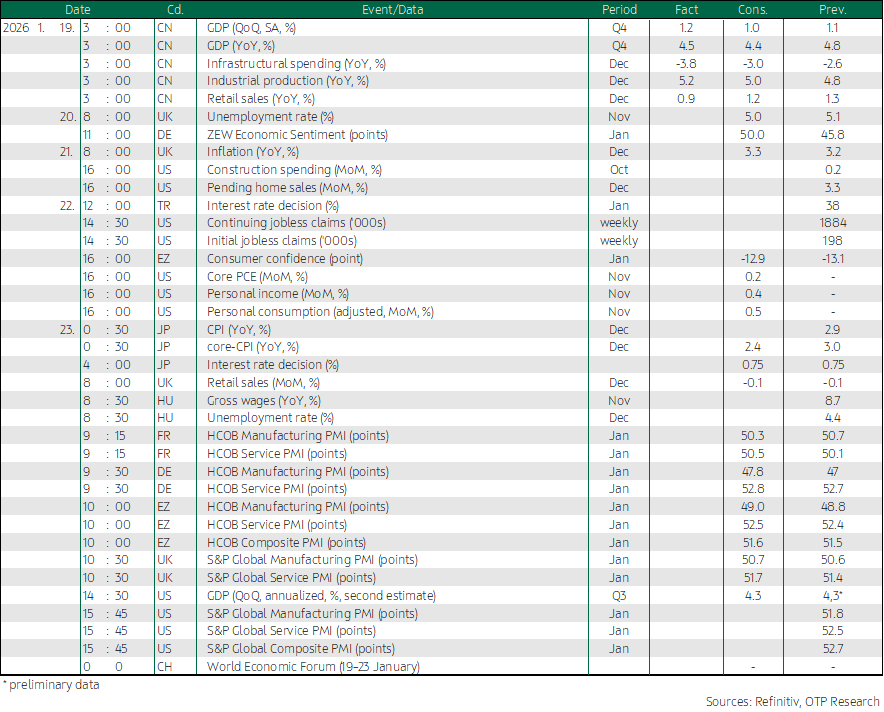
Despite the US tariffs, China posted a record USD 1.2 trillion trade surplus in 2025. While shipments to the US fell by a fifth, those to the rest of the world rose substantially. The success of export-oriented manufacturers is in stark contrasts with the persistent weakness of domestically focused sectors of the economy. Monday’s data reinforced this division: industrial production grew by 5.9% in 2025, outpacing the 3.7% increase in retail sales, while real estate investment plunged by 17.2%. Fixed asset investment shrank by 3.8% in 2025. Private investment also contracted by 6.4% as companies saw no reason to expand capacity in an economy burdened by overproduction and cautious households. Following a 5% economic growth in 2025, the IMF projects 4.5% growth rate in 2026 and 4% in 2027, based on the forecasts published yesterday.
Japan’s prime minister has called a snap election for 8 February. Takaichi Sanae is likely to seek to increase her fiscal space with a favourable election result. On Monday, she announced a plan to suspend the 8% food consumption tax for two years. With gross national debt above 230% of GDP, the prospect of further fiscal expansion has pushed Japan’s government bond yields even higher: the 10-year yield rose almost 10 basis points, to 2.27% on Monday.
Today, the January reading of the ZEW economic sentiment index is due from Germany, and the United Kingdom publishes unemployment data for November.
In Hungary, the ÁKK is offering HUF 30 billion debt in three-month discount T-Bills today.
Get more out of your investments!
Global Markets Services
OTP Global Markets offers a broad range of services in the field of local and international money and capital markets.
Read morePrivate Banking Services
Personal care and expertise with OTP Private Banking, along with the knowledge, security, and innovations of a multinational banking group.
Read more