
OTP Morning Brief: One cut, one hold, one hike. Major central banks made their decisions
Related content
OTP Morning Brief: US producer price index came in above expectations, yet the US 10-year Treasury yield still declined
Western European equities continued to advance despite ongoing pressure on the technology sector. Wall Street indices also rebounded, recovering some ground after Wednesday’s sell-off. Healthcare was the standout performer on both sides of the Atlantic. Eurozone industrial production declined by 0.5% month-on-month in August. In the US, the producer price index accelerated to 6.3%, delivering another upside surprise in inflation developments. US retail sales increased by 0.8% compared to August. The US 10-year Treasury yield declined by more than 10 basis points. The long end of the Hungarian government bond yield curve also declined by 7-9 basis points. In Hungary, August wage data will be released today, while in the US, September industrial production figures are due.
OTP Morning Brief: US CPI data came in above expectations
European equity markets advanced, supported by strong results from ASML and the outstanding performance of the healthcare sector. US equity markets came under pressure following higher-than-expected September CPI data. The annual CPI rate accelerated to 3.7%, driven primarily by a surge in gasoline prices, while core CPI rose by 0.3% month-on-month, supported by higher housing costs and rising transportation service prices. Oil prices rose amid escalating tensions in the Middle East and the impact of the IEA's oil market report. US Treasury yields retreated after an initial increase, driven by Fed commentary, while European bond yields generally moved higher. The US macro calendar will be busy today, with investors focusing on September retail sales and producer price index data, as well as the New York Fed Manufacturing Index, weekly jobless claims, and business inventories. August industrial production data from the euro area will be released today.
Leading Western European indices posted solid gains on Thursday. The European Central Bank kept interest rates unchanged but revised its growth outlook upward. At the EU summit, insufficient backing delayed the EU–Mercosur free trade agreement. The Bank of England cut rates by 25 basis points. Major U.S. indices also advanced, supported by November inflation data coming in better than expected. The yield on the U.S. 10-year Treasury fell to 4.12%. Micron Technology shares surged sharply. The Bank of Japan raised its policy rate to 0.75%, in line with expectations, and signalled that it stands ready for further increases.
Western European indices advanced; the ECB held rates; the Bank of England cut
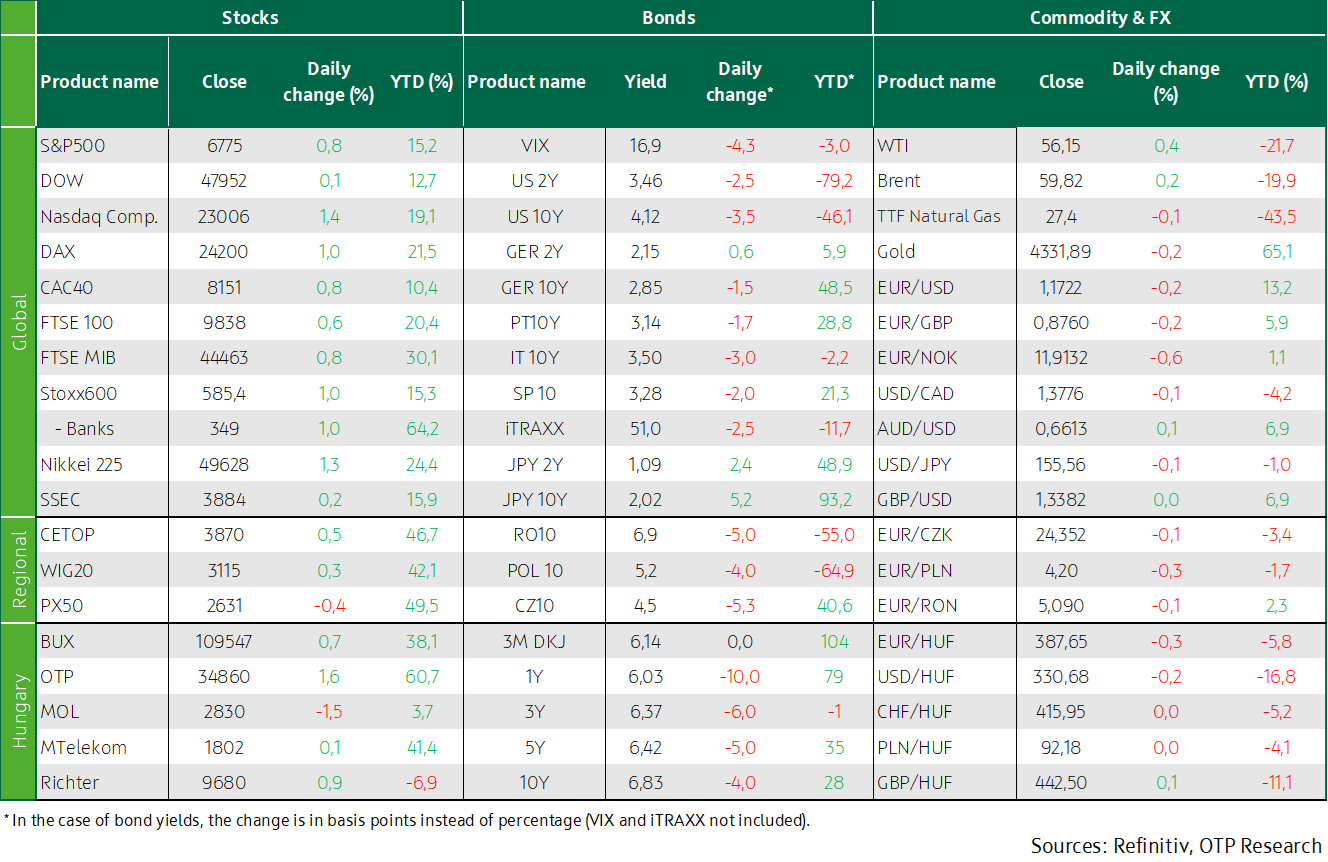
After Wednesday’s mixed performance, leading Western European indices posted solid gains yesterday. The STOXX 600 and DAX rose by 1%, the CAC 40 added 0.8%, while the FTSE 100 advanced 0.65%.
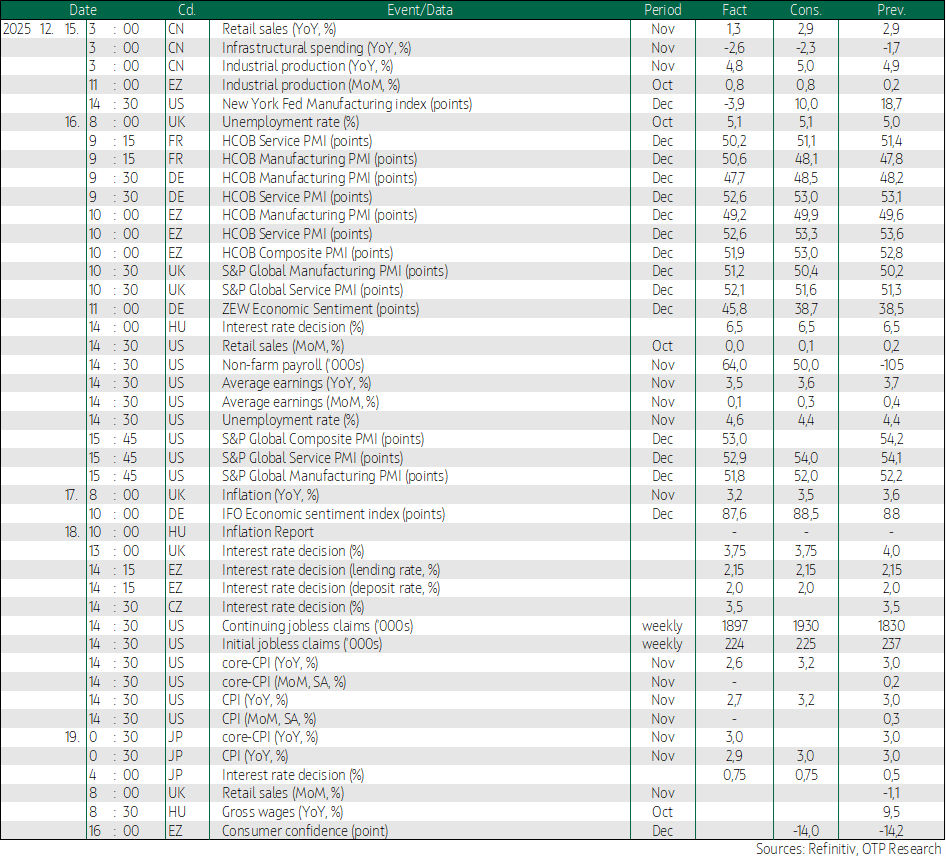
As widely expected, the ECB kept its deposit rate unchanged at 2%. The December meeting was noteworthy mainly for the subsequent press conference, given recent upside surprises in inflation — particularly services inflation accelerating to 3.5% — and whether this would alter the tone of communication. Ahead of the decision, markets had already priced in certain probability of a rate hike by late 2026. Alongside the policy announcement, the ECB revised its growth and inflation forecasts upward. The latest projections see euro area GDP expanding by 1.4%, 1.2%, 1.4%, and 1.4% in 2025–2028, while inflation is expected at 2.1%, 1.9%, 1.8%, and 2% over the same period. Although the higher growth outlook and the upward revision to 2026 inflation suggest the rate-cutting cycle may have ended, the ECB reiterated that it remains data-dependent and will decide on a meeting-by-meeting basis without committing to a predefined rate path.
In the UK, inflation fell more than expected in November, easing to 3.2%. Against this backdrop of favorable data, the Bank of England delivered no surprise by cutting its policy rate by 25 basis points to 3.75% on Thursday. The narrow 5–4 vote signals that the already gradual pace of rate reductions could slow even further.
At the EU summit that began yesterday, the EU–Mercosur free trade agreement failed to secure the necessary backing, partly due to Giorgia Meloni’s request for more time. As a result, the signing — originally planned for Saturday — is now expected to be postponed until January. Furthermore, according to this morning’s reports, European Union leaders have decided to finance Ukraine through borrowing over the next two years rather than using frozen Russian assets, thereby avoiding divisions over the potential use of Russian state funds. At the same time, the leaders authorized the European Commission to continue work on the so-called reparations loan, which would be backed by frozen Russian assets.
In the region, the BUX gained 0.7%, the WIG20 rose 0.3%, while the PX50 slipped 0.4%. In Hungary, the MNB released its December Inflation Report yesterday. The updated forecasts — already signaled after Tuesday’s rate decision — show GDP growth of 0.5%, 2.4%, and 3.1% for 2025–2027, alongside average annual inflation of 4.4%, 3.2%, and 3.3% over the same period.
U.S. indices advanced as November inflation data came in better than expected
After a weaker start to the week, U.S. indices rebounded on Thursday. The Dow Jones edged up 0.1%, while the S&P 500 gained 0.8% and the Nasdaq Composite jumped 1.4%. Six of the S&P 500’s 11 sectors advanced, led by consumer discretionary stocks, which rose 1.8%.
Micron Technology shares surged 10.1% after the U.S. chipmaker issued a quarterly profit forecast well above expectations, underscoring its leadership in the high-bandwidth memory (HBM) market. These chips are critical for training and running generative AI models. The CEO noted that memory supply constraints — driven by explosive demand from data centers — will persist beyond 2026, with Micron able to meet only half to two-thirds of demand from several key clients in the medium term. Other memory makers also rallied, including SanDisk (+6.1%) and Western Digital (+5.3%).
Due to the government shutdown, October data were not released, so November U.S. inflation figures were published only on a year-over-year basis. The consumer price index rose 2.7%, a favorable surprise compared to expectations above 3%. A technical factor may have contributed to the lower CPI reading: data collection was pushed to the end of the month, when retailers offered holiday discounts. Core inflation eased to 2.6% from 3% in September.
Initial jobless claims came in at 224,000, broadly in line with expectations and down from the previous week’s spike.
Following the significantly lower-than-expected November headline and core inflation readings, U.S. rate-cut expectations strengthened
Following the significantly lower-than-expected November headline and core inflation readings, U.S. rate-cut expectations strengthened. In Europe, the ECB kept its key rate unchanged as anticipated and refrained from signaling any stance that would reinforce the recently built-up expectations for future hikes. The U.S. 10-year yield fell by 3–4 basis points to around 4.12%, while European bond yields edged down only marginally, with the German 10-year remaining near 2.85%. The dollar weakened, with EUR/USD stabilizing above 1.17.
Yesterday the MNB softened Tuesday’s signals that had hinted at potential rate cuts. The forint firmed slightly, moving from 390 to 387.5. Yields on discount treasury bills and government bonds fell by 3–5 basis points, with the 10-year approaching 6.8%. Demand was strong at yesterday’s auctions: bids for the 1-year bill totaled HUF 80 billion, but the debt agency sold only HUF 20 billion, pushing the average yield down to 6.05%. The floating-rate bond attracted massive interest with HUF 270 billion in bids, of which HUF 90 billion was allocated. For the 2034 fixed-rate bond, demand was more modest, yet HUF 20 billion was sold versus the planned HUF 15 billion, at an average yield below 6.7%.
Today’s highlights
In Japan, November inflation came in at 2.9%, with core inflation at 3%. The Bank of Japan raised its benchmark interest rate to 0.75% — a level not seen in three decades — in line with expectations, and signaled readiness for further hikes. As markets near the close, the Nikkei is up 1.3%, while the KOSPI has gained 1.1%, the Hang Seng 0.6%, and the SSEC 0.3%.
Today’s calendar includes November retail sales from the UK, the preliminary December consumer confidence index for the euro area, and U.S. existing home sales for November. In Hungary, the statistical office will publish October wage growth data.
Get more out of your investments!
Global Markets Services
OTP Global Markets offers a broad range of services in the field of local and international money and capital markets.
Read morePrivate Banking Services
Personal care and expertise with OTP Private Banking, along with the knowledge, security, and innovations of a multinational banking group.
Read more