
OTP Morning Brief: The Fed left interest rate on hold, oil prices rose further
Related content
OTP Morning Brief: US producer price index came in above expectations, yet the US 10-year Treasury yield still declined
Western European equities continued to advance despite ongoing pressure on the technology sector. Wall Street indices also rebounded, recovering some ground after Wednesday’s sell-off. Healthcare was the standout performer on both sides of the Atlantic. Eurozone industrial production declined by 0.5% month-on-month in August. In the US, the producer price index accelerated to 6.3%, delivering another upside surprise in inflation developments. US retail sales increased by 0.8% compared to August. The US 10-year Treasury yield declined by more than 10 basis points. The long end of the Hungarian government bond yield curve also declined by 7-9 basis points. In Hungary, August wage data will be released today, while in the US, September industrial production figures are due.
OTP Morning Brief: US CPI data came in above expectations
European equity markets advanced, supported by strong results from ASML and the outstanding performance of the healthcare sector. US equity markets came under pressure following higher-than-expected September CPI data. The annual CPI rate accelerated to 3.7%, driven primarily by a surge in gasoline prices, while core CPI rose by 0.3% month-on-month, supported by higher housing costs and rising transportation service prices. Oil prices rose amid escalating tensions in the Middle East and the impact of the IEA's oil market report. US Treasury yields retreated after an initial increase, driven by Fed commentary, while European bond yields generally moved higher. The US macro calendar will be busy today, with investors focusing on September retail sales and producer price index data, as well as the New York Fed Manufacturing Index, weekly jobless claims, and business inventories. August industrial production data from the euro area will be released today.
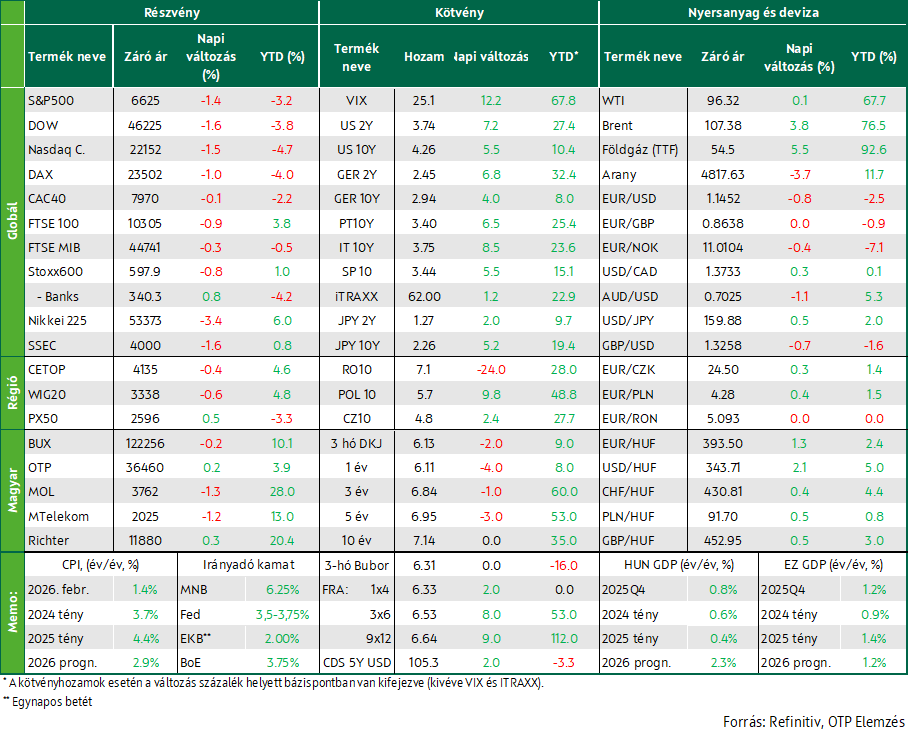
Europe’s stock indices closed in the red yesterday. Oil prices rose sharply after attacks on several oil facilities in the Persian Gulf. US indices fell; the Fed left interest rate on hold, as expected. Producer prices rose faster than expected. Micron released strong earnings report. Advanced economies’ bond yields rose; the USD strengthened. The HUF weakened the most inthe CEE region. The central banks of Europe, England, and Czechia make interest rate decisions today. Britain’s unemployment data, US housing market and the weekly jobless claims data will be in investors' focus.
Europe’s stocks subsided yesterday, ending earlier up moves; oil prices grew steeply after attacks on oil facilities in the Persian Gulf
In Europe, stock markets closed lower yesterday as investors watched the impact of geopolitical tensions over Iran ahead of the Fed’s decision. Despite the morning’s gains, the Stoxx 600 index closed 0.7% lower, and most sectors and national stock exchanges closed in the red. The eurozone’s final inflation data showed that the consumer price index rose by 0.6% month-on-month in February, which was below the preliminary estimate of 0.7% but marked a sharp turnaround from -0.6% in January. In corporate news, shares in Diploma jumped by 17.8% as the UK-based specialized technical products distributor significantly raised its guidance for the year (organic revenue growth of 9%, up from 6%) and analysts’ profit expectations grew by 13%. Softcat shares shot up 9.2% thanks to the company’s exceptionally strong half-year performance; operating profit surged 27.3% and the management raised its guidance.
Oil prices grew steeply on Wednesday after threats by Israel and Iran against each other’s energy facilities further heightened supply risks surrounding the Middle East, exacerbating already significant global supply disruptions due to a drop in tanker traffic in the Strait of Hormuz. The sentiment was soured by Israel's attack on Iran's largest gas processing plant in Bushehr province, while Tehran threatened to target key oil and gas facilities in Saudi Arabia, the United Arab Emirates, and Qatar.
The CEE region's indices closed mixed yesterday. Hungary’s BUX and Poland’s WIG declined, while the Prague index rose. Hungary’s blue chips also painted a mixed picture: OTP and Richter edged higher, while the other two stocks lost more than 1%.
US indices dropped; the Fed left interest rates on hold as expected; producer prices rose faster than expected; Micron released strong earnings report
US indices fell sharply yesterday after the latest macro data and Jerome Powell’s words added to inflation concerns. The Fed left its benchmark interest rate range at 3.5-3.75%, as expected, and signalled that it continues to expect one rate cut this year. At the same time, Chairman Powell acknowledged that inflation was declining more slowly than hoped and indicated that, although it is still early to assess the war’s impact on inflation, it poses a significant risk to prices. The Fed’s new forecast expects slightly higher growth and faster inflation than in December.
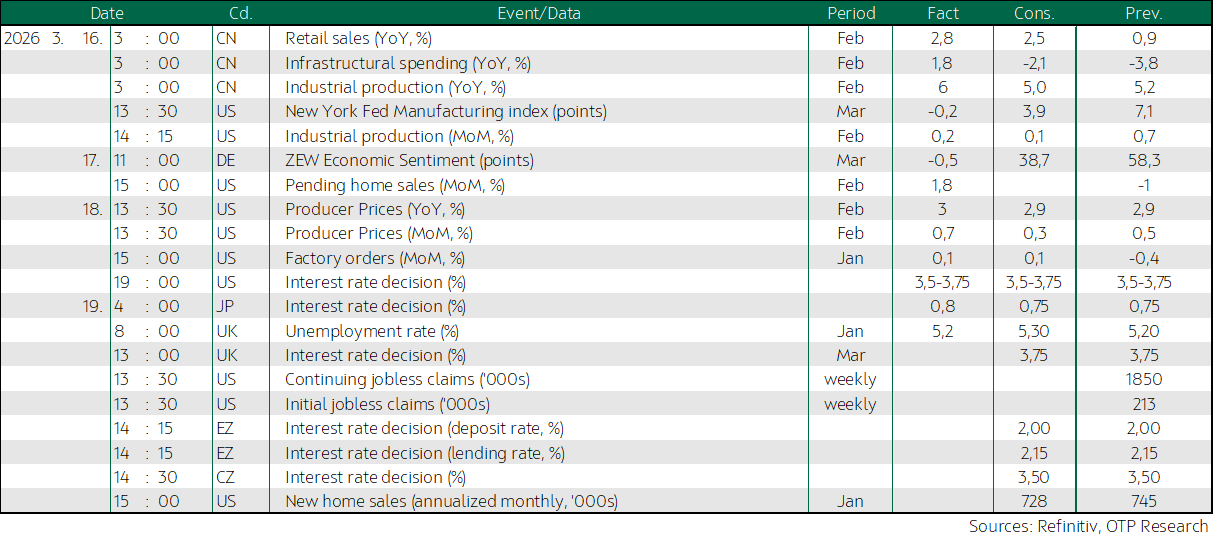
Before the Fed’s interest rate decision came the disappointing release on US producer prices, which rose by 0.7% MoM in February, exceeding both the 0.3% market expectation and the January reading of 0.5%; it was also the fastest growth rate in seven months. Experts find that the increase was mainly driven by tariffs and higher industrial input costs, but the indicator does not yet reflect the impact of the energy market shock. On the other hand, services inflation slowed to 0.5%, which is the mildest increase in three months. The core producer price index rose by 0.5% MoM, down from 0.8% in January but also exceeding forecasts of 0.3%. On an annual basis, the headline PPI jumped to 3.4% (expected: 2.9%), and core inflation accelerated to 3.9%. New orders in the US manufacturing sector rose 0.1% in January, matching the consensus; orders for non-durable goods upped by 0.3%, while durable goods orders remained flat overall, as the growth in electronics, machinery, and metal products was offset by a 0.8% decline in transportation equipment, particularly military aircraft orders (-23.8%). Orders excluding transportation equipment rose by 0.4%, marking the third consecutive monthly expansion.
After market close, Micron released its interim report, which significantly exceeded expectations in terms of both sales and profit. The former grew nearly threefold in a year, and the management is predicting rapid growth for the next quarter. Despite the better-than-expected result, the share price rose only 1% in after-hours trading.
Developed markets’ bond yields rose; the USD strengthened; the HUF weakened the most in CEE
On Wednesday, the bond yields of advanced economies rose in several waves. Firstly, Israel launched attack on Iran’s energy infrastructure, which caused oil prices to soar: WTI (+3%, to USD 100) and Brent (+6%, to USD 110) both surged. Second, the US producer price index and all its relevant sub-indexes rose much higher than thought. In addition, the Fed left the federal funds rate at 3.5-3.75%, as expected, and neither did the interest rate path (which predicts one rate cut for this year and next year) change, while the growth and inflation forecasts increased. The 10Y US yield rose by 7 basis points, closer to 4.3%. European long-term bond yields rose comparably: the 10Y German one is once again above 2.95%. The dollar strengthened again versus the euro, this time by 0.7%, thus the EUR/USD sank below 1.15.
The selling pressure has returned to the CEE region’s currency markets. Unsurprisingly, the Czech koruna (CZK) weakened the least (-0.1%), the zloty (PLN) by 0.4, and the forint by 1.3% (sending the EUR/HUF near 394). Benchmark bond yields barely changed, as they were fixed in the early afternoon, masking Wednesday’s increase that followed the drop on Tuesday afternoon; the 10Y yield remained near 7.15.
Today’s highlights
Asia’s indices sank today, following Wednesday's rise in oil prices and a drop in US stocks. The Bank of Japan left its key rate at 0.75%, as expected.
Today, the European Central Bank, the Bank of England, and the Czech National Bank make monetary policy decisions. Britain’s unemployment statistics, US housing market data as well as weekly jobless claims figures will be in focus today.
Hungary’s ÁKK auctions 3Y, 5Y, and 10Y bonds, offering HUF 15, 15, and 20 billion, respectively.
Get more out of your investments!
Global Markets Services
OTP Global Markets offers a broad range of services in the field of local and international money and capital markets.
Read morePrivate Banking Services
Personal care and expertise with OTP Private Banking, along with the knowledge, security, and innovations of a multinational banking group.
Read more