
OTP Morning Brief: Europe’s stock markets closed at new highs
Related content
OTP Morning Brief: US producer price index came in above expectations, yet the US 10-year Treasury yield still declined
Western European equities continued to advance despite ongoing pressure on the technology sector. Wall Street indices also rebounded, recovering some ground after Wednesday’s sell-off. Healthcare was the standout performer on both sides of the Atlantic. Eurozone industrial production declined by 0.5% month-on-month in August. In the US, the producer price index accelerated to 6.3%, delivering another upside surprise in inflation developments. US retail sales increased by 0.8% compared to August. The US 10-year Treasury yield declined by more than 10 basis points. The long end of the Hungarian government bond yield curve also declined by 7-9 basis points. In Hungary, August wage data will be released today, while in the US, September industrial production figures are due.
OTP Morning Brief: US CPI data came in above expectations
European equity markets advanced, supported by strong results from ASML and the outstanding performance of the healthcare sector. US equity markets came under pressure following higher-than-expected September CPI data. The annual CPI rate accelerated to 3.7%, driven primarily by a surge in gasoline prices, while core CPI rose by 0.3% month-on-month, supported by higher housing costs and rising transportation service prices. Oil prices rose amid escalating tensions in the Middle East and the impact of the IEA's oil market report. US Treasury yields retreated after an initial increase, driven by Fed commentary, while European bond yields generally moved higher. The US macro calendar will be busy today, with investors focusing on September retail sales and producer price index data, as well as the New York Fed Manufacturing Index, weekly jobless claims, and business inventories. August industrial production data from the euro area will be released today.
Western Europe’s stock markets closed at newhighs; so did Richter’s share in Budapest. Hungary’s BUX outperformed its regional peers on Wednesday. Wall Street also posted gains, powered by NVIDIA and AI developments. The ECB’s president reportedly plans early departure. Hungary’s bond yields sank again, bucking the international trend; the EUR/HUF remained below 380. Today, the eurozone releases labour cost and consumer confidence indices, while the USA publishes weekly jobless and monthly housing market data.
Western Europe’s stock markets closed at new highs, as did Richter’s share in Budapest
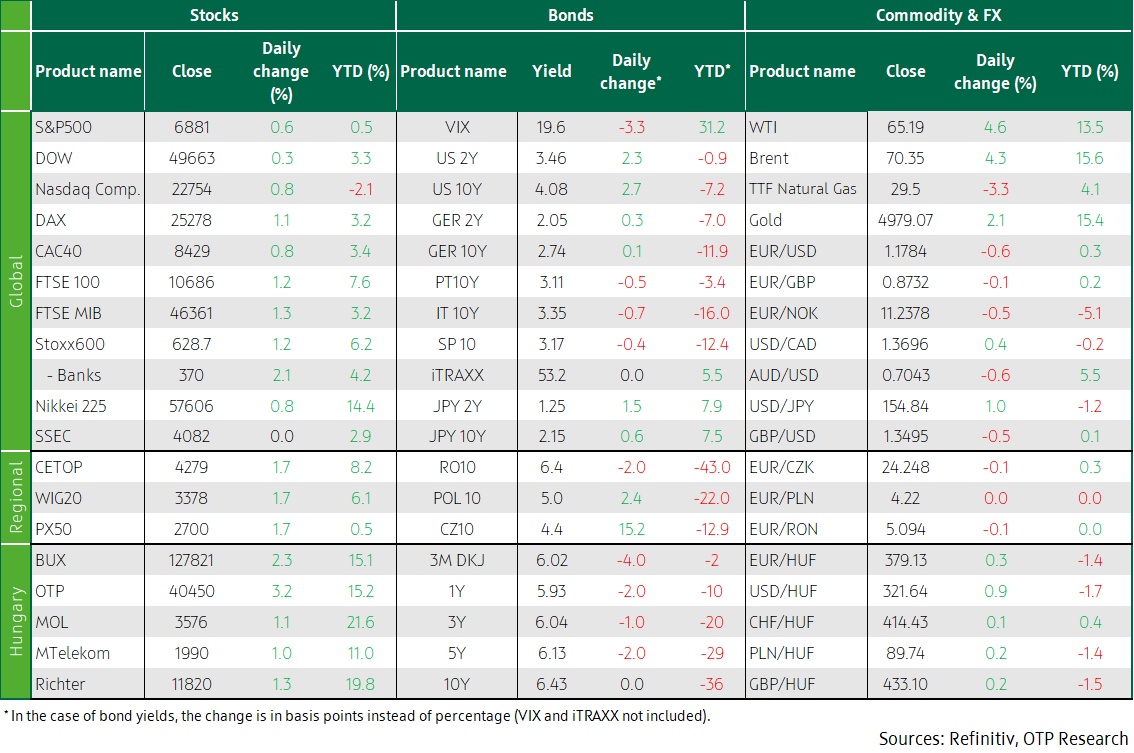
In Western Europe, some stock exchanges (STOXX 600, CAC40, FTSE100) closed at new highs on Wednesday, driven by gains in the materials, IT, defence, and banking stocks. All major regional stock markets closed in positive territory, helping the STOXX600 index rose 1.2%. Of the latter’s sectors, materials (+4.2%) were the engine of growth. Glencore shares advanced by 4.5% after the mining company said it would return USD 2 billion to shareholders, despite reporting slightly lower-than-expected profits.
The defence sector soared 2.9%. BAE Systems took off roughly 4% after reporting better-than-expected annual operating profit as global demand pushed its order book to a record GBP 83.6 billion (USD 113.50 billion). The defence sector was further boosted by the abrupt end of peace talks between Ukraine and Russia and rising concerns about a potential conflict between the USA and Iran.
Investor sentiment appeared to be stabilizing this week after a global sell-off since late January hit several sectors on concerns about artificial intelligence. The STOXX’s tech component surged 2.8%, while the banking sector gained more than 2%. In the latter, Mediobanca shot up 5.7% after Monte dei Paschi di Siena said it would take full control of the credit institution, ending weeks of uncertainty about the future of the commercial bank.
The chemical sector’s 1% drop, partly owing to Bayer’s 7.1% nose-dive, pared the STOXX’s gains yesterday. The German pharmaceutical company had announced a USD 7.25 billion deal to settle tens of thousands of lawsuits alleging its Roundup herbicide caused cancer. Shares of chemical and food ingredients maker IMCD slumped 4.7% as its Q4 results missed expectations.
Shares of Amrize jumped 12.8% to a record high yesterday. On Tuesday, the building materials company had announced a USD 1 billion share buyback programme and a special one-off dividend.
Meanwhile, the Financial Times reported that the European Central Bank’s president Christine Lagarde plans to step down before the 2027 French presidential election. Reportedly, she has not yet decided yet on the exact date of her departure, but she considers it important that Emmanuel Macron and German Chancellor Friedrich Merz be key European leaders in choosing her successor, the FT wrote, citing a source close to the matter.
In the benign external backdrop, the CEE region’s markets also advanced dynamically; the BUX’s 2.3% gain stood out. OTP (+3.2%) excelled, while other blue chips advanced 1%-1.3%. Richter ended Wednesday’s trading at a new high.
Wall Street posted gains, supported by NVIDIA’s gains and AI developments
Wall Street’s indexes also rose on Wednesday, fuelled by gains in NVIDIA, Amazon, and other tech heavyweights as concerns about artificial intelligence have moderated. Shares in NVIDIA increased by 1.6%, following the world's most valuable company’s announcement that it had signed a multi-year deal to sell its current and future artificial intelligence chips to Meta Platforms for millions of dollars. Meta shares ended Wednesday’s session 0.6% higher. Amazon (+1.8%) and Alphabet (+0.4%) also advanced on Wednesday. Sandisk, Western Digital, and Seagate Technology Holdings all gained 1.7%–4.3%, fuelled by huge demand for their storage technology for AI. The PHLX chip index grew by 1%.
The S&P 500 (+0.6%), the NASDAQ (+0.8%), and the Dow Jones Industrial Average (+0.3%) all closed higher yesterday. Six of the S&P500’s eleven sector indexes rose, particularly energy (+2%), followed by information technology and consumer durables (+1% each).
Data released on Wednesday (industrial production, housing data) reinforced the picture that the US economy had grown strongly in the fourth quarter.
Shares in Global Payments skyrocketed 16.5% as the payments technology company’s adjusted annual profit had surpassed expectations. Moderna shares jumped by 6.1% as the US Food and Drug Administration (FDA) had agreed to review its flu vaccine, reversing its earlier decision to refuse it.
Crude oil prices surged yesterday: WTI and Brent both soared around 4.5%, posting their biggest gain since October on fears that the US-Iran conflict could escalate into a military confrontation.
Bucking the international trend, Hungary’s bond yields sank; the EUR/HUF remained below 380
Most of the US economic indicators published yesterday were stronger than expected: industrial production expanded rapidly, durable goods orders fell less than feared, and housing starts also jumped markedly. In addition, the minutes of the Fed's January interest rate-setting meeting also revealed that decision-makers were strongly divided on the future interest rate path, with some calling for further cuts or holding rates steady, while others did not rule out a rate hike as the next step. As a result, the dollar yield curve shifted up by 2-3 basis points; the ten-year yield drew near 4.1% again. Bond yields did not change much in Europe; the 10Y German yield remained near 2.75%. A strong USD strengthening pushed the EUR/USD below a previous low of 1.18.
While the zloty (PLN) and the koruna (CZK) strengthened minimally against the euro yesterday, the forint weakened, leading the EUR/HUF to around 379. However, Hungarian bond yields continued to decline: benchmark yields dropped by 2-3 basis points; the 10Y yield sank to its lowest in the past twelve months, it is just a tad above 6.4%.
Today’s highlights
Asia’s stock markets also rose today: Japan’s Nikkei was up 0.8%, the MSCI Asia-Pacific index excluding Japan was seen 0.5% higher, while the markets in Hong Kong, China and Taiwan are still closed for the Lunar New Year. Meanwhile, the continuing tension between the USA and Iran has kept oil prices high, and investors are finding solace in gold, a safe haven asset. Europe’s index futures were mixed, their US peers were near-stagnant. WTI upped 0.35% this morning.
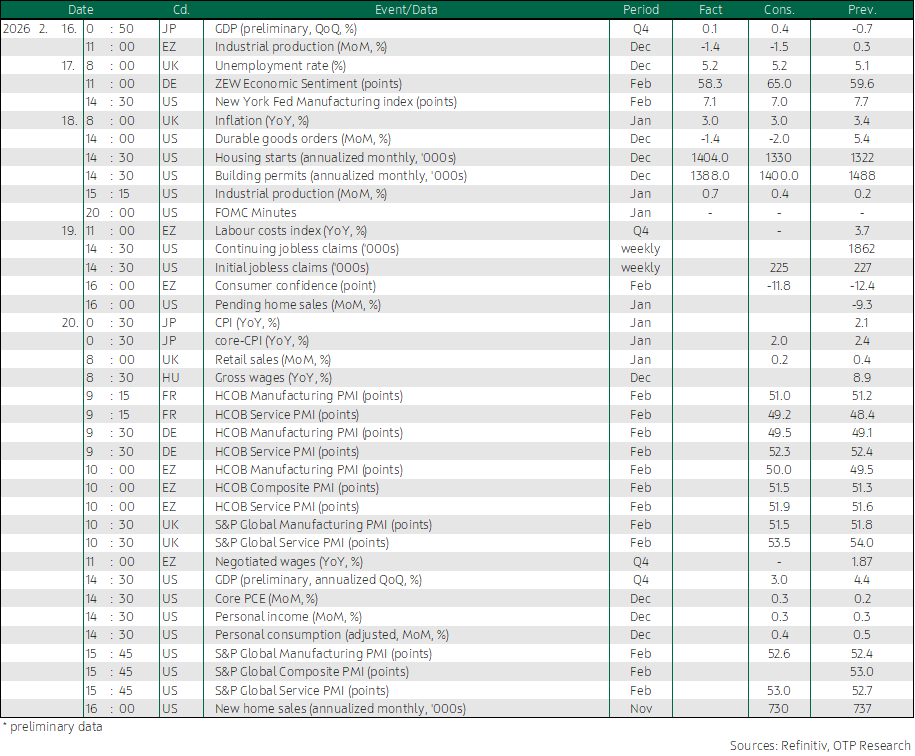
The eurozone’s labour cost and consumer confidence indices, as well as the US weekly jobless claims and monthly housing market data are in focus today.
In Hungary, the ÁKK auctions 3Y, 5Y, and 10Y bonds, offering HUF 20 billion, 25bn, and 25 billion, respectively.
Get more out of your investments!
Global Markets Services
OTP Global Markets offers a broad range of services in the field of local and international money and capital markets.
Read morePrivate Banking Services
Personal care and expertise with OTP Private Banking, along with the knowledge, security, and innovations of a multinational banking group.
Read more