
OTP Morning Brief: Gold and silver hit record highs during weekend
Related content
OTP Morning Brief: US producer price index came in above expectations, yet the US 10-year Treasury yield still declined
Western European equities continued to advance despite ongoing pressure on the technology sector. Wall Street indices also rebounded, recovering some ground after Wednesday’s sell-off. Healthcare was the standout performer on both sides of the Atlantic. Eurozone industrial production declined by 0.5% month-on-month in August. In the US, the producer price index accelerated to 6.3%, delivering another upside surprise in inflation developments. US retail sales increased by 0.8% compared to August. The US 10-year Treasury yield declined by more than 10 basis points. The long end of the Hungarian government bond yield curve also declined by 7-9 basis points. In Hungary, August wage data will be released today, while in the US, September industrial production figures are due.
OTP Morning Brief: US CPI data came in above expectations
European equity markets advanced, supported by strong results from ASML and the outstanding performance of the healthcare sector. US equity markets came under pressure following higher-than-expected September CPI data. The annual CPI rate accelerated to 3.7%, driven primarily by a surge in gasoline prices, while core CPI rose by 0.3% month-on-month, supported by higher housing costs and rising transportation service prices. Oil prices rose amid escalating tensions in the Middle East and the impact of the IEA's oil market report. US Treasury yields retreated after an initial increase, driven by Fed commentary, while European bond yields generally moved higher. The US macro calendar will be busy today, with investors focusing on September retail sales and producer price index data, as well as the New York Fed Manufacturing Index, weekly jobless claims, and business inventories. August industrial production data from the euro area will be released today.
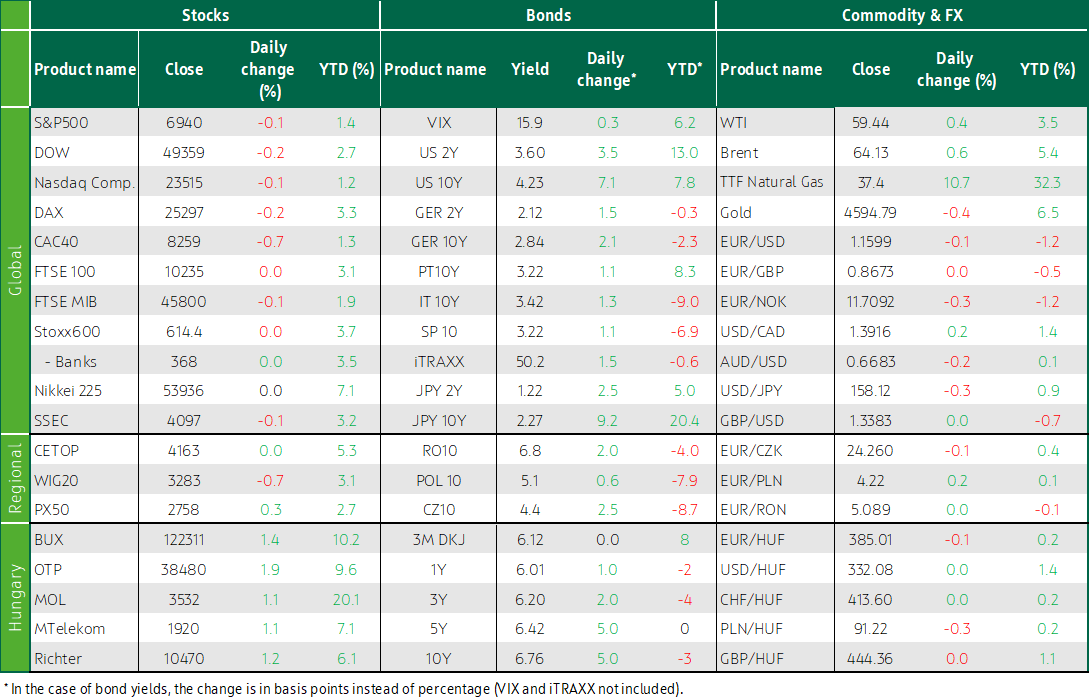
Europe’s and America’s main stock indices mostly declined on Friday, but the majority of European stock exchanges closed last week with gains. However, this morning index futures are falling on both sides of the Atlantic after Donald Trump's weekend announcement to impose new tariffs on eight European countries. Gold and silver hit new highs. Developed economies’ bond yields rose on Friday; the EUR/USD sank to 1.16. Hungary’s yields also increased, the EUR/HUF remained near 385. The BUX hit a new high on Friday, rising 5% last week, fuelled by MOL’s and OTP’s gains. China’s GDP growth met the government's 2025 target and beat expectations. Later this week, the US core PCE, and PMIs from both sides of the Atlantic, Japan’s inflation data and the BoJ's rate decision will be announced. The earnings season continues, but US markets are closed for holiday today.
Most stock markets in Western Europe were dragged down by luxury and mining shares on Friday but indices posted the fifth consecutive week of gains
Most of Western Europe’s stock markets closed in the red on Friday, as the souring sentiment hit luxury goods manufacturers and mining companies hard. The Stoxx600 and the FTSE100 ended Friday's trading session with trivial losses, while Germany’s DAX (-0.2%) and France’s CAC40 (-0.7%) fell sharper. In luxury goods names, Richemont lost more than 5% as the Bank of America downgraded its investment recommendation on the Swiss jewellery maker from Buy to Neutral, following a recent rally. Within the Stoxx600, defence companies gained as did healthcare companies, thanks to Novo Nordisk's more than 6% jump. Analysts said the Danish drugmaker's consumer drug Wegovy, which were launched as pills earlier this year, had a promising start. The UK health regulator approved the use of the drug in higher doses for overweight patients, while Berenberg Bank has raised its price target for Novo Nordisk. The winner of the day was Norway's Kongsberg Gruppen, which develops high-tech systems, including for military purposes; its share jumped almost 10% as two investment services raised their price targets.
The earnings reports released last week, including those from Richemont, BP, and BE Semiconductor, painted a mixed picture. According to data compiled by LSEG, the aggregate revenue of Stoxx600 companies may have fallen by around 4% year-on-year in the fourth quarter. Despite Friday's weakness, the Stoxx600 closed last week higher for the fifth time in a row, while also hitting multiple new highs last week.
The BUX grew by 1.4%, to a new all-time high on Friday, outperforming its regional peers, while Czechia’s PX closed marginally higher and Poland’s WIG20 edged lower. All Hungarian blue chips gained at least 1%; OTP jumped nearly 2%, to a new high. Over the past week, the BUX increased by almost 5%, while the WIG20 and PX added 0.1-0.3% each.
The price of TTF natural gas jumped more than 10% on Friday, which translates into 35% price growth for the past week. Nearing 37 EUR/MWh, the price is at its highest since June 2025. The price growth was primarily triggered by a cold wave hitting the continent, while there are also worrying signs regarding supply and storage. EU gas storage facilities are 52.5% full, down from 65% a year earlier. In addition, LNG shipments from the USA have fallen due to the shutdown of key terminals in Texas. Gas futures price has jumped by more than a third over the past week.
America’s major stock indexes closed slightly lower on Friday, the financial sector was under pressure
Friday’s trading on Wall Street ended with slight decline: the S&P500 and Nasdaq Composite edged down 0.1% each and the Dow shed 0.2% in the volatile trading ahead of a long weekend. Among the S&P50 sector indices, healthcare and telecommunications were drags on growth, while real estate and industrials fuelled it. Chipmakers extended Thursday’s gains, causing the SOX semiconductor index to advance more than 1%. The picture for last week was a bit gloomy: the S&P and the Dow lost 0.5% each, and the Nasdaq Composite slipped 0.9%. In the case of the S&P500, the real estate sector, the non-cyclical consumer discretionary sector, and industrials achieved the largest weekly gains.
The fourth-quarter earnings season began with banks’ figures. Although some of the big banks surprised investors with reassuring numbers, US President Donald Trump's proposal to cap credit card interest rates at 10% for a year kept the financial sector under pressure last week. The past week was also marked by a shift in equity investments from large companies to the mid-cap segment, which latter outperformed the S&P500: the Russell2000 upped 0.1% on Friday, setting a new high, and brought its weekly gain to 2%.
Friday's macro data caused surprises: the month-on-month reading of December’s industrial and manufacturing production were both better than thought, and the monthly and annual indices for November were revised up.
Crude oil prices nudged higher on Friday, slightly correcting a midweek drop of over 4%. Over the past week, WTI edged up 0.5%, while Brent gained 1%, as market concerns over a potential US role in Iran have eased.
Yields rose in Europe and America, the USD strengthened against the EUR; Hungary’s yields rose further, the EUR/HUF closed last week near 385
Although December’s inflation data, released in the first half of last week, caused sighs of relief last week, America’s bond yields rose on Friday, partly owing to stronger-than-expected US industrial production data and concerns about the Fed’s independence. The latter was strengthened by word on criminal investigation against Fed Chairman Jerome Powell last week, while Kevin Warsh's chances for the position of next Fed chairman have improved materially. The market still expects two 25-basis-point cuts from the Fed. The ten-year US bond yield jumped to a four-month high, closer to 4.25%, marking 6-7-basis-point increase in daily and weekly terms. European bond yields also rose, albeit slower, by only a few basis points on Friday and throughout last week. The 10Y German yield is drawing near 2.85%, the top of its post-covid trading range. The strong US macroeconomic data helped the dollar appreciate further: the EUR/USD sank to 1.16 on Friday.
The macroeconomic data Hungary released last week were not exactly encouraging. Inflation exceeded our forecast and the MNB's expectations, while industrial and construction production data reflected the continued weak performance of the real economy. The inflation data made it clear that the MNB is likely to remain cautious in the near future, thus the fall in yields and the weakening of the forint stopped. The forint weakening that started at the beginning of last week brought the EUR/HUF to 387, before it climbed back to 385 after the inflation data release. In the second half of last week, bond yields upped by 1-5 basis points on Friday; thus they increased by 5-10 basis points over the past week. The market is still pricing in four rate cuts from the MNB this year, and the ten-year yield has jumped back above 6.75%.
Today’s highlights
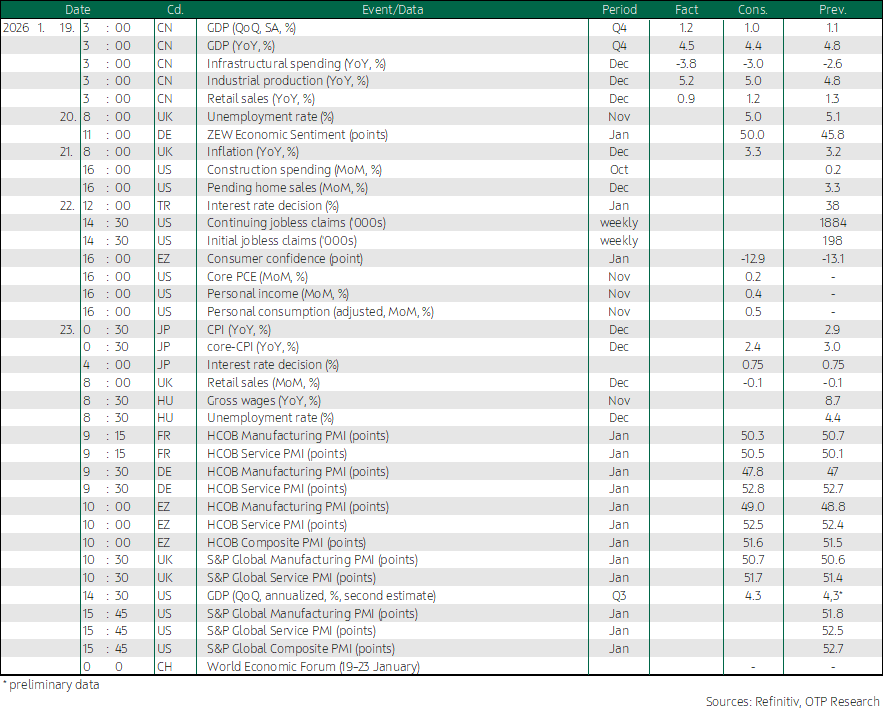
The Asia-Pacific region’s stock markets traded mixed today: the Nikkei and the Hang Seng were in the red, while China’s key indices were heading higher; Korea’s stock index was in for an uptick. In Japan, machinery orders in November fell sharper than expected. China published stronger-than-expected GDP growth data of 1.2% QoQ and 4.5% YoY. This brought annual growth rate to 5%, as the government had planned, driven by the expansion of exports, while domestic consumption weakened. China’s industrial production for December has surpassed expectations, while retail sales and fixed asset investments came in weaker.
The index futures of Europe and the USA were in the red this morning, which is hardly surprising after President Trump's weekend announcements. On Saturday he said he would impose 10% tariff on goods from eight European countries, starting from 1 February; that could rise to 25% in June if the US does not get permission to buy Greenland. Gold (+1.6%) and silver (+4%) hit new highs on Monday. The EU is planning to use anti-coercive mechanisms in response, which could range from tariffs to FDI restrictions, and do not require member states’ approval. The situation between the EU and the US is further escalating as Donald Trump is organizing a new international body to counter the UN, giving the Trump-led Board of Peace Council the functions of the United Nations.
This week looks interesting from a macro perspective, as well: the US core PCE index, which is key to the Fed's decision, is due on Thursday, while the eurozone’s and America’s PMIs will be released on Friday. Japan will release inflation data on Friday, and the BoJ’s will hold a policy meeting where it is expected to leave interest rates unchanged.
The fourth-quarter earnings season continues, with figures from Netflix and Johnson & Johnson (in the USA), and Louis Vuitton and Abbott Labs (in Europe), among others.
America’s markets are closed today to observe a Martin Luther King Jr Day.
Get more out of your investments!
Global Markets Services
OTP Global Markets offers a broad range of services in the field of local and international money and capital markets.
Read morePrivate Banking Services
Personal care and expertise with OTP Private Banking, along with the knowledge, security, and innovations of a multinational banking group.
Read more