
OTP Morning Brief: Despite rising oil prices, bond yields sank on Tuesday
Related content
OTP Morning Brief: US producer price index came in above expectations, yet the US 10-year Treasury yield still declined
Western European equities continued to advance despite ongoing pressure on the technology sector. Wall Street indices also rebounded, recovering some ground after Wednesday’s sell-off. Healthcare was the standout performer on both sides of the Atlantic. Eurozone industrial production declined by 0.5% month-on-month in August. In the US, the producer price index accelerated to 6.3%, delivering another upside surprise in inflation developments. US retail sales increased by 0.8% compared to August. The US 10-year Treasury yield declined by more than 10 basis points. The long end of the Hungarian government bond yield curve also declined by 7-9 basis points. In Hungary, August wage data will be released today, while in the US, September industrial production figures are due.
OTP Morning Brief: US CPI data came in above expectations
European equity markets advanced, supported by strong results from ASML and the outstanding performance of the healthcare sector. US equity markets came under pressure following higher-than-expected September CPI data. The annual CPI rate accelerated to 3.7%, driven primarily by a surge in gasoline prices, while core CPI rose by 0.3% month-on-month, supported by higher housing costs and rising transportation service prices. Oil prices rose amid escalating tensions in the Middle East and the impact of the IEA's oil market report. US Treasury yields retreated after an initial increase, driven by Fed commentary, while European bond yields generally moved higher. The US macro calendar will be busy today, with investors focusing on September retail sales and producer price index data, as well as the New York Fed Manufacturing Index, weekly jobless claims, and business inventories. August industrial production data from the euro area will be released today.
Western Europe’s stock markets saw calm trading session on Tuesday. Germany’s ZEW economic sentiment index was unexpectedly weak. US stock indices climbed higher. Iran attacked energy facilities in the United Arab Emirates. Oil prices rebounded 3%. Developed economies’ bond yields declined. Markets are almost certain that the Fed will keep interest rates on hold today. Investors will closely watch the Fed's updated forecasts, which may also reflect the conflict in the Middle East.
Western Europe’s stock markets continued calm trading
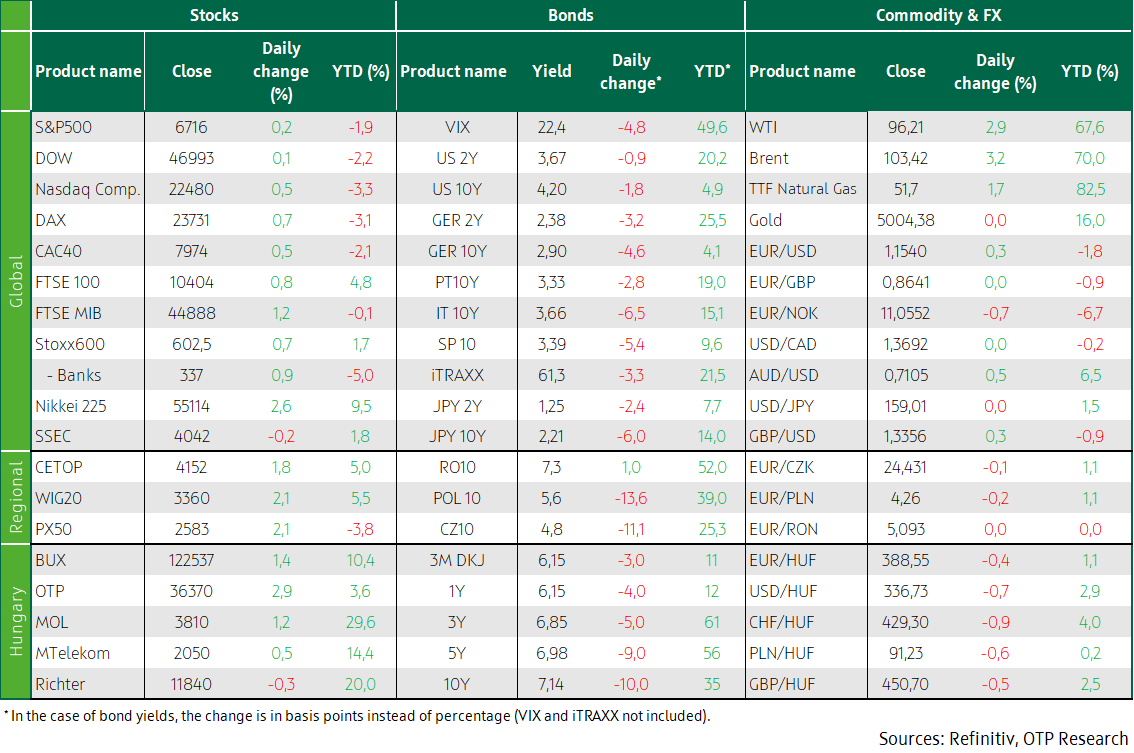
In Western Europe, stock indices extended their gains on Tuesday. Investors await today's rate decision of the Fed and Thursday's meetings of the European Central Bank and the Bank of Japan, as well as their updated guidance amid the Middle East conflict. The STOXX 600 and Germany’s DAX (+0.7% each), the CAC40 (+0.5%), and the UK’s FTSE100 (+0.8%) all made it higher yesterday. The STOXX 600 energy sector index grew by 2.3%, hand in hand with rising oil prices. The Strait of Hormuz remained largely closed and there is still no clear information on when it may reopen to commercial shipments. A defensive sector, utilities added 1.6%. In individual stocks, Springer Nature skyrocketed 12.8% as the German publisher forecast a better-than-expected 2026 year. Sartorius Stedim Biotech jumped by 8.9% after announcing new medium-term growth targets; its German parent, Sartorius, shot up 8.2%. Fraport advanced 5.9% as the airport operator forecast slightly higher earnings for 2026.
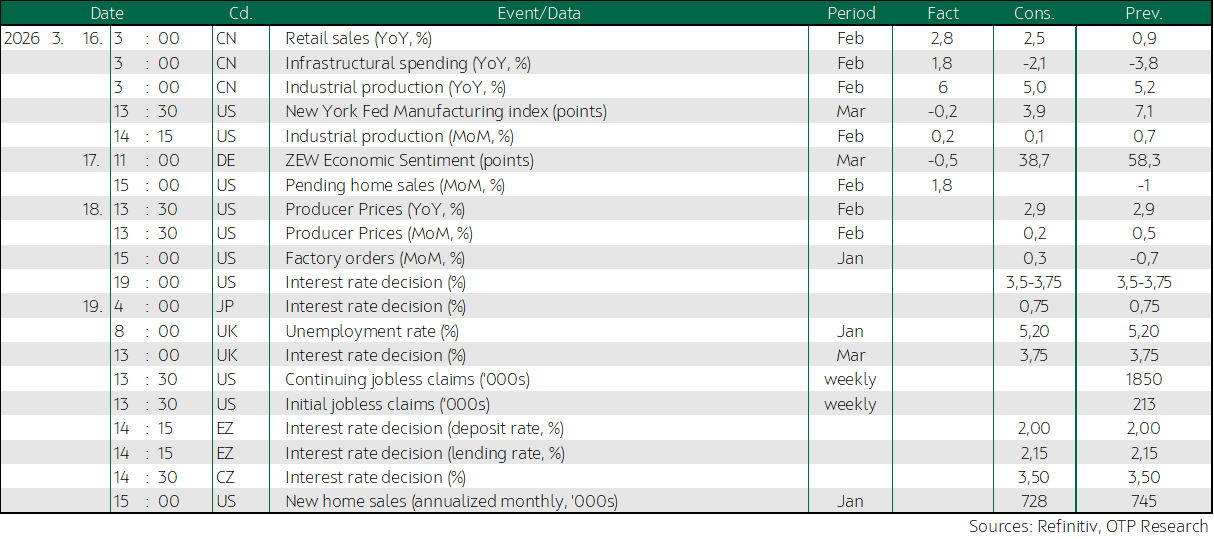
Germany’s ZEW economic sentiment index practically collapsed in March: it came in at -0.5, down from 58.3 in February, and missing the consensus forecast of 39 by a large margin. The negative reading clearly reflects the war in Iran, including its impact on energy prices and inflation. Meanwhile, Deutsche Bank cut its 2026 growth forecast for Germany from 1.5% to 1.0%.
Yesterday, the BUX started to make up for Monday's loss with a 1.45% gain. Of its blue chips, OTP (+2.9%) was top gainer. Elsewhere in the CEE region, Poland’s WIG20 and Czechia’s PX50 grew by 2.1% each.
The price of TTF natural gas increased by 1.7% yesterday.
US stock indices rose moderately
Wall Street’s indices continued to rise on Tuesday, albeit slower than on Monday. The S&P500 (+0.2%), the Dow Jones (+0.1%), and the Nasdaq Composite (+0.5%) all climbed higher. Airline and travel stocks rebounded from the losses made in recent weeks owing U.S. and Israeli strikes on Iran and a surge in energy prices. Delta Air Lines (+6.5%), American Airlines Group (+3.5%), and United Airlines (+3.2%) all took off yesterday. Uber advanced 4.2% after announcing that it would launch robotaxis in 28 cities, using Nvidia's self-driving software next year. The S&P500 financials sector gained 0.5% yesterday, emerging from last week’s plunge, which was partly caused by concerns about private credit quality. The energy (+1%) and the consumer discretionary (+1%) sectors were top gainers. Eli Lilly shrank nearly 6% after HSBC downgraded the pharma stock from Hold to Reduce, and cut its price target to USD 850, from USD 1,070.
President Donald Trump said on Tuesday that, because of the war in Iran, he would postpone his March 31-April 2 visit to Beijing, where he was to meet Chinese President Xi Jinping. Iran has renewed its attacks on energy facilities in the United Arab Emirates. Oil loading partially halted on Tuesday at the port of Fujairah, UAE, following an attack on an export terminal. Fujairah is on the outer side of the Strait of Hormuz and is one of the few ports from which oil from the region can be exported by bypassing the blockaded strait. Donald Trump’s call for allies to provide military support to keep the strait open has fallen on deaf ears. After Monday's decline, oil prices rebounded 3% on Tuesday.
Advanced economies’ bond yields declined
Although oil prices bounced back 3% yesterday, bond and currency markets ignore did not really reflect this change. Developed markets’ bond yields sank, the least of which was the 10-year US yield’s easing by one basis point, to 4.2%. In the eurozone’s major economies, yields shed about five basis points, moving even further away from previous peaks. Germany’s 10-year Bund yield is at 2.9%. The dollar weakened against the euro, pushing the EUR/USD back to near 1.155.
In the CEE region, the koruna (CZK, 0.1%), the zloty (PLN, 0.2%), and the forint (HUF, 0.4%) all appreciated against the euro, so the EUR/HUF dropped below 389. Hungary’s bond yields sank by around 10 basis points; the 10Y yield slipped below 7.15%.
On Tuesday, Hungary’s ÁKK sold 3M discount Treasury Bills worth HUF 32 billion with adequate demand, at an average yield of 6.16%.
Today’s highlights
In Asia, Japan’s and Korea’s markets were seen growing in the last hour of trading, mainly due to the morning's drop in oil prices. Oil prices are easing on positive news about the possibility of alternative oil exports from Iraq; petroleum may reach the port of Ceyhan in Turkey via a pipeline. Japan’s Nikkei (+2.7%) Korea’s KOSPI (+4.7%), Hong Kong’s Hang Seng (+0.7%) were seen rising, while the SSEC was slightly down today.
Today the Fed holds its penultimate interest rate decision meeting under Jerome Powell’s chairmanship. Market prices reflect almost 100% probability of leaving fed funds rate at 3.5-3.75%. The main questions are what figures the updated forecast will print, and how the FOMC (Fed Open Market Committee) assesses the risks of the Middle East conflict, in addition to the latest inflation and labour market data. Separately, the USA will release the producer price index for February and factory orders for January.
Get more out of your investments!
Global Markets Services
OTP Global Markets offers a broad range of services in the field of local and international money and capital markets.
Read morePrivate Banking Services
Personal care and expertise with OTP Private Banking, along with the knowledge, security, and innovations of a multinational banking group.
Read more