
OTP Morning Brief: Earning reports drove markets on Monday
Related content
OTP Morning Brief: US producer price index came in above expectations, yet the US 10-year Treasury yield still declined
Western European equities continued to advance despite ongoing pressure on the technology sector. Wall Street indices also rebounded, recovering some ground after Wednesday’s sell-off. Healthcare was the standout performer on both sides of the Atlantic. Eurozone industrial production declined by 0.5% month-on-month in August. In the US, the producer price index accelerated to 6.3%, delivering another upside surprise in inflation developments. US retail sales increased by 0.8% compared to August. The US 10-year Treasury yield declined by more than 10 basis points. The long end of the Hungarian government bond yield curve also declined by 7-9 basis points. In Hungary, August wage data will be released today, while in the US, September industrial production figures are due.
OTP Morning Brief: US CPI data came in above expectations
European equity markets advanced, supported by strong results from ASML and the outstanding performance of the healthcare sector. US equity markets came under pressure following higher-than-expected September CPI data. The annual CPI rate accelerated to 3.7%, driven primarily by a surge in gasoline prices, while core CPI rose by 0.3% month-on-month, supported by higher housing costs and rising transportation service prices. Oil prices rose amid escalating tensions in the Middle East and the impact of the IEA's oil market report. US Treasury yields retreated after an initial increase, driven by Fed commentary, while European bond yields generally moved higher. The US macro calendar will be busy today, with investors focusing on September retail sales and producer price index data, as well as the New York Fed Manufacturing Index, weekly jobless claims, and business inventories. August industrial production data from the euro area will be released today.
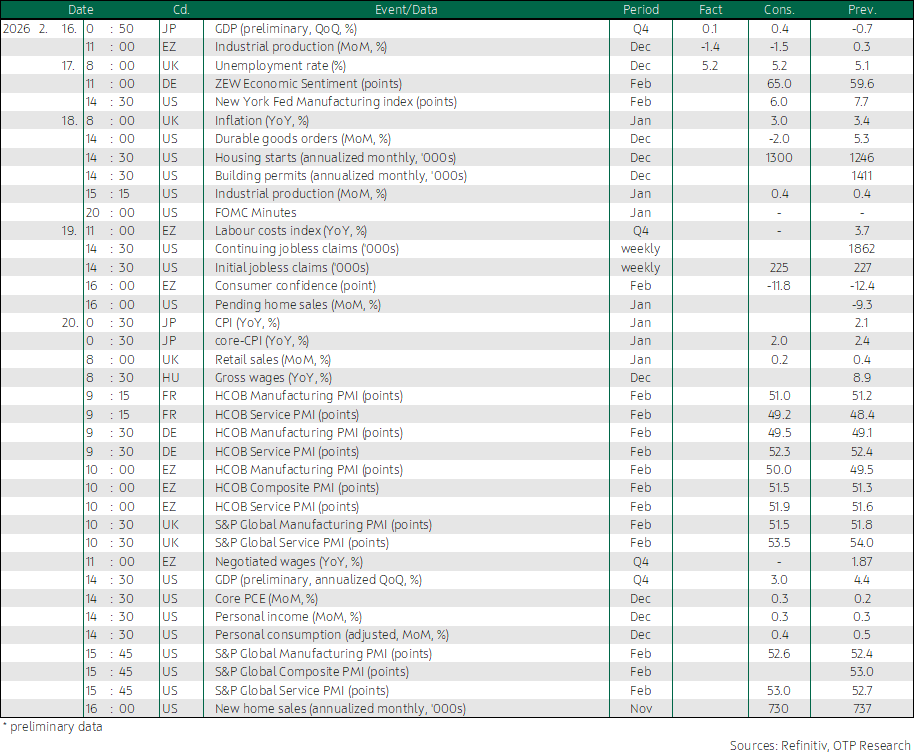
Western Europe’s benchmark stock indices closedmixed on Monday, when markets were mainly driven by corporate earnings reports.Trading with Dassault Systemes was suspended due to a sharp fall in the shareprice. Eurozone industrial output shrank in December compared to November. Losing2% made the BUX the weakest link among CEE stock markets. MOL Group requestedHungary’s Ministry of Energy to release strategic crude oil reserves. US stockmarkets were closed for a holiday. The USA and Iran begin talks in Geneva today. Germany’s the ZEW economic sentiment indexfor February, and the US New York Fed manufacturing index will be released today.
Western Europe’s benchmark stock indices closed mixed on Monday; Hungary’s BUX fell sharply
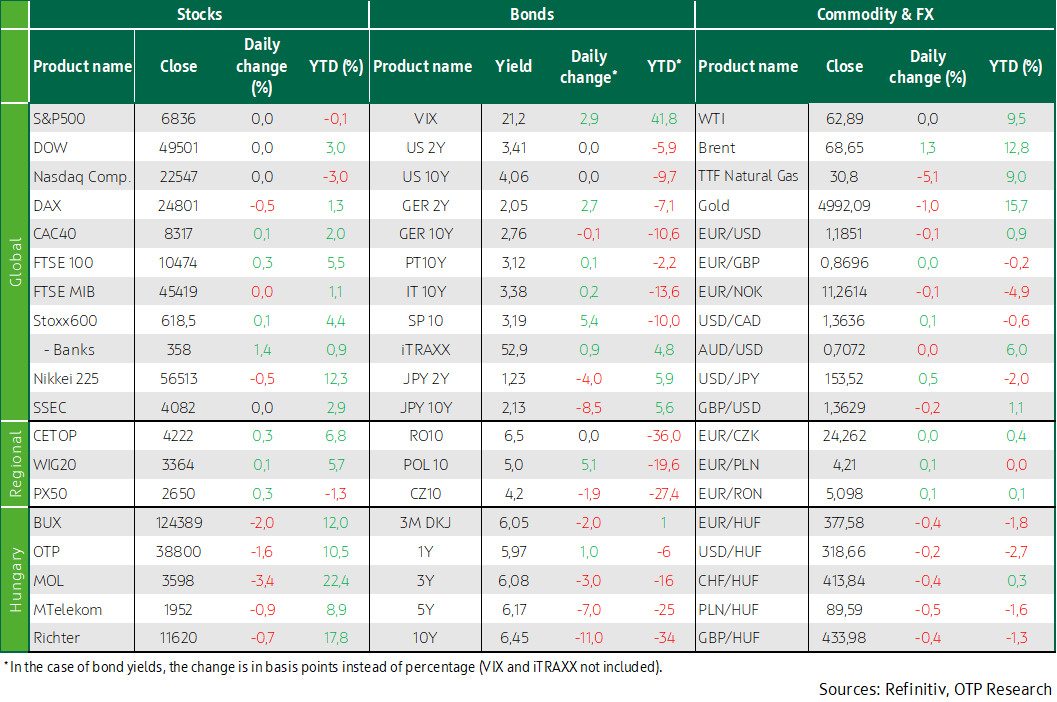
The benchmark stock indices of Western Europe ended mixed on Monday, as did the sector indices of the Stoxx600 (+0.1%). The markets were primarily driven by corporate flash reports; 60% of the results published so far exceeded expectations, which is a better than usual ratio. The weakness of the technology, luxury, and media sectors was offset by the good performance of the banking and insurance sectors. On Monday, the financial sector picked up from Friday's losses; Spain’s IBEX (+1%) posted the strongest gain. The DAX (-0.5%) was the weakest of Europe’s key indices on Monday.
Shares in French software company Dassault Systemes slumped 10.4% by the close, causing a brief halt in trading at one point on Monday, as brokerage AlphaValue downgraded the shares to Reduce, from Buy, citing renewed concerns about the French software group’s artificial intelligence monetization and a “worrying loss of momentum.” The materials sector was dragged down by a drop in Rio Tinto (-1.1%) after the company shut down its Simandou iron ore mine in Guinea following a fatal accident. Industrial output in the eurozone shrank 1.4% month-on-month, erasing the November gain, which was revised down. This decline halted a three-month march, but in a positive turn, the production of consumer durables increased and the eurozone’s industry expanded by 1.5% in full year 2025. Hungary’s BUX (-2%) lagged behind its regional peers. All Hungarian blue chips turned red, particularly MOL (-3.4%) as the oil company published its statement after market close, according to which it has contacted Hungary’s Ministry of Energy in order to release strategic crude oil reserves, as no crude oil has been received through the Barátság (Friendship) crude oil pipeline since 27 January 2026. The group hopes that these measures help ensure that the region’s supply is safely maintained. In Budapest, 4IG (-11.0%), Kermannit (-10.9%) and Rába (-8.7%) took the biggest hits yesterday.
On Monday, investors were waiting for the visit of US Secretary of State Marco Rubio to Hungary, seeking his comments on sanctions against Russian energy sources, but no specific deadline was set. The foreign ministers of the USA and Hungary signed a nuclear energy agreement.
The price of natural gas in Europe sank further yesterday, this time by 5.5%. The current price is 30.7 EUR/MWh, the last time when it was below this mark was in mid-January.
US stock exchanges were closed for a holiday
Wall Street stock exchanges were closed yesterday for Presidents’ Day.
Brent crude oil rose by more than 1% on Monday.
Gold price slipped below USD 5,000 on Monday, reversing Friday's rise. Silver also declined, and is now more than 34% below this year's high.
Developed markets’ bond yields barely moved yesterday; Hungary’s yields sank further
With the holiday in the USA, trading in advanced economies’ bond and currency markets was relatively dull yesterday. Japan’s weaker-than-expected GDP and the anticipated decline in Europe’s industrial production data did not bring any significant changes: Japan’s 10-year yield remained at 2.2%, and the German one stayed near 2.75%, but French and Italian yields did not change much, either. A trivial dollar strengthening drove the EUR/USD towards 1.185.
But the sentiment in Hungary’s currency and bond markets was benign, even if CEE currency and bond markets were idle. The EUR/PLN and the EUR/CZK essentially did not budge, and Polish and Czech bond yields edged minimally lower. In contrast, the forint strengthened by almost half a percent against the euro, sending the EUR/HUF to 377.5. The benchmark yields fixed in the early afternoon sank further from one-year lows, by five basis points on the belly of the curve (3Y-5Y) and by 10 basis points on the longer maturities. The ten-year benchmark yield sank to 6.45%, and then by further 2-3 basis points in the afternoon. There was strong interest in yesterday's switch auction of Discount Treasury Bills, and in the end, HUF 40 billion worth of T-bills changed hands, at an average yield of 6.06%.
Today’s highlights
In the Asia-Pacific region, the markets of China, Hong Kong, Singapore, Taiwan and South Korea were also closed on Tuesday due to Lunar New Year holidays. Japan's Nikkei225 showed the biggest movement this morning, falling nearly 1% in the last hour of trading. Crude oil prices rose in Asian trading ahead of indirect talks between the USA and Iran aimed at resolving the nuclear dispute. The talks begin today in Geneva, and are mediated by Oman.
Germany’s ZEW economic sentiment index for February is expected to reflect a significant improvement compared to January, in line with the German economy’s sluggish but steady recovery.
In the United States, the Empire State manufacturing index will be published. In the previous survey, companies were optimistic about the outlook and there has been no negative news for the sector since then (i.e. no new tariffs announced), so the index is likely to remain in positive territory.
Get more out of your investments!
Global Markets Services
OTP Global Markets offers a broad range of services in the field of local and international money and capital markets.
Read morePrivate Banking Services
Personal care and expertise with OTP Private Banking, along with the knowledge, security, and innovations of a multinational banking group.
Read more