
OTP Morning Brief: The ECB may raise its growth forecast
Related content
OTP Morning Brief: US producer price index came in above expectations, yet the US 10-year Treasury yield still declined
Western European equities continued to advance despite ongoing pressure on the technology sector. Wall Street indices also rebounded, recovering some ground after Wednesday’s sell-off. Healthcare was the standout performer on both sides of the Atlantic. Eurozone industrial production declined by 0.5% month-on-month in August. In the US, the producer price index accelerated to 6.3%, delivering another upside surprise in inflation developments. US retail sales increased by 0.8% compared to August. The US 10-year Treasury yield declined by more than 10 basis points. The long end of the Hungarian government bond yield curve also declined by 7-9 basis points. In Hungary, August wage data will be released today, while in the US, September industrial production figures are due.
OTP Morning Brief: US CPI data came in above expectations
European equity markets advanced, supported by strong results from ASML and the outstanding performance of the healthcare sector. US equity markets came under pressure following higher-than-expected September CPI data. The annual CPI rate accelerated to 3.7%, driven primarily by a surge in gasoline prices, while core CPI rose by 0.3% month-on-month, supported by higher housing costs and rising transportation service prices. Oil prices rose amid escalating tensions in the Middle East and the impact of the IEA's oil market report. US Treasury yields retreated after an initial increase, driven by Fed commentary, while European bond yields generally moved higher. The US macro calendar will be busy today, with investors focusing on September retail sales and producer price index data, as well as the New York Fed Manufacturing Index, weekly jobless claims, and business inventories. August industrial production data from the euro area will be released today.
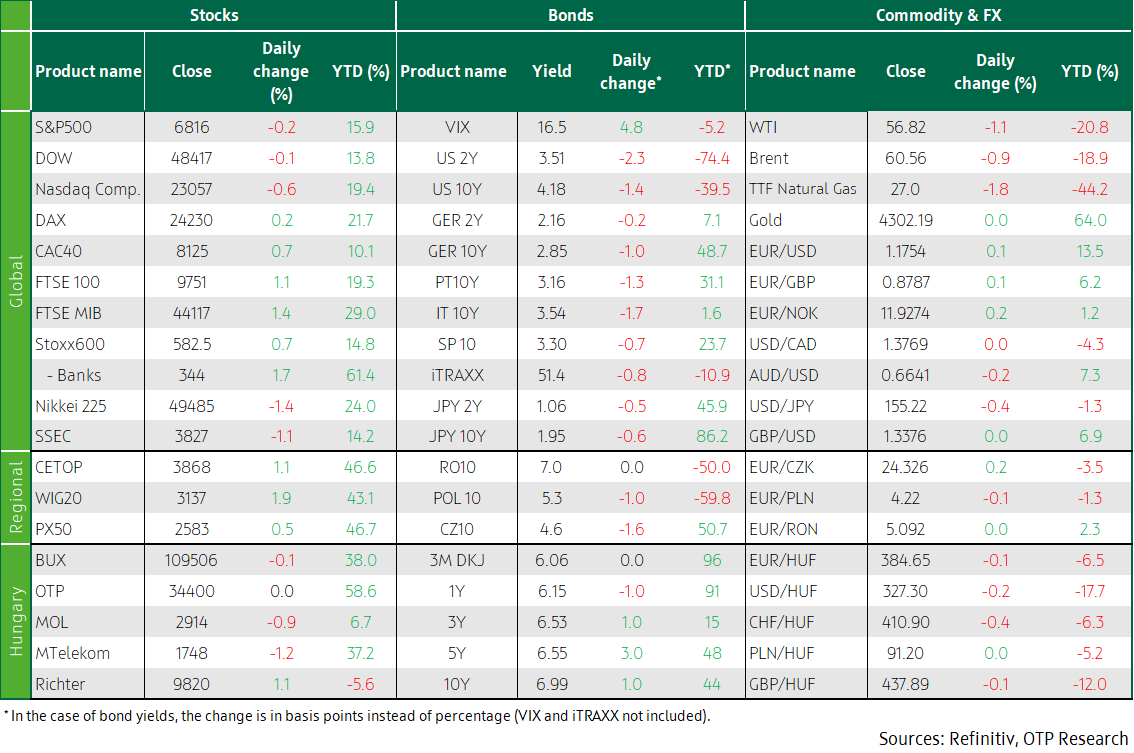
Europe’s stock indices closed higher on Monday. The ECB may raise its growth forecast further, its president indicated. European defence stocks fell yesterday. The Eurozone’s industrial production grew as expected. Wall Street's leading indices were dragged down by AI stocks. The Empire State manufacturing index fell sharper than expected. Developed markets’ long-term yields sank. The USD weakened against the EUR, the HUF strengthened slightly. Today, the focus is on the official US employment and retail sales data for November, European PMIs and the MNB's interest rate decision.
Europe’s stock indices closed higher on Monday; the ECB may raise its growth outlook again, president Lagarde indicated; Europe’s defence shares fell; the eurozone’s industrial production grew as expected
In Europe, the stock markets closed higher on Tuesday. In a statement ahead of Thursday’s policy decision of the ECB, Christine Lagarde indicated that the European Central Bank may lift its growth forecast further in December. The ECB is expected to leave its interest rate at 2% on Thursday. The Bank of England will also make rate decision on Thursday, where the market expects a cut, albeit in a tight vote. Despite the benign sentiment on stock markets, the shares of many European defence companies subsided after Volodymyr Zelensky had suggested that Ukraine was ready to abandon its NATO accession plans. Rheinmetall descended by 2.6% and Renk dropped by 1.6%.
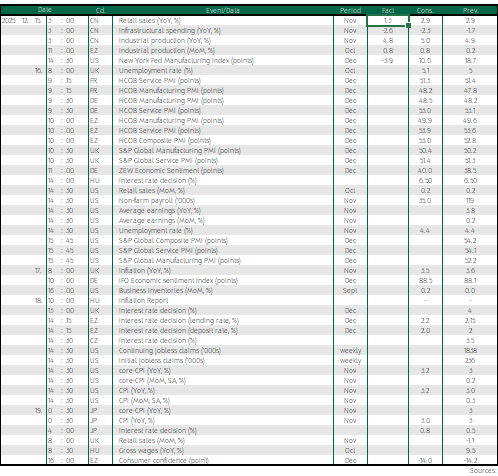
The eurozone’s industrial production rose by 0.8% month-on-month in October, in line with market expectations, in the biggest increase since May 2025, after a 0.2% uptick in the previous month. Growth was broad-based, powered by durable goods (+2.0%), non-durable goods (+1.2%), energy (+1.1%), capital goods (+0.5%) and semi-finished goods (+0.3%). Among the largest economies of the eurozone, production rose in Germany (+1.4%), Ireland (+4.0%), Spain (+0.9%), the Netherlands (+0.3%), and France (+0.2%), while it fell in Italy (-1.0%). In annual terms, industrial production grew by 2.0% in October, to a five-month high, up from 1.2% in September.
The CEE region’s main indices moved mixed on Monday: the BUX sank, but the Prague and Warsaw indices rose. Of the BUX’s four blue chips, only Richter achieved gain, while OTP closed flat, and the other two declined.
Wall Street's major indexes were dragged down by AI stocks; the Empire State Manufacturing Index fell sharper than thought
US indexes fell yesterday. The weakness was mainly due to the decline in AI-related stocks. Broadcom plunged 5.6% and Oracle lost 2.7% as investors sought sectors that are more exposed to the economic cycle, such as consumer goods and industrials, and demand for healthcare stocks also increased. Last week already portended that trend; the S&P500 and the Nasdaq weakened, while the Dow rose, thanks to its lower exposure to technology. Market analysts opines that AI-related companies are currently under pressure, but the Magnificent Seven may remain dominant, owing to their strong balance sheets and future profit prospects.
The Empire State Manufacturing Index slid to -3.9 in December from a one-year high of 18.7 in November, missing expectations for a 10-point increase, and reversing a two-month expansion. New orders remained stable, and the Inventories index came in at 4.0, suggesting a modest build-up in inventories. Delivery times have shortened, Unfilled Orders dropped, and Supply Availability deteriorated. The Number of Employees component nudged higher, as did the Average Employee Workweek. The pace of increases in both input price and selling price moderated but remained elevated. The forward-looking indicator of general business conditions rose by 17 points, to almost a one-year high, suggesting that companies are more optimistic about improving conditions over the next six months.
Developed markets’ long-term yields sank; the USD weakened vs the EUR, the HUF strengthened a bit
Along with the continued decline in AI stocks, US long-term yields sank slightly. In Europe, the German 10-year government bond yield declined minimally, by one basis point, despite the ECB's more optimistic growth outlook. The euro’s appreciation against the dollar continued: the pair traded above 1.175 yesterday. Meanwhile, the forint regained some of its strength before today's policy decision of the MNB; the EUR/HUF closed below 385.
In Hungary, yields on long-term bonds nudged higher; the 10Y bond yield closed just one basis point shy of 7%.
Today’s highlights
Asia’s markets headed down in today’s trading. The shares of Korea Zinc slumped more than 13% after the company reportedly agreed to sell USD 1.9 billion worth of shares to a joint venture controlled by the US government and unnamed US strategic investors.
Today’s important publications include PMIs from Europe, the ZEW index from Germany, and the unemployment rate from the UK. The USA releases retail sales and PMIs, along with official employment data for November, which was delayed owing to the government shutdown.
In Hungary, the MNB makes rate decision today. The ÁKK auctions HUF 20 billion worth of discount Treasury bills maturing in April 2026.
Get more out of your investments!
Global Markets Services
OTP Global Markets offers a broad range of services in the field of local and international money and capital markets.
Read morePrivate Banking Services
Personal care and expertise with OTP Private Banking, along with the knowledge, security, and innovations of a multinational banking group.
Read more