
OTP Morning Brief: Investors watched the volatile developments of the war last week
Related content
OTP Morning Brief: US producer price index came in above expectations, yet the US 10-year Treasury yield still declined
Western European equities continued to advance despite ongoing pressure on the technology sector. Wall Street indices also rebounded, recovering some ground after Wednesday’s sell-off. Healthcare was the standout performer on both sides of the Atlantic. Eurozone industrial production declined by 0.5% month-on-month in August. In the US, the producer price index accelerated to 6.3%, delivering another upside surprise in inflation developments. US retail sales increased by 0.8% compared to August. The US 10-year Treasury yield declined by more than 10 basis points. The long end of the Hungarian government bond yield curve also declined by 7-9 basis points. In Hungary, August wage data will be released today, while in the US, September industrial production figures are due.
OTP Morning Brief: US CPI data came in above expectations
European equity markets advanced, supported by strong results from ASML and the outstanding performance of the healthcare sector. US equity markets came under pressure following higher-than-expected September CPI data. The annual CPI rate accelerated to 3.7%, driven primarily by a surge in gasoline prices, while core CPI rose by 0.3% month-on-month, supported by higher housing costs and rising transportation service prices. Oil prices rose amid escalating tensions in the Middle East and the impact of the IEA's oil market report. US Treasury yields retreated after an initial increase, driven by Fed commentary, while European bond yields generally moved higher. The US macro calendar will be busy today, with investors focusing on September retail sales and producer price index data, as well as the New York Fed Manufacturing Index, weekly jobless claims, and business inventories. August industrial production data from the euro area will be released today.
Europe’s stock market ended last week in the red. The eurozone’s industrial performance was much weaker than hoped. Investors watched the volatile developments of the war last week. Oil and gas prices rose further as the escalation increased. Interest rate cut expectations subsided far and wide; the forint weakened to 395 against the euro. China’s economy opened this year on a strong footing. This week, major economies’ central banks will make interest rate decisions.
Europe’s markets ended last week lower; the euro area’s industrial output shrank stronger than feared
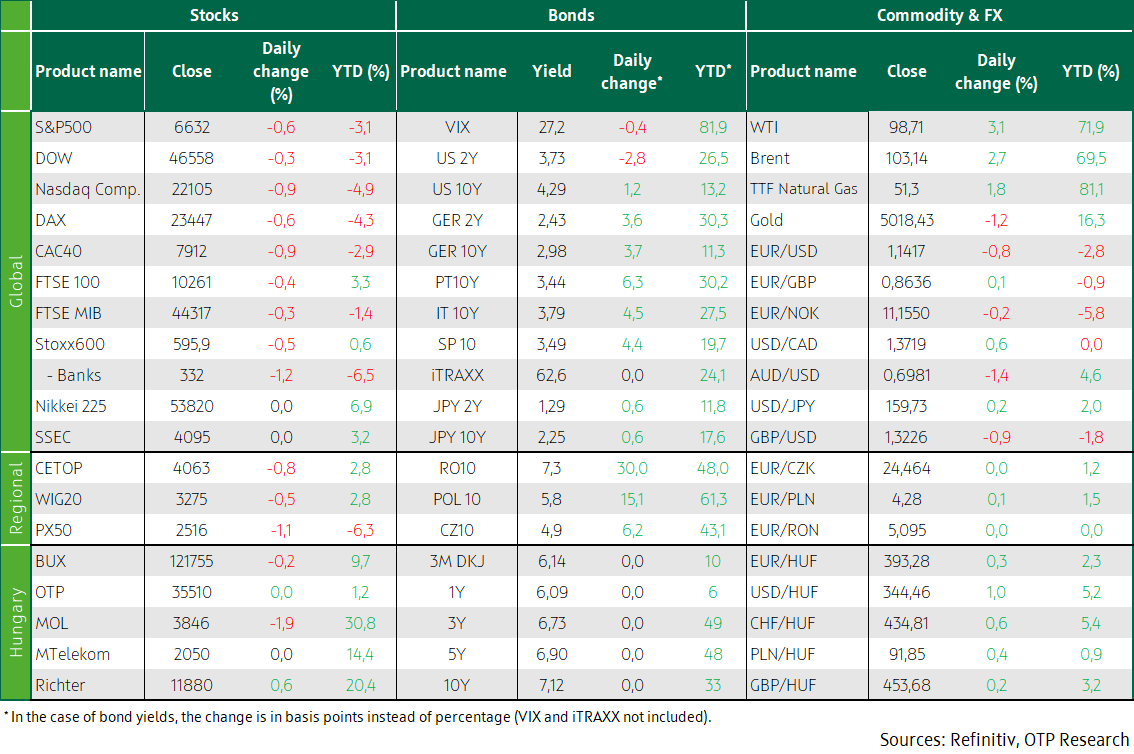
In Europe, stocks fell further on Friday, posting another week in the red as the escalating conflict in the Middle East and inflation fears have dampened risk appetite. The STOXX Europe 600 benchmark slipped 0.5%, and all regional indices sank. At sector level, materials (-3.3%) headed the decline as the banking sector (which is sensitive to the economy) posted 1.2% loss, dragged down by companies such as HSBC (-1.4%), Intesa Sanpaolo (-1.4%), and Standard Chartered (-3.2%). At the same time, rising oil prices helped the energy sector gain 0.3% on Friday and 5.0% last week. In individual stocks, Stellantis shares fell 4.4% after announcing a EUR 22.2 billion one-off write-down, as it had overestimated the pace of demand for electric cars and radically scaled back its EV strategy. Over the past week, the Stoxx 600 slipped half a percent; France’s CAC40 (-1%) was the biggest loser among major indices; the DAX (-0.6%) and the FTSE 100 (-0.2%) also eased. In contrast, Italy’s FTSE MIB rose by 0.4% last week.
The eurozone’s industrial output contracted by 1.5% month/month, missing expectations for a 0.6% increase; Germany, Italy, and Spain all reported declines. In year-on-year comparison, output shrank by 1.2%, further worsened by Eurostat’s upward revision of December’s figures. Energy production grew steeply in January compared to the previous month, while both durable and non-durable consumer goods production fell sharply, as did the output of intermediate goods. The negative pre-war data point casts doubt on the sector’s long-awaited recovery, as soaring energy costs are likely to further exacerbate the sector’s multi-year-long ailing.
The gloom was also felt in the CEE region: Hungary’s BUX (-0.2%), Poland’s WIG20 (-0.5%), and Czechia’s PX50 (-1.1%) all declined. Of Hungary’s blue chips, MOL’s 1.9% drop was a drag, while OTP and MTelekom stagnated, and Richter eked out a small gain. Over the past week, the BUX edged down 0.1%, and OTP slid 2.7%, MTelekom lost 4.0%, while MOL surged 4.5%. According to data published on Friday, Hungary’s construction industry started the year with a sharp fall, with production volume decreasing by 8.8% compared to December and by 11.4% year-on-year.
Investors watched war developments last week; oil prices rose further as the escalation increased
Throughout last week, investors followed the developments of the war in Iran. The uncertainty increased further: at the beginning of the week, Donald Trump said that the war was almost over and America had achieved its goals; in less than one day, Defence Minister Pete Hegseth suggested that America’s strikes were likely to intensify. Then Iran officially closed the Strait of Hormuz and attacked tankers passing through. America launched intensive airstrikes on the Iranian-controlled Kharg Island, which is of paramount importance for oil trade.
Investors tried to react to the developments: markets rose when Donald Trump's words suggested easing, but the rest of the week saw a gradual reversal. Thus, the three major indexes closed in the red on Friday: the NASDAQ slipped 0.9%, the S&P lost 0.6%, and the Dow eased by 0.3%. Six of the S&P500’s eleven sectors rose on Friday, headed by the utilities sector (+1.4%); energy (+0.8%) was the second-best performer. Technology and communications services both slipped about 1.1% on Friday. Over the past week, the utilities sector advanced nearly 1%, while energy increased by 2.5%. Tech stocks showed weakness: giants such as Nvidia, AMD and Tesla all closed the day in the red. In week-on-week terms, the Dow (-2%), the S&P (-1.6%), and the Nasdaq (-1.3%) all slipped.
The uncertain week also brought significant volatility to oil prices: Brent futures surpassed 102 USD/barrel on Friday as the blockade of the Strait of Hormuz continues to cut 20% of global daily energy supplies. The escalating escalation of the war has effectively halted normal maritime trade and forced major Gulf producers to cut output as storage capacity nears critical levels. This sustained supply shock is severely tightening the global energy balance. Meanwhile, TTF natural gas futures rose by 1.6% to above 50 EUR/MWh.
Interest rate cut expectations have declined far and wide, the forint weakened to 395 vs the euro
Donald Trump's announcement last Monday that the US had achieved its goals in Iran and the war was almost over did not bring any real comfort to the bond and currency markets. Given that the actions launched on Iran and the latter’s retaliatory strikes against tankers passing through the Strait of Hormuz and the energy infrastructure of the Middle East continued, it seems increasingly likely that a significant and lasting supply shock threatens the world economy. Globally, the major problem is the oil market, second to it is the gas market, but a significant contraction/decline in supply is also threatening in many other commodity markets. Oil prices have gone beyond the USD 100 mark, stoking inflation fears globally; in addition, US core PCE (the Fed’s preferred gauge) rose by 0.4% again. Thus, despite further downward revisions to the US GDP data, expectations of a US interest rate cut have weakened. On the previous week, the market was pricing in a roughly equal chance of one or two rate cuts for 2026, but on Friday, keeping interest rates on hold this year and one rate reduction seemed equally likely options. The US 10Y yield barely changed on Friday, but it rose by a total of nearly 15 basis points last week, and by 30 basis points in two weeks, drawing near the 4.3% level, its highest since summer 2025. In Europe, markets are already pricing in two rate hikes for this year. Germany’s 10Y yield also rose by 15 basis points in one week, and by more than 30 basis points in two weeks, heading for 3%, which is the top of the post-pandemic trading range. Following the reversal at the beginning of last week, the dollar strengthened again, partly due to the growing appetite for less risky assets and partly due to the lower exposure to energy (the USA is a net energy exporter). The dollar appreciated by almost 1% on Friday, sending the EUR/USD to around 1.14, a nine-month low.
In line with global processes, the CEE region’s currencies weakened last Monday. This was followed by a temporary correction after Donald Trump’s announcement, but the selling pressure returned in the second half of last week. The forint’s weakening pushed the EUR/HUF to 400 on Monday, then the forint strengthened below 385, but later it depreciated again, trading near 395 vs the EUR on Friday. Hungary’s fixed income market was also volatile, and there was weak demand at the auctions. The previous rate cut expectations have disappeared; instead, the market is trying to find out how many rate hikes might be needed: on Friday, prices implied three hikes in 2026, and a 7% base rate by the end of the year. Hungary’s bond yields rose to a nearly 2,5-year high on Monday and, following a brief calming, they returned to this level on Friday. Only the 3Y bond yield remained below 7%, others surpassed that level; the 10Y yield exceeded 7.3%.
Today’s highlights
China’s economy started the year on a strong note: manufacturing output, retail sales, and fixed asset investment all have beaten analysts’ expectations, giving policymakers some reassurance. Meanwhile the USA’s and Israel’s war in Iran adds further uncertainty to growth outlook. However, the SSEC shed 0.3%, responding to the global, rather than domestic, sentiment. The Hang Seng climbed 1.4% higher while Japan’s Nikkei edged down.
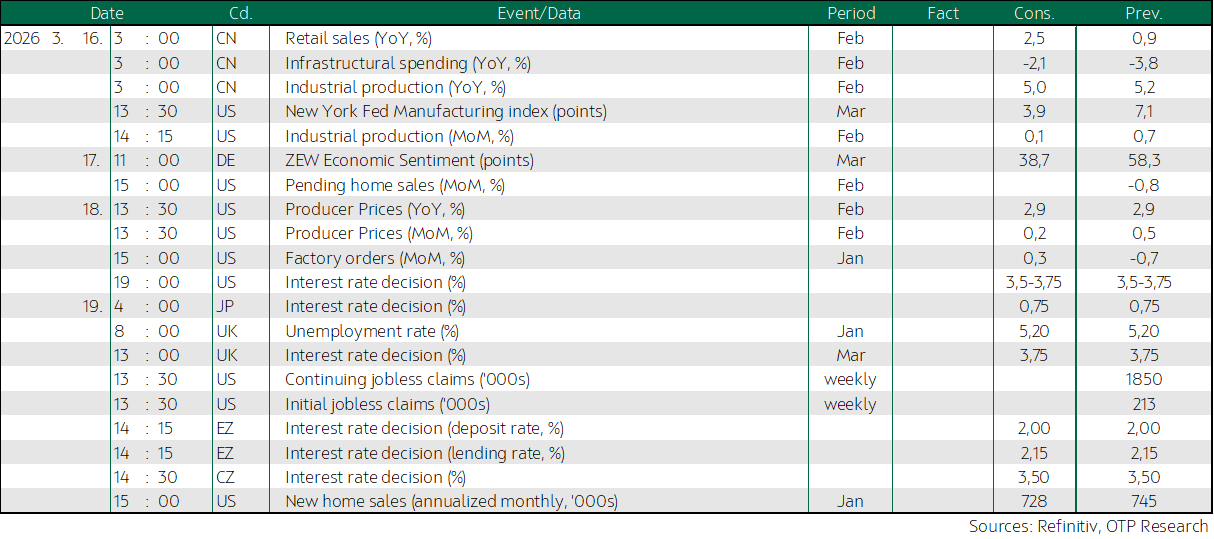
Today’s important publication is the US industrial production data for February. Later in the week, almost all major central banks will hold interest rate decisions. In the case of the ECB, the market unanimously expects it to hold rates, while the Fed's meeting will be the penultimate interest rate decision under Jerome Powell's chairmanship, from which the market practically unanimously expects the base rate to be maintained at the current 3.5-3.75%. Elsewhere, the Bank of Japan will hold its interest rate decision on Thursday. Although governor Kazuo Ueda confirmed at the beginning of March that the BoJ would continue raising interest rates if the incoming data is in line with the BoJ’s forecasts, market prices suggest that the interest rate will almost certainly remain at 0.75% in March.
Get more out of your investments!
Global Markets Services
OTP Global Markets offers a broad range of services in the field of local and international money and capital markets.
Read morePrivate Banking Services
Personal care and expertise with OTP Private Banking, along with the knowledge, security, and innovations of a multinational banking group.
Read more