
OTP Morning Brief: Friday's trading ended mixed
Related content
OTP Morning Brief: US producer price index came in above expectations, yet the US 10-year Treasury yield still declined
Western European equities continued to advance despite ongoing pressure on the technology sector. Wall Street indices also rebounded, recovering some ground after Wednesday’s sell-off. Healthcare was the standout performer on both sides of the Atlantic. Eurozone industrial production declined by 0.5% month-on-month in August. In the US, the producer price index accelerated to 6.3%, delivering another upside surprise in inflation developments. US retail sales increased by 0.8% compared to August. The US 10-year Treasury yield declined by more than 10 basis points. The long end of the Hungarian government bond yield curve also declined by 7-9 basis points. In Hungary, August wage data will be released today, while in the US, September industrial production figures are due.
OTP Morning Brief: US CPI data came in above expectations
European equity markets advanced, supported by strong results from ASML and the outstanding performance of the healthcare sector. US equity markets came under pressure following higher-than-expected September CPI data. The annual CPI rate accelerated to 3.7%, driven primarily by a surge in gasoline prices, while core CPI rose by 0.3% month-on-month, supported by higher housing costs and rising transportation service prices. Oil prices rose amid escalating tensions in the Middle East and the impact of the IEA's oil market report. US Treasury yields retreated after an initial increase, driven by Fed commentary, while European bond yields generally moved higher. The US macro calendar will be busy today, with investors focusing on September retail sales and producer price index data, as well as the New York Fed Manufacturing Index, weekly jobless claims, and business inventories. August industrial production data from the euro area will be released today.
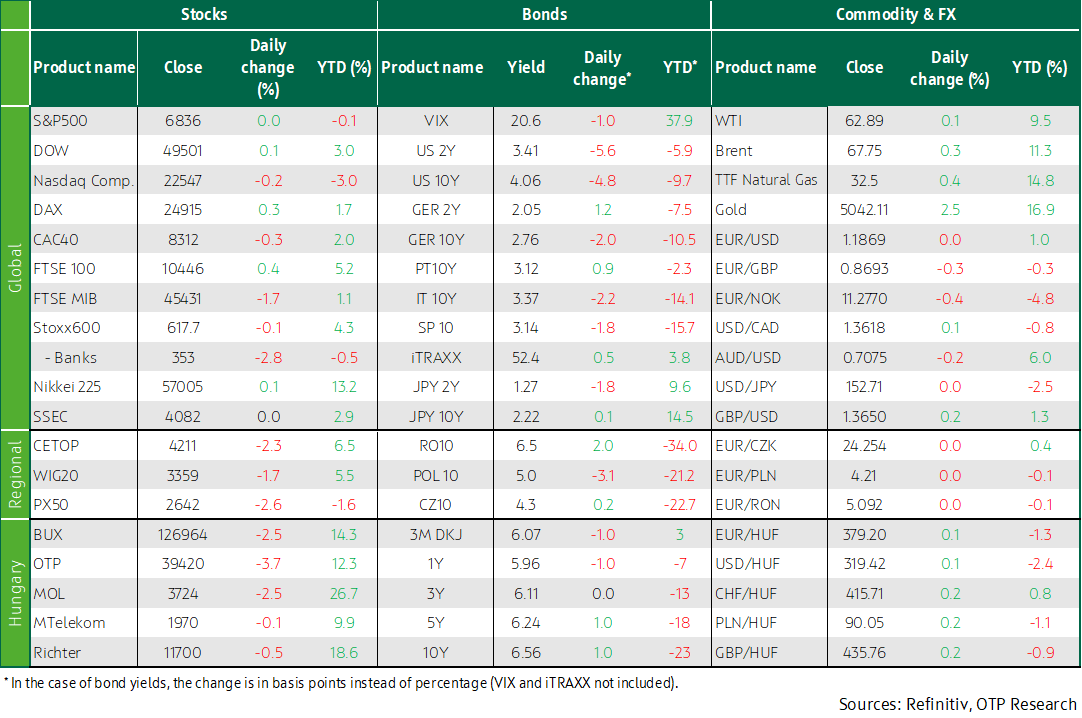
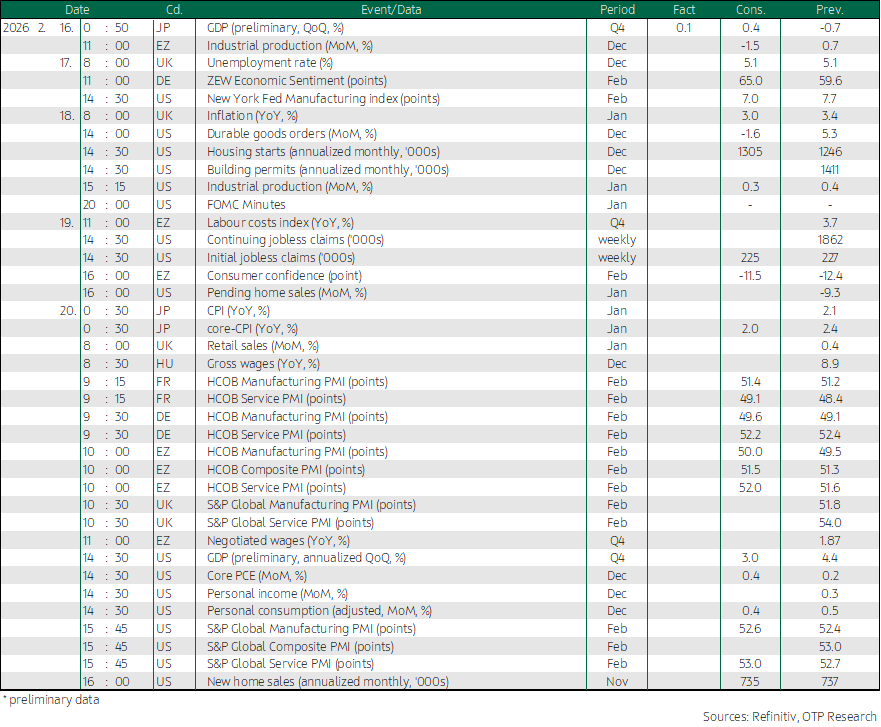
Friday's trading ended mixed in Europe, where the main indices achieved weekly gains, but European banks suffered painful losses. CEE stock markets declined, Hungary’s BUX fell 2.5% on Friday. The Dow and S&P500 picked up slightly from Thursday's sell-off on Friday. Developed markets’ bond yields sank further on Friday; US interest rate cut expectations strengthened somewhat; the EUR/USD closed the week at 1.187. Hungary’s benchmark yields barely changed on Friday; the EUR/HUF closed near 379. Today’s trading was subdued in Asia, due to public holidays and disappointing GDP data from Japan. Stock exchanges in China, Hong Kong and South Korea are closed today for public holidays. December’s industrial production data are due in the eurozone today. Later in the week, wage and PMI figures from the eurozone, as well as preliminary Q4 GDP data, core PCE price index, personal consumption data, and S&P Global PMI will be published in the USA.
Friday's trading ended mixed in Europe, where the main indices achieved weekly gains, but European banks suffered painful losses
In Europe, Friday trading session ended mixed: the Stoxx600 inched down 0.1%, while the DAX (+0.3%) and the FTSE100 (+0.5%) gained. Investors remained concerned about the disruptive impact of artificial intelligence on some industries, following a major reversal in the USA a day earlier. Financial services suffered the biggest losses on Friday, with the Stoxx600 banking index falling more than 3%, while the Italian benchmark FTSE/MIB, in which financial institutions are over-represented, slid 1.7%. The defence sector performed well: aerospace giant Safran took off 8%, to a record high, after forecasting rising revenue and profit for 2026. Technology companies also fared well: CapGemini jumped by 5% after reporting stronger-than-expected quarterly figures. L’Oréal lost 5% after reporting weaker-than-expected quarterly revenue. The Stoxx600 consumer goods and services sector index fell nearly 1%. Corporate earnings reports also conveyed reassuring information. Overall, European corporate earnings dropped by 1% year-on-year in the quarter, whereas analysts had estimated 4% contraction. Still, it marked the weakest performance in seven quarters.
Last week, the Stoxx600 edged up by just 0.1%, while its banking index slipped by 5%. The best performers were the raw materials and telecommunications sectors. The FTSE100 (+0.7%), the DAX (+0.8%), and the CAC40 (+0.5%) all gained. The FTSE/MIB (-1.0%), and Spain’s IBEX35 (-1.5%) declined last week.
The CEE region’s stock exchanges had an unlucky Friday: Czechia’s PX (-2.6%) Hungary’s BUX (-2.5%), and Poland’s WIG20 (-1.6%) all closed in the red. All Hungarian blue chips closed in the red: OTP (-3.7%) and Mol (-2.5%) fell sharply, while Richter and MTelekom posted smaller losses. 4iG slumped nearly 3%. Last week, the PX (-4.3%), the BUX (-2.4%, and the WG20 (+0.6%) all sank.
In Europe, the price of natural gas dropped both on Friday (-2%) and last week (-9%). The price level above 32 EUR/MWh is the lowest since mid-January. According to updated weather forecasts, milder weather than previously expected can be expected in Northern and Eastern Europe. The same applies to the USA, which will reduce heating consumption and increase the availability of liquefied natural gas that can be transported across the Atlantic Ocean.
Dow and S&P500 picked up on Friday from Thursday's sell-off
US stock indexes picked up somewhat on Friday after a sell-off a day earlier, with the S&P500, Dow, and Nasdaq100 up 0.1-0.2%. Better-than-expected January inflation data helped sentiment brighten, but concerns about the rise of AI lingered. The Nasdaq Composite slipped 0.2%, with telecom and IT companies the biggest losers among the S&P sector indexes. Among megacap companies, Nvidia's (-2.2%) and Apple's (-2.3%) losses weighed on the S&P's performance on Friday, and Broadcom's 1.8% decline did not help either. However, Applied Materials reported some good news, with the company improving its quarterly revenue and profit forecast, which the market rewarded with an 8% rally. New about reducing tariffs on aluminium and steel imports were refuted by trade adviser Peter Navarro. Nevertheless, US manufacturers came under pressure: Nucor 3, Steel Dynamics slipped almost 4%, Alcoa's share price fell almost 1%, while Century Aluminium slumped 7%. Among the S&P sector indices, utilities, and real estate posted the steepest increases.
Looking at the weekly performance of the stock market, major indices are down more than 1-2%, with stock markets recently retreating from record levels as fears about AI have raised concerns in sectors ranging from software and insurance to trucking companies. In addition to communications and IT, the financial and cyclical consumer sectors also suffered heavy losses. The best performers were utilities, real estate and basic materials.
Oil prices remained largely unchanged on Friday, falling for the second time in a week. The decline was driven by concerns about the lasting oversupply after the IEA reiterated its forecast for a record-strong 3.7 million barrel per day glut this year. The agency also cut its global oil demand forecast for 2026. Meanwhile, President Donald Trump said talks with Iran could drag on for up to a month, reducing the probability of a military action disrupting Iranian production in the short term.
Gold and silver prices rose on Friday, ending a hectic week: gold exceeded the 5,000 USD/ounce line once again, gaining 1.5% last week. Silver dipped slightly last week.
On Friday, developed markets’ bond yields sank further, expectations of US rate cut strengthened somewhat, the EUR/USD closed last week at 1.187. Hungary’s benchmark yields did not budge on Friday, the EUR/HUF closed near 379
Although January’s delayed labour market data were stronger than thought on all fronts, the previous week's trading brought a significant drop in developed economies’ bond market yields. First, after the initial jump, fears of excessive spending eased in Japan and the rise in yen yields stopped. In the USA, retail sales and the increase in wage costs in the fourth quarter were weaker than expected in the first half of the week, and on Friday, January inflation data were also lower than expected. In addition, investors fled to bonds after the significant fall in US stock markets and precious metals on Thursday. The eurozone's fourth-quarter GDP data, which were in line with the preliminary data, and the European employment data, which slowed down less than expected, did not affect the yield trend. Interest rate cut expectations in the US have strengthened somewhat, and the chance of a third rate cut has increased compared to the two expected this year. The US ten-year yield sank 5 basis points on Friday and by fifteen basis points last week, to 4.05%, approaching the bottom of the post-COVID trading range. Yields have also fallen in Europe, but to a lesser extent than in the US. The market expects the ECB to keep interest rates unchanged this year, and the chance of another interest rate cut is barely 30%. The ten-year German yield fell by two basis points on Friday and by 10 basis points last week, to 2.75%, which is the upper quarter of the post-pandemic trading range. The dollar started the week with a massive weakening last Monday (the EUR/USD jumped above 1.19), but this was followed by a slow reversal until Friday, and the EUR/USD closed last week around 1.1875, in a 0.5% increase.
In Hungary, Thursday’s release on January inflation data was the most awaited publication, as the MNB had previously made it clear that in case of favourable CPI data, the 6.5% key interest rate level, which has been unchanged for more than a year, may be reduced. Since both headline and core inflation decreased stronger than thought, to 2.1% and 2.7%, respectively, and services inflation also eased, the cut in February seems really likely. In addition, the market was still dubious whether the forint would be able to remain below the 380 level. Although the exchange rate temporarily weakened above this value, the EUR/HUF was back near the 379 level by Thursday. Interest rate cut expectations also strengthened slightly in Hungary’s government securities market, and the market began to price in a fifth cut by 2026. Bond yields did not change significantly, remaining near their one-year low, with the ten-year yield still hovering slightly above 6.5%. Friday did not bring much excitement: neither the EUR/HUF nor benchmark bond yields changed significantly.
Today’s highlights
Asia’s stocks were subdued this morning, due to holidays and disappointing GDP data from Japan. Stock exchanges in China, Hong Kong and South Korea are closed for holidays today. Japan reported weaker-than-expected preliminary fourth-quarter GDP data, with annualized growth of 0.2%, well below consensus of 1.6%, while the third-quarter annualized decline of 2.3% was also revised down to 2.6%. The Nikkei thus remained near last Friday's level, fading last week's momentum, fuelled by the fiscal-loose ruling party's historic election victory a week earlier. Over the past week, the Nikkei has gained 5%, Taiwan's benchmark has grown by 6%, while South Korea's tech-heavy Kospi has jumped 8%.
Today December’s industrial production data for the eurozone will be released. On the corporate front, the earnings report from mining company BHP Group will be of interest.
Looking ahead to the week, the most interesting macro data from the eurozone are wage indicators and purchasing managers' indices. In terms of wages, in addition to the preliminary estimate of labour costs for the fourth quarter, fresh statistics on negotiated wages will also be released.
In the USA, preliminary GDP data for the fourth quarter, core PCE price index, household consumption data, and S&P Global BMI will be worth paying attention to. As for inflation data, the core PCE, which is closely monitored by the Fed and best captures national inflation processes, may have accelerated significantly, by up to 0.4% month-on-month in December, based on the components of the already known consumer and producer price index, which could have pushed the annualized index up to 3.0%, significantly exceeding the 2% target. Moreover, the rate of price increases may have increased further in January due to the impact of import tariffs, the increase in corporate input prices, brisk economic activity, and accelerating credit growth, thus strengthening inflation risks and justifying expectations for a cautious interest rate cut, especially in combination with the surprisingly strong labour market data in January. This makes the rest of the year particularly exciting, as Donald Trump is campaigning in the year of midterm election with the promise of making everyday life more affordable, which he hopes to help in part by having Kevin Warsh, his nominee for Fed chairman, cut the key interest rate faster than the market is currently pricing in (50 basis points by the end of the year). However, a rapid rate cut would run counter to the reality dictated by inflation and labour market data.
As the corporate earnings season continues, Antofagasta, Booking, BAE Systems, Glencore, among others, release their figures. Thursday looks particularly exciting, with reports from Walmart, Alibaba, Nestlé, Airbus, Rio Tinto, Deere & Co., Newmont, and PKN Orlen.
Get more out of your investments!
Global Markets Services
OTP Global Markets offers a broad range of services in the field of local and international money and capital markets.
Read morePrivate Banking Services
Personal care and expertise with OTP Private Banking, along with the knowledge, security, and innovations of a multinational banking group.
Read more