
OTP Morning Brief: Chipmakers bounced higher on Thursday
Related content
OTP Morning Brief: US producer price index came in above expectations, yet the US 10-year Treasury yield still declined
Western European equities continued to advance despite ongoing pressure on the technology sector. Wall Street indices also rebounded, recovering some ground after Wednesday’s sell-off. Healthcare was the standout performer on both sides of the Atlantic. Eurozone industrial production declined by 0.5% month-on-month in August. In the US, the producer price index accelerated to 6.3%, delivering another upside surprise in inflation developments. US retail sales increased by 0.8% compared to August. The US 10-year Treasury yield declined by more than 10 basis points. The long end of the Hungarian government bond yield curve also declined by 7-9 basis points. In Hungary, August wage data will be released today, while in the US, September industrial production figures are due.
OTP Morning Brief: US CPI data came in above expectations
European equity markets advanced, supported by strong results from ASML and the outstanding performance of the healthcare sector. US equity markets came under pressure following higher-than-expected September CPI data. The annual CPI rate accelerated to 3.7%, driven primarily by a surge in gasoline prices, while core CPI rose by 0.3% month-on-month, supported by higher housing costs and rising transportation service prices. Oil prices rose amid escalating tensions in the Middle East and the impact of the IEA's oil market report. US Treasury yields retreated after an initial increase, driven by Fed commentary, while European bond yields generally moved higher. The US macro calendar will be busy today, with investors focusing on September retail sales and producer price index data, as well as the New York Fed Manufacturing Index, weekly jobless claims, and business inventories. August industrial production data from the euro area will be released today.
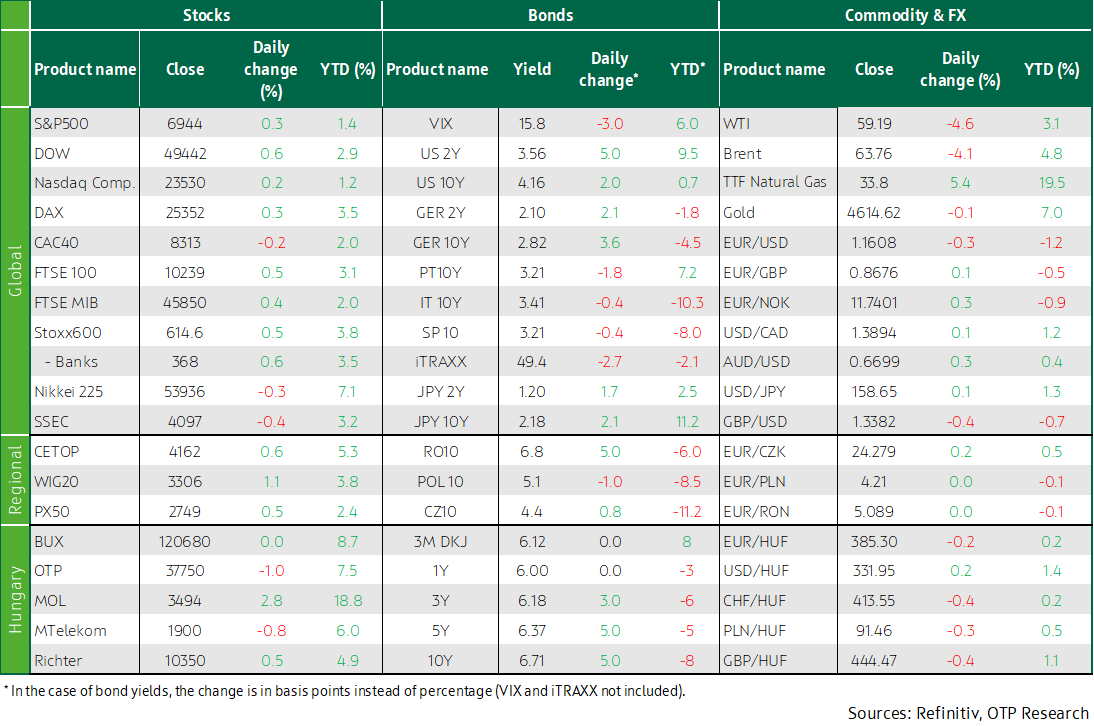
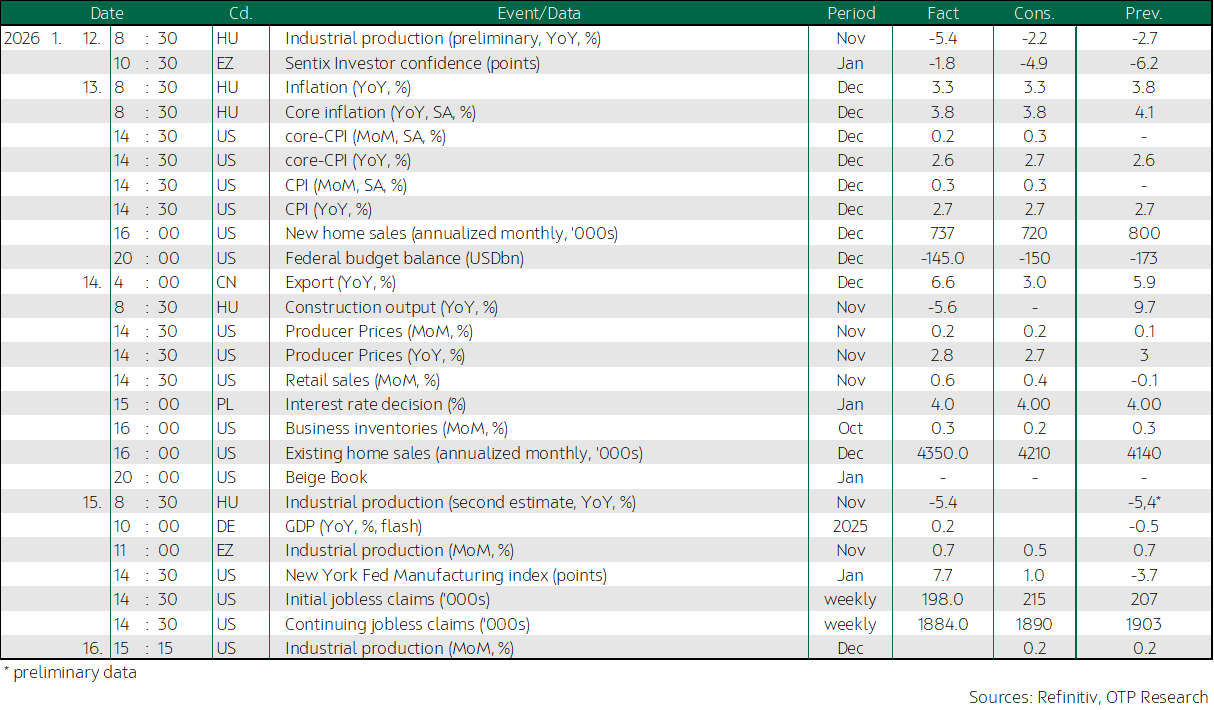
Most of Europe’s major stock markets rose on Thursday; ASML's share price grew sharply. Germany’s GDP inched up in 2025, picking up from the previous year’s decline. EZ November industrial production growth beat forecasts. The UK’s November GDP surpassed expectations. The USA’s major indices closed higher, fuelled by growth in chipmakers and banks. Oil prices slipped. The Empire State manufacturing index surpassed expectations; the decline in jobless claims indicates tight US labour market. Advanced economies’ bond yields rose, the dollar appreciated against the euro. Hungary’s bond yields continued the rise that began after worse-than-expected CPI data. US industrial statistics for December are in focus today.
Most of Europe’s major stock markets rose yesterday; ASML’s share price rose sharply; Germany’s GDP picked up in 2025 from the previous year’s decline; EZ November industrial production grew stronger than thought; the UK’s November GDP exceeded expectations
In Europe, most stock markets closed higher yesterday, driven by a rally in AI chipmakers after Taiwan Semiconductor (TSMC) reported a stronger-than-expected record profit, and said it would boost investment to USD 52-56 billion in 2026. This indicates strong confidence in the sustainability of AI capacity building. The Stoxx 600 closed 0.5% higher, while ASML's share price soared 5.6%. TSMC's fourth-quarter profit skyrocketed 35%, beating analysts' expectations. On the geopolitical front, tensions have been heightened by a dispute among the USA, Denmark, and Greenland; some states started joint military exercises on the island.
Germany’s GDP grew by 0.2% in 2025 after a 0.5% decline in the previous year, marking the end of a two-year recession. The expansion was primarily supported by household consumption and government spending, while exports fell further due to US tariffs, the strong euro, and competition from China. Investment remained weak, especially in the machinery and construction sectors, where rising costs have increased the number of bankruptcies. Industrial production fell for a third straight year, with significant losses in the automotive and machinery sectors, while services showed a mixed picture. In the eurozone, industrial production increased by 0.7% month-on-month in November, beating market expectations of 0.5%, and expanded 2.5% year-on-year (vs expected: 2.0%), marking the biggest growth since May. The monthly increase was largely supported by a 2.8% jump in capital goods, while energy and durable goods production fell. In the United Kingdom, GDP grew 0.3% month-on-month in November, surpassing market expectations of 0.1%.
The CEE region’s stock indices rose, but Hungary’s BUX lagged behind its peers. Of the latter’s blue chips, Mol and Richter advanced, unlike the other two.
The USA’s key indices closed higher, fuelled by chipmakers’ and banks’ growth; oil prices slipped; the Empire State manufacturing index beat expectations; falling jobless claims indicate tight labour market
US stock markets closed higher on Thursday, driven by chipmakers, as TSMC's (+5%) record quarter fuelled optimism in US trading 5%. The banking sector also outperformed: Goldman Sachs surged 4.6% as its fourth-quarter profit beat expectations, and Morgan Stanley jumped nearly 6%, driven by better-than-expected performance in its asset management business; both stocks hit new 52-week highs. The equity market also benefited from a sharp correction in oil prices, as Brent and WTI both slid more than 4%. Yesterday's rebound followed two consecutive weaker trading days, when geopolitical and monetary policy risks weighed on sentiment.
The New York Fed manufacturing index jumped to 7.7 in January from -3.7 in December, significantly exceeding market expectations of 1 point. The data indicated a moderate expansion of activity in New York State, supported by an increase in new orders (6.6 vs. -1) and shipments (16.3 vs. -5), while employment (-9 vs. -7.5) and average weekly hours worked (-5.4 vs. 2.5) declined. Input prices remained high, while the rate of increase in selling prices slowed to a near one-year low. Meanwhile, US initial jobless claims fell by 9,000 to 198,000 in the week ended 10 January (versus market expectations of 215,000), to the second lowest level in the past two years. The continuing jobless claims figure fell by 19,000 to 1.884 million, slightly missing market expectations and indicating a continued tight labour market.
Yields rose in Europe and America, the USD strengthened against the EUR; Hungary’s bond extended the rise that began after worse-than-expected inflation data
The US manufacturing confidence indices released yesterday were strong, and the number of people applying for unemployment benefits fell to a remarkably low level. In addition, Italy’s unexpectedly strong industrial production and Germany’s 0.2% GDP growth in 2025 also indicate that Europe's largest economy is slowly climbing out of recession. As a result, most bond yields in the USA and Germany rose; the 10Y US yield once again exceeded 4.15% and the latter traded above 2.8%. The dollar’s appreciation sent the EUR/USD below 1.16.
The forint strengthened a tad, trading near 385 against the euro. The ÁKK auctioned 12M discount Treasury Bills, 10Y and 15Y bonds, offering HUF 30, 30 and 10 billion, respectively. It sold the planned quantity of the T-Bill, with adequate demand. Bonds were also sought, allowing the ÁKK to sell securities worth a total nominal value of HUF 90 billion. The increase in bond yields, which began with the publication of the inflation data, continued yesterday: benchmark yields upped 1-5 basis points, and the ten-year one is back above 6.7%.
Today’s highlights
Asian stocks moved mixed this morning, they were also bolstered by chipmakers’ stocks. The sentiment may have been brightened owing to reports that Taiwan and the USA had reached a trade deal, under which the former's semiconductor companies will invest USD 250 billion in the USA in exchange for lower tariffs.
US manufacturing statistics for December are in focus today.
Get more out of your investments!
Global Markets Services
OTP Global Markets offers a broad range of services in the field of local and international money and capital markets.
Read morePrivate Banking Services
Personal care and expertise with OTP Private Banking, along with the knowledge, security, and innovations of a multinational banking group.
Read more