
OTP Morning Brief: Resurfacing fears about the sustainability of the AI rally weighed on US indices
Related content
OTP Morning Brief: US producer price index came in above expectations, yet the US 10-year Treasury yield still declined
Western European equities continued to advance despite ongoing pressure on the technology sector. Wall Street indices also rebounded, recovering some ground after Wednesday’s sell-off. Healthcare was the standout performer on both sides of the Atlantic. Eurozone industrial production declined by 0.5% month-on-month in August. In the US, the producer price index accelerated to 6.3%, delivering another upside surprise in inflation developments. US retail sales increased by 0.8% compared to August. The US 10-year Treasury yield declined by more than 10 basis points. The long end of the Hungarian government bond yield curve also declined by 7-9 basis points. In Hungary, August wage data will be released today, while in the US, September industrial production figures are due.
OTP Morning Brief: US CPI data came in above expectations
European equity markets advanced, supported by strong results from ASML and the outstanding performance of the healthcare sector. US equity markets came under pressure following higher-than-expected September CPI data. The annual CPI rate accelerated to 3.7%, driven primarily by a surge in gasoline prices, while core CPI rose by 0.3% month-on-month, supported by higher housing costs and rising transportation service prices. Oil prices rose amid escalating tensions in the Middle East and the impact of the IEA's oil market report. US Treasury yields retreated after an initial increase, driven by Fed commentary, while European bond yields generally moved higher. The US macro calendar will be busy today, with investors focusing on September retail sales and producer price index data, as well as the New York Fed Manufacturing Index, weekly jobless claims, and business inventories. August industrial production data from the euro area will be released today.
Despite the morning’s gains, Western European markets fell on Friday, while CEE indices ended higher. Resurfacing fears about the sustainability of the AI rally weighed on US indices. Bond yields did not budge in Hungary but rose elsewhere on Friday; the forint has weakened. China’s economic data for November were softer than hoped. This week, the MNB and the ECB hold interest rate-setting meetings, and the USA releases labour market and inflation data.
Western Europe’s stock markets lost the mornings’ gains; CEE indices ended higher
Erasing the morning’s gains, Western Europe’s stock markets closed in the red on Friday as concerns about a possible artificial intelligence bubble resurfaced on Wall Street. European markets, which had been fluctuating until Friday, ended last week with slight losses.
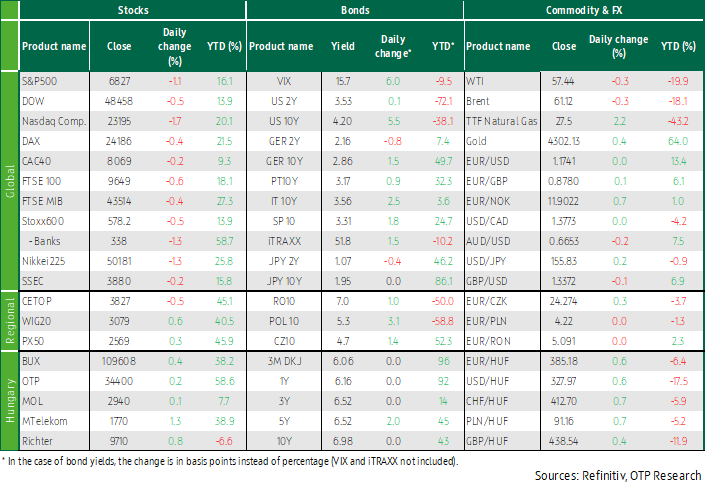
The STOXX600 slipped 0.5% after posting its biggest single-day gain in more than two weeks on Thursday. Major national indices also fell, with Britain's FTSE100 losing 0.6% and Germany's DAX sinking 0.4%. The risk-off sentiment was triggered by a profit margin warning from US-based Broadcom, which added to concerns about the sustainability of the AI-driven rally and the sector’s ambitious spending. Pessimism had already temporarily surfaced on Wednesday last week when Oracle issued a forecast that fell short of expectations. European stocks with AI exposure, such as ASML and Schneider Electric, lost 3.7% and 1.6% respectively.
Nonetheless, it was the basic materials sector (-1.5%) that led the losses in Western Europe on Friday, as risk aversion spread to raw materials markets; copper prices slumped by more than 3%. The banking sector slipped 1.3%, reversing four days of gains; yet it gained 1.9% over the past week. UBS rose 2.5%, to a 17-year high, after Swiss lawmakers proposed a compromise on new capital requirements, to keep the bank competitive internationally. Insurance shares shed 0.2% on Friday but advanced 2.1% for the week. Travel & leisure stocks outperformed, adding 2.3% last week and gaining another 1.1% on Friday, benefiting from a 4.8% jump in Lufthansa after Kepler Cheuvreux upgraded the airline stock to Buy, from Hold. The luxury index was the worst performer last week, shrinking 3.2%, partly due to the announcement of Google’s artificial intelligence-powered smart glasses, which weighed on shares of Ray-Ban maker EssilorLuxottica.
The weakness in Western Europe has not yet significantly affected the CEE region’s markets, as the negative global trend began only after US markets opened, around 16:00 (CET). Thus, Poland’s WIG20 (+0.6%), Czechia’s PX50 (+0.3%), and Hungary’s BUX (+0.4%) all gained. The latter’s blue chips excelled: Magyar Telekom (+1.3%), Richter (+0.8%), OTP (+0.2%), and Mol (+0.1%) all increased. The CEE region’s markets advanced, particularly the WIG (+4.4%); the PX50 (+1.7%) and the BUX (+0.6%) also achieved gains.
Investors’ resurfacing concerns over the AI rally dragged down indices in the USA
America’s stock markets were hit by renewed concerns over the sustainability of the AI ??sector, triggering a sharp sell-off: the Nasdaq (-1.7%), the S&P500 (-1.1%), and the Dow Jones (-0.5%) all declined. The weakness dragged down the weekly performance of the NASDAQ (-1.6%) and the S&P500 (-0.6%), while the Dow ended last week 0.5% higher. Investors shunned the tech sector and sought other industries, as Broadcom and Oracle fuelled fears of an AI bubble, while rising US Treasury yields added further pressure. Yields rose as Fed officials who opposed a rate cut last week signalled that inflation remains too high to warrant monetary easing.
Broadcom shares fell 11.4% after the chipmaker warned of tighter future margins. Oracle lost another 4.5% after nose-diving nearly 11% on Thursday, owing to a weak financial guidance. The stock remained under pressure on Friday, even though the company denied a Bloomberg report that its OpenAI data centres were delayed.
While Broadcom was the biggest drag on the S&P500, AI chipmaker Nvidia (-3.3%) was the second-biggest loser. The Philadelphia Semiconductor Index also slumped 5.1%, in its worst day since 10 October. Other AI-related companies also slid, with SanDisk tanking 14.7%, to become the biggest loser in the S&P 500. AI infrastructure companies also decreased, with CoreWeave down 10.1% and Oklo sliding 15.1%. Six of the S&P500’s eleven industry sectors closed in the red, led by IT (-2.9%), which also saw its biggest single-day drop since 10 October. Consumer staples (+0.9%) headed the gains. Lululemon Athletica’s shares jumped 9.6% as the clothing company raised its annual profit forecast and said that CEO Calvin McDonald would resign.
Oil prices shed 0.3% on Friday and lost 4% last week, as oversupply and a possible Russia-Ukraine peace deal more than offset concerns about the U.S. seizure of a Venezuelan oil tanker. The U.S. seized a sanctioned oil tanker off the coast of Venezuela on Wednesday and is preparing to seize more ships, people familiar with the matter said on Thursday. The International Energy Agency forecast on Thursday that global oil supply would exceed demand by 3.84 million barrels per day next year, or nearly 4% of world consumption. At odds with that is OPEC’s forecast, which sees supply and demand to be roughly balanced in 2026.
Bond yields did not budge in Hungary but rose elsewhere on Friday; the EUR/HUF traded above 385
The rise in developed markets’ yields continued last week. Concerns about fiscal sustainability have intensified, partly owing to the strong earthquake that shook Japan last week. In addition, Isabel Schnabel, a senior official at the ECB, said that the ECB's next step may be a rate hike, albeit not in the near future; markets have priced in the move by the end of 2026. On Wednesday, the Fed's meeting brought some calm, by delivering the expected 25-basis-point interest rate cut, and it announced that it would again buy financial assets in order to provide liquidity. In addition, the Fed slightly raised its economic growth forecasts for 2025 and 2026 and lowered its inflation outlook for both years. Policymakers have forecast only one rate cut next year, although financial markets are pricing in two more 25-basis-point cuts. Bond yields nudged higher on Friday: the 10Y US yield closed the week up five basis points, at 4.2%, continuing to hover around the bottom of its post-pandemic trading range. The yield on the German 10-year bond jumped nearly 10 basis points last week, to above 2.85% on Friday, approaching the top of the post-pandemic range. The euro strengthened by nearly 1% against the dollar, as expectations of a European interest rate hike built up; the EUR/USD rose to around 1.175.
Despite the euro’s strengthening, the forint weakened by nearly half a cent against the euro on Friday, and by 0.75% over the past week. This benefited from the fact that on the previous Friday, after market close, Fitch had changed the outlook for Hungary’s sovereign debt credit rating: while maintaining the BBB category (two levels above speculative), the outlook became Negative, down from Stable. In addition, news broke last week that the European Union would initiate infringement proceedings against Hungary, over profit margin caps. On Friday, the deterioration in global risk appetite weakened the forint: the EUR/HUF climbed above 385, from recent lows of around 380 and from 382 in the previous week. Hungarian benchmark bond yields barely moved on Friday, but rose by nearly 10 basis points last week; the 10Y drew near 7%.
Today’s highlights
Asian indices were sagging today; Japan’s Nikkei (-1.3%) and China’s SSEC (-0.2%) were seen in the red before closing. The former was dragged down by Friday's decline in America; Softbank shares dived 6.3%. China’s markets were dragged down by weaker-than-expected economic data for November: retail sales slowed significantly; the 1.3% increase is the weakest pace since 2022, the fall in investments deepened (-2.6% vs -1.7% in October) and as did real estate prices (-2.4% vs -2.2%); only the expansion of industrial production remained dynamic (4.8% vs 4.9%), although it also has slowed. Index futures for Europe and America were up a few decimal points after Friday's decline. WTI rose by 0.5%.
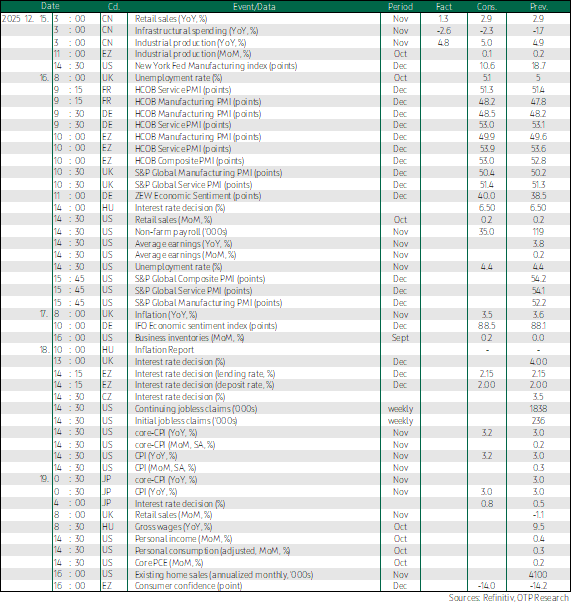
We are looking forward to a truly exciting week in terms of macro data and events. In Hungary, the MNB's interest rate decision will be in focus: although the key interest rate, which has been flat at 6.5% since September 2024, will almost certainly not change, it will be worth checking the decision for several reasons. First, the central bank will publish the updated Inflation Report and forecasts for Hungary’s economy. Second, the MNB has repeatedly said that the forecasts in the December report will be crucial for the future interest rate path, so the MNB may share more information about the base rate’s trajectory in 2026. The external data of the past month did not really support a short-term decrease in Hungary’s interest rates. Although the Fed eventually reduced the key interest rate level for the third time, the weakening of the dollar has stalled, and US interest rate cut expectations have not changed significantly in the past month. However, instead of the previous permanent hold, the market is now pricing in one or possibly two 25-basis-point interest rate hikes from the ECB, but no sooner than the end of 2026. In Hungary, inflation slowed faster than expected, to 3.8%, but the deceleration was primarily caused by food prices; the underlying indicators still reflect 4-5% inflation. Accordingly, rate cut expectations have weakened in Hungary: the market is pricing in a maximum of two interest rate cuts next year; we also expect that much, one in September and one in December.
Elsewhere, the ECB's interest rate decision on Thursday may be the most interesting event. Nobody expects the interest rate to be changed – in recent weeks, members of the Governing Council have repeatedly indicated that they do not intend to modify the key rate, and the 96 analysts surveyed by Refinitiv unanimously expect a hold. The event is worth the attention because of the subsequent press conference. The main question is whether the communication panel that has been repeated so far (“interest rates are in a good place”) will change. This is not unthinkable, given that recent months’ CPI data have been consistently unfavourable. Although headline inflation mostly remained around 2%, services inflation gradually accelerated from 3.1% in August to 3.5% in November (year-on-year). Moreover, this was caused by the strengthening of incoming monthly data, rather than by the base effect: annualized, seasonally adjusted services inflation has been around 4% for the third month in a row. Meanwhile, the third-quarter GDP data showed a stronger-than-expected 0.3% quarter-on-quarter growth, which indicates an annualized expansion of more than 1%. Not surprisingly, Chief Economist Philip Lane spoke of an “unfavourable surprise” , after the November inflation data, while Isabel Schnabel said that the ECB’s next move may be an increase rather than a reduction, albeit not anytime soon.
The USA will release a set of important data: November’s labour market and inflation data will be published this week, with a significant delay. September’s figures showed a 97,000 increase in non-farm payrolls, the highest gauge since May. The unemployment rate continued its upward trend since the beginning of the summer, rising to 4.4%, while October data was lost due to the government shutdown. According to alternative indicators seen so far, November did not bring any increase in employment, which would be negative news, as this is unusual during the end-of-year holiday period, when labour demand is traditionally stronger. November inflation reading follow September's figures, as October's data will not be published, owing to the government shutdown. The inflation picture is somewhat clearer than that of the labour market, as disinflation has clearly stalled and an acceleration is widely expected as tariffs are feeding into consumer prices. The Fed has emphasized that this normally has a one-time price-raising effect, but it will remain cautious.
Get more out of your investments!
Global Markets Services
OTP Global Markets offers a broad range of services in the field of local and international money and capital markets.
Read morePrivate Banking Services
Personal care and expertise with OTP Private Banking, along with the knowledge, security, and innovations of a multinational banking group.
Read more