
OTP Morning Brief: Earnings and geopolitical tensions drove markets on Tuesday
Related content
OTP Morning Brief: US producer price index came in above expectations, yet the US 10-year Treasury yield still declined
Western European equities continued to advance despite ongoing pressure on the technology sector. Wall Street indices also rebounded, recovering some ground after Wednesday’s sell-off. Healthcare was the standout performer on both sides of the Atlantic. Eurozone industrial production declined by 0.5% month-on-month in August. In the US, the producer price index accelerated to 6.3%, delivering another upside surprise in inflation developments. US retail sales increased by 0.8% compared to August. The US 10-year Treasury yield declined by more than 10 basis points. The long end of the Hungarian government bond yield curve also declined by 7-9 basis points. In Hungary, August wage data will be released today, while in the US, September industrial production figures are due.
OTP Morning Brief: US CPI data came in above expectations
European equity markets advanced, supported by strong results from ASML and the outstanding performance of the healthcare sector. US equity markets came under pressure following higher-than-expected September CPI data. The annual CPI rate accelerated to 3.7%, driven primarily by a surge in gasoline prices, while core CPI rose by 0.3% month-on-month, supported by higher housing costs and rising transportation service prices. Oil prices rose amid escalating tensions in the Middle East and the impact of the IEA's oil market report. US Treasury yields retreated after an initial increase, driven by Fed commentary, while European bond yields generally moved higher. The US macro calendar will be busy today, with investors focusing on September retail sales and producer price index data, as well as the New York Fed Manufacturing Index, weekly jobless claims, and business inventories. August industrial production data from the euro area will be released today.
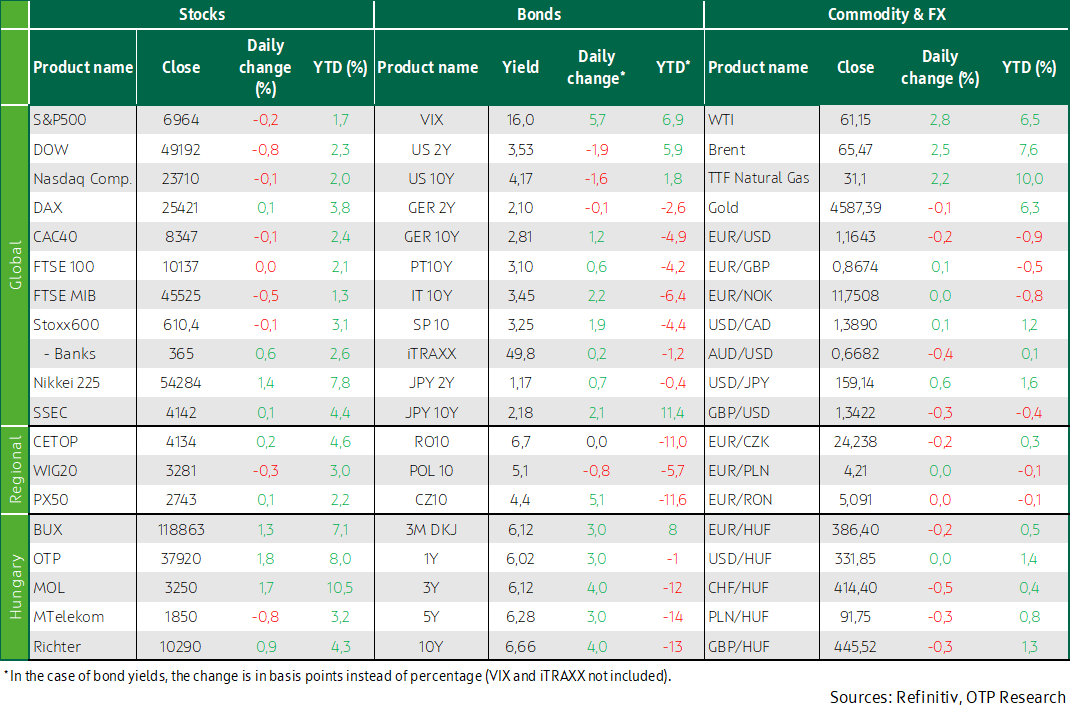
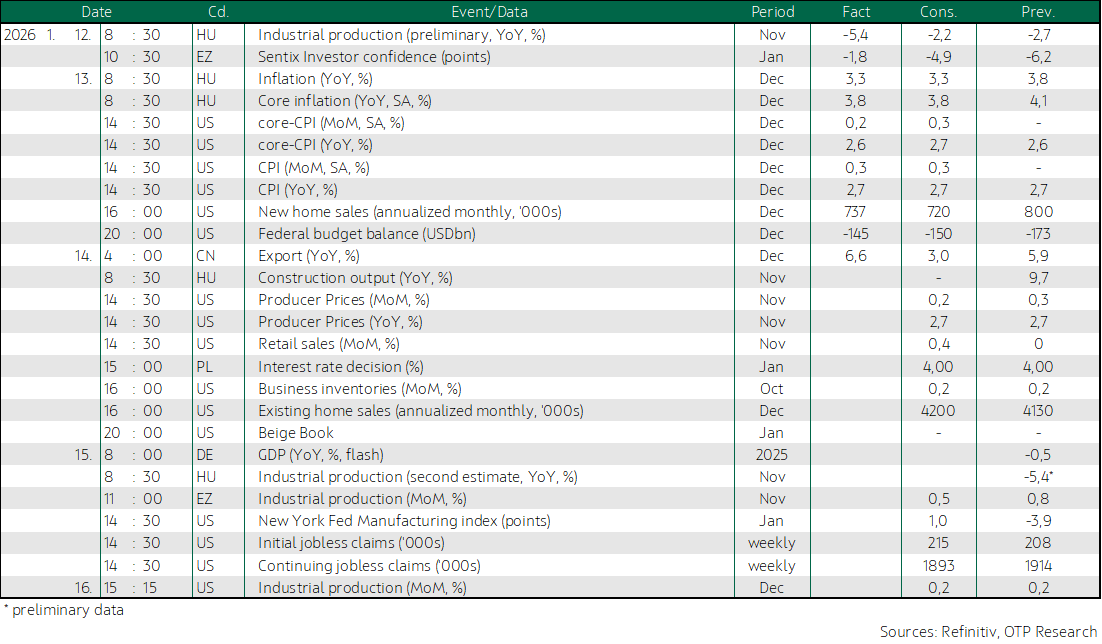
Most of the key stock exchanges in Europe and the USA closed Tuesday's trading in the red. The BUX outdid its regional peers; its main engine OTP hit new high. In Hungary, inflation was 3.3% in December, in line with market consensus. December’s US inflation data were reassuring. Gold and crude oil prices marched higher. Hungary’s benchmark bond yields rose by 2-6 basis points. The forint has regained some lost ground from the euro. November’s producer price index and retail sales data, and the Fed's new Beige Book will be released in the USA today. The earnings season is picking up steam.
Tuesday's trading ended with trivial changes on Western Europe’s leading stock exchanges
In Western Europe, the leading indices closed with tiny, mostly negative changes on Tuesday. Germany’s DAX stood out with an uptick, fuelled by a 1.9% rise in Airbus after the company reported a 4% take-off in the number of aircraft delivered last year. Having had set a record high at one point on Tuesday, the Stoxx600 eventually closed 0.1% lower. The losses was led by the construction sector, following a 7.7% fall in shares of Rockwool after Russia ordered temporary administration over two of the Danish company’s Russian subsidiaries. Meanwhile, Danish offshore wind developer Orsted soared 5.4%, thanks to a US court ruling that the company can press ahead with its USD 5 billion project, which the Trump administration had suspended in December.
Hungary’s BUX (+1.3%) was the top performer in the CEE region. MTelekom was its only its blue chip to close in the red, while OTP went to a new all-time high.
Wall Street’s leading indices declined yesterday; December’s inflation data were reassuring
America’s stock exchanges dropped on Tuesday, largely dragged down by the financial sector, after JPMorgan executives expressed concerns about Donald Trump's proposal to impose a 10% cap on credit card interest rates for one year. This has intensified the selling wave seen in the financial sector in recent days. Visa and Mastercard also lost roughly 4% each, and shares in JPMorgan (-4.2%) also plunged even though the bank reported better-than-expected quarterly profit. Delta Air Lines descended as the company’s 2026 profit forecast missed analysts’ forecasts.
US headline inflation was flat at 2.7% year-on-year in December, in line with consensus, while core inflation eased to 2.6%, a better reading that than the market had expected. However, items that go into the core PCE index came in higher than thought, so there could be an upside surprise. The incoming data did not overwrite interest rate expectations: the market is pricing in a total of 50-basis-point rate cuts by the end of 2026, and almost unanimously expects rates to be held at the January meeting. At the same time, tensions around the Fed continue to simmer: in response to the investigation against Jerome Powell, the heads of the world's leading central banks issued a joint statement, standing up for central bank independence and standing by Chairman Powell.
Geopolitical tensions fuelled the rise in crude oil prices after President Trump promised help to Iranian protesters and cancelled planned meetings with Iranian officials.
Japan’s bond yields picked up again; Hungary’s inflation was 3.3% in December
On Tuesday, the bond markets of advanced economies started trading with yields rising due to the repeated substantial increase in Japanese bond yields - they jumped by seven basis points, to above 2.16%, the highest level since 1999. However, this later reversed when favourable US inflation data were released: the US 10Y yield closed below 4.2% again. In the eurozone, yields upped by a few basis points; Germany’s 10-year yield is back above 2.8%. The dollar strengthened slightly, pushing the EUR/USD below 1.165.
In Hungary, headline inflation fell to 3.3%, core inflation sank to 3.8%, in line with market consensus, but services inflation rose, to which the MNB added that corporate repricing remained strong. After the inflation data release, interest rate cut expectations slightly eased, the forint strengthened (the EUR/HUF closed trading at 386), and benchmark bond yields rose by 2-6 basis points. The 10Y yield rose to 6.65%, yet this is considered low compared to its typical trading range in the past almost a year. Amid healthy demand, the ÁKK accepted bids worth HUF 40 billion (vs offered: HUF 30 billion) at yesterday's auction of three-month discount Treasury Bills, at an average yield of 6.11%.
Today’s highlights
Asia-Pacific stocks traded mixed this morning. Japan’s indices went to new highs on expectations that Prime Minister Takaichi Sanae could call a snap election in February. She has been a proponent of looser monetary policy and has announced a massive economic stimulus package, which markets have welcomed.
The yen weakened, pushing the USD/JPY below 159, its lowest since July 2024, when Japan’s authorities intervened to stop the yen's depreciation.
Silver’s price broke above USD 90 for the first time, bringing its year-to-date gain to more than 25%. Meanwhile, gold’s rally continued; it has gained more than 7% this year.
In Hungary, the ÁKK is offering six-month discount T-bills worth HUF 30 billion, and at the switch auction, investors can obtain 2032/A and 2034/A bonds worth HUF 10 billion each, in exchange for securities maturing next year. Hungary’s KSH statistical office publishes construction production data for November.
In the USA, November’s producer price index and retail sales figures, as well as the Fed's new Beige Book will be released.
The earnings reports season continues with figures from Bank of America, Wells Fargo and Citigroup, among others.
Get more out of your investments!
Global Markets Services
OTP Global Markets offers a broad range of services in the field of local and international money and capital markets.
Read morePrivate Banking Services
Personal care and expertise with OTP Private Banking, along with the knowledge, security, and innovations of a multinational banking group.
Read more