
OTP Morning Brief: Brent traded above USD 100 again
Related content
OTP Morning Brief: US producer price index came in above expectations, yet the US 10-year Treasury yield still declined
Western European equities continued to advance despite ongoing pressure on the technology sector. Wall Street indices also rebounded, recovering some ground after Wednesday’s sell-off. Healthcare was the standout performer on both sides of the Atlantic. Eurozone industrial production declined by 0.5% month-on-month in August. In the US, the producer price index accelerated to 6.3%, delivering another upside surprise in inflation developments. US retail sales increased by 0.8% compared to August. The US 10-year Treasury yield declined by more than 10 basis points. The long end of the Hungarian government bond yield curve also declined by 7-9 basis points. In Hungary, August wage data will be released today, while in the US, September industrial production figures are due.
OTP Morning Brief: US CPI data came in above expectations
European equity markets advanced, supported by strong results from ASML and the outstanding performance of the healthcare sector. US equity markets came under pressure following higher-than-expected September CPI data. The annual CPI rate accelerated to 3.7%, driven primarily by a surge in gasoline prices, while core CPI rose by 0.3% month-on-month, supported by higher housing costs and rising transportation service prices. Oil prices rose amid escalating tensions in the Middle East and the impact of the IEA's oil market report. US Treasury yields retreated after an initial increase, driven by Fed commentary, while European bond yields generally moved higher. The US macro calendar will be busy today, with investors focusing on September retail sales and producer price index data, as well as the New York Fed Manufacturing Index, weekly jobless claims, and business inventories. August industrial production data from the euro area will be released today.
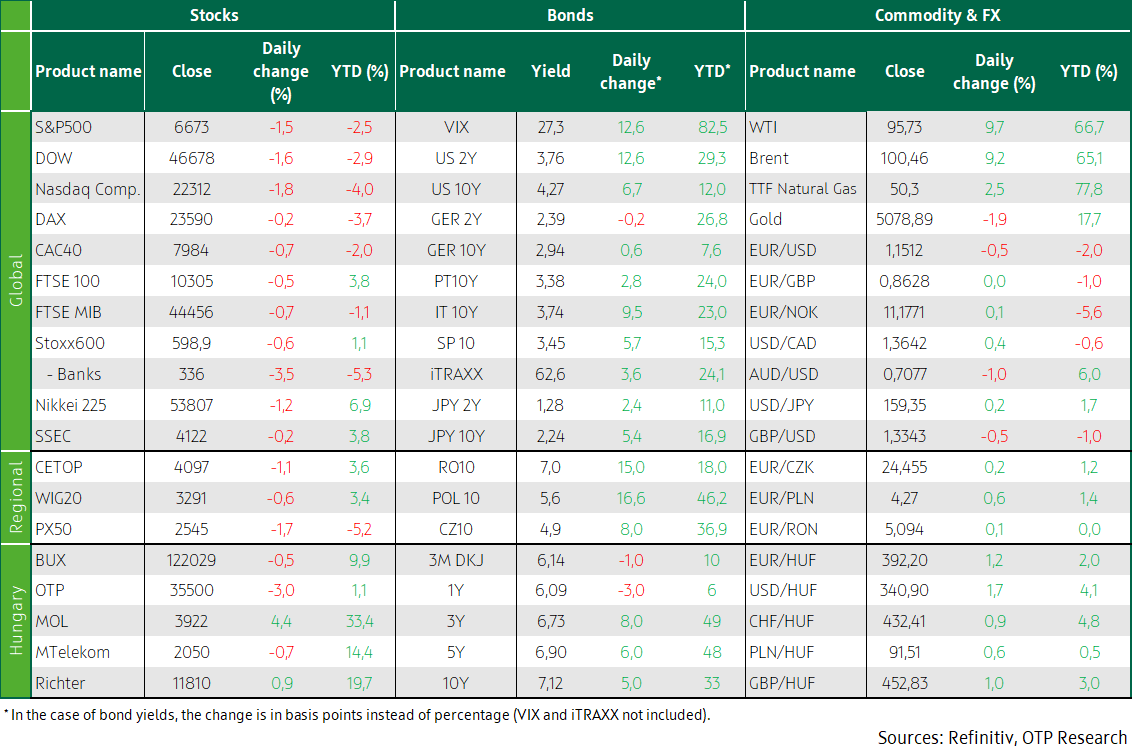
Western Europe’s stock markets extended losseson Thursday. Markets prices imply 25-basis-point ECB rate hike by July. Iran's supreme leader vowed to keep the Strait of Hormuz closed. Iran attacked tankers in the Persian Gulf. TTF natural gas price surged 2.5%, trading above EUR 50 again. Brent jumped above USD 100 on Thursday. US stock indices fell sharply yesterday. US 10-year yield upped another 5 basis points, above 4.25%. The EUR/USD dropped 0.5%, closer to 1.15. Investors remained concerned about USprivate credit. The USA releases January core PCE , and the UoM consumer sentiment index for March.
Western Europe’s markets extended losses on Thursday
Western Europe’s markets fell deeper on yesterday. The STOXX 600 (-0.6%), Germany’s DAX (-0.2%), France’s CAC40 (-0.7%), and the FTSE100 (-0.5%) all slipped. Apparently, investors worried about the resurgence of oil prices amid the Middle East war, which has brought inflation fears back to the fore. Financial markets now price in a 25-basis-point ECB interest rate hike by July as expectations took a U-turn: before the Middle East conflict, interest rates cuts were anticipated. The energy price shock of 2021/2022 is still fresh in the minds of policymakers and investors; at that time, major central banks overlooked energy price increases for more than a year, believing they were temporary; then they were forced to belatedly hike interest rates sharply.
Banking stocks (-3.5%), which are sensitive to economic cycles, saw the sharpest dive but the losses were broad-based. Rising oil prices helped the energy sector gain 1.4%. The defensive utilities sector rose 1.8%. Some positive earnings reports helped pare losses. Leonardo shares took off 5.7%, to a record high, as the defence company said its orders, revenue, and core profit would continue to grow this year. Daimler Truck, which specializes in commercial vehicles, advanced 4.1% after forecasting a stable profit rate for 2026. Zalando jumped 9.5% after the online fashion retailer forecast a growing adjusted operating profit for 2026. Germany's largest electricity producer, RWE said on Thursday that it would begin a more aggressive expansion in the USA, where data centres have significantly boosted demand for electricity. This will also include the construction of new gas-fired power plants. The company's share price soared nearly 4% on Thursday.
Neither could the CEE region’s stock markets avoid losses. Hungary’s BUX declined 0.5%. OTP shares (-3%) were under pressure, while MOL gained 4.4% – both in sync with the banking and energy patterns in Western Europe. Poland's WIG20 (-0.6%) and Czechia’ PX50 (-1.7%) also ended in the red. As expected, Turkey’s central bank left its base rate at 37%. The Western Balkan countries' accession to the European Union may be accelerated by compromises, in which they would give up some of their rights, including their veto power in the European Council.
The price of TTF natural gas added 2.5%, going beyond EUR 50 again.
US stocks closed lower on Thursday
US stock indices fell on Thursday. The S&P 500 (-1.5%), the Dow Jones (-1.6%), and the Nasdaq Composite (-1.8%) all closed in the red. All sectors of the S&P500, except energy (+1%) and defensive sectors like consumer staples (+0.1%) and utilities (+0.7%), posted losses. The decline was primarily driven by negative news about the war in Iran. In his first public speech, Iran’s new Supreme Leader, Mojtaba Khamenei, vowed revenge and the closure of the Strait of Hormuz. Meanwhile, Iran launched an attack on tankers stranded in the Persian Gulf, using small boats. According to US intelligence, Iran’s leadership remained largely intact, and the regime is not in danger of collapsing, despite nearly two weeks of bombing by the USA and Israel. Although Donald Trump’s message on Monday (that the war had essentially been won) brought relief to markets, the events did not exactly validate this. Thus, Brent jumped above USD 100 again on Thursday, and the price of European-listed TTF natural gas rose above EUR 50. This caused WTI (+9.7%) and Brent (+9.2%) skyrocket in a single day. US Energy Secretary Chris Wright said that the Navy was unlikely to be able to provide escorts for commercial ships passing through the Strait of Hormuz before the end of March. In response to the events, China banned the export of refined fuels in March with immediate effect. The USA has also issued a 30-day sanctions waiver, allowing countries to buy Russian oil and petroleum products currently stranded at sea under sanctions. As of Thursday, about 124 million barrels of Russian crude oil were at sea worldwide, enough to replace the volume lost from the Middle East for five to six days.
Investors continue to watch US private credit developments with concern. This involves loans that are provided not directly by commercial banks, but by funds or other institutional investors outside banking regulations, typically to corporate clients. One of the concerns is that the lending clientele is heavily represented by software companies whose operating models are threatened by the rise of artificial intelligence. The recent liquidity crunch in private equity funds has forced several major players — including Morgan Stanley and BlackRock — to limit redemptions after some funds reached the 5% redemption level that traditionally allows such action. The Federal Reserve’s vice chairwoman for supervision, Michelle Bowman said that capital requirements for big banks will be reduced slightly in a review of capital requirements rules. The weekly US jobless data were in line with expectations.
The US 10Y yield jumped by another five basis points, above 4.25%
The attacks on tankers passing through the Strait of Hormuz and Iran’s statements threatening Middle East energy infrastructure have pushed oil prices up by another 10%, to around USD 100, further increasing tensions in bond and currency markets. The US ten-year yield jumped another 5 basis points, surpassing 4.25%. Germany’s ten-year yield inched up trivially, remaining below 2.95% – yet this marks a three-year high, and is at the top of the post-pandemictrading range. The dollar was further strengthened by demand for risk-freeassets; the EUR/USD sank another half a percent, to close near 1.15.
The CEE region’s currencies have weakened. The koruna (CZK) shed 0.2%, the zloty (PLN) lost 0.4%, and the forint (HUF) depreciated by 1.2%; the latter traded at 392 against the euro. The sentiment in Hungary’s bond market remained depressed. Due to weak demand, only half of the planned HUF 20 billion worth of 12M discount Treasury Bills were sold at yesterday’s auction, at an average yield of 6.16%. There was subdued demand for the 15Y bond too; the ÁKK sold the amount on offer, HUF 10 billion, at an average yield of 7.18%. On the secondary market, benchmark yields grew by 5-8 basis points, the 10Y bond yield exceeded 7.1%.
Today’s highlights
Asia’s markets were also seen in the red in the last hour of trading. Japan’s Nikkei (-1.2%), Korea’s KOSPI (-1.7%), Hong Kong’s Hang Seng (-0.5%) and China’s SSEC (-0.2%) were all set to lose.
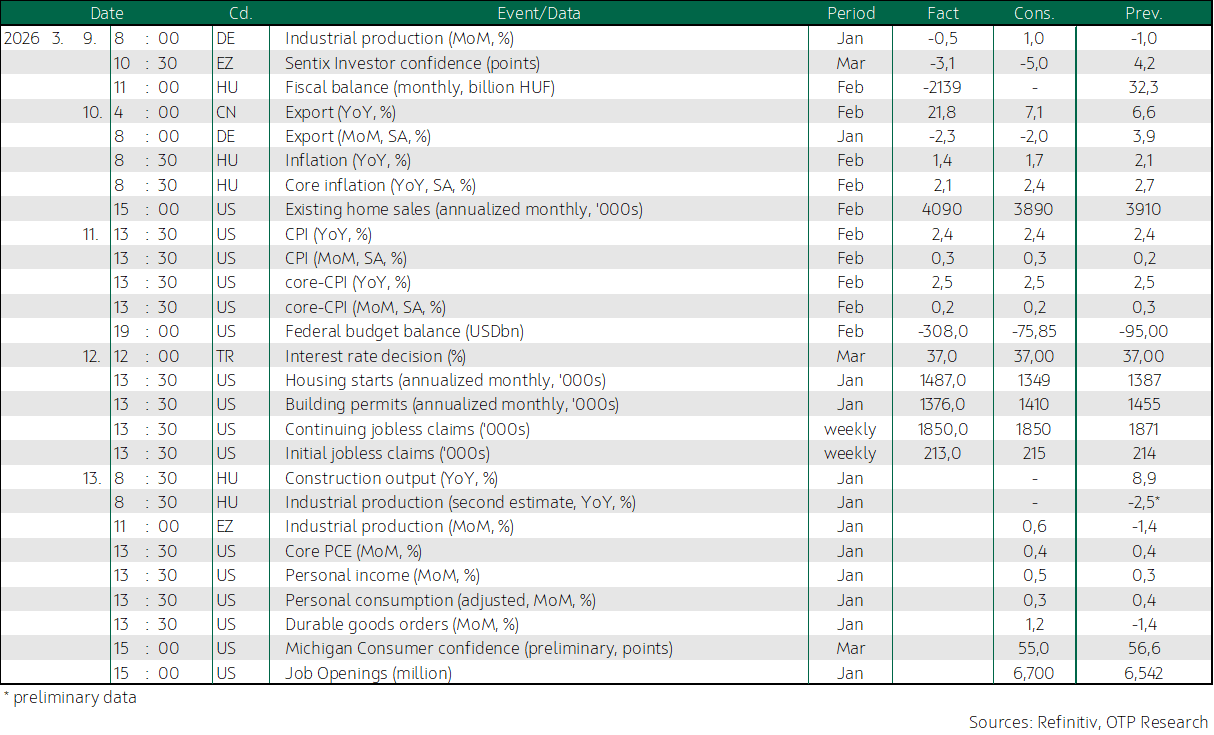
Today Hungary’s KSH statistics office publishes January construction production data and the second (detailed) estimate of industrial output. Elsewhere, the eurozone’s industrial production data for January will be released. On the other side of the Atlantic, the January core PCE indicator will see the light of day; based on the producer price index, it may show a strong 0.4% MoM dynamic, similarly to the December gauge; but the January consumer price index suggests otherwise. The January readings of personal income and consumption, durable goods orders, and the job openings statistics will also be published in the USA, as well as the University of Michigan's consumer confidence index for March.
Get more out of your investments!
Global Markets Services
OTP Global Markets offers a broad range of services in the field of local and international money and capital markets.
Read morePrivate Banking Services
Personal care and expertise with OTP Private Banking, along with the knowledge, security, and innovations of a multinational banking group.
Read more