
OTP Morning Brief: The major stock indices declined on Thursday
Related content
OTP Morning Brief: US producer price index came in above expectations, yet the US 10-year Treasury yield still declined
Western European equities continued to advance despite ongoing pressure on the technology sector. Wall Street indices also rebounded, recovering some ground after Wednesday’s sell-off. Healthcare was the standout performer on both sides of the Atlantic. Eurozone industrial production declined by 0.5% month-on-month in August. In the US, the producer price index accelerated to 6.3%, delivering another upside surprise in inflation developments. US retail sales increased by 0.8% compared to August. The US 10-year Treasury yield declined by more than 10 basis points. The long end of the Hungarian government bond yield curve also declined by 7-9 basis points. In Hungary, August wage data will be released today, while in the US, September industrial production figures are due.
OTP Morning Brief: US CPI data came in above expectations
European equity markets advanced, supported by strong results from ASML and the outstanding performance of the healthcare sector. US equity markets came under pressure following higher-than-expected September CPI data. The annual CPI rate accelerated to 3.7%, driven primarily by a surge in gasoline prices, while core CPI rose by 0.3% month-on-month, supported by higher housing costs and rising transportation service prices. Oil prices rose amid escalating tensions in the Middle East and the impact of the IEA's oil market report. US Treasury yields retreated after an initial increase, driven by Fed commentary, while European bond yields generally moved higher. The US macro calendar will be busy today, with investors focusing on September retail sales and producer price index data, as well as the New York Fed Manufacturing Index, weekly jobless claims, and business inventories. August industrial production data from the euro area will be released today.
The UK’s Q4 growth was weaker than hoped, British shares weighed on the Stoxx. Poland’s economy expanded dynamically. US indices fell. Donald Trump rolled back climate change policies. Investors sought bonds amid growing risk aversion. In Hungary, January inflation was lower than feared. Asia’s stocks echoed Thursday’s downward trend in the West. Today’s most important release is America’s CPI.
UK Q4 growth missed expectations, British stocks weighed on the European index, Poland’s economy grew dynamically
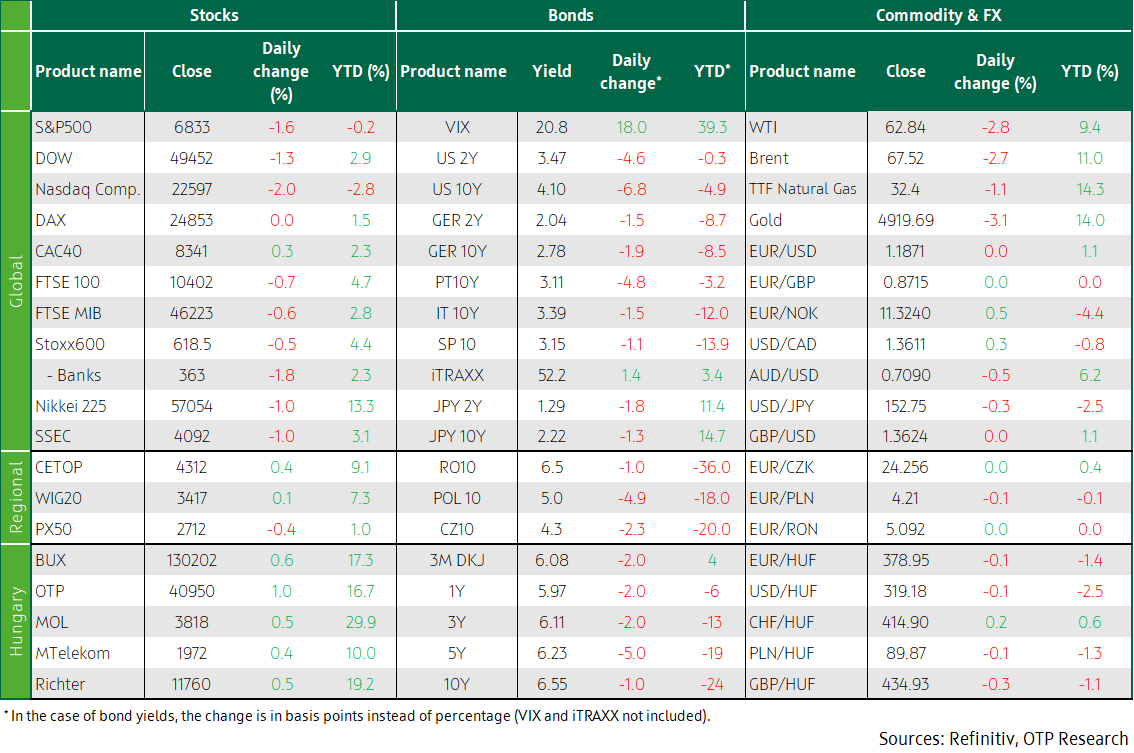
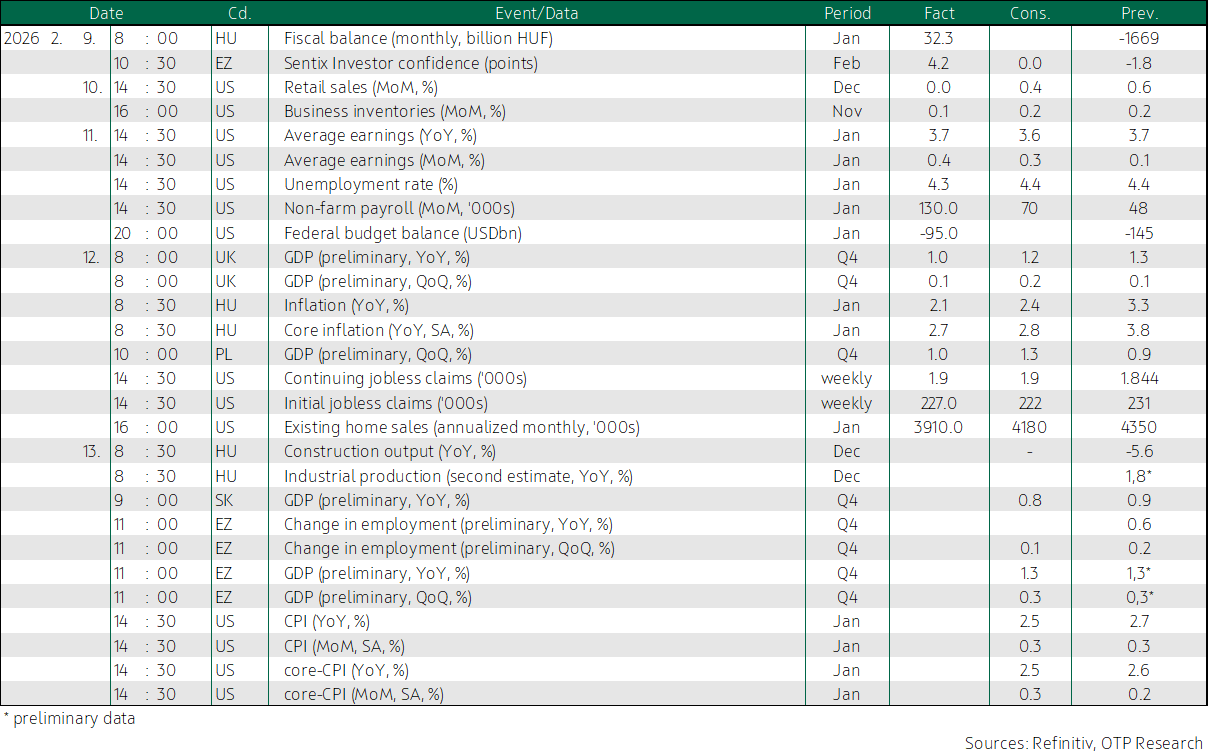
The stock markets of Europe painted a mixed picture on Thursday: France's CAC 40 added 0.3%, Germany’s DAX ended flat, while the UK's FTSE100 (-0.7%) dragged down Stoxx index (-0.5%). One reason for the weakness of the British market may have been the UK’s pale economic performance in the fourth quarter, when it rose by just 0.1% QoQ, whereas economists had projected 0.2% increase. The annual growth rate was 1.0%. The positive performance of the manufacturing industry was offset by the still ailing construction industry, while services stagnated for the first time in two years.
At sector level, telecommunications (+1.9%) and food (+1.8%) increased, while banking fell 1.8%. France's Sanofi replaced its CEO Paul Hudson, who is leaving after six years mainly because of slowing innovation and anti-vaccination pressure from the USA, with the relatively lower-profile Belén Garijo, head of Merck KGaA; the move sent shares down nearly 4.2%. Siemens shares jumped vigorously during the day, then reversed slightly, to end Thursday trading with 0.3% gain; its earnings report printed stronger-than-expected quarterly results on robust demand for its AI-driven data centre infrastructure, thus the giant raised its full-year profit guidance. French luxury goods giant Hermes (+2.6%) reported a 9.8% surge in sales, amid a stagnant luxury goods industry.
On Thursday, China cut import duties on more than USD 500 million worth of EU dairy products; in the final decision of an 18-month anti-dumping investigation launched in response to the EU’s tariffs on electric vehicles from China. The new duties on dairy products from the EU, ranging from 7.4% to 11.7%, will be in effect for five years from today, 13 February 2026, replacing the 21.9% to 42.7% rates in a preliminary decision made in December.
The sentiment in the CEE region was also mixed: Czechia’s PX index sank 0.4%, Poland’s WIG upped 0.1%, and Hungary’s BUX rose by 0.6%. In Budapest, the strongest blue chips was OTP (+1%), but the other three also increased by about half a percent each. Poland’s economy expanded by 1.0% on a quarterly basis, thus achieving 4.0% annual growth rate, the highest since Q3 2022.
America’s indices fell, Donald Trump revoked further climate change regulations
US indices fell as investors increasingly dumped technology stocks and fled transportation companies following AI-related news. According to a report by CNBC, the Algorhythm Holdings AI company could increase the efficiency of freight transportation, thereby narrowing the market. The Dow (-1.3%), the S&P500 (-1.6%) and the Nasdaq (-2.0%) all fell . Although the early trading session was heading higher, stock indexes turned back as investors abandoned riskier sectors and sought more defensive categories such as utilities (+1.5%), consumer staples (+1.3%) and real estate (+0.3%). Shares of Cisco Systems slumped 12.3% on Thursday after the networking equipment giant reported a lower-than-expected quarterly gross margin due to the crowding-out effect of AI companies. Shipping company C.H. Robinson nose-dived 14% for the above-mentioned reasons. Shares in Palantir slid almost 5%, bringing their year-to-date loss to more than 27%.
Last week, US jobless claims fell slower than expected but disruptions caused by winter storms continued to have an impact. Initial jobless claims dropped by 5,000, to 227,000 in the week ended 7 February, whereas analysts estimated the latter at 222,000. In the USA, existing home sales shrank by 8.4% in January, to a more-than-two-year low of 3.91 million. The tight supply has pushed up prices, and the decline likely reflects the contracts signed in November and December. On Thursday, Donald Trump announced that he would end federal greenhouse gas emissions requirements for all vehicles and engines, thereby rejecting scientific finding that greenhouse gases are harmful to human health. Separately, ’border czar’ Tom Homan said that President would halt a much-criticized wave of deportations in Minnesota.
Oil prices fell on Thursday owing to weakening demand, easing tensions in the Middle East, and expected supply increases. Brent (-2.71%) crude futures closed at 67.5 USD/barrel, while WTI (-2.77%) ended the day at USD 62.8.
Investors sought bonds as risk aversion mounted; Hungary’s January inflation came in lower than expected
Following the sharp fall in US equities and precious metals, investors sought shelter in bonds. US bond yields with maturities of three years and beyond have dropped sharply, by 5-8 basis points, and the 10Y yield declined to a two-month low of 4.1%. The eurozone’s bond yields also fell, but to a lesser extent, by 2-3 basis points; the ten-year German Bund yield sank below 2.8%. The dollar barely benefited from the declining risk appetite this time: the EUR/USD dipped 0.1%, to 1.185.
On Thursday morning, Hungary’s markets awaited January inflation data, which came in significantly lower than expected – not only the headline (2.1%) but also core (2.7%) and service inflation, opening the door to an interest rate cut in February. Should February inflation data be favourable, even an interest rates reduction in March may not be ruled out. Immediately after the data release, the forint weakened, sending the EUR/HUF to 381, but later the cross returned to 379, despite the deteriorating sentiment abroad and news that Hungary may lose access to the EUR 12.2 billion EU fund that had already been released. At the auction of 12M discount Treasury Bills, the ÁKK sold the amount on offer, HUF 30 billion worth of T-bills, seeing subdued demand. The average yield was 5.99%. About HUF 35 billion worth of 15Y and 20Y year fixed-interest bonds (2041/A, 2051/G) were sold, amid healthy demand; yield levels were five basis points below Thursday's benchmark yields. Yields inched up by one or two basis points before the benchmark yields were fixed in the early afternoon, but they sank by 1-5 basis points compared to Thursday. The ten-year yield remained slightly above 6.5%.
Today’s highlights
Asia’s stock markets retreated from record highs as concerns about shrinking margins in the tech sector, which has hit companies like Apple, drove investors towards safer government bonds ahead of important inflation data from the USA. The Nikkei and SSEC slipped 1.0% each, while the Kospi descended 0.3%.
In Hungary, a string of macroeconomic data for December will be out today, in the form of industrial production and construction output. In the eurozone, the second estimate of fourth-quarter GDP and employment data will be released. In the USA, the focus will be primarily on the consumer price index; headline and core inflation are both expected to have accelerated by 0.3% month-on-month. However, the sharp jump in US natural gas prices in the middle of the month due to extreme weather conditions, and the increase in food prices due to import tariffs both pose upside risks to the January data. We maintain that the impact of the tariffs will be less severe than previously thought, but it may strengthen price pressures for a few more months, so inflation may remain above the Fed's 2% target throughout the year.
Get more out of your investments!
Global Markets Services
OTP Global Markets offers a broad range of services in the field of local and international money and capital markets.
Read morePrivate Banking Services
Personal care and expertise with OTP Private Banking, along with the knowledge, security, and innovations of a multinational banking group.
Read more