
OTP Morning Brief: Fed independence and geopolitical tensions in focus
Related content
OTP Morning Brief: US producer price index came in above expectations, yet the US 10-year Treasury yield still declined
Western European equities continued to advance despite ongoing pressure on the technology sector. Wall Street indices also rebounded, recovering some ground after Wednesday’s sell-off. Healthcare was the standout performer on both sides of the Atlantic. Eurozone industrial production declined by 0.5% month-on-month in August. In the US, the producer price index accelerated to 6.3%, delivering another upside surprise in inflation developments. US retail sales increased by 0.8% compared to August. The US 10-year Treasury yield declined by more than 10 basis points. The long end of the Hungarian government bond yield curve also declined by 7-9 basis points. In Hungary, August wage data will be released today, while in the US, September industrial production figures are due.
OTP Morning Brief: US CPI data came in above expectations
European equity markets advanced, supported by strong results from ASML and the outstanding performance of the healthcare sector. US equity markets came under pressure following higher-than-expected September CPI data. The annual CPI rate accelerated to 3.7%, driven primarily by a surge in gasoline prices, while core CPI rose by 0.3% month-on-month, supported by higher housing costs and rising transportation service prices. Oil prices rose amid escalating tensions in the Middle East and the impact of the IEA's oil market report. US Treasury yields retreated after an initial increase, driven by Fed commentary, while European bond yields generally moved higher. The US macro calendar will be busy today, with investors focusing on September retail sales and producer price index data, as well as the New York Fed Manufacturing Index, weekly jobless claims, and business inventories. August industrial production data from the euro area will be released today.
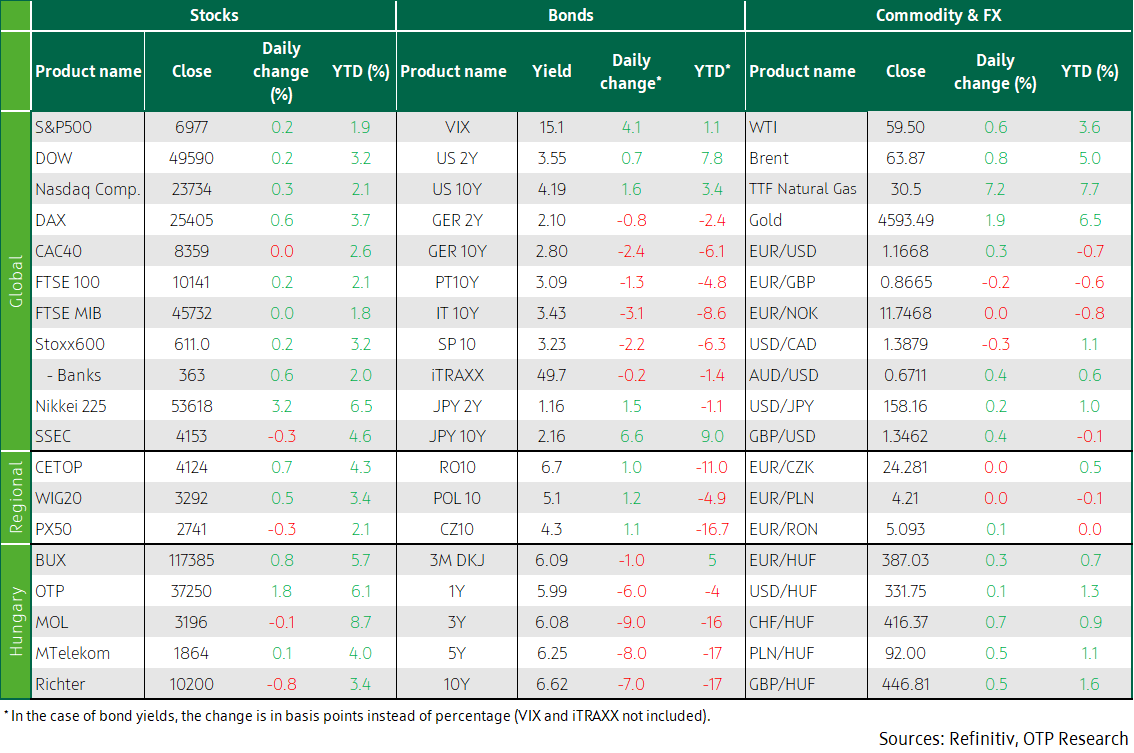
Western Europe’s and America’s indices edged higher on Monday. The eurozone’s Sentix index for January was better than expected. The turnaround in Hungary’s industrial production is yet to come, November’s weak data suggest. The credit card interest rate cap proposed by President Trump kept the banking sector under pressure. Jerome Powell spoke clearly about the political pressure on the Fed's interest rate policy. President Trump announced 25% tariff on countries doing business with Iran. Gold price exceeded USD 4,600 at one point on Monday. There was no significant movement in the US bond market. Hungary and the USA release inflation data today.
Western Europe’s leading indices ground higher
The leading indices in Western Europe rose moderately on Monday: the STOXX 600 (+0.2%), the DAX (+0.6%), and the FTSE100 (+0.2%) all closed with gains; France’s CAC40 ended almost stagnant. In individual names, Aurubis (+3.1) and Fresnillo (+5.1%), both active in the precious metals industry, did well amid growing gold and silver prices. The STOXX 600 defence sector (+0.5%) extended its seven-day winning streak yesterday. The credit card interest rate cap proposed by Donald Trump weighed on Barclays (-2%), which is active in the US credit card market. Yet the banking sector closed 0.6% higher. Heineken shares slid 4.1% after CEO Dolf van den Brink unexpectedly resigned on Monday. BE Semiconductor Industries soared 7.3% as the chip-making equipment supplier reported better-than-expected fourth-quarter pre-orders. Abivax’ shares jumped 5% on media reports that U.S. pharmaceutical giant Eli Lilly is still interested in buying the French biotech company.
On Monday, the European Commission outlined conditions for China’s electric vehicle manufacturers to avoid EU tariffs via ‘price undertakings’. 0On the whole, China’s Ministry of Commerce welcomed the guidance. On Monday, Volkswagen reported 4.9% contraction in fourth-quarter vehicle sales: while boosting sales in Europe, the German car manufacturer suffered a 17.4% fall in North America and China. In the USA, it was the tariffs and the removal of subsidies for electric cars, while in China it was the extremely intense competition that dragged down Volkswagen's sales. Its share price dropped by 1.2% yesterday. Porsche AG shares slumped more than 5%, amid concerns that the luxury carmaker's current profit estimates may be too high.
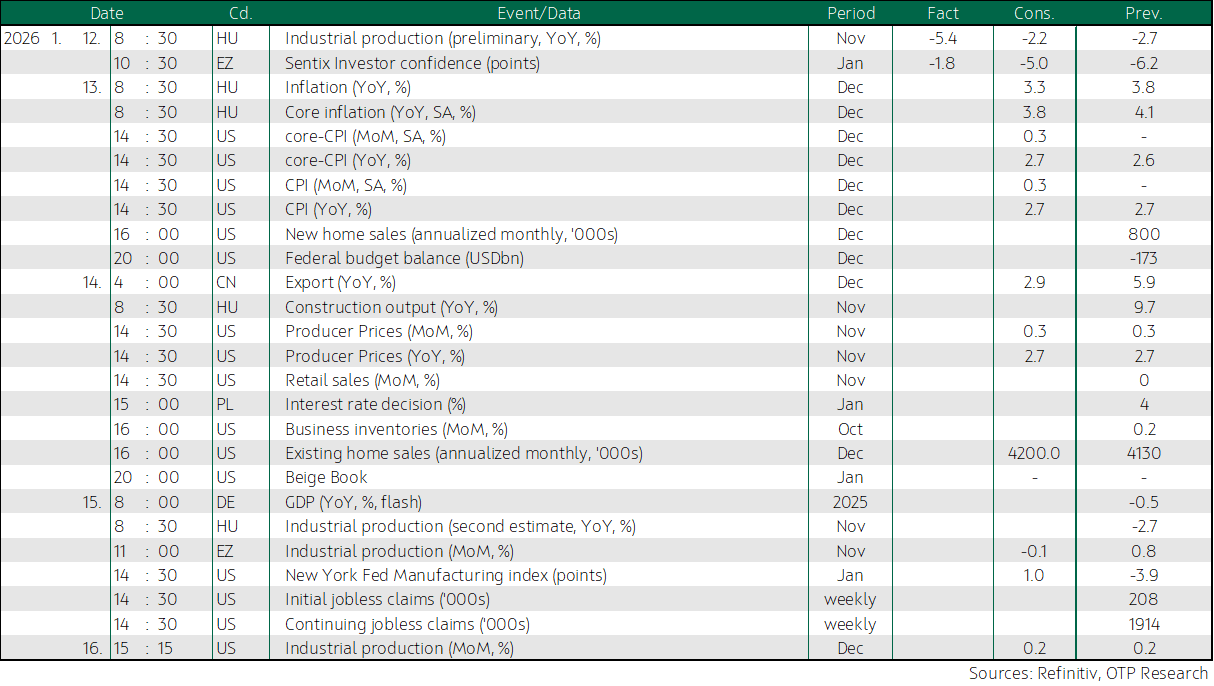
In the eurozone, the Sentix index of investor sentiment rose more than expected in January. At -1.8, the indicator reached its highest since July 2025; the improvement was mainly driven by the expectations component. Currently, there is still a strong division between the expectations component (10), which continues to rise in positive territory, and the negative, but also improving, current economic situation component (-13).
In November, Hungary’s industrial production contracted by 2% month on month. This translates into 5.4% year-on-year decline, falling short of analysts’ consensus of -2.2% by a large margin. Thus, a turnaround that could reverse the more-than-three-years-long downtrend is yet to be seen. In the CEE region, Hungary’s BUX (+0.8%) and Poland’s WIG20 (+0.5%) rose, while Czechia’s PX50 shed 0.3%.
US markets posted modest gains
America’s stock indices also showed moderate increases. The S&P 500 and the Dow Jones upped 0.2% each, and the Nasdaq Composite added 0.3%. Walmart shares grew by 3%. Consumer staples increased by 1.4% and led the sector winners. The financial sector was the worst performer of the S&P500’s eleven sectors. Back on Friday, President Trump proposed a 10% cap on credit card interest rates, effective from 20 January. The news weighed on the financial sector: on Monday, JPMorgan (-1.4%), Bank of America (-1.1%), Citigroup (-3%), and Wells Fargo (-1%) all fell. The financial sector is also in the spotlight as the fourth-quarter earnings season begins this week with reports from big banks.
Jerome Powell said on Sunday evening that the Department of Justice has served subpoenas, threatening a criminal indictment related to the cost of renovating the Fed's headquarters in Washington. Jerome Powell was very specific: he called the action a pretext and said the real goal was to exert political pressure on interest rate policy.
In addition to the US action in Venezuela, the wave of protests in Iran, which has been lasting since late December, is also contributing to the increase in global geopolitical tensions. Reportedly, more than 500 people may have been killed during the protests. US President Donald Trump has also raised the possibility of a military strike if the Iranian government uses violence against the protesters. On Monday, he announced an immediate 25% tariff on countries that have business relations with Iran; the details are not yet known.
Amid political and global geopolitical tensions over the independence of the Fed, gold prices rose by 1.9% on Monday, crossing the USD 4,600 level for the first time at one point on Monday. Silver prices jumped by 6.2%. WTI and Brent rose by 0.6-0.8%.
US bond yields barely moved on Monday
Yesterday, the market was uneasy about the criminal indictment against the Fed chairman for the cost overruns of the renovation of the Fed headquarters. Concerns about the Fed’s independence were fuelled by the fact that Fed Chairman Jerome Powell said the reason for the proceedings was President Trump’s dissatisfaction with the Fed's interest rate policy. As a result, the US dollar weakened, sending the EUR/USD to 1.17, and the price of gold went to a new high. US bond yields barely moved; the 10Y yield remained flat below 4.2%. In the euro zone, yields sank by a few basis points, the 10-year German Bund yield eased to 2.8%.
The forint weakened by 0.4%, driving the EUR/HUF above 387, while Hungarian bond yields continued to decline. Yesterday, 3Y and 10Y bond yields sagged by 5-10 basis points, those on longer tenors dipped 3-4 basis points; the 10Y bond yield is drawing near 6.6%. Seeing the adequate demand, the ÁKK accepted bids worth HUF 30 billion at yesterday's switch auction of discount Treasury Bills. Today, the ÁKK auctions 3M discount T-Bills, offering HUF 30 billion.
Today’s highlights
Heading into today’s close, strong growth was seen in Asia. It was partly fuelled by Japan’s Nikkei (+3.3%), which benefited, among other things, from news that the ruling coalition is planning early election, which could ultimately increase its fiscal space. The KOSPI (+1.5%) and the Hang Seng (+0.7%) increased, while the SSEC gave back 0.3%.
Hungary publishes December’s inflation data today. Following the 3.8% headline inflation in November, our in-house forecast is 3% year-on-year price increase for the last month of the year. In the afternoon, the USA will also release December’s inflation data, which are of paramount importance now, as they will show whether the disinflation seen in November's data was real or whether the statistics have been distorted by data collection delays due to the longest government shutdown on record. The USA also publishes new home sales for December and the monthly federal budget balance.
Of the corporate reports, the banking sector is worth paying special attention today, including those from JPMorgan and the Bank of New York.
Get more out of your investments!
Global Markets Services
OTP Global Markets offers a broad range of services in the field of local and international money and capital markets.
Read morePrivate Banking Services
Personal care and expertise with OTP Private Banking, along with the knowledge, security, and innovations of a multinational banking group.
Read more