
OTP Morning Brief: The Dow and the S&P500 closed at record highs
Related content
OTP Morning Brief: US producer price index came in above expectations, yet the US 10-year Treasury yield still declined
Western European equities continued to advance despite ongoing pressure on the technology sector. Wall Street indices also rebounded, recovering some ground after Wednesday’s sell-off. Healthcare was the standout performer on both sides of the Atlantic. Eurozone industrial production declined by 0.5% month-on-month in August. In the US, the producer price index accelerated to 6.3%, delivering another upside surprise in inflation developments. US retail sales increased by 0.8% compared to August. The US 10-year Treasury yield declined by more than 10 basis points. The long end of the Hungarian government bond yield curve also declined by 7-9 basis points. In Hungary, August wage data will be released today, while in the US, September industrial production figures are due.
OTP Morning Brief: US CPI data came in above expectations
European equity markets advanced, supported by strong results from ASML and the outstanding performance of the healthcare sector. US equity markets came under pressure following higher-than-expected September CPI data. The annual CPI rate accelerated to 3.7%, driven primarily by a surge in gasoline prices, while core CPI rose by 0.3% month-on-month, supported by higher housing costs and rising transportation service prices. Oil prices rose amid escalating tensions in the Middle East and the impact of the IEA's oil market report. US Treasury yields retreated after an initial increase, driven by Fed commentary, while European bond yields generally moved higher. The US macro calendar will be busy today, with investors focusing on September retail sales and producer price index data, as well as the New York Fed Manufacturing Index, weekly jobless claims, and business inventories. August industrial production data from the euro area will be released today.
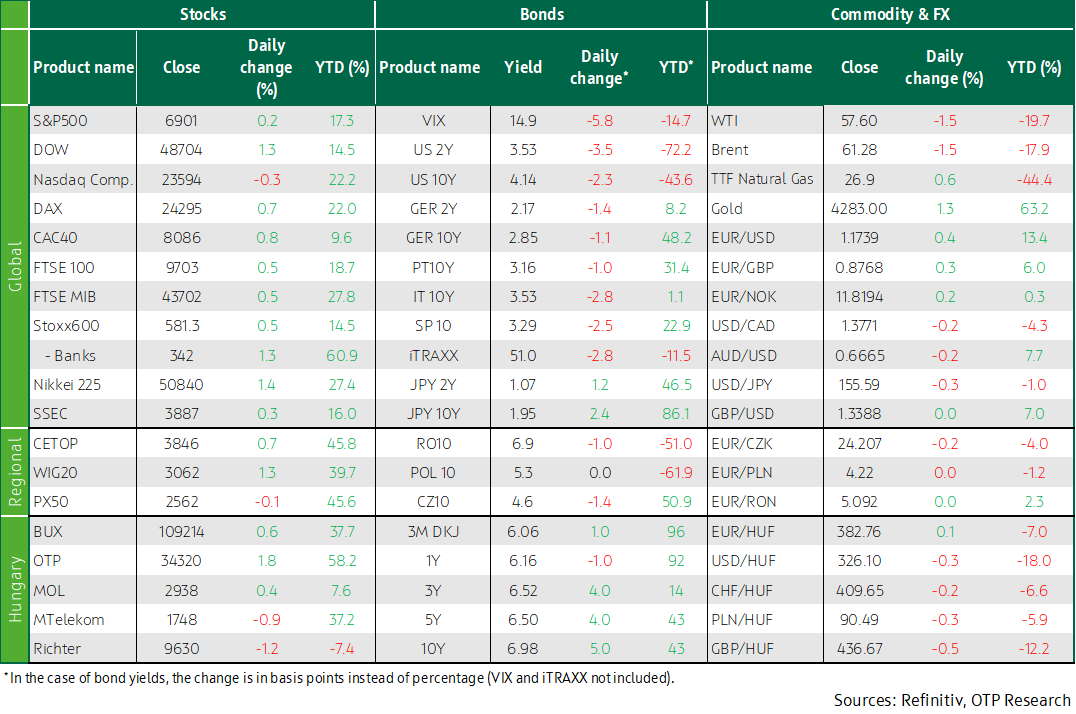
Europe’s key indices picked up from Wednesday's directionless trading. In Hungary, OTP led the gains, benefiting from favourable target prices. The Dow and the S&P500 closed at record highs, but Oracle’s almost 11% plunge dragged down the tech-heavy Nasdaq. US initial jobless claims rose to 236,000, but the continuing claims figure fell. US bond yields returned to Wednesday's levels by the close; the 10Y yield is hovering around 4.16%. The European Union's infringement procedure for Hungary’s margin price caps caused minor and partly temporary selling pressure in local markets.
Europe’s key indices picked up from Wednesday's directionless trading. In Hungary, OTP led the gains, benefiting from favourable target prices
After Wednesday's directionless trading, the leading indices of Europe climbed higher. The STOXX 600 and FTSE 100 rose by half a percent each, the DAX added 0.7%, and the CAC40 advanced 0.8%. Initially, Oracle's plunge left its mark on the sentiment in Europe, but the markets overcame it by the afternoon; eventually, even the technology sector closed near-stagnant. The latter benefited from the fact that SAP had worked off a significant part of its morning loss of around 3%. The banking sector (+1.7%) fared well, Unicredit (+2.4%) and ING (+2.2%) excelled. The construction (+1.7%) and the travel (+1.9%) sectors also helped the benchmark index. The European aerospace and defence index, which is sensitive to news of the Russia-Ukraine war, retreated 0.7% on Thursday.
Delivery Hero lost 5.3% of its value after Citigroup downgraded the German-based multinational food delivery company from Neutral to Sell. Schneider Electric announced a 3.5-billion-euro share buyback programme until 2030 and plans to increase its EBITA margin by 250 basis points over the same time horizon. The French-based technology company has recently gained more attention as a supplier of data centres, such as power switches, cooling systems, and server racks, which are the backbone of AI infrastructure. The share price surged 2.4% on Thursday. RS Group jumped 6.6%, to become the biggest individual gainer on the STOXX 600 after JP Morgan upgraded the industrial and electronics parts supplier from Neutral to Overweight.
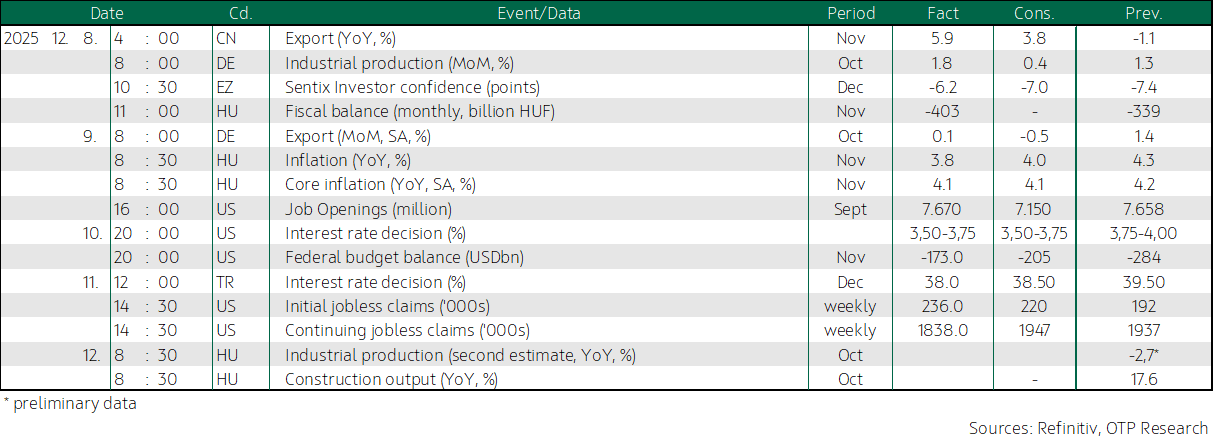
The Swiss National Bank left its key interest rate unchanged at 0%. Although inflation sank to 0% in November, it may not need to return to negative interest rates. Martin Schlegel, the president of the Swiss National Bank, said that the likelihood of using negative rates has not increased since the previous meeting. Turkey’s central bank cut its key interest rate by 150 basis points, to 38%.
On the Budapest Stock Exchange, OTP (+1.8%) posted the strongest gain, after Trigon Dom Maklerski raised its target price to HUF 39,200 and JP Morgan raised its target price to HUF 39,700. The BUX (+0.6%) and Poland's WIG20 (+1.3%) rose, while Czechia’s PX50 edged 0.1% lower.
After weeks of protests, Bulgaria’s government resigned yesterday.
The Dow and the S&P500 closed at record highs, but Oracle’s almost 11% plunge dragged down the tech-heavy Nasdaq Composite; US initial jobless claims hit 236,000
Continuing Wednesday's gains, the Dow Jones (+1.3%) and the S&P500 (+0.2%) closed at historic highs on Thursday. The Russell 2000 index of small-cap stocks closed 1.2% higher. That said, the tech-heavy Nasdaq underperformed (-0.25%), dragged down by Oracle's 10.8% nose-dive. Oracle posted disappointing revenue for the second fiscal quarter (September-November). Although the AI ??business continued to fare well, with backlogs rising 15% to USD 523 billion in the quarter, driven by orders from Meta and Nvidia, the USD 16.06 billion revenue fell short of analysts' expectations, even though it was up from a year earlier. To make it worse, the cost of default insurance (CDS spread) on Oracle's debt has risen sharply. Investors are concerned about the high debt level and the return on its gigantic AI investments. Eli Lilly (1.6%) said on Thursday that its next-generation obesity drug, retatrutide, outperformed the company's blockbuster drug Zepbound in late-stage clinical trials. Financials (+1.8%) were among top performers in the USA, just like in Europe. Visa jumped by 6.1%, while American Express, JP Morgan, and Goldman Sachs all soared more than 2%. Tesla sales fell to a near four-year low in November, even though the automaker introduced new, cheaper versions of its most popular electric vehicles. Sales of electric cars have generally dropped since the end of September, when the Trump administration eliminated the USD 7,500 federal tax credit for EVs.
In the USA, the number of people receiving continued unemployment benefits fell by almost 100,000, to 1.84 million; this figure is well below expectations of 1.95 million. However, the number of initial jobless claims rose to 236,000 from 192,000 the previous week. The 44,000 jump is the largest one since March 2020. Seasonal effects are particularly strong at this time of year, and the figure does not reduce uncertainty about the US labour market.
On Wednesday, the United States stepped up pressure on Venezuelan President Maduro by seizing a large oil tanker off the coast of Venezuela. The move, especially if followed by similar measures, may also affect oil prices. However, Brent and WTI prices fell by 1.5% yesterday.
US bond yields returned to Wednesday's levels by Thursday’s close; the 10Y yield is hovering around 4.16%. The European Union's infringement procedure for Hungary’s margin price caps caused minor and partly temporary selling pressure in local markets
Owing to the Fed's 25-basis-point interest rate cut on Wednesday and a surge in initial jobless claims, the decline in US yields proved to be temporary: bond yields returned to Wednesday's levels by Thursday’s close; the 10Y yield was hovering around 4.16%. Most yields in Europe sank by a few basis points: the 10Y German yield was at 2.85%. The dollar lost further ground against the euro, pushing EUR/USD 0.4 percent higher, to near 1.175.
In Hungary, there was minor and partly temporary selling pressure as the European Union initiated infringement proceedings against Hungary over the profit margin cap. The forint weakened by nearly 1% after the announcement, sending the EUR/HUF to 385, but then returned to around 382. The morning’s auction of Hungarian government bonds was a successful one: a total of around 200 billion forints worth of bids were submitted for 3Y, 5Y, and 10Y bonds, the average yields at the auctions were one or two basis points below Wednesday's benchmark yields. However, following the EU's announcement, yields jumped by 4-5 basis points; the 10Y benchmark yield bounced back to almost 7%.
Today’s highlights
Heading into the close today, Asia’s leading indices were in for strong gains. Japan’s Nikkei (+1.4%), Korea’s KOSPI (+1.1%), Hong Kong’s Hang Seng (+1.7%), and China’s SSEC (+0.4%) were all trading in positive territory.
Hungary will release the second estimate of industrial production in October. In the preliminary reading, output increased by 0.5% month-on-month, but production volume shrank by 2.7% year-on-year. Hungary’s KSH also publishes construction production statistical for October today.
Get more out of your investments!
Global Markets Services
OTP Global Markets offers a broad range of services in the field of local and international money and capital markets.
Read morePrivate Banking Services
Personal care and expertise with OTP Private Banking, along with the knowledge, security, and innovations of a multinational banking group.
Read more