
OTP Morning Brief: Uncertainty in the oil market continued
Related content
OTP Morning Brief: US producer price index came in above expectations, yet the US 10-year Treasury yield still declined
Western European equities continued to advance despite ongoing pressure on the technology sector. Wall Street indices also rebounded, recovering some ground after Wednesday’s sell-off. Healthcare was the standout performer on both sides of the Atlantic. Eurozone industrial production declined by 0.5% month-on-month in August. In the US, the producer price index accelerated to 6.3%, delivering another upside surprise in inflation developments. US retail sales increased by 0.8% compared to August. The US 10-year Treasury yield declined by more than 10 basis points. The long end of the Hungarian government bond yield curve also declined by 7-9 basis points. In Hungary, August wage data will be released today, while in the US, September industrial production figures are due.
OTP Morning Brief: US CPI data came in above expectations
European equity markets advanced, supported by strong results from ASML and the outstanding performance of the healthcare sector. US equity markets came under pressure following higher-than-expected September CPI data. The annual CPI rate accelerated to 3.7%, driven primarily by a surge in gasoline prices, while core CPI rose by 0.3% month-on-month, supported by higher housing costs and rising transportation service prices. Oil prices rose amid escalating tensions in the Middle East and the impact of the IEA's oil market report. US Treasury yields retreated after an initial increase, driven by Fed commentary, while European bond yields generally moved higher. The US macro calendar will be busy today, with investors focusing on September retail sales and producer price index data, as well as the New York Fed Manufacturing Index, weekly jobless claims, and business inventories. August industrial production data from the euro area will be released today.
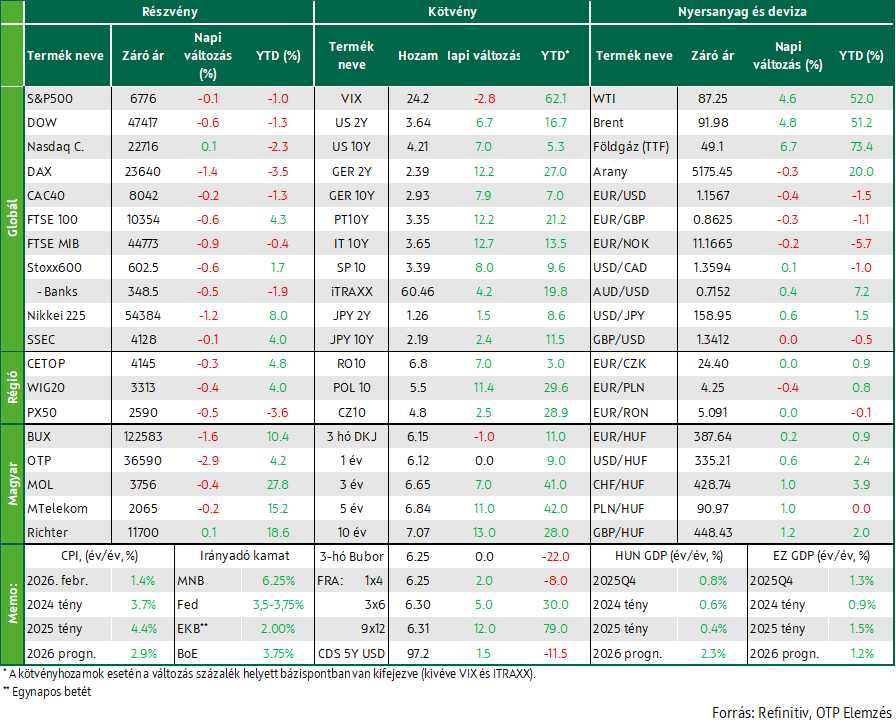
Europe’s indices fell yesterday; IEA decides torelease strategic reserves amid continued uncertainty in the Middle East. America’sindices closed mixed; US inflation in February was as expected; Oracle shares grew sharply. Developed markets’ bond yields rose; the USD strengthened; CEE currencie smoved mixed, the HUF weakened. Today, the US will release housing market data and the weekly jobless claims statistics. Turkey’s central bank holds rate-setting meeting.
Europe’s stocks fell on Wednesday; IEA is to release strategic reserves amid continued uncertainty in the Middle East
Europe’s stock markets declined yesterday. The Stoxx 600 index slipped 0.8%, as investors watched the escalation of military operations in the Middle East. Germany's Rheinmetall reported full-year revenue of EUR 9.94 billion and EUR 1.68 billion profit; despite its potential role in replacing US missile stocks depleted in the Iran war, its shares dived 8%. Porsche, which projected cost-cutting plans and an expansion of its model range after a year plagued by multiple profit warnings in 2025, saw its shares fall 1.2% yesterday. The exception to the negative sentiment was Inditex, which rose 0.5% thanks to strong first-quarter results. The Strait of Hormuz remained blocked, and the IEA has decided to release a record 400 million barrels of oil from its strategic reserves to offset the loss of oil supply. Oil prices grew sharply on the news: Brent jumped by 5.4%. Geopolitical risk was further heightened by the US military's announcement yesterday that it had destroyed Iranian ships, including 16 minelayers, in the Strait of Hormuz area, after Washington called on Iran to immediately remove mines it had laid in the area.
The indices of the CEE region fell, Hungary’s BUX underperformed. Of its blue chips, only Richter eked out gain.
US indices closed mixed; US inflation in February was in line with expectations; Oracle shares rose sharply
America’s stock markets closed mixed yesterday as investors continued to watch developments in the US-Iran war and oil market movements. The Dow Jones Industrial Average slipped 289 points, or 0.61%, to 47,417, the S&P500 shed 0.08%, but the Nasdaq Composite inched up 0.08%. Market analysts said the International Energy Agency’s record 400-million-barrel stock release alone would not solve the risks related to the Strait of Hormuz, especially the logistics of refined products such as kerosene. Adding to the uncertainty was news yesterday of another missile strike on a commercial vessel off the coast of Iran, stoking market fears that oil prices could remain high despite President Donald Trump’s earlier message that the war could end very soon. In the corporate world, Oracle ‘s shares skyrocketed 9% after reporting better-than-expected third-quarter results and a strong revenue outlook for 2027.
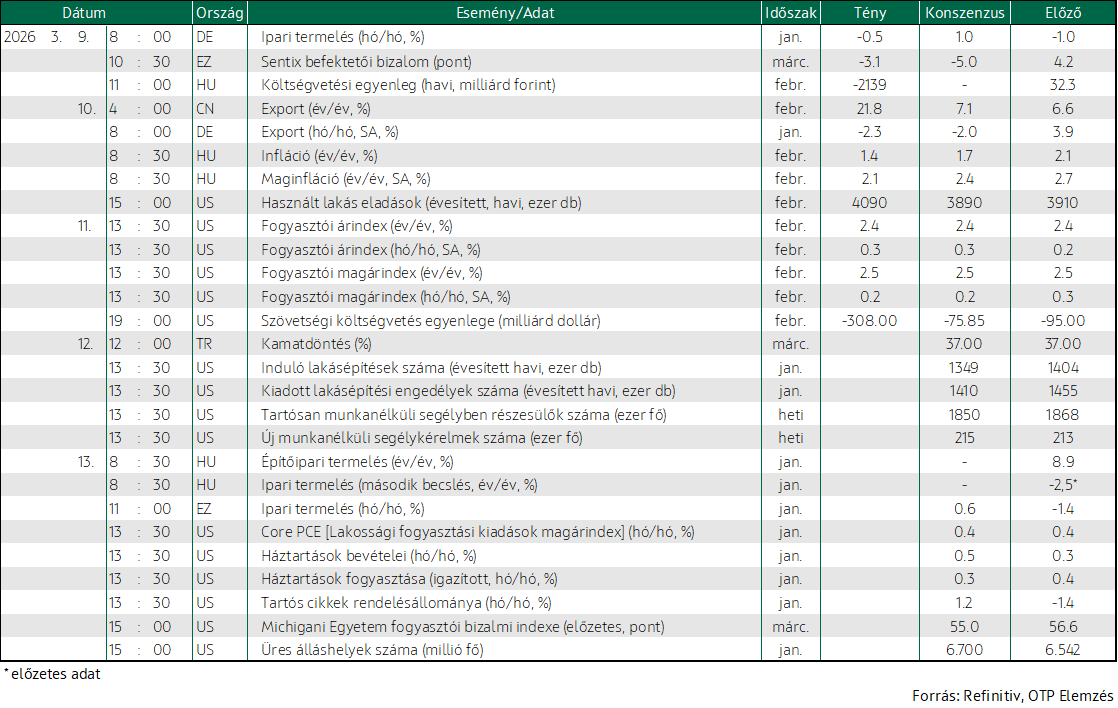
In line with market expectations, US annual inflation remained at 2.4% in February. This is the same as the January reading, and marks its lowest since May 2025. Details were mixed: energy prices rose 0.5% (as expected), gasoline prices slowed year-on-year, while diesel and natural gas prices rose. Food and housing inflation were unchanged, in line with forecasts, while used car prices fell. CPI rose 0.3% MoM, also in line with the consensus, but accelerated from 0.2% in January; housing contributed the most to this (+0.2%). Core inflation remained at 2.5% YoY, also in line with expectations, but it slowed to 0.2% MoM, from 0.3% in January.
Developed markets’ bond yields rose; the USD strengthened; CEE currencies moved mixed, the HUF weakened
Although US inflation and core inflation data were in line with expectations, rising tensions in the Middle East and growing oil prices have re-intensified inflation and interest rate hike expectations, especially since President Christine Lagarde said that the European Central Bank would do everything it can to keep inflation in check despite rising oil prices. The market expects at least one interest rate hike from the ECB this year, but even two moves could be in the cards, according to pricing. As a result, Germany’s 10Y Bund yield jumped by almost ten basis points, to around 2.95%, the top of its post-pandemic trading range; it has not been higher in more than three years. French and Italian yields rose by a few basis points stronger. US yields rose milder, still the ten-year dollar yield drew near 4.25%. As investors sought risk-free assets, the dollar strengthened by 0.4% against the euro, sending the EUR/USD to around 1.155.
The CEE currency market turned tables: on Tuesday, the HUF was the only currency to strengthen, but on Wednesday it was the only one to weaken against the euro (EUR/HUF: 388). The sentiment on bond markets was unenthusiastic. At the auction of six-month discount T-Bills, not even a quarter of the planned quantity could be sold, owing to anaemic demand. Interest was relatively stronger at the switch auction, where the planned HUF 10 billion bonds changed hands. Reference yields rose by about ten basis points; the ten-year yield drew near 7.1%.
Today’s highlights
Asia’s indices sank this morning – even though the IEA decided on a larger-than-ever strategic stock release; the measure does not appear to have reassured Asian investors.
Today, the US will release housing data and the usual weekly jobless claims figures. Turkey’s central bank will also hold a rate-setting meeting.
Today, the ÁKK auctions 12M discount T-Bills and 15Y fixed-interest bonds, offering HUF 20 billion and HUF 10 billion, respectively.
Get more out of your investments!
Global Markets Services
OTP Global Markets offers a broad range of services in the field of local and international money and capital markets.
Read morePrivate Banking Services
Personal care and expertise with OTP Private Banking, along with the knowledge, security, and innovations of a multinational banking group.
Read more