
OTP Morning Brief: Upside surprise in US job market data
Related content
OTP Morning Brief: US producer price index came in above expectations, yet the US 10-year Treasury yield still declined
Western European equities continued to advance despite ongoing pressure on the technology sector. Wall Street indices also rebounded, recovering some ground after Wednesday’s sell-off. Healthcare was the standout performer on both sides of the Atlantic. Eurozone industrial production declined by 0.5% month-on-month in August. In the US, the producer price index accelerated to 6.3%, delivering another upside surprise in inflation developments. US retail sales increased by 0.8% compared to August. The US 10-year Treasury yield declined by more than 10 basis points. The long end of the Hungarian government bond yield curve also declined by 7-9 basis points. In Hungary, August wage data will be released today, while in the US, September industrial production figures are due.
OTP Morning Brief: US CPI data came in above expectations
European equity markets advanced, supported by strong results from ASML and the outstanding performance of the healthcare sector. US equity markets came under pressure following higher-than-expected September CPI data. The annual CPI rate accelerated to 3.7%, driven primarily by a surge in gasoline prices, while core CPI rose by 0.3% month-on-month, supported by higher housing costs and rising transportation service prices. Oil prices rose amid escalating tensions in the Middle East and the impact of the IEA's oil market report. US Treasury yields retreated after an initial increase, driven by Fed commentary, while European bond yields generally moved higher. The US macro calendar will be busy today, with investors focusing on September retail sales and producer price index data, as well as the New York Fed Manufacturing Index, weekly jobless claims, and business inventories. August industrial production data from the euro area will be released today.
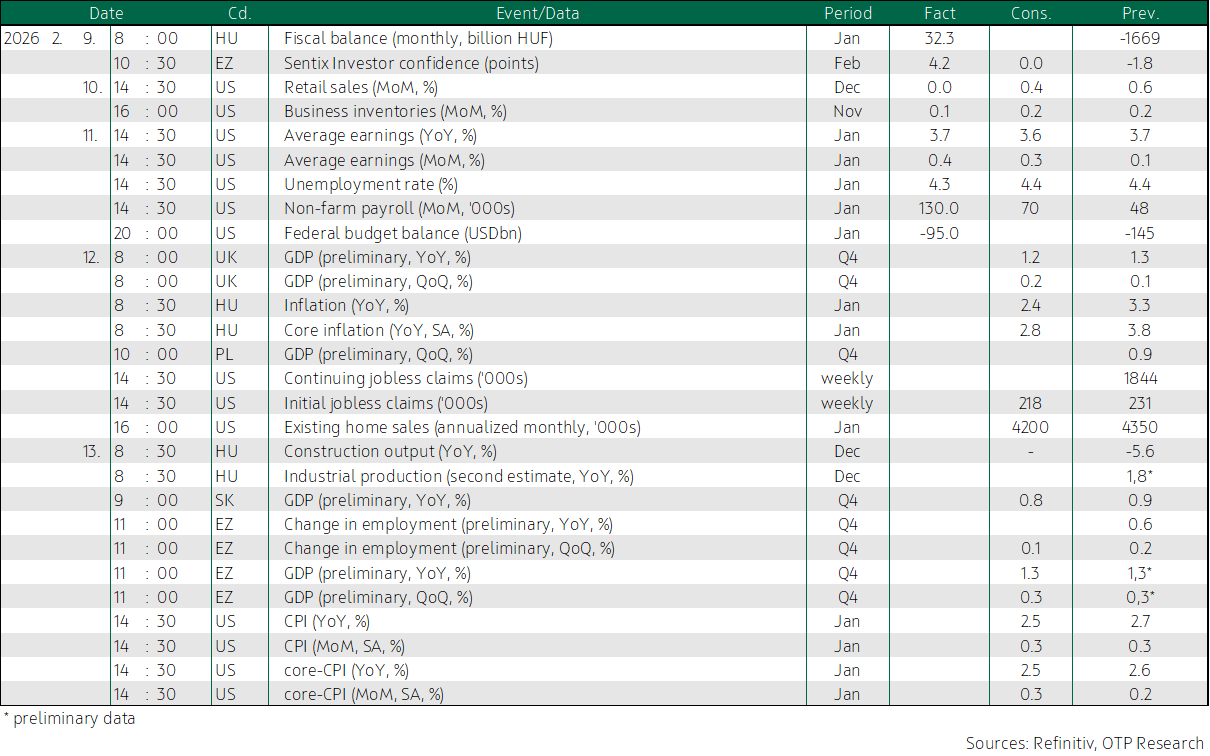
A 0.1% uptick led the STOXX 600 to record high. Technology and media stocks underperformed in Europe. Fears that AI may disrupt traditional companies in many sectors remain strong. In the USA, January job growth beat expectations: NFP grew by 130,000 and unemployment fell to 4.3%. The energy sector fuelled the rise on both sides of the Atlantic. US bond yields shed a few basis points on strong labour market data, yields in Europe were flat. The CBO expects US budget deficit at 5.8% of GDP in 2025 and 2026. Q4 GDP statistics from the UK and Poland, as well as the US jobless claim figures are data to watch today. Hungary publishes the January reading of inflation.
An 0.1% uptick took the STOXX 600 to record high
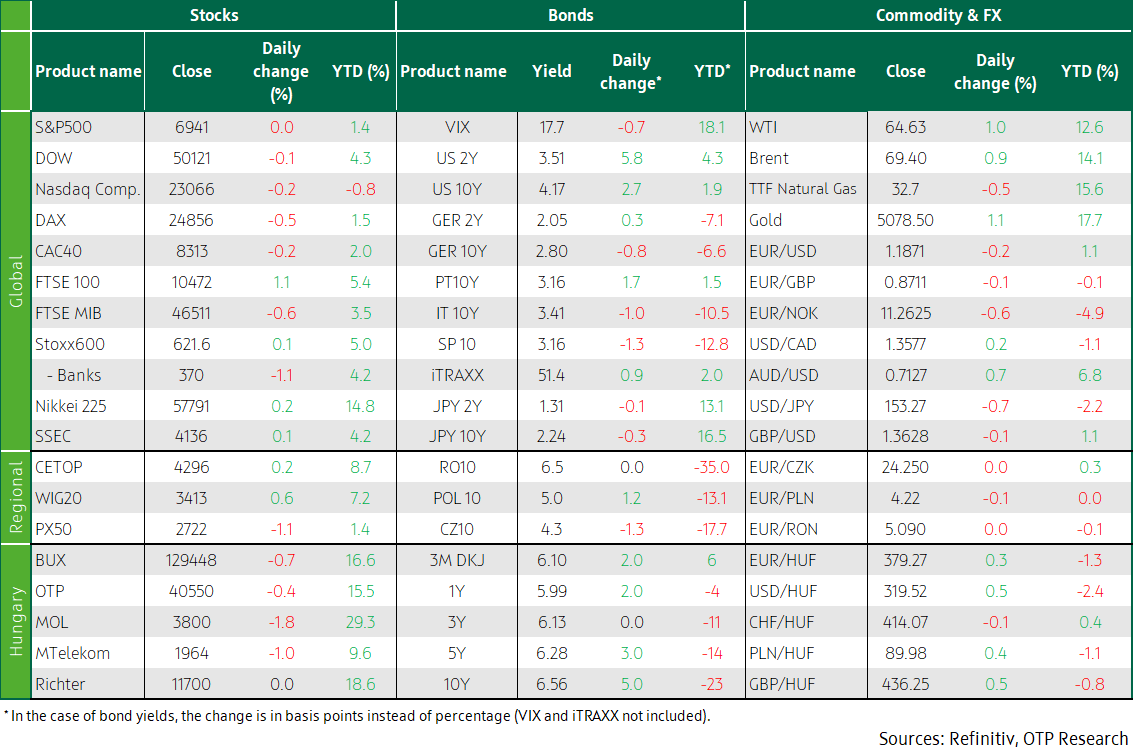
Having risen by 0.1%, the STOXX 600 closed at all-time high on Wednesday. Germany’s DAX (-0.5%) and France’s CAC40 (-0.2%) declined, while the UK’s FTSE 100 gained 1.1%. Rising oil prices helped energy stocks fuel growth, the sector index jumped by 3.8%. Technology (-1.8%) and media (-2.6%) stocks were the laggards. The latter was hit by sustained strong fears that artificial intelligence could disrupt certain industries, including ‘traditional’ software companies. France’s industrial software developer Dassault Systemes nose-dived 20.8% on Wednesday after reporting a 5% drop in software revenue in the fourth quarter of 2025. Siemens Energy’s net profit nearly tripled in the first three months of the company’s current fiscal year, boosted by AI-driven demand for gas turbines and grid equipment, and thanks to smaller losses at its struggling wind turbine business. Big tech companies plan to spend about USD 600 billion on AI in 2026, creating significant demand for power plants and grid infrastructure. The AI boom has helped Siemens Energy’s share price grow more than tenfold in the past two years; it soared 8.4% on Wednesday.
Heineken, which is looking to replace CEO Dolf van den Brink, said on Wednesday it could cut up to 6,000 jobs from its global workforce of 87,000, in a bid to boost productivity. The company lowered its profit growth forecast from last year, expecting 2%–6% increase 2026, as the Dutch brewery and its rivals face weak demand. Investors welcomed the announcement, the share price shot up 4.4% yesterday. Germany’s Commerzbank said on Wednesday it expected its 2026 net profit to exceed its previous target of EUR 3.2 billion. In 2025, net profit shrank slightly due to restructuring costs but beat analysts’ expectations. Italy’s UniCredit has acquired a 26% stake in the German bank and continues to push for a merger between the two banks, while Commerzbank executives are trying to convince shareholders of the viability of the bank’s standalone strategy. The German government is also opposed to the takeover. Commerzbank’s share price fell 2% on Wednesday.
The European Commission this week approved Volkswagen Group’s request to exempt its Chinese-made all-electric Cupra Tavascan SUV from import duties, in exchange for a minimum price and sales quota. While China had been seeking a collective agreement on tariffs on electric vehicles between its automakers and the EU, Volkswagen’s bilateral deal is a sign that a collective solution is increasingly unlikely.
In the CEE region, Hungary’s BUX lost 0.7% and Czechia’s PX50 fell 1.1%, while Poland’s WIG20 gained 0.6%.
In the USA, January job growth surpassed expectations
The Nasdaq and Dow edged lower on Wednesday, while the S&P 500 closed practically flat.
US jobs report for January came in better than expected. Nonfarm payrolls rose by 130,000, exceeding the consensus forecast of 70,000, and posting the best figure since early 2025. In addition, the annual benchmark revisions were not as negative as many had feared, as the monthly growth estimate for last month, which was originally an average of 49,000, was revised down to a still positive 15,000. Wrong-footing those expecting stagnation, the unemployment rate dropped to 4.3%. Wage growth remained strong, at 3.7% year-on-year in January. Even the average weekly workweek rose from 34.2 hours to 34.3 hours. The latest statistics suggest that the labour market is stable and strong – at a time when data on the US labour market tend to be inconsistent. In terms of the market impact of the data releases, the stronger-than-expected employment data eased concerns about the economy, but reinforced expectations that the Fed may slow the pace of interest rate cuts. Thus, the initial strong gains in all three major stock market indices quickly melted away. Eight of the eleven main sectors of the S&P 500 rose yesterday. Financial services and communication services lost more than 1%, while energy marched 2.6% higher, second to it was the defensive consumer staples sector (+1.4%). The technology sector moved mixed: chipmakers grew sharply while software companies slid, ending three days of gains. The Philadelphia Semiconductor Index soared 2.3%, while the S&P 500 software index slumped 2.6%. Microsoft slid 2.2%, while Alphabet (-2.3%) weighed heavily on communications services index. Brokerage firms, which had already fallen on Tuesday after startup Altruist announced AI-powered tax planning features, weakened further on Wednesday, with Charles Schwab and Ameriprise Financial slipping nearly 4% each and LPL Financial diving 6.1%.
The U.S. budget deficit is expected to rise slightly in 2026, to USD 1.853 trillion, the Congressional Budget Office (CBO) said in a forecast released on Wednesday. The CBO said the deficit in fiscal year 2026 will be about 5.8% of GDP, roughly the same as in 2025. But the U.S. deficit-to-GDP ratio will average 6.1% over the next decade and reach 6.7% by 2036. The CBO forecasts a much slower economic growth than the Trump administration's estimates.
Strong labour market data pushed US bond yields a few basis points higher
China’s lower-than-expected inflation data led to a drop in yields on global bond markets, but stronger-than-expected January US labour market data on all fronts – job creation, unemployment, wages – have turned the tables. In the end, US bond yields upped a few basis points, but the 10-year yield still closed below 4.2%. There was no significant movement in European bond markets, Germany’s 10-year Bund yield remained around 2.8%. The dollar gained strength from the strong labour market data, and the EUR/USD sank below 1.19 by the afternoon.
On Monday, Hungary’s forint strengthened to its strongest since the end of 2023, pushing the EUR/HUF below 377, before the slow reversals (by 0.3% each on Tuesday and Wednesday) drove the cross to 379.5. Hungary’s benchmark bond yields on 5Y maturities and beyond rose by 3-5 basis points, but the 10Y yield is still around its one-year low, slightly above 6.5%.
Investors sought longer-term bonds at yesterday's auctions. At the auction of six-month discount Treasury Bills, the amount on offer (HUF 30 billion) was sold with moderate demand, at an average yield of 6.06%. However, there was hefty demand at the switch auctions, where the ÁKK offered 2033/A and 2037/A bonds worth HUF 15 billion in each, in exchange for securities maturing this year. Bids totalled more than HUF 130 billion, and nearly HUF 100 billion, respectively. The ÁKK did not hesitate to exchange bonds worth HUF 80 billion and 60 billion, respectively, at average yields of 6.34% and 6.63%.
Today’s highlights
Heading into the close in Asia, Japan’s Nikkei upped 0.2%, the KOSPI soared 2.8%, the SSEC added 0.1%, while the Hang Seng sank 0.8%.
Hungary publishes inflation data for January today. We forecast 2.3% year-on-year inflation, thus we expect the index to have fallen well below the MNB's 3% target. January is one of the most significant repricing periods of the year, so January inflation data always carry extra uncertainty. Previously, the MNB indicated that inflation data from the beginning of the year would be crucial in the timing of its easing cycle. Beyond the possibly reassuring headline data, the indicators that better capture underlying processes are also worth checking.
Elsewhere, the United Kingdom and Poland release GDP data for the fourth quarter. In the USA, initial jobless claims will reveal whether the previous week's figure of 231,000 was a one-off spike. The January reading of existing home sales will also come to light in the USA.
In Hungary, the ÁKK auctions 12M discount T-Bills, 15Y, and 20Y fixed-interest bonds (2041/A, 2051/G), offering HUF 30, 15 and 15 billion, respectively.
Get more out of your investments!
Global Markets Services
OTP Global Markets offers a broad range of services in the field of local and international money and capital markets.
Read morePrivate Banking Services
Personal care and expertise with OTP Private Banking, along with the knowledge, security, and innovations of a multinational banking group.
Read more