
OTP Morning Brief: Equities reversed course on Monday
Related content
OTP Morning Brief: US producer price index came in above expectations, yet the US 10-year Treasury yield still declined
Western European equities continued to advance despite ongoing pressure on the technology sector. Wall Street indices also rebounded, recovering some ground after Wednesday’s sell-off. Healthcare was the standout performer on both sides of the Atlantic. Eurozone industrial production declined by 0.5% month-on-month in August. In the US, the producer price index accelerated to 6.3%, delivering another upside surprise in inflation developments. US retail sales increased by 0.8% compared to August. The US 10-year Treasury yield declined by more than 10 basis points. The long end of the Hungarian government bond yield curve also declined by 7-9 basis points. In Hungary, August wage data will be released today, while in the US, September industrial production figures are due.
OTP Morning Brief: US CPI data came in above expectations
European equity markets advanced, supported by strong results from ASML and the outstanding performance of the healthcare sector. US equity markets came under pressure following higher-than-expected September CPI data. The annual CPI rate accelerated to 3.7%, driven primarily by a surge in gasoline prices, while core CPI rose by 0.3% month-on-month, supported by higher housing costs and rising transportation service prices. Oil prices rose amid escalating tensions in the Middle East and the impact of the IEA's oil market report. US Treasury yields retreated after an initial increase, driven by Fed commentary, while European bond yields generally moved higher. The US macro calendar will be busy today, with investors focusing on September retail sales and producer price index data, as well as the New York Fed Manufacturing Index, weekly jobless claims, and business inventories. August industrial production data from the euro area will be released today.
Geopolitical tensions escalated during the weekend, and a new chapter in the Trump-Powell conflict also drove investors towards safer assets on Monday morning. Gold and silver are at record levels, the dollar has weakened. Defence and tech shares soared last week. The BUX outperformed its regional peers last week. The Dow and S&P500 reached new highs on Friday as the unemployment rate fell in December, although non-farm employment rose slower than hoped. The eurozone’s bond yields fell markedly last week. The dollar strengthened, the EUR/HUF climbed higher. Oil prices rose last week. Hungary’s industrial production data and the eurozone’s Sentix investor confidence index will be released today. Later in the week, Hungary and the US publish CPI data. The earnings season kicks off in the USA.
Western Europe’s key indexes hit new highs on news of Glencore takeover bid, but tech stocks also revved up
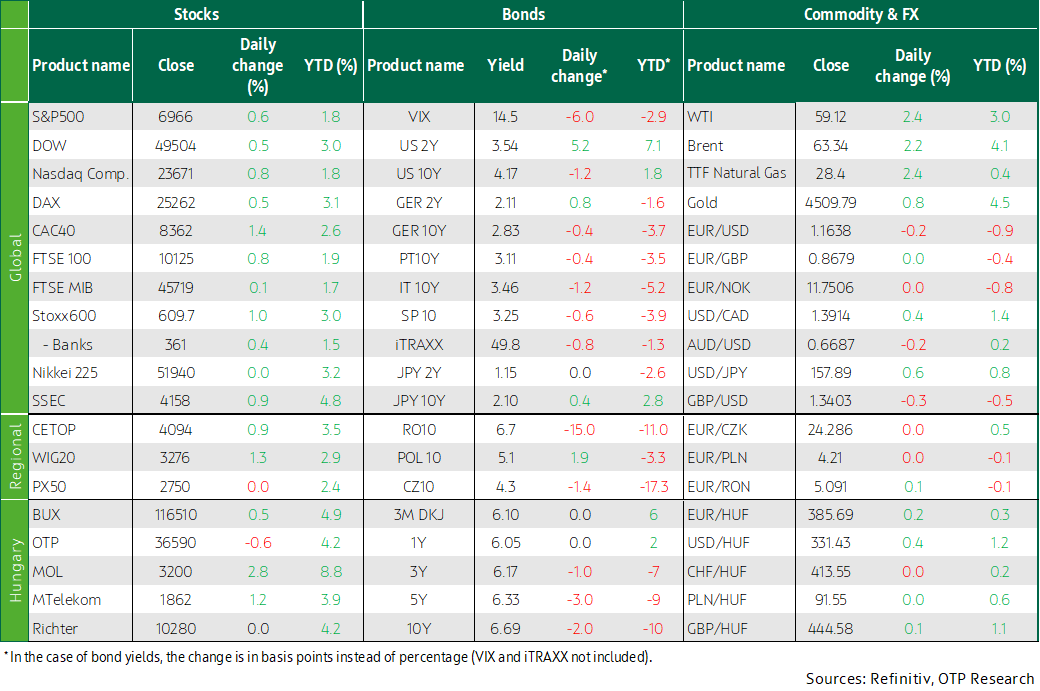
Western Europe’s stock markets ended last week on a bright note: the Stoxx600 (+1%), the FTSE100 (+0.8%), the DAX (+0.5%), and the CAC40 (+1.4%) all closed at record levels. What gave markets a boost on Friday morning was Rio Tinto's Thursday announcement that it was in initial talks to acquire Glencore; the latter closed Friday's trading 10% higher, while Rio Tinto lost 2.6%. In addition to the materials sector, technology also fuelled the Stoxx600's growth on Friday as Taiwan's TSMC, the world's largest chipmaker, reported stronger-than-expected fourth-quarter figures. ASML's share price jumped nearly 7% on HSBC's target price increase. Infineon surged 2.4%, STMicroelectronics advanced almost 3%. The retail segment continued to decline: Pandora dived 13% after warning of weaker revenue growth in 2025. Sainsbury's closed 5% in the red, as the department store chain warned of a decline in general merchandise and clothing sales. Separately, the Euro area’s retail sales turnover statistics surprised to the upside.
The leading indices in Europe ground 1-3% higher over the past week: the Stoxx600 and the CAC40 added more than 2% each, the FTSE100 grew by 1.7%, and the DAX surged 2.9%. The tech sector’s strengthening was an engine of this impressive weekly growth; the sector index soared roughly 10%, partly benefiting from US President Donald Trump's call for increased defence spending.
European gas futures increased by 3%. Having slipped by 1.4% last week, the price of 28 EUR/MWh is still relatively low.
The CEE region’s stock indices performed mixed: the Warsaw index rose by 1.3%, the Czech benchmark closed flat, while the BUX added 0.5%. Of the latter’s blue chips, Mol and MTelekom climbed higher, Richter stagnated, and OTP eased by 0.6%. Over the past week, the BUX outperformed, jumping by nearly 5%, largely fuelled by Mol , and (+9%) and OTP (+4%), which hit a new high last week.
In December, US non-farm payrolls rose slower than hoped but the unemployment rate edged lower; the Dow and S&P500 hit new highs
America’s key stock indices closed at new highs on Friday after December’s jobs report indicated a slower-than-expected increase in non-farm payrolls, but the unemployment rate edged lower. The US Labor Department reported a 50,000 increase in non-farm payrolls in December (vs the consensus forecast of 60,000), while the November figure was revised down to 56,000 from 64,000. The unemployment rate dropped to 4.4% as expected, falling from November’s 4.5%, which was revised down from 4.6%.
The latest labour market data did not overwrite expectations of rate cuts this year. The Dow (+0.5%), the S&P500 (+0.65%), and the Nasdaq Composite (+0.8%) all increased, and each achieved gains in last week trading: the Dow (+2.3%), the S&P500 (+1.6%), and the Nasdaq Composite (+2%) all advanced. Technology stocks did well on Friday, especially chipmakers; the Philadelphia Semiconductor Index went up nearly 3%, to a record high. Intel rallied nearly 11% after President Trump said he had a great meeting with the company's CEO, Lip-Bu Tan. Lam Research jumped nearly 9%, Mizuho raised its price target on the chip equipment maker by 10%, to USD 220. Broadcom (+4%), Alphabet (+1%) and Tesla (+2%) all excelled. Nine of the S&P500’s eleven sector indexes closed in the green, fuelled by the materials and utilities sectors. Mortgage lenders marched higher after Donald Trump announced he would order his representatives to buy USD 200 billion in mortgage bonds to help lower housing costs. LoanDepot skyrocketed nearly 20%, Rocket Companies shot up 10%, and Opendoor Technologies jumped by 13%. The Philadelphia Housing Index surged almost 6%. General Motors shares reversed more than 2% on Friday after the automaker announced a day earlier that it would take a six-billion-dollar write-down for cancelling investment in electric vehicles.
Crude oil prices grew by 2% on Friday, as supply concerns resurfaced owing to the protests in Iran. On Friday, OPEC said that member countries had produced 28.4 million barrels of oil per day in December, 100,000 barrels less than in November. Iran and Venezuela saw the biggest falls.
Europe’s and America’s yields in barely moved on Friday. The eurozone’s yields sank last week. The EUR/HUF climbed higher
Of the data released on Friday, the eurozone’s retail sales were stronger than expected. The USA released unexpectedly strong labour market data for December: the unemployment rate came in lower than thought, while wage growth accelerated, even though the 50,000 job creation slightly missed expectations and fell significantly short of the 200,000 mark, the level considered to be normal.
Yields on Europe’s bond markets eased by one or two basis points on Friday. Over the past week, most of them sank by 5-10 basis points from the top of the post-pandemic trading range, due to lower-than-expected December inflation data, which pushed the date of the ECB’s expected interest rate hike to a much later date, to the second half of 2027. The German 10Y Bund yield dropped from 2.9% to around 2.8%. On Friday, the short end and the belly of the US yield curve rose, but yields on 10Y maturities and beyond declined: the 10Y yield traded below 4.2% and closed last week’s trading essentially flat. The market still expects the Fed to cut interest rates twice in 2026. As rate cut expectations in Europe have waned, the euro’s weakening against the dollar continued: the EUR/USD eased 0.3% on Friday and sank nearly 1% last week.
In Hungary, Minister of National Economy Márton Nagy said last week that in 2025 the budget deficit could be 4.9% of GDP (on accrual basis) and the public debt could be 74.6%. In November, Hungary’s foreign trade balance unexpectedly deteriorated and turned into deficit. The ÁKK started the new year by FX bond issue, issuing 10Y and 15Y foreign exchange bonds worth EUR 3 billion. The dollar’s strengthening did not benefit the CEE region’s currencies last week: only the stagnant zloty held up well, while the koruna (CZK) and the forint (HUF) depreciated. The Hungarian currency’s weakening pushed the EUR/HUF from around 384 to 386 by Friday, partly due to November’s unexpectedly weak foreign trade balance data. The slow decline in yields continued on the bond market, where yields shed 2-3 basis points on Friday and dropped by 10 basis points last week; the 10Y yield sank below 6.7%. The yield curve is consistent with four 25-basis-point interest rate cuts this year.
Today’s highlights
Asia’s main stock indices were seen in positive territory, except for India’s benchmark, today: the Shanghai Composite and the Hang Seng rose by 0.8% each, and the Kospi indices upped 0.2-0.6%. The rise in Chinese stock indices was mainly driven by the soaring technology, especially AI companies, as well as commercial real estate firms. The Shanghai Composite climbed to its highest in a decade. Japan’s stock market is closed for a holiday today.
Index futures did not bode well for today’s opening in the USA and Europe. Gold and silver hit new all-time highs on Monday as risk aversion intensified amid geopolitical tensions and after Jerome Powell said on Sunday that the Trump administration had threatened him with criminal indictment over his Congressional testimony. The Fed chair found that a pretext and a move aimed at further pressuring the Fed to cut interest rates. In addition to stock futures, the dollar also stumbled on Monday morning, causing the EUR/USD to climb above 1.166.
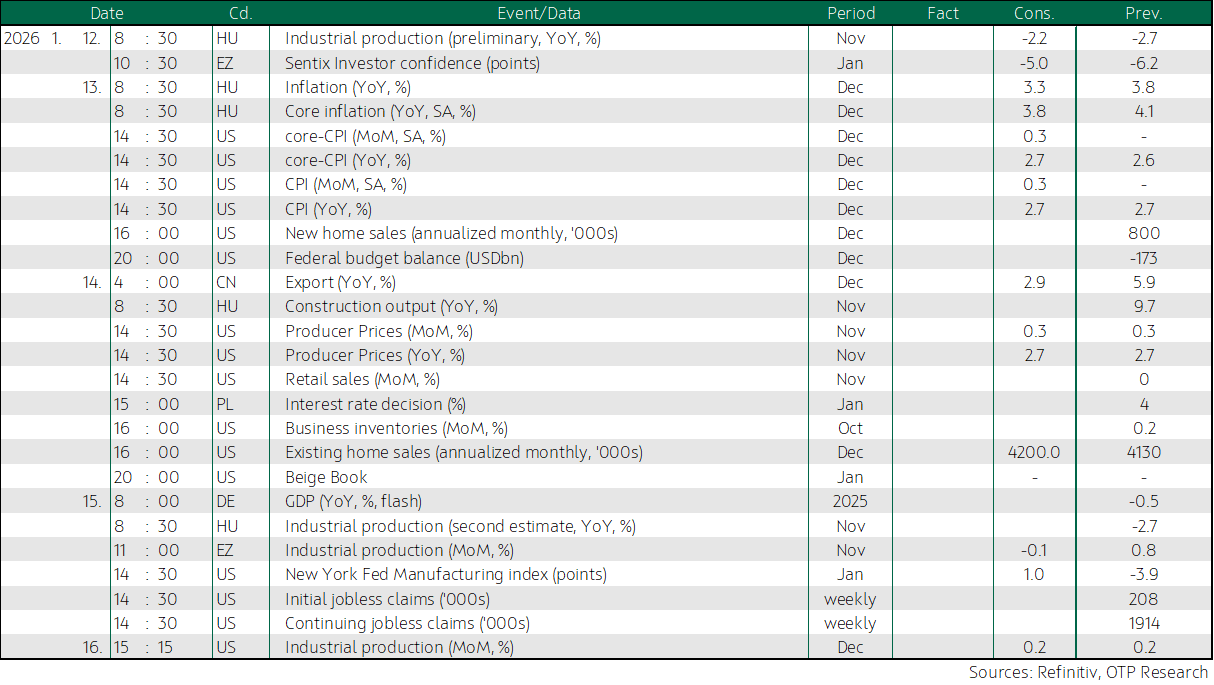
Today, the Sentix investor confidence index is due in the eurozone, while Hungary publishes preliminary industrial output data for November.
Later this week, Hungary is to publish inflation data on Tuesday; the market consensus expects prices to have increased by 3.3% year-on-year in December, while our forecast is 3.0%. In another key publication this week, the US inflation data for December will be released also on Tuesday. Other important releases include US retail sales data and the Fed's Beige Book on Wednesday, and Germany’s preliminary 2025 GDP data on Thursday.
This week, the fourth-quarter corporate earnings season begins with the reports of the major US banks. JPMorgan and Bank of New York kick off the season on Tuesday, followed by Bank of America, Wells Fargo, and Citigroup on Wednesday, and then Morgan Stanley, Goldman Sachs and BlackRock on Thursday.
Get more out of your investments!
Global Markets Services
OTP Global Markets offers a broad range of services in the field of local and international money and capital markets.
Read morePrivate Banking Services
Personal care and expertise with OTP Private Banking, along with the knowledge, security, and innovations of a multinational banking group.
Read more