
OTP Morning Brief: December’s US retail sales were weaker than hoped
Related content
OTP Morning Brief: US producer price index came in above expectations, yet the US 10-year Treasury yield still declined
Western European equities continued to advance despite ongoing pressure on the technology sector. Wall Street indices also rebounded, recovering some ground after Wednesday’s sell-off. Healthcare was the standout performer on both sides of the Atlantic. Eurozone industrial production declined by 0.5% month-on-month in August. In the US, the producer price index accelerated to 6.3%, delivering another upside surprise in inflation developments. US retail sales increased by 0.8% compared to August. The US 10-year Treasury yield declined by more than 10 basis points. The long end of the Hungarian government bond yield curve also declined by 7-9 basis points. In Hungary, August wage data will be released today, while in the US, September industrial production figures are due.
OTP Morning Brief: US CPI data came in above expectations
European equity markets advanced, supported by strong results from ASML and the outstanding performance of the healthcare sector. US equity markets came under pressure following higher-than-expected September CPI data. The annual CPI rate accelerated to 3.7%, driven primarily by a surge in gasoline prices, while core CPI rose by 0.3% month-on-month, supported by higher housing costs and rising transportation service prices. Oil prices rose amid escalating tensions in the Middle East and the impact of the IEA's oil market report. US Treasury yields retreated after an initial increase, driven by Fed commentary, while European bond yields generally moved higher. The US macro calendar will be busy today, with investors focusing on September retail sales and producer price index data, as well as the New York Fed Manufacturing Index, weekly jobless claims, and business inventories. August industrial production data from the euro area will be released today.
Most stock markets in Europe declined yesterday. Earnings from Philips and Kering beat expectations; BP’s shares fell. America’s major indices closed mixed. Disappointing retail sales data put retail stocks under pressure. The financial sector’s shares also fell. US business inventories grew less than expected. Developed markets’ and Hungary’s yields declined. The USD strengthened slightly, while theHUF weakened somewhat, paring previous gains. Employment and federal budget data will be published in the USA today.
Most of Europe’s stock markets declined on Tuesday; Philips’s and Kering’s reports beat expectations; BP’s shares fell
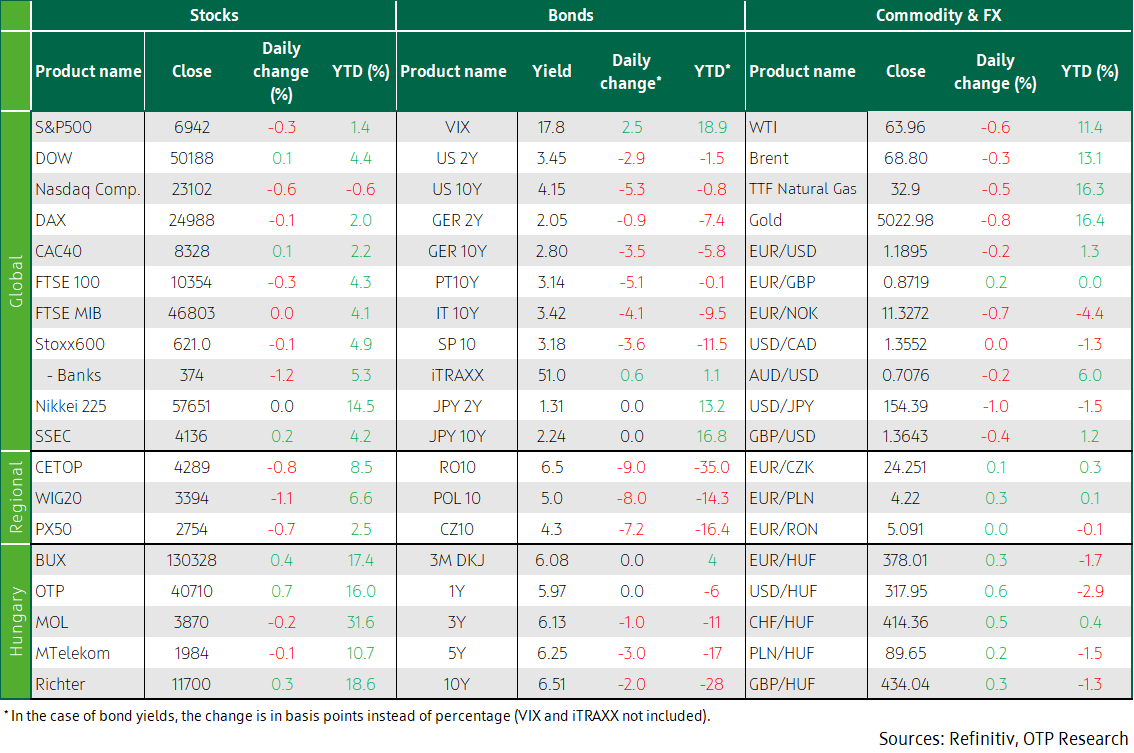
In Europe, many stock markets ended in the red on Tuesday. Several major European companies released their results. The 2025 annual report of Philips revealed that it had achieved a 6% increase in order intake, returned to profitability after a loss-making 2024, and forecast sales growth of 3-4.5% for 2026. The stock price jumped nearly 12%. In contrast, BP lost 6.1% after announcing that it will suspend share buybacks to strengthen its balance sheet, and its 2025 net profit of USD 7.49 billion missed expectations. Shares in France's Kering jumped by 10.9% as the revenue of Gucci’s owner beat analysts' forecasts and the company expects growth to return by 2026. The positive sentiment buoyed the entire luxury segment. Investors continue to keep an eye on political developments in Britain, where Prime Minister Keir Starmer's position has been weakened by fresh criticism and scandals surrounding the appointment of Peter Mandelson to Washington.
The CEE region's indices closed mixed: the BUX rose, but the Prague and Warsaw indices slipped. In Budapest, OTP and Richter rose, while the other two blue chips subsided.
US indexes closed mixed; pale retail sales data put retail stocks under pressure; the financial sector’s stocks also fell; US business inventories rose less than expected
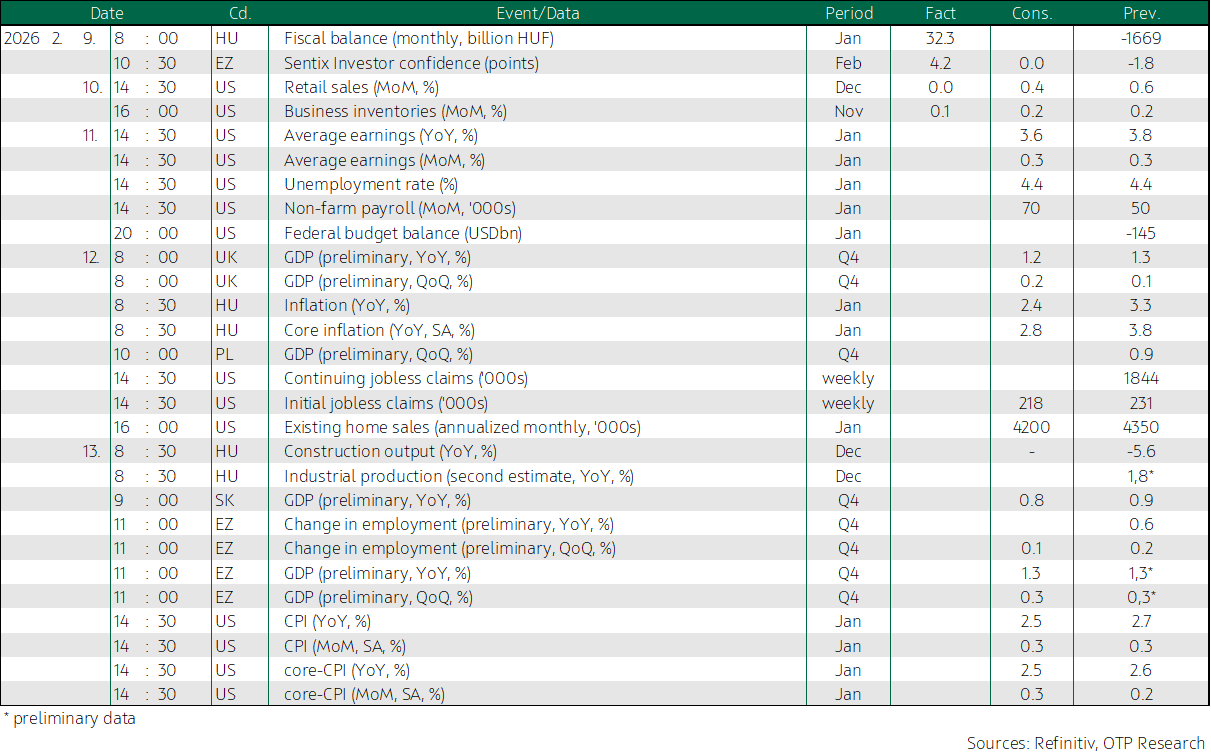
US indexes closed mixed on Wednesday as investors grew cautious on weaker-than-expected retail sales data and the potential impact of artificial intelligence on the financial sector. The retail sector came under pressure: shares in Costco and Walmart slid nearly 2%. In the USA, retail sales were flat in December, well below market expectations for a 0.4% increase and in a clear slowdown from a 0.6% increase in November. The ex-auto and fuel sales figure also stagnated, while the control group retail sales, used to calculate GDP, shrank 0.1% MoM, in the first decline in three months. Investors focused on key macro data due later this week: non-farm payrolls on Wednesday and the consumer price index on Friday. The financial sector also saw selling pressure after technology platform Altruist unveiled a new tax planning tool based on artificial intelligence: LPL Financial shares (-8.3%), Charles Schwab (-7.4%), and Morgan Stanley (-2.4%) all suffered painful losses. At the same time, there was a rotation into sectors that are less sensitive to cycles, such as basic materials and utilities.
Meanwhile, US business inventories upped just 0.1% in November 2025, missing the market consensus of 0.2%. Inventories rose at wholesalers (0.2%) and manufacturers (0.1%), while retail inventories dipped 0.1%. Inventories rose by 1.2% year-on-year.
Developed markets’ and Hungary’s yields declined; the dollar strengthened slightly; the forint weakened somewhat, reversing a previous appreciation
In Japan, bond trading started with a decline in yields, as fears of excessive fiscal spending eased after the two-thirds victory of the Liberal Democratic Party led by Takaichi Sanae. Japan’s 10Y yield sank by six basis points, to less than 2.25%. Later, the weaker-than-expected US retail sales data and the slowing rise in wage costs (quarterly growth of 0.7% after the previous 0.8%) contributed to the decline in yields on both sides of the Atlantic. The ten-year dollar yield sank by more than 5 basis points, to 4.15%. In the eurozone, there was a smaller yield decrease of 3-4 basis points; the 10Y German yield sank to 2.8%. Ending Monday’s dollar weakening, the EUR/USD sank below the 1.19 mark yesterday.
Reversing a previous rapid strengthening, the forint lost 0.4% on Tuesday, sending the EUR/USD above the 378 level. The zloty (PLN) and the koruna (CZK) also weakened, but to a lesser extent. Bond yields sank again, by 1-3 basis points, thus the 10Y yield dropped to the bottom of its 12-month trading range, to 6.5%. There was adequate demand at the auction of three-month discount Treasury Bills, and the ÁKK did not hesitate to sell HUF 50 billion worth of T-bills (vs the planned 30bn), at an average yield of 6.1%.
Today’s highlights
Asia’s stock markets were on the rise today. In China, January inflation came in at a lower-than-expected 0.2%, confirming the deflationary situation in the absence of major stimulus. Japan’s markets were closed for a national holiday.
Today, the USA releases average earnings and unemployment data, non-farm payrolls for January, as well as the US federal budget balance for January.
In Hungary, the ÁKK auctions six-month discount Treasury Bills, offering HUF 30 billion. At the switch auction, investors can obtain 2033/A and 2037/A bonds worth HUF 15 billion in each, in exchange for securities maturing this year.
Get more out of your investments!
Global Markets Services
OTP Global Markets offers a broad range of services in the field of local and international money and capital markets.
Read morePrivate Banking Services
Personal care and expertise with OTP Private Banking, along with the knowledge, security, and innovations of a multinational banking group.
Read more