
OTP Morning Brief: All eyes on the Fed
Related content
OTP Morning Brief: US producer price index came in above expectations, yet the US 10-year Treasury yield still declined
Western European equities continued to advance despite ongoing pressure on the technology sector. Wall Street indices also rebounded, recovering some ground after Wednesday’s sell-off. Healthcare was the standout performer on both sides of the Atlantic. Eurozone industrial production declined by 0.5% month-on-month in August. In the US, the producer price index accelerated to 6.3%, delivering another upside surprise in inflation developments. US retail sales increased by 0.8% compared to August. The US 10-year Treasury yield declined by more than 10 basis points. The long end of the Hungarian government bond yield curve also declined by 7-9 basis points. In Hungary, August wage data will be released today, while in the US, September industrial production figures are due.
OTP Morning Brief: US CPI data came in above expectations
European equity markets advanced, supported by strong results from ASML and the outstanding performance of the healthcare sector. US equity markets came under pressure following higher-than-expected September CPI data. The annual CPI rate accelerated to 3.7%, driven primarily by a surge in gasoline prices, while core CPI rose by 0.3% month-on-month, supported by higher housing costs and rising transportation service prices. Oil prices rose amid escalating tensions in the Middle East and the impact of the IEA's oil market report. US Treasury yields retreated after an initial increase, driven by Fed commentary, while European bond yields generally moved higher. The US macro calendar will be busy today, with investors focusing on September retail sales and producer price index data, as well as the New York Fed Manufacturing Index, weekly jobless claims, and business inventories. August industrial production data from the euro area will be released today.
On Tuesday, markets awaited today’s decision of the Fed, where the current 3.75-4.0% interest rates may be cut by 25 bps. Stock investors were sitting on the fence on both sides of the Atlantic, only corporate news moved markets. Crude oil prices sank deeper. Developed economies’ bond yields made tiny movements. The BUX rose by 0.6%, underperforming its peers. After four months of stagnation at 4.3%, Hungary’s CPI slowed to 3.8% in November, easing into the MNB's tolerance band. The forint has strengthened against the euro.
Europe’s stock markets ended Tuesday’s trading with small movements; the BUX rose
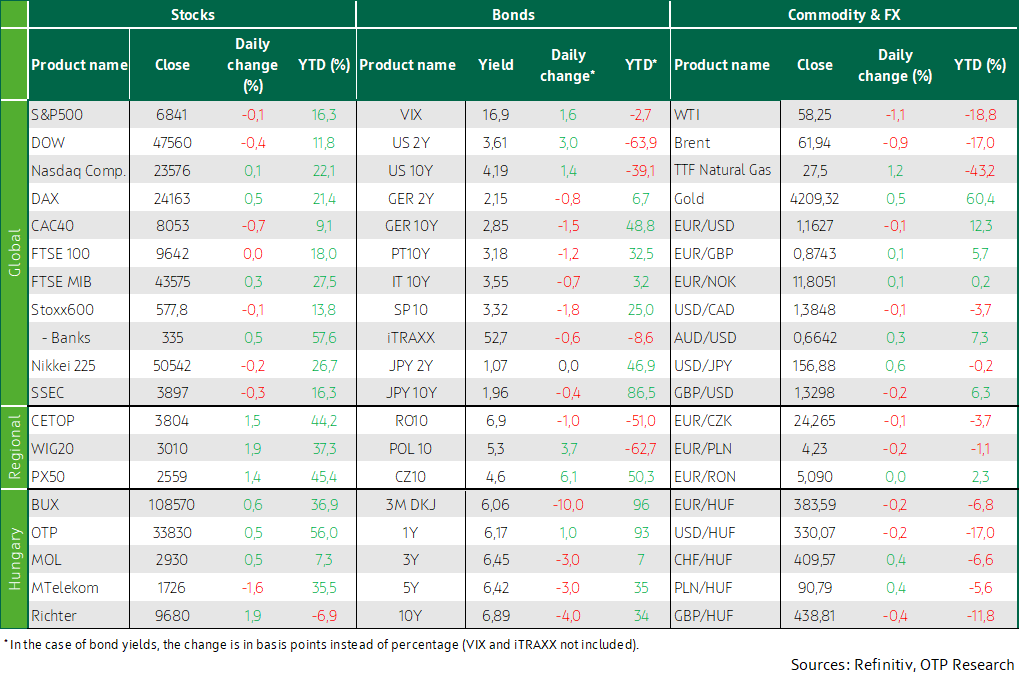
The direction was unclear on Europe’s stock markets on Tuesday. Investors’ attention shifted to the two-day interest rate decision meeting of the Federal Open Market Committee, which ends today, and is expected to lower the fed funds rate by another 25 basis points. The STOXX600 barely moved, while other leading indices closed mixed; Germany’s DAX (+0.5%) and Italy’s FTSE MIB (+0.3%) achieved gains, while France’s CAC40 (-0.7%) and the UK’s FTSE100 ended in the red.
Meta partner EssilorLuxottica (maker of Ray-Ban) slumped 5.6% after Google’s announcement that it would launch its first AI glasses in 2026 in partnership with Warby Parker (+9.3%). This left its mark on Tuesday’s performance of luxury companies such as Kering (-1.9%) and LVMH (-1.4%), and made this sector the weakest link in Europe. Top earning sectors were insurance (+1.2%), media (+0.8%) and banking (+0.5%). The defence industry also did well following news that the German parliament may approve a record EUR 52 billion worth of procurement contracts next week. As a result, the prices of Rheinmetall (+3.6%), RENK (+5.5%) and Hensoldt (+5.9%) all surged. Thyssenkrupp slid 6.5% after the company forecast up to EUR 800 million loss for 2026. Galp’s price dived 14.7% after handing over the operation of the Mopane oil field in Namibia to TotalEnergies. Renewable energy companies such as Nordex (+2.2%) and SMA Solar (+3.1%) rebounded as a US judge rejected the Trump administration's ban on wind energy.
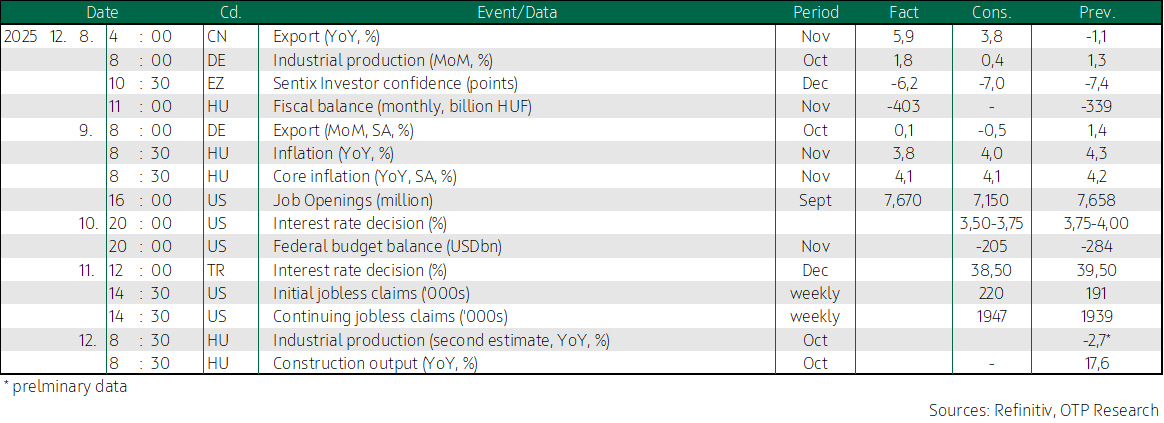
On the macro front, Germany’s exports upped by 0.1% in October compared to the previous month; this is significantly better than the 0.5% drop the market had expected after the 1.4% expansion in September.
The CEE region’s stock markets also rose. The BUX’s 0.6% rebound from Monday's loss marked the smallest gain. MTelekom, which was the only blue chip to rise on Monday, was the only loser yesterday.
Wall Street’s benchmark indices closed mixed on the first day of the Fed's rate-setting meeting
The key indices on Wall Street ended mixed, making minor movements on the first day of the Federal Open Market Committee's interest rate decision in December. The market expects the Fed to further reduce the base rate by 25 basis points, but to continue to strike a cautious tone, owing to inflation risks. The Dow, the weakest of the three major indexes yesterday, was dragged down by JP Morgan after the bank announced significant cost increases for 2026, dragging down the banking sector's performance yesterday. The vast majority of the S&P sector indexes closed in the red.
The most notable of the macrodata published yesterday was JOLTS: in October, a small uptick was seen compared to the previous month. The American Federation of Small Business (NFIB) business confidence survey points to the possibility of a new impetus in the labour market, but also emphasizes the upside risks to inflation.
Oil prices sank again on Tuesday, as markets watched news related to the Russia-Ukraine peace talks and the Fed's interest rate decision. Ukraine has drawn up its own peace plan and, according to media reports, President Zelensky is initiating a request for parliament to find a legal opportunity to hold elections despite the state of war.
The bond markets of advanced economies barely changed in Tuesday's trading
Yesterday was a relatively calm day for the bond and currency markets of advanced economies. Investors waited to see today’s rate decision of the Fed. In the USA, job vacancies exceeded expectations and it seems that the previous downtrend has stopped. US yields have risen: the 10Y one drew near 4.2%. The eurozone’s yields have edged lower, the 10Y German yield is still above 2.85%. The dollar strengthened slightly against the euro: the EUR/USD sank to 1.162.
Ending four months of stagnation at 4.3%, Hungary’s inflation slowed to 3.8% in November, easing into the MNB's tolerance band. The main reason for the deceleration was food prices, but core inflation also decelerated, from 4.2% to 4.1%. Having weakened from around 380 to 385, the forint picked up slightly: the EUR/HUF sank below 384 on Tuesday. Bond yields dropped by 3-5 basis points; the 10Y one is below 6.9% again. At the ÁKK's auction of 3M discount Treasury Bills, the ÁKK sold more than twice the amount on offer (HUF 20 billion forints), at an average yield of 6.21%.
Today’s highlights
In the final hours of Wednesday’s trading, major Asia-Pacific stock markets were likely to close with small, typically negative movements. In addition to the Fed's rate decision, the markets' attention focused on the sudden weakening of the Japanese yen, which appears to have been driven by an overnight yen selling wave by momentum funds. Silver broke above USD 60, to a new record. Its price has more than doubled this year as inventories have dwindled and demand has grown from sectors such as solar energy, electric cars, as well as data centres and artificial intelligence.
Index futures dis not bode well for Europe but US trading may start with cautious increase today.
All eyes are on today’s interest rate decision of the Fed: markets expect that the key interest rate will be reduced by another 25 basis points from the current 3.75-4.0%. Beyond the policy decision, the Fed's latest forecast, including the dot plot of policymakers' interest rate expectations, is also worth checking. This will be the last time for the board of governors to provide projections with the current members.
Get more out of your investments!
Global Markets Services
OTP Global Markets offers a broad range of services in the field of local and international money and capital markets.
Read morePrivate Banking Services
Personal care and expertise with OTP Private Banking, along with the knowledge, security, and innovations of a multinational banking group.
Read more