
OTP Morning Brief: The rebound continued on Monday
Related content
OTP Morning Brief: US producer price index came in above expectations, yet the US 10-year Treasury yield still declined
Western European equities continued to advance despite ongoing pressure on the technology sector. Wall Street indices also rebounded, recovering some ground after Wednesday’s sell-off. Healthcare was the standout performer on both sides of the Atlantic. Eurozone industrial production declined by 0.5% month-on-month in August. In the US, the producer price index accelerated to 6.3%, delivering another upside surprise in inflation developments. US retail sales increased by 0.8% compared to August. The US 10-year Treasury yield declined by more than 10 basis points. The long end of the Hungarian government bond yield curve also declined by 7-9 basis points. In Hungary, August wage data will be released today, while in the US, September industrial production figures are due.
OTP Morning Brief: US CPI data came in above expectations
European equity markets advanced, supported by strong results from ASML and the outstanding performance of the healthcare sector. US equity markets came under pressure following higher-than-expected September CPI data. The annual CPI rate accelerated to 3.7%, driven primarily by a surge in gasoline prices, while core CPI rose by 0.3% month-on-month, supported by higher housing costs and rising transportation service prices. Oil prices rose amid escalating tensions in the Middle East and the impact of the IEA's oil market report. US Treasury yields retreated after an initial increase, driven by Fed commentary, while European bond yields generally moved higher. The US macro calendar will be busy today, with investors focusing on September retail sales and producer price index data, as well as the New York Fed Manufacturing Index, weekly jobless claims, and business inventories. August industrial production data from the euro area will be released today.
Friday's rebound continued on the developed stock markets on Monday, the pressure on the tech sector has eased. The Stoxx600 closed at new high on Monday, as the strengthening banking sector and mining companies gave impetus. The BUX edged lower yesterday. The recovery continued in the USA as well, the Dow went to new high. Developed markets’ bond yields barely moved yesterday. The forint traded at its strongest in two years against the euro. Today, US retail sales and business inventory statistics will be in focus. The earnings season continues with reports from Coca-Cola, AstraZeneca, UniCredit, BP, and Kering.
Western Europe’s stock markets rallied as the pressure on the tech sector eased; mining and defence companies lifted indices
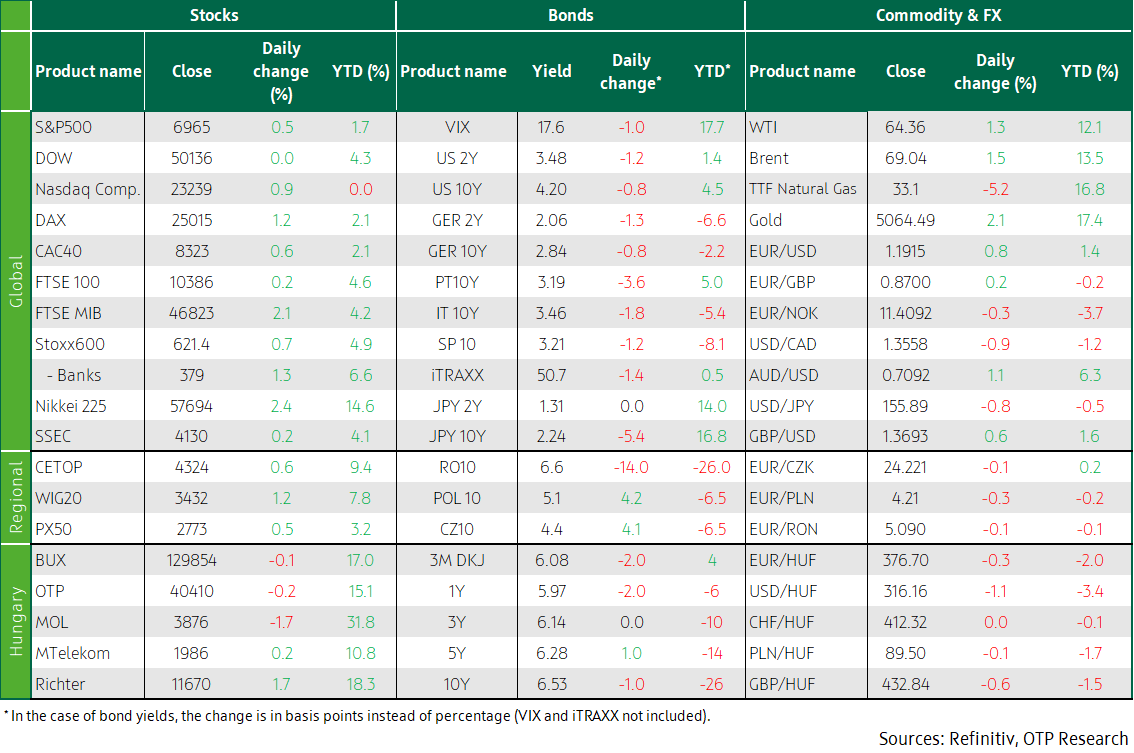
Ending last week's sell-off, Europe’s major stock indexes closed at new highs on Monday as concerns about the tech sector subsided. The Stoxx600 rose by 0.7%, propelled by STMicroelectronics’ nearly 10% jump after the French company announced it would expand its partnership with Amazon Web Services (AWS). Europe’s banking sector also posted strong gains, particularly UniCredit: the Italian bank shot up almost 7% after raising its profit forecast and holding on to stakes in its rivals. The Stoxx600 banking index rose by 1.3%, while the bank-heavy FTSE-MIB gained 2%. Novo Nordisk, which has been hit hard by fierce competition in the weight-loss drug market in the past week, bounced back 5% after Hims and Hers Health said it would stop selling an unapproved, cheap copycat of the original weight-loss drug after the US Food and Drug Administration (FDA) threatened to fine the US drugmaker.
The DAX grew by 1.2%, to a three-week high, driven by banks and industrials, particularly defence companies such as Rheinmetall. Commerzbank (+3.7%) was the top performer, boosted by strong results and profit forecasts from Italian banking giant UniCredit, which has a 26% stake in the German bank. SAP (+2.2), and Dutch fintech platform Adyen (+4.6%) rebounded from last week’s sector-wide sell-off, triggered by the performance of Anthropic’s automation tools. TotalEnergies, Siemens, EssilorLuxottica, and Siemens Energy all closed higher ahead of their earnings reports this week. In the UK, the FTSE100 ended slightly above Friday’s close on Monday, as mining shares helped pare the morning’s losses. Antofagasta soared 6.6%, tracking a rise in copper prices, followed by precious metals operators Fresnillo (+5.9%), and Endeavour Mining (+5.5%). Diversified miners such as Glencore, Rio Tinto and Anglo American also posted strong gains of between 3% and 5%. The UK’s defence manufacturers fared well, too: Rolls-Royce revved up nearly 4%, BAE Systems and Babcock advanced roughly 3% each.
M&A news also drove Europe’s stock markets on Monday. A consortium led by Advent and FedEx agreed to buy InPost for USD 9.2 billion, sending the Polish courier company's share price 13.5% higher. NatWest lost 5.6% after agreeing to buy asset management firm Evelyn Partners for GBP 2.7 billion.
The TTF natural gas price fell 6%, to less than 34 EUR/MWh on Monday, as the cold wave affecting northern and eastern European countries in the second half of February may be milder than previously thought, reversing earlier increases in gas transmission prices.
In the CEE region, Hungary’s BUX (-0.1%) underperformed on Monday, as its peers PX (+0.5%) and WIG20 (+1.2%) closed higher. Of Budapest’s blue chips, MOL fell 1.7%, Richter gained that much, and OTP shed 0.2% but MTelekom rose comparably.
The rebound continued in America, technology led the rise
After an uncertain beginning, US stock indices continued to climb higher on Monday. The Dow’s tiny uptick was enough to reach a new high, the S&P500 gained 0.5%, and the Nasdaq Composite grew by 0.9%. Following last week’s sell-off on AI concerns, Friday’s bounce back continued yesterday, with technology leading the S&P500 sector gains, followed by the materials sector. The biggest losers were consumer discretionary and healthcare. The S&P500 Software Services index surged nearly 3%, ending a multi-day decline last week on concerns about the competitive nature of artificial intelligence. Among software developers, Oracle was the biggest gainer of the day, jumping nearly 10% after D.A. Davidson upgraded its Neutral rating to Buy. The Philadelphia’s SE Semiconductor index rose 1.4%; of its stocks, Nvidia (+2.5%) posted the biggest gain, which was also the largest in the S&P 500 on Monday, but market participants will have to wait until the end of the month to see the latest figures from the AI chip leader.
In individual stocks, Hims & Hers Health fell 16%, recording its seventh consecutive daily loss. Novo Nordisk sued the telehealth company for patent infringement after the U.S. company launched a USD 49 copycat of the Danish drugmaker’s diet pill Wegovy, and then withdrew it on the back of negative reviews from FDA. Workday shares fell 5% after the human resources software provider said its co-founder Aneel Bhusri would return as CEO. Kyndryl shares plunged 55% after the IT service provider delayed its quarterly report, warning of ‘material weaknesses’ in its financial statements. The stock price of Kroger jumped by 4% after the grocery giant named former Walmart executive Greg Foran as CEO.
Crude oil prices nudged higher on Monday, as tensions between the United States and Iran failed to ease significantly, despite progress in recent talks. On Monday, the USA issued a warning to all US-flagged ships to avoid Iranian waters when passing through the Strait of Hormuz. The warning came as talks between the two countries appeared to be continuing, as Friday’s talks in Oman were described as positive. However, uncertainty remains over a deal, as Iran insists on uranium enrichment, the stopping of which is a key issue for the USA.
The rebound in the price of gold and silver continued on Monday: gold added 2% and silver marched 7% higher, even though risk aversion has slightly eased. However, China's purchases of precious metals continue to heat the market, further strengthening volatility, market experts opine.
Long-term yields barely moved in developed economies’ bond markets and in Hungary; the USD wobbled, the forint went to its strongest in two years against the euro
Although Japan’s Liberal Democratic Party achieved a historic two-thirds victory, after which Japan’s bond yields rose markedly (the 10Y yield increased by six basis points, to 2.3%), yields in other markets did not budge. The 10Y dollar yield remained at 4.2% after a trivial dip, and the 10Y German Bund yield traded around 2.85%. The dollar lost almost 1% ground from the euro, trading at 1.19.
The forint’s appreciation sent the EUR/HUF to a two-year low of less than 377. Bond yields have barely changed after the substantial fall in previous weeks and the correction at the end of last week. The ten-year yield is still hovering at the bottom of its trading range of the past year, around 6.5%. The ÁKK’s switch auction of discount Treasury Bills failed yesterday, due to lack of interest.
Today’s highlights
The sentiment in Japan’s stock markets remained benign, following the weekend elections and Monday's 4% rally. Heading into today’s close, the Nikkei was seen gaining more than 2%. Elsewhere in Asia, stock markets painted a mixed picture: China’s Shanghai Composite and Hong Kong’s Hang Seng nudged higher, but Korea’s benchmarks were mostly in the red.
Futures pointed to mixed opening on both sides of the Atlantic. Today, the quarterly earnings figures of Coca-Cola, AstraZeneca, UniCredit, BP, Kering, Barclay’s, Spotify, Ferrari and Ford Motor will see the light of day.
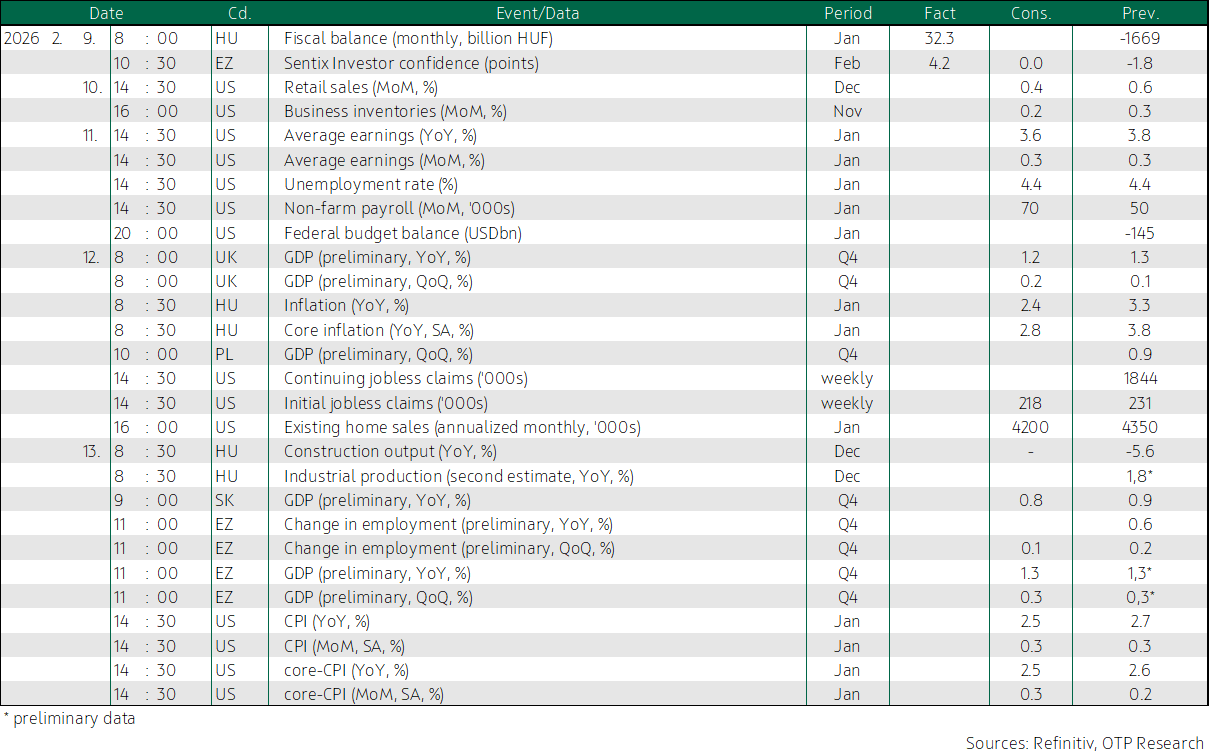
On the macro front, US retail sales statistics and business inventory data could make an interesting reading.
In Hungary, the ÁKK auctions three-month discount Treasury Bills, offering HUF 30 billion.
Get more out of your investments!
Global Markets Services
OTP Global Markets offers a broad range of services in the field of local and international money and capital markets.
Read morePrivate Banking Services
Personal care and expertise with OTP Private Banking, along with the knowledge, security, and innovations of a multinational banking group.
Read more