
OTP Morning Brief: Stock markets fell widely after first week of war
Related content
OTP Morning Brief: Developed market bond yields edged lower yesterday
European indices declined yesterday amid rising oil prices, while the German government revised its GDP growth forecast upward; German exports lost momentum toward the end of the summer; meanwhile, ECB policymakers see upside risks to European inflation. Major US indices moved mostly lower; OpenAI's revenue fell significantly short of previously projected levels; meanwhile, the number of initial jobless claims declined in the US. Long-term yields in both the US and Europe declined following the sharp increase seen in the previous period, while Christopher Waller noted that further Fed rate hikes do not necessarily need to occur at consecutive meetings. The focus today will be on the latest reading of the University of Michigan Consumer Sentiment Index.
OTP Morning Brief: Long-end yields temporarily moved higher, putting equity markets under pressure
Wednesday's trading session was relatively uneventful, with a familiar pattern once again unfolding as the situation in the Persian Gulf drove oil prices higher, pushed yields up, and weighed on equity markets. The correction came within the day, as declining oil prices helped pull the US 10-year yield back from its multi-decade high of 5.36% to around 5.30%. The German 10-year yield followed a similar intraday pattern and ultimately ended the session unchanged from Tuesday's close at 3.48%. The EUR/USD closed at a 17-month low, just below 1.12. Equity markets, however, failed to regain momentum, with both the Nasdaq and the S&P pulling back from their recent highs as investors continued to digest the financing plans of AI-related companies. In Europe, banks led the declines, topping the list of worst-performing sectors. Regional stock markets, including Hungary’s, posted notable declines. The EUR/HUF rose to near 366. Hungarian long-term yields declined. Hungary’s September CPI came in slightly lower than expected. Asian equity indices declined in early trading. Today, German export data will be released, while weekly jobless claims figures are due from the US.
The war continued over the weekend, and Iran elected a new supreme leader. Europe’s indices closed one of their worst weeks in a long time, with shares falling in all segments except the energy sector. Germany’s industrial orders and Hungary’s industrial production rose. Stocks fell sharply on Wall Street, oil prices continued to rise. Bond yields rose due to geopolitical tensions, and the forint’s weakening led the EUR/HUF above 392. Asia’s stock markets fell today. A string of inflation data will be worth watching this week.
The war continued over the weekend, Iran elected new supreme leader
During the weekend, Iranian sources indicated that the succession process was in advanced stage. In a video message, religious leader Hosseinali Eshkevari suggested that Ayatollah Khamenei's son, Mojtaba, may be elected as successor – and this was officially confirmed this morning. Analysts opine that the election of Mojtaba - a deeply hardline cleric, whose wife, mother, and several family members were killed in US-Israeli air strikes - sends a clear message: for the survival of the regime, the Iranian leadership rejects any compromise, and sees no other way than confrontation, retaliation, and survival. However, Donald Trump says Washington should have a say in the succession. Meanwhile, Israel continued its targeted strikes against Iranian leaders, and Tehran was covered in black smoke after attacks on oil facilities. The conflict spread to several Arab countries during the week: Saudi Arabia, Kuwait, the United Arab Emirates and Bahrain reported Iranian drone and missile attacks, which caused deaths and infrastructure damage. In Lebanon, the Israeli army attacked Beirut, targeting Hezbollah leaders, while the Iranian-linked terrorist organization joined the conflict with strikes against Israel.
Europe’s stock markets had a harsh week; German industrial orders and Hungary’s industrial production rose
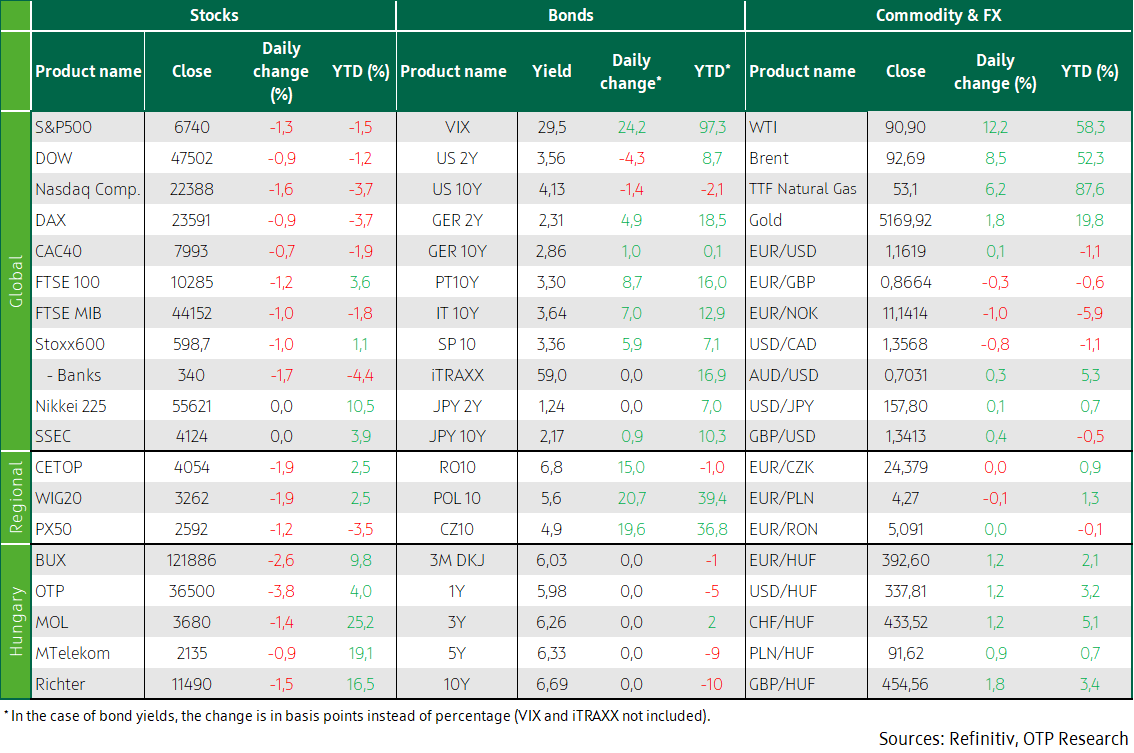
Having declined 1% on Friday, the STOXX 600 index posted its worst weekly loss (-5.5%) in nearly a year on Friday, on the back of the growing uncertainty in the Middle East and a nasty surprise in US employment data, which casts a shadow over the Fed's interest rate path. On Friday, Germany’s DAX (-0.9%), France’s CAC40 (-0.7%), and the UK’s FTSE 100 (-1.2%) all slid. The French index recorded the biggest weekly drop (-6.8%). Among the sectors, only energy rose (+0.8%), on the back of rapidly rising energy prices. The biggest drop was seen in the media sub-sector (-2.3%), but banks (-1.7%) also came under pressure again, sinking to almost a three-month low. HSBC (-2.6%) and Allianz (-1.6%) shares slumped, too. Healthcare companies slipped 1.6%, as Zealand Pharma shares nose-dived 36% and those of Roche slumped 2.9% as mid-stage trial results for its experimental obesity treatment fell short of investors’ expectations. Beyond the energy sector, defence companies had a good day, benefiting from a growing demand for weapons; Rheinmetall advanced 2.9% and Leonardo soared 3.4%.
In terms of macroeconomic data, Germany’s factory orders expanded by 7.8% month-on-month in December 2025, exceeding market expectations for a 2.2% decline by a large margin and accelerating from a slightly upwardly revised 5.7% increase in November. This was the fourth consecutive monthly increase and the strongest one since December 2023, driven mainly by large orders in the metal products (30.2%) and machinery (11.5%) sectors.
Risk aversion hit the CEE region particularly hard: Czechia’s PX 50 (-1.2%), Poland’s WIG20 (-1.9%), and Hungary’s BUX (-2.6%) all slid. In Budapest, OTP fell the most (-3.8%), but other blue chips also showed significant declines. Over the past week, the BUX dived 3.7%, and OTP lost 7.1%, while MOL grew by 4.3%.
In January, Hungary’s industrial production expanded by 1.5% month-on-month, posting increase for the second consecutive month, slightly reversing the negative trend that has been going on for years, while it still shows a 2.5% year-on-year contraction.
Wall Street’s stocks fell sharply, oil prices rose further
Wall Street's three major indexes closed lower on Friday after a sharp deterioration in the US labour market and a sharp jump in US oil prices due to the escalation of the Middle East conflict. The Dow (-0.9%), the S&P500 (-1.3%), and the NASDAQ (-1.6%) closed in the red on Friday, which hurt their weekly performance: the Dow (-3%), the S&P (-2%) and the NASDAQ (-1.2%) all closed lower over the past week. The banking sector lost 2.0%, driven by BlackRock’s 7.1% slump as the asset manager had restricted cash withdrawals. Shares in Western Alliance dived 8.4% after suing Jefferies for failing to make a loan payment related to bankrupt auto parts supplier First Brands Group. Jefferies shares plunged 13.5%. Travel & leisure stocks also retreated, owing to rising fuel costs: the S&P Passenger Airlines sub-index, which tracks passenger airlines, descended 4.1%. On the other hand, the S&P’s energy stocks inched up 0.1%, as higher energy prices could boost their earnings.
The outlook was further dampened by labour market data released on Friday, which showed that the U.S. economy lost jobs in February, and the unemployment rate increased to 4.4%, pointing to a worsening labour market, and making it harder for the Fed to cut interest rates amid rising oil prices due to the Middle East war. Nonfarm payrolls fell by 92,000, partly due to healthcare workers’ strike and disruptions caused by a winter storm. The weak data may have been affected by a sudden surge in January growth, partly owing to a statistical bias. The trends indicate that employment has slowed significantly, undermining the Fed’s narrative that the labour market is stabilizing. The market currently expects the Federal Reserve to keep interest rates steady in March, and the chance of a rate cut in June has increased. US retail sales shrank by 0.2% month-on-month in January 2026, following a flat month in December, and slightly exceeding market expectations for a 0.3% decline.
Brent crude oil prices headed higher, towards 108 USD/barrel last night, up 16.5% from the previous day and up 41.95% in the past month. Precious metals rose in sync with the rising uncertainty: gold added 1.8% and silver soared 2.6% on Friday.
Bond yields rose on geopolitical tensions; the forint’s weakening sent the EUR/HUF above 392
The offensive by the United States and Israel against Iran, and Iran's retaliatory strikes – the closure of the Strait of Hormuz and attacks on the region’s energy infrastructure – brought about a significant shock in the commodity and stock markets, as well as in the bond and currency markets last weekend. Oil prices skyrocketed 10% on Friday and grew by 50% in a week. European gas prices shot up 4% on Friday, and jumped by 70% in a week, thus inflation fears ran high once again. Neither did it help that inflation and all major sub-indices in the eurozone came in higher than expected. Although the number of US jobs fell in February, wage dynamics accelerated again. US interest rate cut expectations have weakened: now the most likely scenario is that there will be only one rate cut this year. In the eurozone, previous expectations of holding (or possibly reducing) interest rates were replaced by the anticipation of an interest rate hike: the market is pricing in the possibility of the ECB raising rates once (or even twice) in 2026. Although US long-term yields barely moved on Friday, they have risen materially last week: the ten-year yield rose by 20 basis points from last week's below-4% levels, reaching 4.15%. Germany’s ten-year yield rose comparably, to 2.85%. France’s and Italy’s long-term yields jumped even stronger, by 30-35 basis points. In this environment, it is no wonder that the dollar appreciated substantially: the EUR/USD decreased by almost 3%. Having started last week at 1.18-1.185, the cross ended around 1.16 on Friday.
The CEE region’s currencies also weakened against the euro. The Czech koruna (CZK) weakened by almost 1% in a week, the zloty (PLN) lost nearly 1.5%, while the forint depreciated by 4% in a week, driving the EUR/HUF from 376 to nearly 393. The sentiment on the CEE region’s government bond markets was likewise gloomy: the 10Y bond yields of Czechia, Poland, and Hungary rose by 50-60 basis points (half of that on Friday); the Hungarian one bounced back to around 7%. Previous interest rate cut expectations have weakened significantly: a week ago, prices implied around 5.5% base rate by the end of the year – but on Friday the yield curve was consistent with only one further cut and a 6% year-end rate.
Today’s highlights
This morning, Asia’s indices slipped broadly, owing to the war. The Hong Kong index hit a six-month low on today, while China’s markets erased their year-to-date gains as the escalation of the Middle East war sent oil prices soaring, and sharply dampened appetite to buy Asian stocks. The Hang Seng decreased by 1.8%, the SSEC lost half a percent, while Japan's Nikkei plunged 4.9%. South Korea's Kospi index, which had outperformed so far this year, slumped 6%.
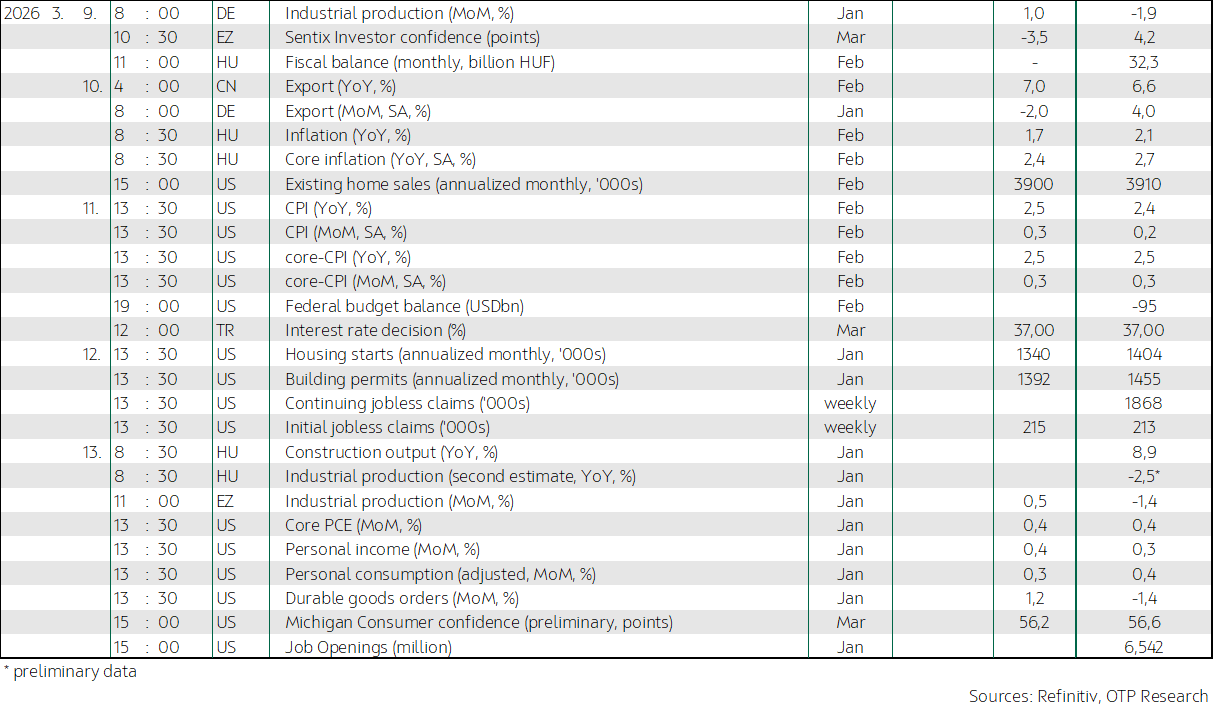
Today, Germany’s industrial production data and the eurozone’s Sentix sentiment index are due. Hungary publishes February inflation data on Tuesday; the market expects inflation to have fallen to 1.7% in February, and our in-house forecast is 1.8%, down from 2.1% in January. The main driving force of disinflation in February may have been food prices, but to a lesser extent, alcohol and tobacco products, as well as administered prices, may have also contributed to the tamed inflation. The USA releases inflation data on Wednesday; the median market expectation for headline and core inflation rates is +0.3% month-on-month. However, the inclement weather and the uptick in oil and service prices in February may cause a negative surprise.
Get more out of your investments!
Global Markets Services
OTP Global Markets offers a broad range of services in the field of local and international money and capital markets.
Read morePrivate Banking Services
Personal care and expertise with OTP Private Banking, along with the knowledge, security, and innovations of a multinational banking group.
Read more