
OTP Morning Brief: The world's key stock markets rebounded on Friday
Related content
OTP Morning Brief: US producer price index came in above expectations, yet the US 10-year Treasury yield still declined
Western European equities continued to advance despite ongoing pressure on the technology sector. Wall Street indices also rebounded, recovering some ground after Wednesday’s sell-off. Healthcare was the standout performer on both sides of the Atlantic. Eurozone industrial production declined by 0.5% month-on-month in August. In the US, the producer price index accelerated to 6.3%, delivering another upside surprise in inflation developments. US retail sales increased by 0.8% compared to August. The US 10-year Treasury yield declined by more than 10 basis points. The long end of the Hungarian government bond yield curve also declined by 7-9 basis points. In Hungary, August wage data will be released today, while in the US, September industrial production figures are due.
OTP Morning Brief: US CPI data came in above expectations
European equity markets advanced, supported by strong results from ASML and the outstanding performance of the healthcare sector. US equity markets came under pressure following higher-than-expected September CPI data. The annual CPI rate accelerated to 3.7%, driven primarily by a surge in gasoline prices, while core CPI rose by 0.3% month-on-month, supported by higher housing costs and rising transportation service prices. Oil prices rose amid escalating tensions in the Middle East and the impact of the IEA's oil market report. US Treasury yields retreated after an initial increase, driven by Fed commentary, while European bond yields generally moved higher. The US macro calendar will be busy today, with investors focusing on September retail sales and producer price index data, as well as the New York Fed Manufacturing Index, weekly jobless claims, and business inventories. August industrial production data from the euro area will be released today.
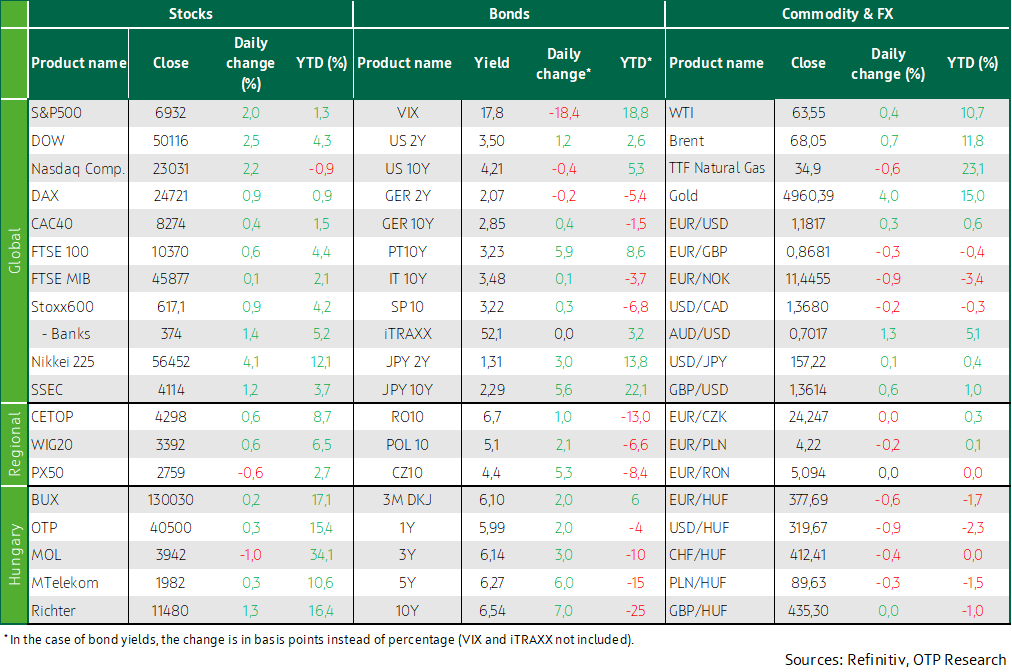
Friday's rebound helped Europe’s indices achieve weekly gains. Hungary’s BUX grew on Friday and last week. US indices also picked up in Friday's trading; the Dow has crossed the 50,000 mark. Advanced economies’ bond yields inched down last week. The forint has strengthened against the euro. Hungary will publish January inflation figures on Thursday. InJapan, Prime Minister Takaichi Sanae's party won early parliamentary elections by a large margin. Later this week, the USA publishes delayed labour market and CPI data for January. The earnings season continues with reports from many giants.
Friday's pick-up helped Europe’s leading indices achieve weekly gains
The leading stock exchanges in Western Europe closed in the red on Friday. The Stoxx Europe rose by 0.9%, in a broad-based reversal from Thursday's decline. Although the technology sector gained more than 1% on Friday, last week it recorded its biggest loss in eleven weeks, owing to the uncertainty caused by the AI race. Although the banking sector did well overall, Societe Generale's share price slid 2.2% as its trading revenues, which were far behind those of its competitors, disappointed investors. In individual stories, Novo Nordisk (+5.3%) rebounded, after the US Food and Drug Administration (FDA) threatened to take swift action against "illegal copycat drugs". Stellantis’ share price nose-dived more than 25% as the automaker had written down nearly EUR 22 billion and had scaled back its electric vehicle development plans. The pale results dragged down carmakers’ shares, this sector saw the biggest decline (-3%). In contrast, defence stocks soared, including Norway’s Kongsberg, which reported strong quarterly profits and new orders.
On the data front, the 1.9% month-on-month decline in German industrial production in December caused disappointment, and November’s figures were also revised down. It was chiefly automotive and machinery manufacturing, as well as the energy-intensive sectors that weighed on the gauge. These data pour cold water on the hopes of a recovery.
In weekly comparison, the Stoxx600 rose by 1.0%. At sector level, banks, finance, media, technology, and car manufacturers slipped. Western Europe’s leading indices headed higher, particularly France’s CAC40 (+1.8%). The most important event of last week was the ECB’s interest rate decision meeting, where the effective interest rate was left on hold, in line with expectations, and the communication also remained the same, suggesting a data-driven, meeting-by-meeting approach. The most awaited data release was the eurozone's January inflation report: the headline index slipped from 1.9% to 1.7%, and core inflation edged down from 2.3% to 2.2%, to the lowest since October 2021. Services inflation, which had been stuck at a high level, eased from 3.4% to 3.2% and is expected to decline further.
The Dutch TTF natural gas futures fell nearly 15% last week, and they have risen by a total of 23% since the beginning of 2026.
The 0.2% increase in the BUX on Friday was enough to rank it in the middle of the CEE league table. Poland’s WIG rose by 0.6%, while Czechia’s PX lost that much. Hungary’s blue chips rose on the last trading day of the week, with the exception of MOL. Over the past week, Poland’s WIG and Hungary’s BUX increased by about 1%, while Czechia’s PX edged lower.
US markets also picked up in Friday's trading; the Dow has crossed the 50,000-point mark
Wall Street saw a strong rebound on Friday as the tech sector's decline came to a halt: the Dow marched 2.5% higher, the NASDAQ surged 2.2%, and the S&P500 gained 2%. The Dow thus crossed the 50,000 line for the first time ever, thanks to the good performance of semiconductor manufacturers. Nvidia (+7.9%) and Broadcom (+7.2%) were the two biggest winners of Friday's trading, recovering from the painful losses earlier in the week. Oracle (+4.7%) and Palantir (+4.5%) also rebounded on Friday.
US stock markets have been rocked by the AI-driven realignment over the past week. In the technology sector, software stocks fell particularly sharply as investors worry that artificial intelligence will fundamentally reshape the industry’s business models. Last week, the tech-heavy NASDAQ lost nearly 4%, the S&P500 slid 2%, while the Dow surged by 2.5%. The most important event of last week was the end of the government shutdown on Tuesday. On the data front, job vacancies fell to a surprisingly low level in December and weekly jobless claims rose, adding to concerns about the labour market outlook.
Crude oil prices edged higher on Friday as Iran and the USA held talks mediated by Oman on Tehran’s nuclear programme, but no headway has been made. WTI (-2.5%) and Brent (-3.7%) both slipped last week as concerns about supply disruptions in the Middle East eased.
Gold and silver prices rebounded slightly on Friday, ending several days of steep declines. Over the past week, gold rose slightly, while silver subsided nearly 8%.
Developed markets’ bond yields edged lower last week; the forint’s strengthening continued
At the beginning of last week, stronger-than-expected US manufacturing PMIs and the partial government shutdown pushed bond yields higher, but later several factors led the bond market towards lower yields, such as the aforementioned weaker-than-expected labour market data, favourable inflation indicators from the eurozone, and the fact that the ECB left interest rates unchanged and was not concerned about the strong euro. Thus, the US 10Y yield sank a few basis points last week, to 4.2%, which is around the lower quarter of its post-pandemic trading range. Germany’s 10Y Bund yield printed a similar pattern, also closing with a trivial drop in weekly comparison, at 2.85%, which is the top of its post-covid trading range. After last week’s strong but brief breakout, which took the EUR/USD to a five-year high, above 1.20, the pair moved in a narrow range, hugging the 1.18 line as the dollar benefited from the increasing risk aversion. But a 0.3% euro appreciation made the cross pick up, closing near 1.185.
The external backdrop remained supportive for Hungary’s FX market. The forint was the best-performing currency in the CEE region last week: it appreciated by half a percent on Friday, and by 0.8% over the past week, and sinking back below the 380 mark. The drop in Hungarian bond yields continued until Thursday, but yields rose by 5-7 basis points on Friday, thus the ten-year yield rebounded above the 6.5% level. In a weekly comparison, yields on the two longest maturities still declined, while the short end of the curve barely moved
Today’s highlights
In Japan, Prime Minister Takaichi Sanae's risky decision to hold early elections has paid off: her party, LDP, had won a two-thirds majority in the lower house for the first time since World War 2, winning more than 310 of the 465 seats, and more than 340 ones with the broader coalition. Japan's Nikkei225 rose steeply this morning, setting new records: in the last hour of trading, it was seen gaining more than 4%. On Sunday, Japan’s Finance Minister Katayama Satsuki said that tapping foreign exchange reserves could be on the agenda due to the recent fluctuations in the yen. The sentiment was also optimistic on other stock exchanges in the Asia-Pacific region, where the leading indices were likely to close in positive territory.
Index futures boded well for the leading stock exchanges of Europe and the USA.
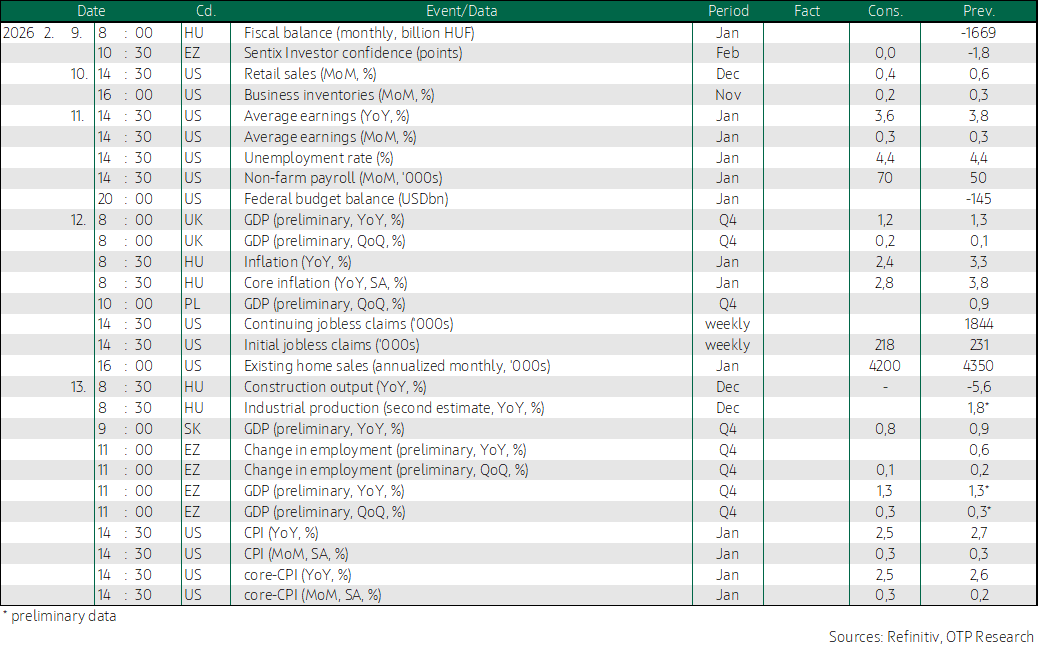
In Hungary, the KSH statistical office will publish its January inflation data on Thursday. We expect inflation to be 2.3% year-on-year. In our forecast, inflation may have decreased in all major goods and service groups (food, energy, services, products/services with administered prices) except for consumer goods.
The USA is to release January labour market and inflation reports, delayed by the government shutdown. Nonfarm payrolls are expected to have risen by 70,000 in January, while the unemployment rate is likely to remain flat. Headline and core inflation are expected to have accelerated by 0.3% in January; risks are on the upside.
The earnings season also has some big names in store this week, with reports from Coca-Cola, McDonald’s, Spotify, and many others.
Get more out of your investments!
Global Markets Services
OTP Global Markets offers a broad range of services in the field of local and international money and capital markets.
Read morePrivate Banking Services
Personal care and expertise with OTP Private Banking, along with the knowledge, security, and innovations of a multinational banking group.
Read more