
OTP Morning Brief: Defence stocks surged and oil prices have picked up
Related content
OTP Morning Brief: US producer price index came in above expectations, yet the US 10-year Treasury yield still declined
Western European equities continued to advance despite ongoing pressure on the technology sector. Wall Street indices also rebounded, recovering some ground after Wednesday’s sell-off. Healthcare was the standout performer on both sides of the Atlantic. Eurozone industrial production declined by 0.5% month-on-month in August. In the US, the producer price index accelerated to 6.3%, delivering another upside surprise in inflation developments. US retail sales increased by 0.8% compared to August. The US 10-year Treasury yield declined by more than 10 basis points. The long end of the Hungarian government bond yield curve also declined by 7-9 basis points. In Hungary, August wage data will be released today, while in the US, September industrial production figures are due.
OTP Morning Brief: US CPI data came in above expectations
European equity markets advanced, supported by strong results from ASML and the outstanding performance of the healthcare sector. US equity markets came under pressure following higher-than-expected September CPI data. The annual CPI rate accelerated to 3.7%, driven primarily by a surge in gasoline prices, while core CPI rose by 0.3% month-on-month, supported by higher housing costs and rising transportation service prices. Oil prices rose amid escalating tensions in the Middle East and the impact of the IEA's oil market report. US Treasury yields retreated after an initial increase, driven by Fed commentary, while European bond yields generally moved higher. The US macro calendar will be busy today, with investors focusing on September retail sales and producer price index data, as well as the New York Fed Manufacturing Index, weekly jobless claims, and business inventories. August industrial production data from the euro area will be released today.
Europe’s key stock markets ended mixed on Thursday. German factory orders saw strong growth while the eurozone economic sentiment indicator has weakened. The unemployment rate fell to 6.3%, while producer prices rose stronger than expected. Oil prices have picked up. Major US indices closed mixed yesterday, defence and auto stocks rose. Unit labour costs fell in non-farm sectors but rose in manufacturing. US jobless claims data still point to a tight labour market. Yields rose on both sides of the Atlantic; the EUR/HUF is above 385. Today, the focus will be on US non-farm payrolls for December, while Europe releases industrial, retail sales and exports data.
Europe’s key stock markets ended mixed on Thursday. German factory orders saw strong growth while the eurozone economic sentiment indicator has weakened, the unemployment rate fell to 6.3%, while producer prices rose stronger than expected
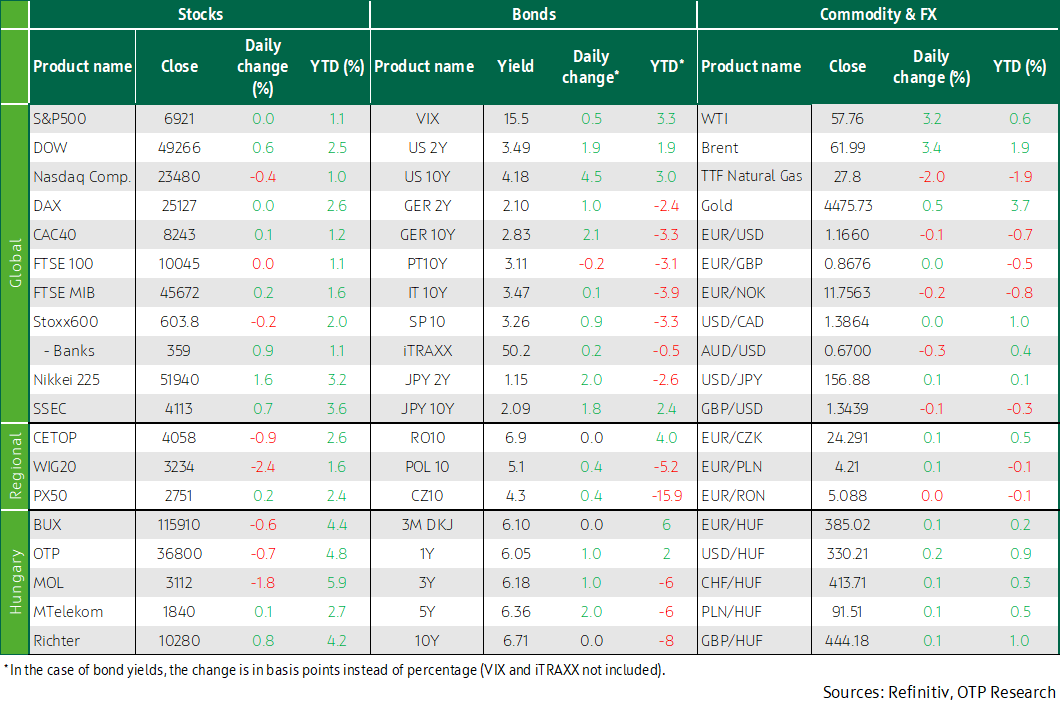
In Europe, stock markets posted modest losses on Thursday, when the Stoxx 600 index inched down 0.2%, as its sectors performed mixed. The defence sector rose for the fifth day in a row as Donald Trump’s social media post on Wednesday urged a USD 500 billion (+50%) increase in U.S. defence spending by 2027. In Europe, the defence sector index rose by 1.1%, Leonardo grew by 2%, while Rheinmetall closed 1.4% higher. In contrast, oil stocks weakened following the previous days’ drop in oil prices: Shell (-3.5%) and BP (-0.6%) both slumped in European trading.
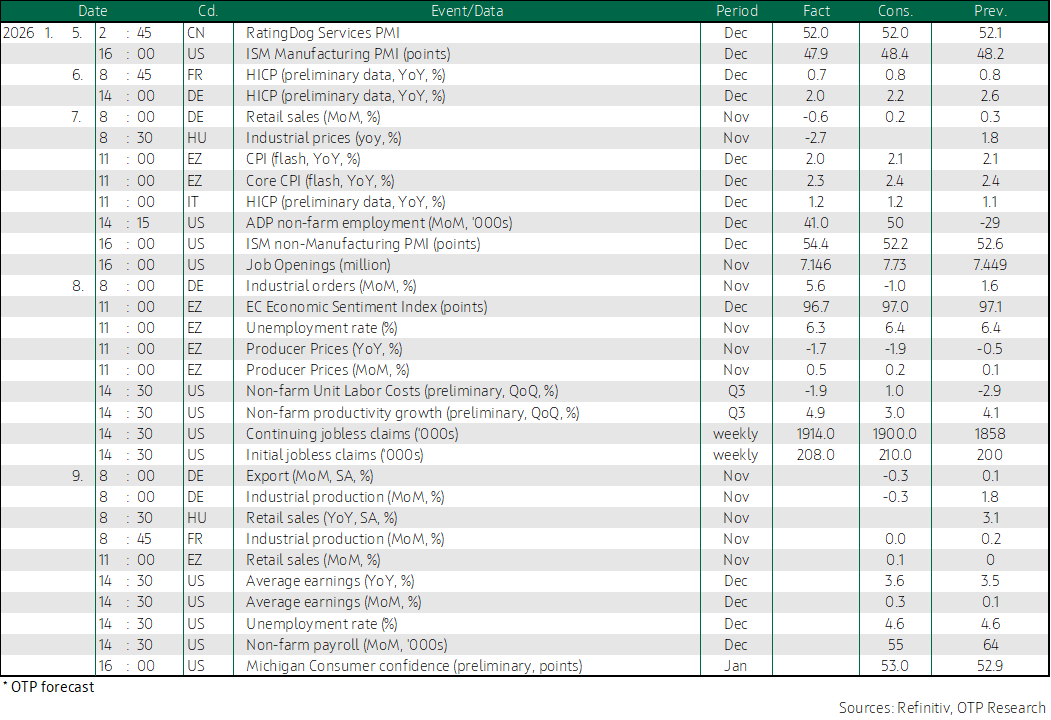
Europe’s macroeconomic data painted a mixed picture. Exceeding expectations for a 1% decline by a large margin, Germany’s industrial orders surged by 5.6% month-on-month in November, largely driven by demand for metal products and high-value transport equipment. Excluding large-volume orders, the growth rate was 0.7%. In contrast, the eurozone’s economic sentiment indicator fell to 96.7 points in December, missing market expectations for 97. Services, retail, and consumer confidence all weakened, while inflation expectations rose again. The unemployment rate fell to 6.3%, the lowest level since April, while there was also a slight improvement among young people. Producer prices increased by 0.5% month-on-month in November, beating market expectations of 0.2%, driven mainly by energy prices. However, producer prices continued to decline by 1.7% year-on-year.
The CEE region’s indices moved mixed: the Warsaw and Budapest indices fell, while the one in Prague managed to rise. Of Hungary’s blue chips, Mol and OTP both subsided from Wednesday’s highs, but the other two achieved gains.
America’s major indices closed mixed; defence and auto stocks rose. Oil prices picked up. Unit labour costs fell in non-farm sectors but rose in manufacturing. US jobless claims data still point to a tight labour market
US stock markets closed mixed on Thursday. The IT sector (-2%) was the only significant loser as large AI-related stocks were dumped: Nvidia (-2%), Oracle (-1.6%), and Apple (-0.5%) all fell yesterday. But defence stocks did well after Donald Trump's post: Lockheed Martin took off 4%, Northrop Grumman soared 3%, and Kratos Defence jumped more than 14%. US auto stocks rose after the announcement of Donald Trump's programme, which provides a tax refund of up to 10,000 USD/year for the interest on loans for new cars made in the US between 2025 and 2028. Ford (+4.8%) and General Motors (+3.9%) revved up on the news. Oil prices have picked up: Brent and WTI both added more than 3%, ending the fall that was triggered by news of America’s access to Venezuelan oil. With the support of five Republicans, the US Senate unexpectedly passed a resolution on Thursday that would prohibit Donald Trump from taking further military action against Venezuela without authorization from Congress. Although the resolution is not yet final, the result of the vote is indicative.
US data pointed to strong productivity improvement and unexpectedly low cost pressures: non-farm business unit labour costs fell 1.9% in the third quarter, whereas 1.0% increase was expected, while productivity jumped by 4.9% (forecast: 3%), outpacing wage growth (+2.9%). Productivity showed the strongest growth rate since the third quarter of 2023. In the manufacturing sector, however, unit labour costs rose 1.5%, while productivity (+3.3%) and wages (+4.8%) increased. Initial jobless claims rose to 208,000 in early January, slightly missing expectations of 210,000, while the continuing claims rose to 1.914 million, beating forecasts of 1.9 million, suggesting that the labour market is a still tight but slowing.
Yields rose on both sides of the Atlantic; the EUR/HUF is above 385
On Thursday, bond yields rose in both Europe and the US as recession fears have eased. Reasons include the unexpectedly strong industrial orders data from German, and the eurozone’s unemployment rate falling to a historic low. In the USA, layoffs fell to a 17-month low and initial jobless claims remained subdued last week. The US (+4.5bps) and German (+2bps) 10-year yields both rose, the former drew near 4.2% and the latter exceeded 2.8%. The dollar strengthened by 0.2% against the euro, thus the EUR/USD traded around 1.165.
The CEE region’s currencies were not doing well yesterday: the zloty (PLN), the Czech koruna (CZK) and forint (HUF) all weakened. The EUR/HUF closed above 385. The decline in Hungarian bond yields has stopped: most reference yields inched up 1-2 basis points; the 10Y one is still hovering at a nearly one-year low of around 6.7%. Yesterday, the ÁKK auctioned 3Y, 5Y, and 10Y fixed-rate bonds, as well as 10-year floaters. Demand for fixed-rate bonds was strong: bids for the three maturities surpassed HUF 250 billion, and the ÁKK accepted more than HUF 110 billion worth of them, with average yields typically in line with Wednesday's lows. Bids for the floating-rate bond surpassed HUF 350 billion, of which the debt manager accepted nearly HUF 200 billion.
Today’s highlights
Asia’s stock markets traded mixed this morning: defence stocks also rose in Asia, following the events in Venezuela. In China, December inflation came in at 0.8%, as expected.
Today, the USA publishes employment and earnings data, as well as the University of Michigan's consumer sentiment index. In Europe, industrial data from Germany and France, Germany’s exports statistics, as well as the eurozone’s and Hungary’s retail sales figures are scheduled for release.
Get more out of your investments!
Global Markets Services
OTP Global Markets offers a broad range of services in the field of local and international money and capital markets.
Read morePrivate Banking Services
Personal care and expertise with OTP Private Banking, along with the knowledge, security, and innovations of a multinational banking group.
Read more