
OTP Morning Brief: Enthusiasm is fading in developed economies' stock markets
Related content
OTP Morning Brief: US producer price index came in above expectations, yet the US 10-year Treasury yield still declined
Western European equities continued to advance despite ongoing pressure on the technology sector. Wall Street indices also rebounded, recovering some ground after Wednesday’s sell-off. Healthcare was the standout performer on both sides of the Atlantic. Eurozone industrial production declined by 0.5% month-on-month in August. In the US, the producer price index accelerated to 6.3%, delivering another upside surprise in inflation developments. US retail sales increased by 0.8% compared to August. The US 10-year Treasury yield declined by more than 10 basis points. The long end of the Hungarian government bond yield curve also declined by 7-9 basis points. In Hungary, August wage data will be released today, while in the US, September industrial production figures are due.
OTP Morning Brief: US CPI data came in above expectations
European equity markets advanced, supported by strong results from ASML and the outstanding performance of the healthcare sector. US equity markets came under pressure following higher-than-expected September CPI data. The annual CPI rate accelerated to 3.7%, driven primarily by a surge in gasoline prices, while core CPI rose by 0.3% month-on-month, supported by higher housing costs and rising transportation service prices. Oil prices rose amid escalating tensions in the Middle East and the impact of the IEA's oil market report. US Treasury yields retreated after an initial increase, driven by Fed commentary, while European bond yields generally moved higher. The US macro calendar will be busy today, with investors focusing on September retail sales and producer price index data, as well as the New York Fed Manufacturing Index, weekly jobless claims, and business inventories. August industrial production data from the euro area will be released today.
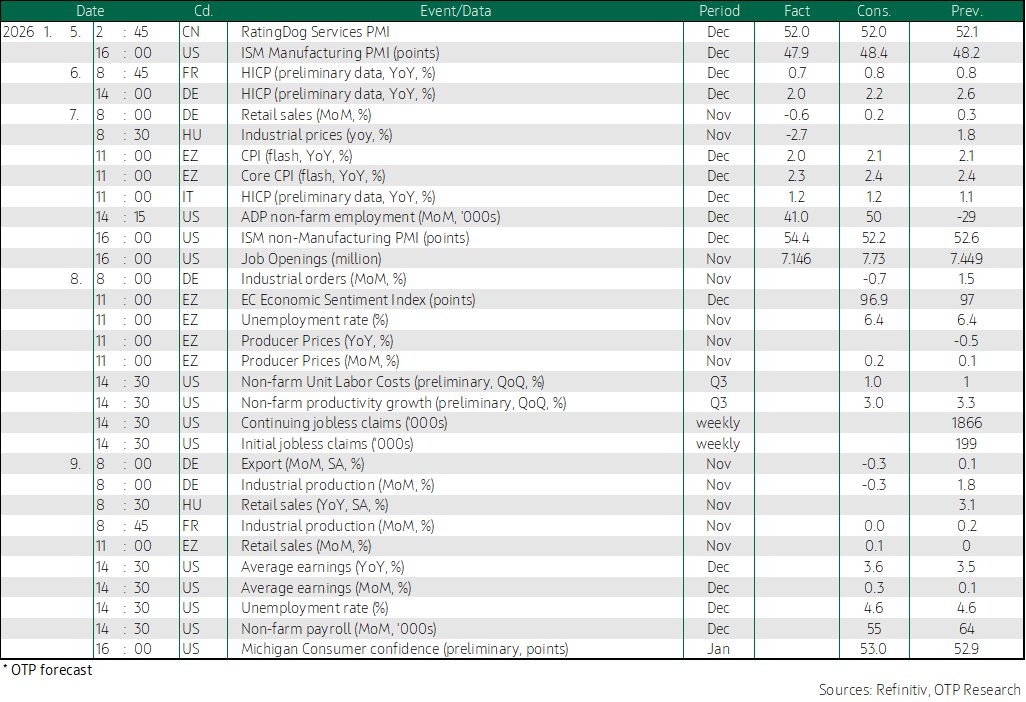
Growth on Europe’s key stock exchanges has halted, while the CEE region's benchmarks closed at new highs on Wednesday. In the eurozone, December’s inflation was lower than expected. Despite new intraday highs, the Dow and S&P500 closed in the red; tech stocks’ gains saved the day for the Nasdaq yesterday. Yields sank in Europe and America, the EUR/HUF closed below 385. Today’s most important releases are the EZ economic sentiment indicator and producer price index, as well as US weekly jobless claims, Q3 non-farm productivity, and unit labour cost statistics. Hungary’s ÁKK auctions 3Y, 5Y, and 10Y bonds today.
The growth on most of Europe’s major stock markets halted, while CEE benchmarks hit new highs on Wednesday. December’s inflation in the eurozone came in lower than thought
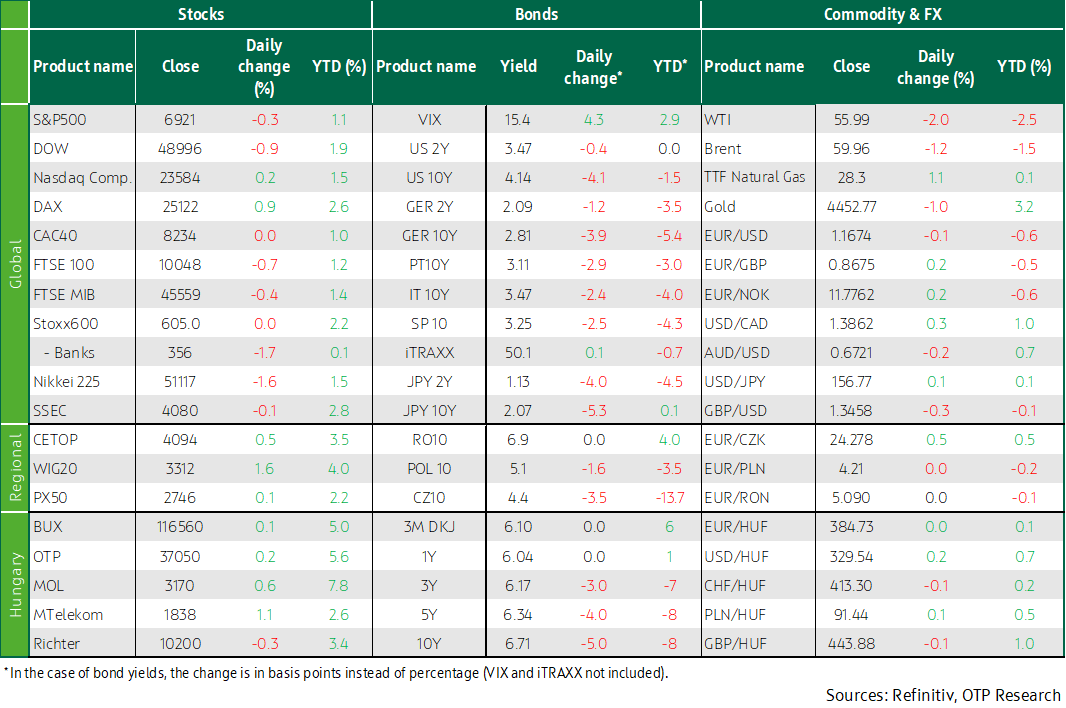
The enthusiasm on Western Europe’s stock markets waned on Wednesday, and the Stoxx600 Europe closed a tad below Tuesday's closing price. National stock markets ended the day mixed: the UK’s FTSE100 and Spain’s IBEX35 subsided from their previous day's all-time highs, Germany’s DAX extended its gains, while France’s CAC40 closed flat. The recent geopolitical events made investors warier, especially after US President Donald Trump announced on Wednesday that the US had reached an agreement with Venezuela to import USD 2 billion worth of crude oil. Crude oil prices fell on expectations that oil supply may expand, thus Shell and BP slipped more than 3%, dragging down the broader Stoxx600 energy sector index.
Investors had a batch of economic data to choose from yesterday. Financials were the biggest losers on Tuesday as the eurozone’s inflation data for December unexpectedly fell to 2%. This eased earlier expectations of an interest rate hike by the end of the year, and the perspective of ??a lower interest rate environment benefited the real estate and construction sectors, but banking stocks came under pressure. In Germany, retail sales in November were weaker than expected, while the number of unemployed people in December rose milder than expected. Separately, the eurozone’s construction PMIs have improved, including that of Germany, whose indicator is again above the 50 mark, indicating expansion, unlike those of France and Italy, where PMIs deteriorated slightly.
In individual names, Thales jumped by 8% after Covivio and Blue Owl Capital agreed to buy the French defence company's sites for around EUR 500 million. Chip-making equipment maker ASML fell 1%, snapping a six-day winning streak. Nestlé lost 2% as brokerages Jefferies and Bernstein cut their price targets on its shares after the food giant had recalled some of its baby formula on Tuesday, due to possible toxin contamination.
TTF European natural gas prices remained at EUR 28/MWh, relatively close to the 20-month low of EUR 26.8 hit in mid-December, thanks to ample supply in Europe’s main gas trading hubs. Record gas production in the USA last year and new supply contracts with Middle Eastern producers have led to a 28% increase in LNG imports to Europe in 2025, while Norwegian gas fields also provide steady supplies. On the demand side, weather forecasts predict that the cold snap will ease in the second half of January, reducing demand for heating.
The benign sentiment in the CEE region persisted: reopening after Tuesday’s holiday, Poland’s WIG20 grew by 1.6%, while Czechia’s PX and Hungary’s BUX inched up 0.1% each. Of the latter’s blue chips, OTP closed at a new high of HUF 37,050 (+0.2%), MTelekom rose by 1.1%, Mol advanced 0.6%, whereas Richter shed 0.3%. Rába shares s hot up 20.5%, after 4iG had announced that the acquisition of the majority stake in the Hungarian automotive company had been completed.
Despite new intraday highs, the Dow and S&P500 closed in the red; the strengthening of tech stocks saved the day for the Nasdaq
Although the Dow and S&P500 hit new highs at one point on Wednesday, they ended the day below Tuesday's closing levels. Homebuying companies’ shares plunged after President Trump announced that he would bar Wall Street investors from buying single-family homes, in an effort to lower housing prices. Blackstone and Apollo Global Management slumped more than 5% each, contributing to a more than 1% loss in the S&P500 financial index. American Homes 4 Rent’s share price fell 4.3%.
Defence stocks also slid: Northrop Grumman (-5.5%) and Lockheed Martin (-4.8%) nosedived after Donald Trump said he would not allow defence companies to pay dividends or buy back shares until they fix problems with military equipment production. His social media post avoided naming specific companies. The strength of the technology sector offset other weaknesses: Nvidia and Microsoft upped 1% each and Alphabet surged more than 2% as investors returned to AI stocks after recent concerns about their overvaluation. Further fuelling investors’ interest in big AI players, Anthropic is planning a multibillion-dollar equity raise that would value the maker of the Claude chatbot at USD 350 billion. That would make the privately held company more valuable than the vast majority of companies, such as AMD, Chevron, and Wells Fargo. The NASDAQ Composite climbed almost 0.2% higher. Memory and storage technology companies gave back some of their recent gains yesterday. Western Digital dived nearly 9% and Seagate Technology plunged nearly 7%. First Solar slumped 10% after Jefferies had downgraded the solar panel maker to Hold from Buy.
Oil prices fell further on Wednesday: Brent futures slipped more than 1% and WTI came down 2%. Washington outlined plans to exert long-term control over Venezuela’s crude sales, starting with the release of stored oil, and then via the controlled sale of future production. At the same time, US authorities stepped up sanctions enforcement by seizing more Venezuelan oil tankers. This came after President Trump said Venezuela was shipping 30 to 50 million barrels of crude to the United States.
Yields fell in Europe and America, the EUR/HUF traded below 385
again
In the eurozone, December’s headline and core inflation dropped stronger than thought, to 2% and 2.4%, respectively, and services inflation has also decelerated. In addition, the US published a string of disappointing data: the ADP report, reflecting frail employment growth in December, showed a further cooling of the labour market, and the number of vacant positions has also decreased. Accordingly, bond yields edged lower: the 10Y US yield shed about one basis point, and European yields sank by about three basis points, the former to 4.15%, and the German one to nearly 2.8%.
The EUR/USD remained below 1.17, at an almost one-month low.
The EUR/HUF is still trading around 385.Yesterday, Hungary’s ÁKK issued 10Y and 15Y foreign currency bonds worth EUR 3 billion. The yield on Hungarian bonds eased further; a five-basis-point drop took the 10Y bond yield to 6.7%, a nearly one-year low.
Today’s highlights
Asia’s stock markets are mostly in the red this morning: the Nikkei slid 1.6%, a day after China banned exports of dual-use (including military) products to Japan. The Shanghai Composite inched down 0.1%, the CSI 300 slipped 0.9%, and the Hang Seng descended 1.5%. South Korea’s benchmarks were also in the red, a day after the Kospi rose to a record high on AI optimism. The price of crude oil has picked up.
Index futures did not bode well for today’s open in Europe and America.
Germany’s industrial orders jumped 5.6% month-on-month in November, and the figure for October, which showed an increase of over 1%, was slightly revised upward. Later today, the eurozone’s economic confidence index and producer price index data, as well as the USA’s weekly unemployment figures and Q3 non-farm productivity and unit labour cost statistics are worth checking.
In Hungary, the ÁKK auctions 3Y, 5Y, and 10Y fixed-rate and 10Y floating-rate bonds, offering HUF 20, 25, 25 and 50 billion.
Get more out of your investments!
Global Markets Services
OTP Global Markets offers a broad range of services in the field of local and international money and capital markets.
Read morePrivate Banking Services
Personal care and expertise with OTP Private Banking, along with the knowledge, security, and innovations of a multinational banking group.
Read more