
OTP Morning Brief: Defence and energy stocks drove stock exchanges higher
Related content
OTP Morning Brief: US producer price index came in above expectations, yet the US 10-year Treasury yield still declined
Western European equities continued to advance despite ongoing pressure on the technology sector. Wall Street indices also rebounded, recovering some ground after Wednesday’s sell-off. Healthcare was the standout performer on both sides of the Atlantic. Eurozone industrial production declined by 0.5% month-on-month in August. In the US, the producer price index accelerated to 6.3%, delivering another upside surprise in inflation developments. US retail sales increased by 0.8% compared to August. The US 10-year Treasury yield declined by more than 10 basis points. The long end of the Hungarian government bond yield curve also declined by 7-9 basis points. In Hungary, August wage data will be released today, while in the US, September industrial production figures are due.
OTP Morning Brief: US CPI data came in above expectations
European equity markets advanced, supported by strong results from ASML and the outstanding performance of the healthcare sector. US equity markets came under pressure following higher-than-expected September CPI data. The annual CPI rate accelerated to 3.7%, driven primarily by a surge in gasoline prices, while core CPI rose by 0.3% month-on-month, supported by higher housing costs and rising transportation service prices. Oil prices rose amid escalating tensions in the Middle East and the impact of the IEA's oil market report. US Treasury yields retreated after an initial increase, driven by Fed commentary, while European bond yields generally moved higher. The US macro calendar will be busy today, with investors focusing on September retail sales and producer price index data, as well as the New York Fed Manufacturing Index, weekly jobless claims, and business inventories. August industrial production data from the euro area will be released today.
Western Europe’s stock markets extended their gains on Monday. Defence stocks drove European indices higher. The BUX gained 1.9% yesterday, outperforming its regional peers. US indices also had a strong day. The first trading day after the military action against Venezuela lacked wild moves on markets. US companies may modernize Venezuela’s oil industry. America’s energy sector is soaring. In the USA, ISM manufacturing PMI fell again. Bond yields sank on both sides of the Atlantic on Monday, after the continued rise in Japan’s bond yields. Asia’s markets grew further today.
Western Europe’s stock indices marched higher on Monday
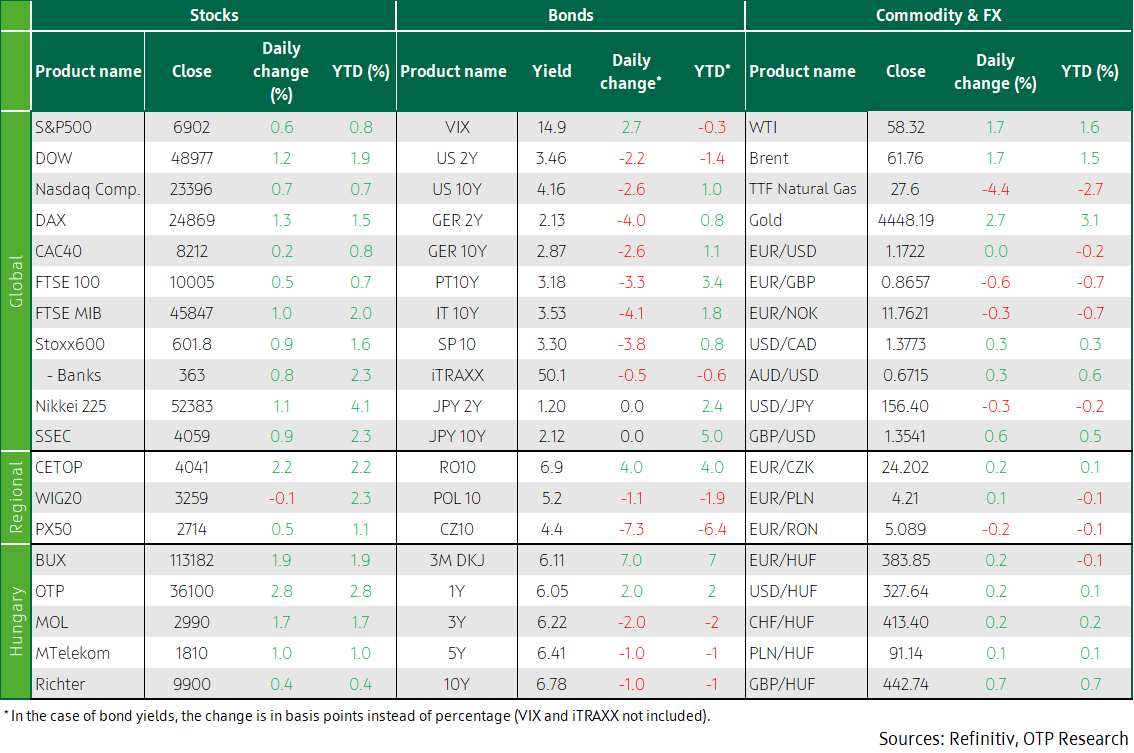
In Western Europe, stock markets extended their gains on Monday. The STOXX Europe 600 advanced 0.9%, breaking above the 600-point mark for the first time in its history. Germany’s DAX (+1.3%), France’s CAC40 (+0.2%) and the UK’s FTSE100 (+0.5%) all climbed higher yesterday.
Following US strikes on Venezuela, Europe’s defence stocks gained new momentum. They have been rather weak since October, on the back of news about the Russia-Ukraine peace process. But the defence sector marched 4.1% higher on Monday, the first trading day after the US action. Rheinmetall (+8.9%), Renk (+8%), Dassault (+4.1%), and Saab (+6.6%) all skyrocketed. Other top performers on Monday included the technology (+3.75%) and materials (+2.3%) sectors. ASML, the world's largest supplier of computer chip manufacturing equipment, jumped by 5.5%. Analysts at brokerage Bernstein upgraded the tech giant to Outperform, and raised their price target to EUR 1,300, from EUR 800. The food and beverage sector, however, had a bad day. Nestlé's (-2.9%) and Unilever's (-2.6%) losses contributed to the 1.4% sector-wide decline. The energy sector gained 0.8%, as oil prices increased by more than 1%.
Along with Western Europe’s defence stocks, 4IG (+3.6%) and Rába (+16%) shot up on Monday. The BUX (+1.9%) closed a strong day, as did its blue chips OTP (+2.85%), MOL (+1.7%), and MTelekom (+1%). Thus the BUX outperformed its peers in the CEE region, where Czechia’s PX50 rose 0.5%, and Poland’s WIG20 edged down 0.1%.
US indices also closed with strong gains
US indices also recorded significant gains on Monday. The Dow Jones Industrial Average (+1.2%), the S&P500 (+0.6%), and the Nasdaq Composite (+0.7%) all excelled. The best-performing sectors of the S&P500 were energy (+2.7%), financials (+2.15%) and consumer discretionary (+1.9%). The aerospace and defence sectors also did well, adding 1.5% each. Of the latter, Lockheed Martin (+2.9%) and General Dynamics (+3.5%) soared.
Although Venezuela’s interim President Delcy Rodríguez called the US military action illegal on Saturday, she struck a more conciliatory tone on Sunday and sought cooperation with the US government. Monday's trading did not see wild market reactions, investors are not pricing in significantly increased geopolitical risks at this point. Yet the price of gold grew by 2.7%, to USD 4,448.
Venezuela holds about 17% of the world's oil reserves, more than Saudi Arabia does. Nevertheless, its output has significantly contracted in the past 50 years, partly due to the nationalization of the oil industry. Back in the 1970s, Venezuela produced 3.5 million barrels per day, but today its output is just 800,000 barrels. Following the action, the US government openly spoke about involving US oil companies in the development of the out-of-date oil industry infrastructure. According to analysts, assuming significant investments, in the long term the US intervention could be followed by a boost in production, which could put pressure on oil prices from the supply side. But in the short term, it is rather the US sanctions policy that could affect prices. Chances that the US assets that had been confiscated during Hugo Chávez’ presidency may be returned have improved. The share prices of the energy companies affected, such as ConocoPhillips and Exxon Mobil, surged by 2.6% and 2.2%, respectively. The stock price of Chevron, the only major US company currently operating in Venezuela’s oil fields, jumped by 5.1%. The developments in Venezuela have also benefited refineries in the Gulf of Mexico, which are particularly well-equipped to use the heavy, high-sulphur crude oil from Venezuela. The US military action also suggests geopolitical rivalry with China, as a significant part of Venezuela’s oil exports flows to China, bypassing US sanctions.
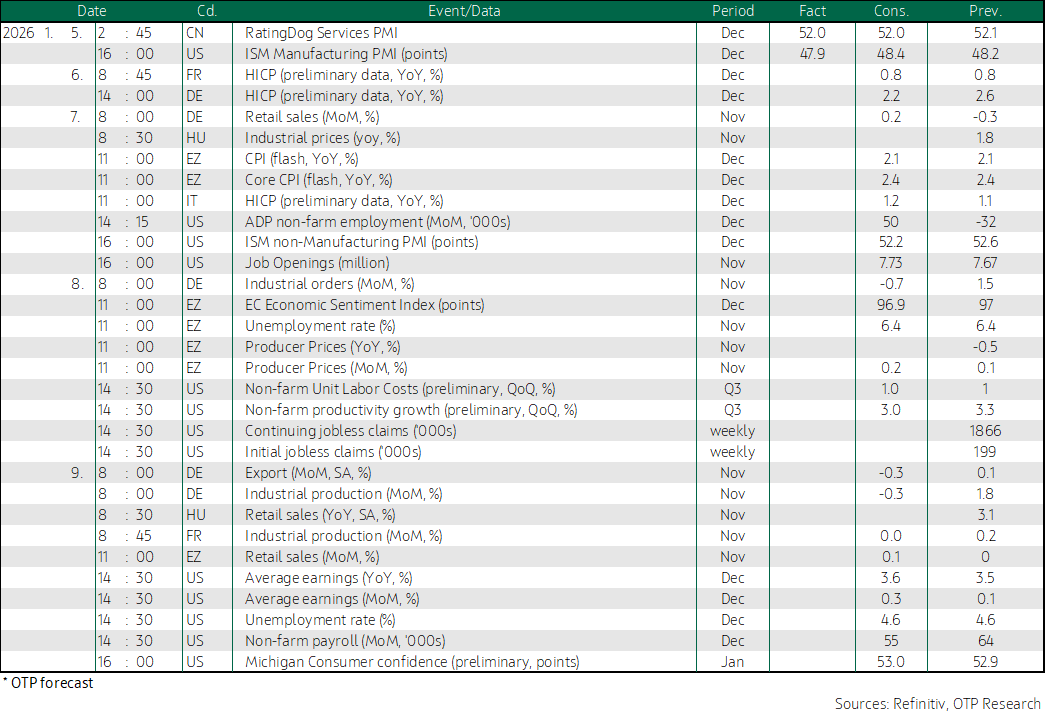
In the USA, the ISM manufacturing PMI fell for the third consecutive month. The December figure of 47.9 is the lowest value since October 2024. A reading below 50 indicates contraction in the manufacturing sector, which accounts for 10.1% of the U.S. economy. Economists polled by Reuters had expected a higher reading of 48.4.
Yields in Europe and the USA declined on Monday after Japan's yield continued to rise
Although Japan’s 10Y bond yield rose to another 26-year high of more than 2.12% on Monday morning, yields on US and European bonds mostly sank yesterday. The US 10-year yield turned back from a four-month peak and the German one declined by 3-4 basis points from the upper edge of its post-Covid trading range; the former dropped to around 4.15% and the latter to around 2.85%. Reasons for the decrease included the faster-than-expected fall in the US ISM manufacturing index, and the anticipations that the US labour market data due on Friday will be weak. The EUR/USD hugged the 1.17 level, remaining in the vicinity of its four-year high.
Ending its strong appreciation in 2025 and around the end of the year, the forint started year 2026 with a moderate, quarter-percentage-point weakening against the euro. The EUR/HUF climbed above the 384 mark. The Czech koruna (CZK) weakened comparably, while the zloty (PLN) lost less than that. Hungarian government bonds’ benchmark yields sank by 2-5 basis points on Monday; the ten-year one dipped below 6.8%. Due to the anaemic demand for the shorter maturity (August), the ÁKK did not accept any bids at yesterday's discount Treasury Bill switch auctions, but bids for the longer (October) tenor totalled HUF 55 billion, and the agency accepted 60% of them.
Today’s highlights
Heading into today's close, Asia’s markets were seen grinding higher. The Nikkei, the KOSPI, the Hang Seng, and the SSEC were all set to gain at least 1%.
France and Germany are to publish preliminary inflation data for December. They precede Wednesday's release for the whole eurozone.
Today Hungary’s ÁKK is offering HUF 30 billion worth of three-month discount Treasury Bills.
Get more out of your investments!
Global Markets Services
OTP Global Markets offers a broad range of services in the field of local and international money and capital markets.
Read morePrivate Banking Services
Personal care and expertise with OTP Private Banking, along with the knowledge, security, and innovations of a multinational banking group.
Read more