
OTP Morning Brief: Oil prices’ rise halted on Wednesday
Related content
OTP Morning Brief: US producer price index came in above expectations, yet the US 10-year Treasury yield still declined
Western European equities continued to advance despite ongoing pressure on the technology sector. Wall Street indices also rebounded, recovering some ground after Wednesday’s sell-off. Healthcare was the standout performer on both sides of the Atlantic. Eurozone industrial production declined by 0.5% month-on-month in August. In the US, the producer price index accelerated to 6.3%, delivering another upside surprise in inflation developments. US retail sales increased by 0.8% compared to August. The US 10-year Treasury yield declined by more than 10 basis points. The long end of the Hungarian government bond yield curve also declined by 7-9 basis points. In Hungary, August wage data will be released today, while in the US, September industrial production figures are due.
OTP Morning Brief: US CPI data came in above expectations
European equity markets advanced, supported by strong results from ASML and the outstanding performance of the healthcare sector. US equity markets came under pressure following higher-than-expected September CPI data. The annual CPI rate accelerated to 3.7%, driven primarily by a surge in gasoline prices, while core CPI rose by 0.3% month-on-month, supported by higher housing costs and rising transportation service prices. Oil prices rose amid escalating tensions in the Middle East and the impact of the IEA's oil market report. US Treasury yields retreated after an initial increase, driven by Fed commentary, while European bond yields generally moved higher. The US macro calendar will be busy today, with investors focusing on September retail sales and producer price index data, as well as the New York Fed Manufacturing Index, weekly jobless claims, and business inventories. August industrial production data from the euro area will be released today.
In Europe, stock indices rose, natural gas prices retreated yesterday, the unemployment rate and producer prices painted a mixed picture. The National Bank of Poland reduced interest rates. In the USA, stock markets rose, data for the services sector and the labour market were positive; oil prices seemed to stabilize. The dollar slightly weakened, CEE currencies appreciated.
In Europe, stock indices rose, natural gas prices retreated yesterday, the unemployment rate and producer prices painted a mixed picture. The National Bank of Poland lowered interest rates
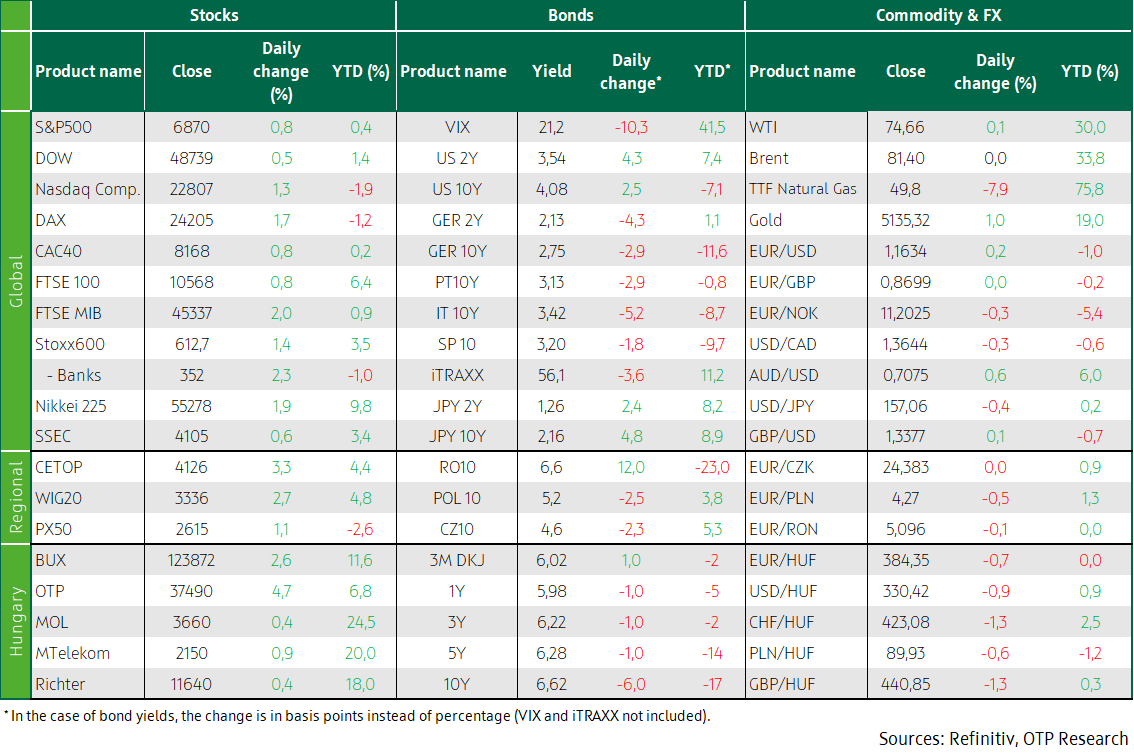
Europe’s stock markets picked up on Wednesday as investors continued to digest the events of the Middle East war; the Stoxx 600 gained 1.4%. Spain’s IBEX 35 rose by 1.5% even though US President Donald Trump threatened the country with a full trade embargo the previous day for not allowing US troops to use its bases to strike Iran. Spain’s Prime Minister Pedro Sánchez again sharply criticized the US-Israeli attacks yesterday, calling them a "catastrophe" and comparing them to the Iraqi war. Markets recovered from a sharp decline on Tuesday when war tensions soured the sentiment. Oil prices were little changed on Wednesday after Donald Trump said on Tuesday that the US would provide security assistance and, if necessary, naval escorts for tankers passing through the Strait of Hormuz, to help restore sea traffic.
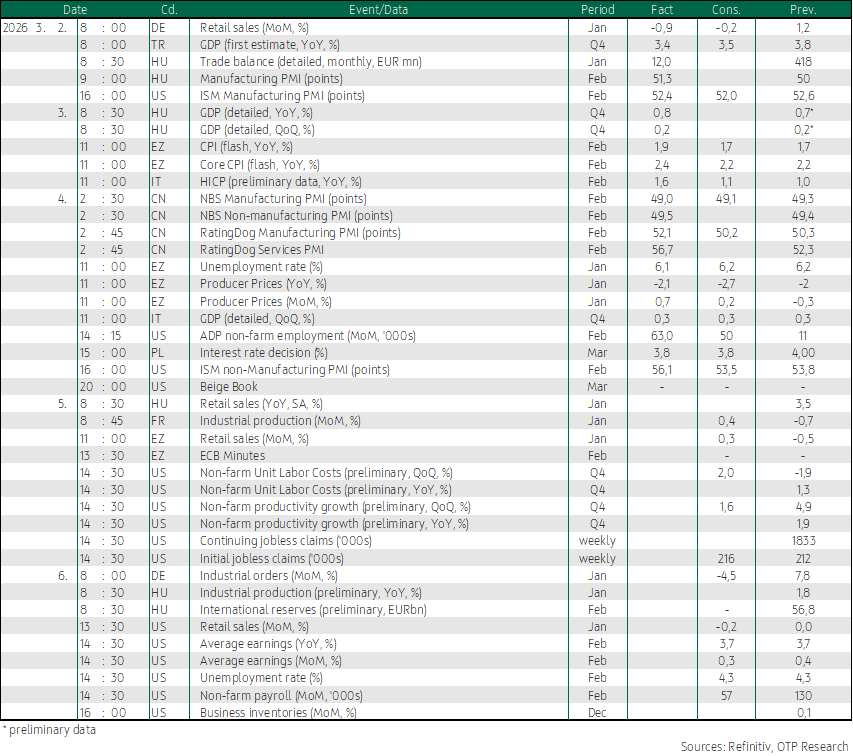
Eurozone labour market and producer price data for January showed a mixed picture: the seasonally adjusted unemployment rate fell to 6.1%, while analysts had expected 6.2%, and youth unemployment fell to 14.8% from 15% the previous month. At the same time, industrial producer prices rose by 0.7% MoM, well above the consensus forecast of 0.2%, following a 0.3% decline in December. The increase was mainly driven by a 1.3% rebound in energy prices. On an annual basis, producer prices remained 2.1% lower than a year earlier, at a slightly accelerating pace after -2.0% reading in December.
The indices of the CEE region rose yesterday. Hungary’s blue chips all grew, particularly OTP (+4.7%). Despite the escalation in Iran, the National Bank of Poland lowered its key interest rate by 25 basis points, to 3.75%, as expected, even though geopolitical risks also weakened the zloty at the beginning of the week - albeit to a lesser extent than the forint. Inflation was at 2.2% in January.
The European natural gas market seemed to calm down somewhat on Wednesday: prices fell 8%, to less than EUR 50/MWh.
US indices rose; the services sector and the labour market data were positive; oil prices appear to be stabilizing
US stock markets rose yesterday as growth fears over Middle East war tensions eased, and oil prices appeared to be stabilizing. The sentiment benefited from strong macro data. The US services sector performed better than expected in February: the ISM services PMI rose to 56.1 points, exceeding analysts' expectations of 53.5 points, which is the strongest expansion rate since August 2022. The improvement was supported by a broad-based increase in activity: the business activity index jumped to 59.9 points, and new orders rose to 58.6 points, well above the previous month's 53.1. The employment index also accelerated, cost pressures eased, and the price sub-index fell to 63 points, the lowest reading since March 2025, but it is still considered high. The labour market also showed a better-than-expected picture: according to the ADP survey, the US private sector created 63,000 new jobs in February, compared to expectations of 50,000 and well above the 11,000 in January. The bulk of the expansion was in education and healthcare (58,000 new jobs), while several sectors – such as professional services (–30,000) and manufacturing (–5,000) – reported layoffs. Wage dynamics remained stable: annual wage growth for job-stayers slowed to 4.5%, while for job-changers it slowed to 6.3%.
The positive reaction from the markets was also reinforced by the announcement by US Treasury Secretary Scott Bessent that the US would soon take “multiple steps” to secure oil shipping lanes, particularly through the Persian Gulf, after President Trump said the previous day that the US would provide political risk insurance for tankers traversing the Strait of Hormuz and provide naval escorts if necessary. This has eased concerns about the disruption of tanker traffic, which was triggered by the threat from the Iranian commander of the Revolutionary Guard Corps. However, uncertainty remains, especially as Donald Trump’s 15% global tariff comes into effect this week, although Treasury Secretary Scott Bessent said yesterday that tariffs could return to the old rates within five months.
The dollar slightly weakened, CEE currencies appreciated
Although oil prices inched up yesterday, the wide moves triggered by the Iran war have stopped in most markets – in fact, in many cases a correction began. The European natural gas price fell 8%, to less than EUR 50/MWh. The increase in the US and German bond yields essentially stopped; the US ten-year yield closed below 4.1%, the German one above 2.75%, but Italian and French bond yields fell noticeably. After several days of strengthening (totalling around 3.5%), the dollar ran out of steam, and the EUR/USD, which had recently been above 1.2, took a U-turn at 1.155 and ended trading below 1.165, which is half a percent higher than Monday's close.
Although the National Bank of Poland cut its key interest rate by 25 basis points, to 3.75%, as expected, the zloty – and with it the forint – strengthened against the euro on Wednesday. Having depreciated from 375 to 390 in two days, the EUR/HUF closed at 384 yesterday. After the 30-basis-point increase in yields and the pricing out of an interest rate cut in the past two days, Hungary’s bond market also reversed. Benchmark bond yields eased by a few basis points yesterday but the 10Y one stuck above 6.6%.
Today’s highlights
Asia’s indices rose this morning, ending the previous days’ slump. South Korea’s market did particularly well as chipmakers rebounded from a previously large fall, leading the rise today.
Today, industrial and retail sales data are due from Europe, and the minutes of the ECB’s interest rate decision will be released. In the USA, productivity and labour cost data, as well as the usual weekly new jobless claims statistics will see the light of day.
In Hungary, the ÁKK auctions 3Y, 5Y, and 10Y, offering HUF 20bn, 20bn, and 20 billion.
Get more out of your investments!
Global Markets Services
OTP Global Markets offers a broad range of services in the field of local and international money and capital markets.
Read morePrivate Banking Services
Personal care and expertise with OTP Private Banking, along with the knowledge, security, and innovations of a multinational banking group.
Read more