
OTP Morning Brief: Stocks fell on the fourth day of the war
Related content
OTP Morning Brief: US producer price index came in above expectations, yet the US 10-year Treasury yield still declined
Western European equities continued to advance despite ongoing pressure on the technology sector. Wall Street indices also rebounded, recovering some ground after Wednesday’s sell-off. Healthcare was the standout performer on both sides of the Atlantic. Eurozone industrial production declined by 0.5% month-on-month in August. In the US, the producer price index accelerated to 6.3%, delivering another upside surprise in inflation developments. US retail sales increased by 0.8% compared to August. The US 10-year Treasury yield declined by more than 10 basis points. The long end of the Hungarian government bond yield curve also declined by 7-9 basis points. In Hungary, August wage data will be released today, while in the US, September industrial production figures are due.
OTP Morning Brief: US CPI data came in above expectations
European equity markets advanced, supported by strong results from ASML and the outstanding performance of the healthcare sector. US equity markets came under pressure following higher-than-expected September CPI data. The annual CPI rate accelerated to 3.7%, driven primarily by a surge in gasoline prices, while core CPI rose by 0.3% month-on-month, supported by higher housing costs and rising transportation service prices. Oil prices rose amid escalating tensions in the Middle East and the impact of the IEA's oil market report. US Treasury yields retreated after an initial increase, driven by Fed commentary, while European bond yields generally moved higher. The US macro calendar will be busy today, with investors focusing on September retail sales and producer price index data, as well as the New York Fed Manufacturing Index, weekly jobless claims, and business inventories. August industrial production data from the euro area will be released today.
European markets fell widely, led by UK banks and airline shares. Natural gas prices rose further. Eurozone inflation grew higher than expected. US stocks also fell on the fourth day of the war. Oil prices rose further, precious metals climbed higher. Amid the panic, the dollar strengthened, while CEE currencies weakened. This morning, Asia’s markets traded in the red, particularly the Korean index.
Europe’s markets fell across the board, gas prices rose further, eurozone inflation disappointed
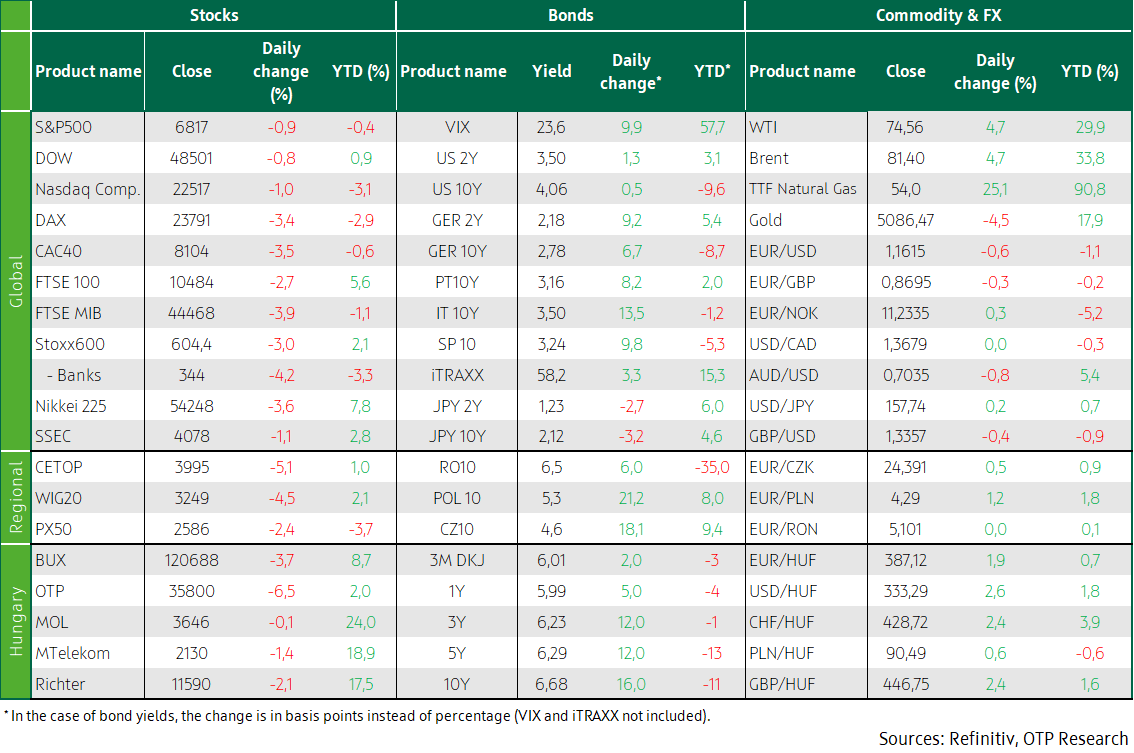
In Europe, shares fell to a one-month low on Tuesday as the sell-off on global stock markets accelerated; investors worried about the inflationary impact of a protracted Middle East war and a fresh surge in oil prices. The STOXX Europe 600 (-3.0%), the DAX (-3.4%), the CAC40 (-3.5%) and London's FTSE100 (-2.7%) all slid. All sectors of the STOXX 600 fell, particularly financials (-4.2%). British lenders fell particularly sharply, as they have the largest exposure to the Middle East. Barclays, which saw the largest turnover in the UK, lost 3.4%, while HSBC slumped 5.2%. Rising oil prices did not help energy companies (-1.6%) – indicating that under the circumstances, higher oil price is not just a profit-boosting factor, but it also causes demand shock, given that the market is risk-averse currently. The travel sector was hit particularly hard: Lufthansa (-4.1%), British Airways’ owner IAG (-5.4%), WizzAir (-6.5%) and Air France-KLM (-7.9%) all nose-dived.
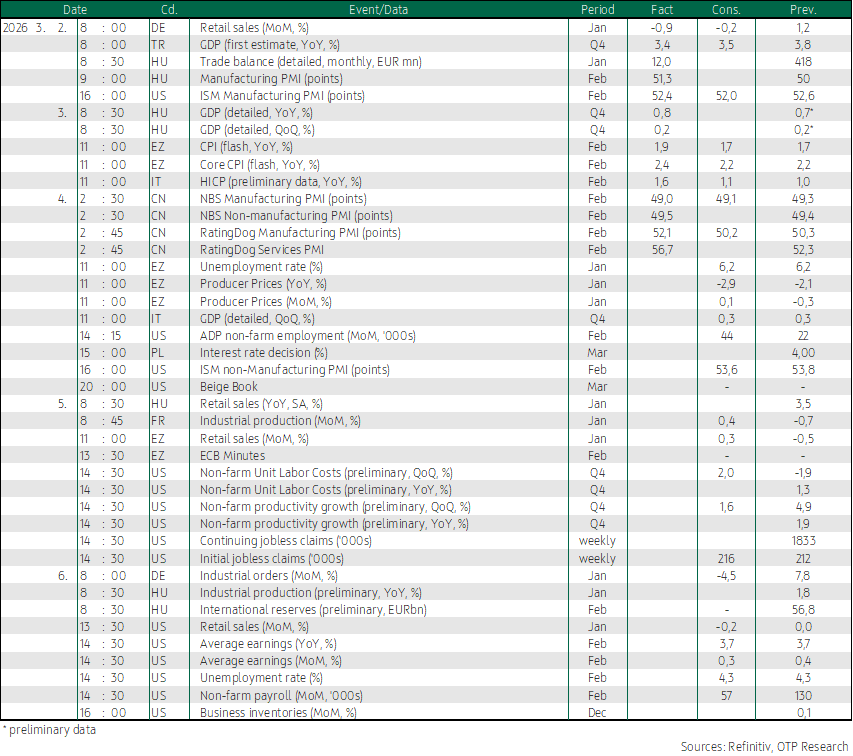
In the eurozone, inflation rose to 1.9% in February, well above analysts’ expectations of 1.7%. Price pressures increased especially in services and food, while core inflation rose to 2.5%, wrong-footing those projecting 2.2%. The rise in prices is an unwelcome surprise, as the conflict in Iran brings about further potential price pressures through the direct increase in oil prices and its second-round effects.
Global risk aversion did not spare the CEE region either: Czechia’s PX50 (-2.4%), Hungary’s BUX (-3.7%), and Poland’s WIG20 (-4.5%) all dived. OTP shares plunged 6.5%, while MOL, which potentially benefits from higher energy prices, inched down 0.1%.
European natural gas prices skyrocketed 23.1% on Tuesday, jumping 67% in a week, to above 50 EUR/MWh, as concerns about disruptions to LNG supplies due to tensions in the Middle East grew. Qatar halted production after Iranian drone attacks hit key facilities in the region and, although Iran has not officially closed it, has begun blocking trade through the Strait of Hormuz. The situation is exacerbated by the fact that EU gas stocks are at historically low levels (31%) due to the chilly winter.
US stocks fell on the fourth day of the war
Tuesday marked the fourth day of the US-Israeli war against Iran, during which Israel sent troops to Lebanon to fight the Iranian-backed terrorist organization Hezbollah and bombed Tehran and Beirut, while Iran carried out airstrikes on several neighbouring countries (United Arab Emirates, Bahrain, Qatar) and announced the closure of the Strait of Hormuz, significantly increasing geopolitical uncertainty.
All three major indices recorded significant losses due to the war: the Dow (-0.8%), the Nasdaq (-1.0%), and the S&P (-0.9%) all slid. All sectors of the S&P ended in the red, most notably materials (-2.3%) and industrials (-1.6%), while technology posted smaller decline. The stocks of Nvidia (-1.3%), Ford (-5.2%), Intel (-5.3%), and Tesla (-2.7%) were under the heaviest selling pressure. Palantir closed 1.4% higher.
Oil prices extended their gains on Tuesday: Brent crude (+5.5%) traded near 82 USD/barrel, its highest since July 2024. The escalating conflict with Iran is disrupting fuel shipments and raising the risk of further supply disruptions in the Middle East’s oil markets. Yesterday, Aramco shut down operations at Saudi Arabia’s largest oil refinery in Ras Tanura in the Gulf, following a drone attack. Today, debris from a captured drone caused a major fire in the United Arab Emirates’ oil trading hub of Fujairah, but normal operations have since been restored. Oil trading in the Strait of Hormuz has also ground to a halt.
The dollar strengthened amidst the panic, CEE currencies weakened
As the war against Iran escalates, the stock and commodity markets, as well as developed economies’ bond and currency markets showed massive signs of panic yesterday. The higher-than-expected headline, core, and services inflation indicators from Europe could not make the sentiment any worse, but the market had calmed down by the evening. Starting from 4.05%, the ten-year US yield jumped by almost 10 basis points on Tuesday, but only two basis points remained by the end of the day. The ten-year German yield opened near 2.7%, peaked above 2.8%, and then ended trading around 2.75%, while the France’s 10Y yield closed seven basis points higher and that of Italy added 13 basis points yesterday. The dollar continued to advance, strengthening by another 0.6% against the euro, the EUR/USD plunged closer to 1.16.
Hungary published detailed data on the fourth-quarter GDP. The economy grew by 0.8% YoY and the 0.4% MoM; the expansion in consumption was offset by the decreasing investment and the negative growth contribution of net exports. The CEE region’s currencies – the koruna (-0.4%, the zloty (-1.2%), and the forint (-1.7%) – further weakened against the euro. The EUR/HUF jumped from 380 to 390 and closed near 386.5. In Hungary’s bond market, interest rate cut expectations have weakened, and benchmark bond yields jumped by 12-15 basis points. The 10-year yield, which was trading at 6.4% last week, is again approaching 6.7%. In the uncertain environment, there was weak demand for at the ÁKK's auction, where the agency sold only HUF 10 billion worth of 3M Treasury bills (the third of the amount on offer), at an average yield of 6.08%.
Today’s highlights
Asia also showed a strong decline on Wednesday morning. In Seoul, the Kospi, which had broken records in previous weeks, nosedived 12.4% today, but Japan’s Nikkei also slid 3.1% and China’s SSEC slipped 1.4%. The performance of China’s industry showed a mixed picture in February: the official PMI, in which state-owned companies weigh heavily, sank to 49.0, remaining in contraction territory, and dashing analysts’ hope for a slight improvement. In contrast, RatingDog's manufacturing PMI rose to 52.1, indicating the best business conditions in more than five years.
Today, unemployment data and producer price index are due in the eurozone, and the National Bank of Poland makes interest rate decision. In the USA, investors await ADP employment data and the ISM manufacturing index.
Get more out of your investments!
Global Markets Services
OTP Global Markets offers a broad range of services in the field of local and international money and capital markets.
Read morePrivate Banking Services
Personal care and expertise with OTP Private Banking, along with the knowledge, security, and innovations of a multinational banking group.
Read more