
OTP Morning Brief: commodity-linked shares offset the tech sector’s losses
Related content
OTP Morning Brief: US producer price index came in above expectations, yet the US 10-year Treasury yield still declined
Western European equities continued to advance despite ongoing pressure on the technology sector. Wall Street indices also rebounded, recovering some ground after Wednesday’s sell-off. Healthcare was the standout performer on both sides of the Atlantic. Eurozone industrial production declined by 0.5% month-on-month in August. In the US, the producer price index accelerated to 6.3%, delivering another upside surprise in inflation developments. US retail sales increased by 0.8% compared to August. The US 10-year Treasury yield declined by more than 10 basis points. The long end of the Hungarian government bond yield curve also declined by 7-9 basis points. In Hungary, August wage data will be released today, while in the US, September industrial production figures are due.
OTP Morning Brief: US CPI data came in above expectations
European equity markets advanced, supported by strong results from ASML and the outstanding performance of the healthcare sector. US equity markets came under pressure following higher-than-expected September CPI data. The annual CPI rate accelerated to 3.7%, driven primarily by a surge in gasoline prices, while core CPI rose by 0.3% month-on-month, supported by higher housing costs and rising transportation service prices. Oil prices rose amid escalating tensions in the Middle East and the impact of the IEA's oil market report. US Treasury yields retreated after an initial increase, driven by Fed commentary, while European bond yields generally moved higher. The US macro calendar will be busy today, with investors focusing on September retail sales and producer price index data, as well as the New York Fed Manufacturing Index, weekly jobless claims, and business inventories. August industrial production data from the euro area will be released today.
Europe’s markets moved sideways yesterday, when commodity-linked shares offset the tech sector’s losses. US stock markets fell on Tuesday. The government shutdown in the USA ended again. Oil prices rose amid Middle East tensions. The EUR/USD is once again above 1.18. Hungary’s long-term bond yields dropped. Services sector activity increased in China. The euro area’s inflation data and Alphabet's earnings will be in focus today.
Europe’s stock markets moved sideways, commodity-linked shares offset the tech sector’s drop
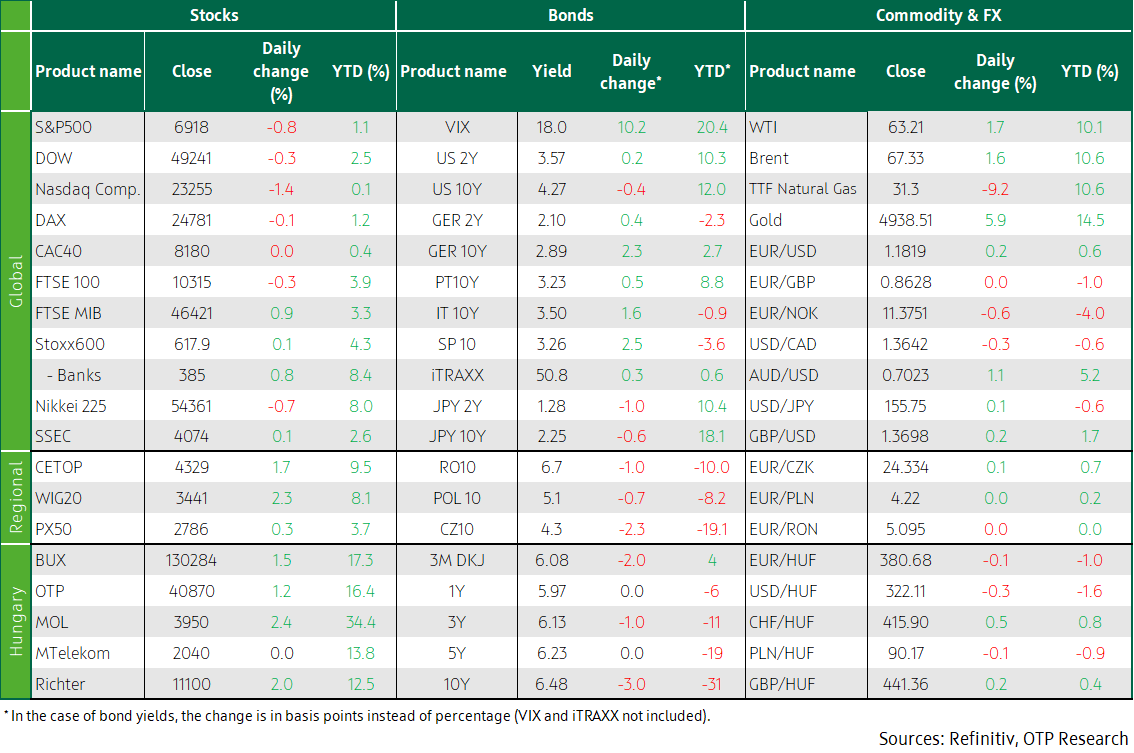
European markets made subtle movements on Tuesday, thus the Stoxx 600 index inched up 0.1%. Of the major indices, the UK's FTSE 100 (-0.3%), France’s CAC40 (-0.1%) edged lower, while Germany’s DAX closed flat – all of this was offset by the 0.9% increase in Italy’s FTSE MIB, which drew near a peak last seen in 2000. Of the various sectors, basic resources (+4.2%) excelled, benefiting form a rebound in precious metal prices: reversing Tuesday's decline, gold bounced back 5.2%, and silver grew by 5.3%. The media (-5.9%) and the tech (-4.2%) sectors had a less lucrative day; the latter was dragged down by stocks such as Infineon (-1.9%) and SAP (-4.6%). Europe’s largest asset manager, Amundi, gained 1.7% after reporting higher-than-expected net capital inflows in the fourth quarter. Novo Nordisk said it expects its profit and revenue to shrink by up to 13% this year due to US price pressure, strong competition, and the expiry of semaglutide patents. Accordingly, its shares listed in New York plunged 14.6%.
The sentiment was noticeably better in the CEE region, where the PX50 (+0.3%), the BUX (+1.5%), and the WIG20 (+2.3%) all posted gains. Hungary’s blue chips made nice gains, particularly MOL (+2.4%).
European natural gas futures continued Monday’s decline on Tuesday, sinking by 3.7%, to 34.2 EUR/MWh, indicating that concerns about LNG supply have eased.
America’s stock markets declined on Tuesday, the US government shutdown has ended, Middle East tensions drove oil prices higher
US indices slipped yesterday as investors worried about shrinking margins owing to overinvestment in AI and intensifying competition. Accordingly, the Nasdaq fell the most (-1.4%), followed by the S&P500 (-0.8%), and the Dow (-0.3%). AI giants Nvidia and Microsoft both fell 2.8%. Alphabet sagged ahead of its flash report today. Accordingly, the biggest loser in the S&P was technology (-2.4%). The exception within the sector was Palantir’s 6.9% rally, on the back of its positive earnings report. Soaring 3.4%, the materials sector outperformed in America too. In individual stocks, Walt Disney dropped slightly after appointing theme park chief Josh D’Amaro as the next CEO, thus ending uncertainty over succession. PayPal shares dived 20.3% as its 2026 profit forecast missed analysts’ estimates.
Donald Trump signed a budget deal that ended the partial government shutdown, restored funding for several agencies and gives lawmakers until 13 February to negotiate easing immigration restrictions; then, funding for the Department of Homeland Security (DHS) will be suspended again. The deal passed with broad, bipartisan support in Senate and narrowly in the House, as Democrats push for further restrictions on Donald Trump’s immigration policies in the wake of recent deadly incidents.
Brent crude oil futures rose by 1.6%, to 67.3 USD/barrel, while US WTI increased by 1.7%, to USD 63.21, as recent events have raised concerns that negotiations aimed at easing tensions between the United States and Iran could come to a halt. The US military said on Tuesday that it had shot down an Iranian drone that had "aggressively" approached the aircraft carrier Abraham Lincoln in the Arabian Sea. According to maritime sources and a security consulting firm, a group of Iranian motorboats also approached a US-flagged tanker in the Strait of Hormuz, north of Oman.
The EUR/USD went back above 1.18, Hungary’s long-term bond yields sank
Advanced economies’ bond markets opened with gains on Tuesday, even as France’s inflation data came in much lower than expected, but the trend reversed in the afternoon. European bond yields upped by 2-3 basis points; Germany’s 2.9% yield closed near the upper edge of its post-pandemic trading range. Yields on the US bonds edged lower by the end of the day; the 10Y one sank to 4.27%. The dollar’s weakening sent the EUR/USD above 1.18 once again.
The EUR/HUF did not budge, it hugged the 381 mark. In Hungary’s bond market, however, the rapid decline in yields on long-term maturities continued yesterday: the 10Y yield shed 3 basis points, below 6.5%, and the 20Y sank by nine basis points, to the vicinity of 7%. In yesterday’s auction, the ÁKK offered HUF 30 billion debt in three-month discount Treasury Bills, and despite the subdued demand, it could raise the allotted amount by a third.
Today’s highlights
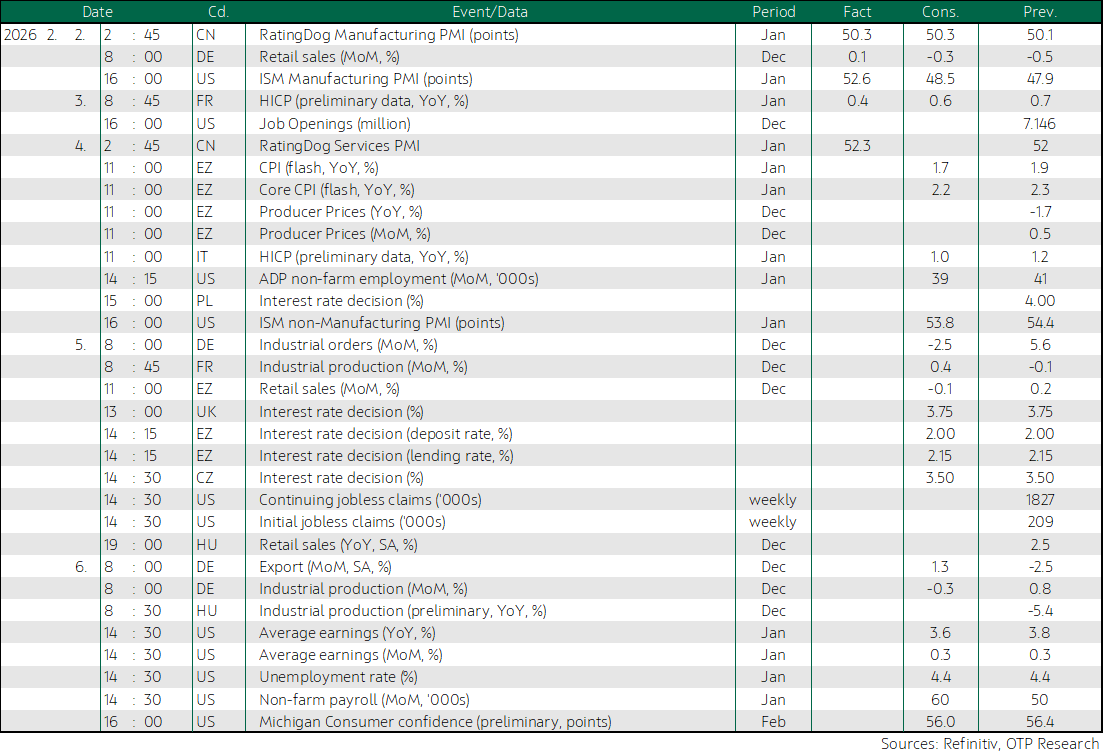
The RatingDog China General Services purchasing managers’ index rose to 52.3 points in January, from 52.0 points in the previous month. In January, activity in China’s service sector expanded at its fastest pace in three months, supported by stronger new orders, and employment also rose to its highest level since July. In sync with the manufacturing survey, these data may point to a slight improvement at the beginning of the year. China's SSEC stock index inched up 0.1% and Hong Kong's Hang Seng advanced 0.4%, while Japan's Nikkei lost 0.7%.
In Europe, the eurozone’s inflation data release and National Bank of Poland’s rate decision are in focus today. In America, ADP employment data and the ISM non-manufacturing PMI are scheduled for release. As the earnings season continues, investors await reports from Google's parent company Alphabet, as well as from Novo Nordisk's rival Eli Lilly.
Get more out of your investments!
Global Markets Services
OTP Global Markets offers a broad range of services in the field of local and international money and capital markets.
Read morePrivate Banking Services
Personal care and expertise with OTP Private Banking, along with the knowledge, security, and innovations of a multinational banking group.
Read more