
OTP Morning Brief: Stoxx600 and FTSE100 closed at new highs on Monday
Related content
OTP Morning Brief: US producer price index came in above expectations, yet the US 10-year Treasury yield still declined
Western European equities continued to advance despite ongoing pressure on the technology sector. Wall Street indices also rebounded, recovering some ground after Wednesday’s sell-off. Healthcare was the standout performer on both sides of the Atlantic. Eurozone industrial production declined by 0.5% month-on-month in August. In the US, the producer price index accelerated to 6.3%, delivering another upside surprise in inflation developments. US retail sales increased by 0.8% compared to August. The US 10-year Treasury yield declined by more than 10 basis points. The long end of the Hungarian government bond yield curve also declined by 7-9 basis points. In Hungary, August wage data will be released today, while in the US, September industrial production figures are due.
OTP Morning Brief: US CPI data came in above expectations
European equity markets advanced, supported by strong results from ASML and the outstanding performance of the healthcare sector. US equity markets came under pressure following higher-than-expected September CPI data. The annual CPI rate accelerated to 3.7%, driven primarily by a surge in gasoline prices, while core CPI rose by 0.3% month-on-month, supported by higher housing costs and rising transportation service prices. Oil prices rose amid escalating tensions in the Middle East and the impact of the IEA's oil market report. US Treasury yields retreated after an initial increase, driven by Fed commentary, while European bond yields generally moved higher. The US macro calendar will be busy today, with investors focusing on September retail sales and producer price index data, as well as the New York Fed Manufacturing Index, weekly jobless claims, and business inventories. August industrial production data from the euro area will be released today.
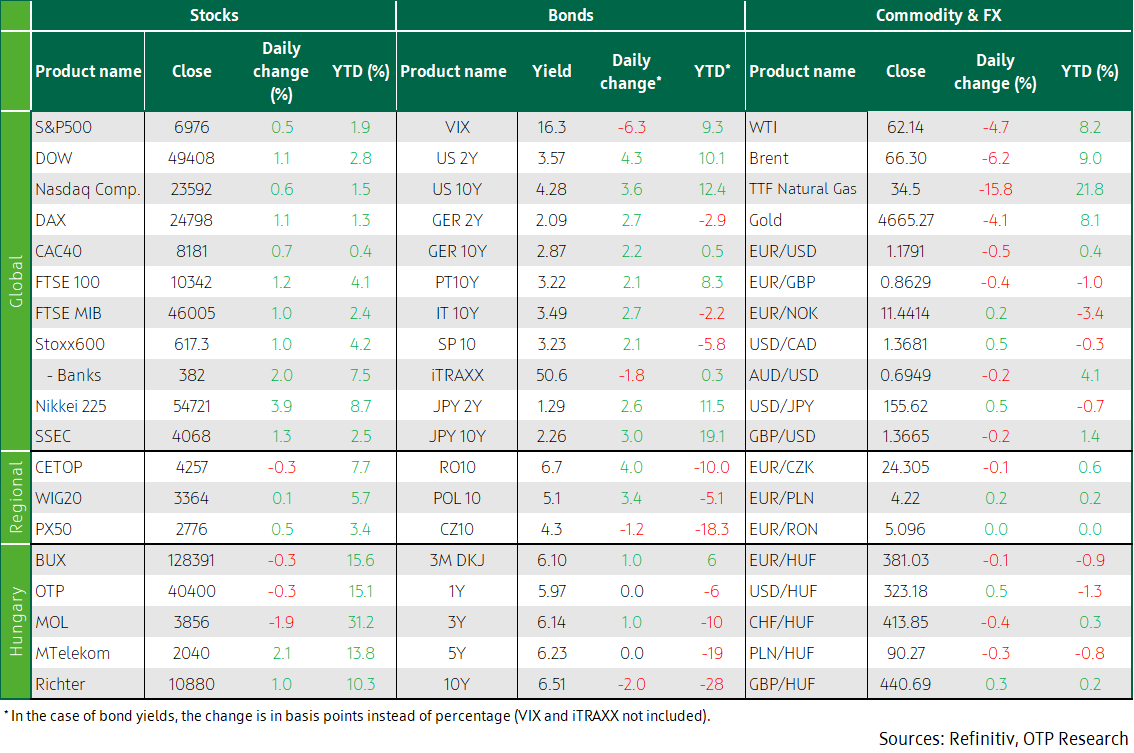
Global stock markets started Monday’s trading with sharp fall, as precious metal prices plunged for the second day. Developed stock markets gained momentum after the commodity markets stabilized, the Stoxx600 and FTSE100 closed at new highs in Europe, while America’s S&P500 is nearing all-time high. Despite the volatility in commodity markets, the USA’s leading stock indices closed higher, led by chipmakers and AI-related businesses. The US manufacturing PMI was much stronger than expected, and the data, coupled with the nomination of Kevin Warsh for Fed chairmanship, led to further increase in yields. The dollar’s continued appreciation pushed the EUR/USD below 1.18. TTF prices plunged by double digits, crude oilprice fell by 4-6% on Monday. Hungary’s long-term yields continued to decline, theEUR/HUF stopped around 381. Precious metal prices were rising this morning,while Asia’s stock markets rebounded from previous falls, Japan’s Nikkei closedat new high. France’s inflation data will be released today, while US joblessclaims and Friday's labour market report will be delayed, due to the partialgovernment shutdown. As the earnings season continues, reports from AMD, Merck, PepsiCo and Pfizer are slated for release, among others.
Despite opening in the red, the Stoxx600 and the FTSE100 hit new highs on Monday as commodity markets stabilized
Although Western Europe’s markets started Monday with losses, they achieved meaningful gains by the close: the Stoxx600 and FTSE100 climbed 1% higher, to record levels, and the DAX posted 1.3% gain. The second day of the slump in commodities initially kept European producers under heavy pressure, but the strengthening of some defensive sectors offset the weakness of mining companies. The easing of tensions between the USA and Iran helped crude oil prices decline, which did not favour Europe’s energy sector. Among the defensive sectors, food industry fared particularly well, with Danone soaring nearly 3%. The healthcare sector also rose notably, led by AstraZeneca (+3%) as the pharmaceutical company ‘moved’ from the Nasdaq to the New York Stock Exchange. Julius Baer lost 3% of its value after reporting a 25% slump in profits for 2025 in its quarterly earnings. Italy’s BFF Bank plummeted 45% after the financial institution’s CEO had resigned and the bank scaled back its financial targets for 2026. Nevertheless, the banking sector was the day's winner among the Stoxx600’s sectors: the banking sub-index reached levels last seen in 2008. As the selling pressure eased on commodity markets, producers' losses also moderated, and Europe’s materials sector ultimately achieved slight gains. Pandora rallied 9% on Monday; the Danish jewellery maker's share price benefited from the fall in silver prices. Capgemini advanced more than 2% on news that the French IT company may sell its US subsidiary.
Wrong-footing expectations of contraction, Germany’s retail sales expanded in January. The final manufacturing PMIs for Germany, France, and the whole of the eurozone was slightly stronger than the preliminary figure.
In the CEE region, the morning’s losses were pared as the sentiment improved, but only the Polish and Czech benchmarks made it into positive territory. Hungary’s BUX slipped 0.3% as the gains of Richter (+1%) and MTelekom (+2%) could not offset the declines of Mol (-2%) and OTP.
In Europe, natural gas futures fell by nearly 16% on Monday, to 34.5 EUR/MWh from a seven-month high of EUR 40 on 23 January, as concerns about LNG supplies eased.
US stock indexes rose, the S&P500 was nearing record at the end of a volatile day
America’s stock indexes closed higher on Monday: the S&P500 (+0.5%) was heading for a previous record, the Nasdaq Composite increased by 0.6%, the Dow and Russell2000 gained more than 1% each. It was chipmakers and AI-related companies that fuelled indices’ growth: Scandisk (+15%), AMD (+4%), and Micron Technology (+5.5%) all excelled. Palantir, which reported after market close, rose almost 1%. Alphabet grew by 1.9%, to a record high, and Amazon also added 1.5%, both companies will publish their quarterly earnings later this week. Meanwhile, Walt Disney, which reported stronger-than-expected quarterly results, fell 7% after forecasting a drop in the number of foreign tourists visiting its U.S. theme parks and a decline in profits from its TV and film division.
Commodity markets fell for a second day on Monday after President Donald Trump nominated Kevin Warsh to be the next Fed chairman on Friday, sparking a sell-off in precious metals. The nominee is considered to be a hawk, which has significantly dampened the glitter of metals in investors’ eyes. The decline began on Friday, when spot gold posted its biggest one-day drop since 1983, down more than 9%, while silver plunged 27%, its biggest one-day drop ever. The sell-off in precious metals accelerated after CME Group raised margin requirements on metal futures and options, effective from market close on Monday. Margin increases tend to adversely affect the contracts involved, as higher capital outlays can dampen speculative participation, reduce liquidity and prompt traders to unwind their positions.
VIX, the index of volatility, rose to a two-week high at one point on Monday, but shed one point, to 16.5 by the close. Crude oil prices also fell as tensions between the USA and Iran eased, boosting airline stocks: shares in United Airlines, JetBlue, Delta Airlines and Southwest all took off 4-8%.
Energy was the biggest loser in the S&P 500 sector index yesterday, followed by utilities, while consumer discretionary and industrials were the best performers. The ISM manufacturing PMI improved stronger than expected and crossed the 50-point mark for the first time in a year.
On Monday, WTI almost 5% and Brent slid more than 6% as geopolitical tensions eased. The US and Iran said they would resume talks on Friday, easing concerns about disruptions to oil supplies in the Middle East. OPEC+ confirmed that it would leave production levels unchanged for March and continue to provide ample supply by suspending production increases due to weak seasonal demand. In Monday's trading, gold slipped 4% and silver subsided 6%.
Following Kevin Warsh's nomination, developed markets’ long-term yields rose further; the EUR/USD traded below 1.18; Hungary’s long-term yields sank, the EUR/HUF is around 381
Bond yields rose significantly, especially in the USA, and the dollar strengthened in response to the unexpectedly strong US manufacturing confidence index and the nomination of Kevin Warsh as the new Chairman of the Fed, who is seen as an advocate of tight monetary policy. The ten-year US bond yield rose by five basis points, drawing near 4.3%. Yields also rose in Europe’s major markets; the 10Y German yield upped two basis points, to 2.87%. The dollar regained further ground from the euro: the EUR/USD subsided 0.5% yesterday, slipping below 1.18, from the high of 1.205 hit during a probably false breakout last week.
The EUR/HUF hovered around 381 on Monday, and closed at that level. Hungary’s benchmark bond yields with maturities of 10Y and beyond sank again, the ten-year yield one essentially reached 6.5%. At yesterday's switch auction, HUF 55 billion worth of discount Treasury bills changed hands, with strong demand.
Today’s highlights
Heading into the close, Asia posted significant gains this morning. Japan’s Nikkei (nearly +4%) went to a new high, KOSPI was soaring around 7%, the Shanghai Composite (+1.3%), CSI300 (+1.2%), and the Hang Seng (+0.3%) all increased. India’s stock market had a relief rally on news of US tariff reduction, the SENSEX (+3%), the Nifty 50 (+4%) surged before market hours on the announcement that the USA has reduced tariffs on India to 18% after India’s government stopped buying Russian energy resources.
Index futures boded well for major US benchmarks and Western Europe’s major stock exchanges. Precious metals prices gained strength again this morning, with gold soaring 5% and silver jumping 9%. Among industrial metals, copper (+4%) and platinum (+5%) have increased.
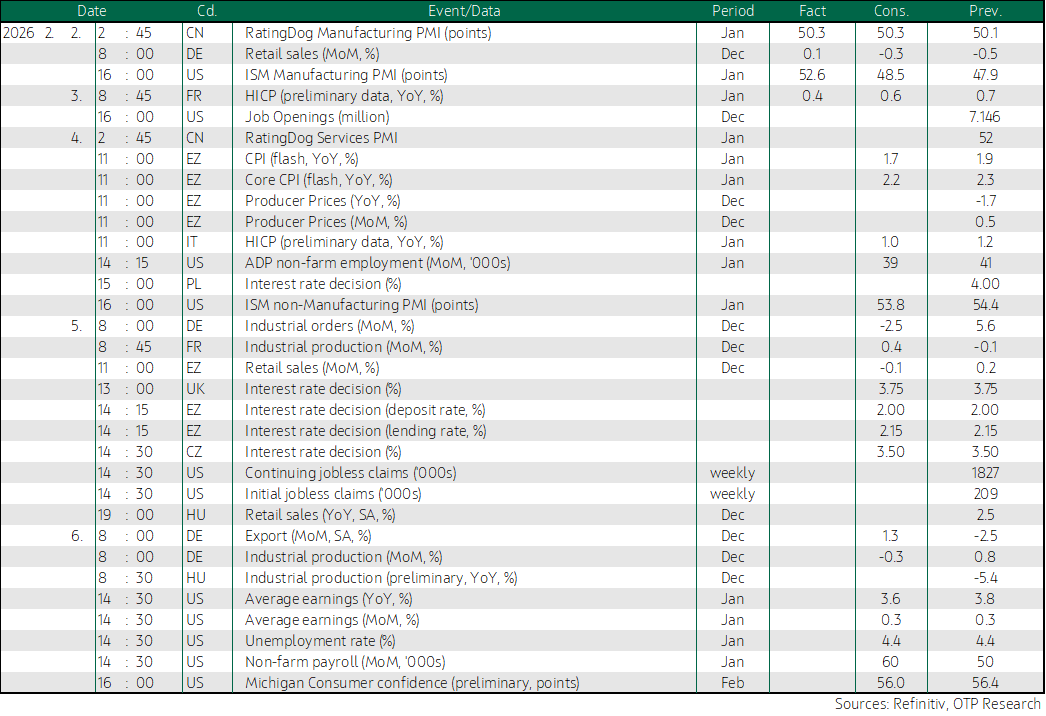
Today, France publishes inflation data for January In the USA, the House of Representatives has introduced a bill to end the partial government shutdown that began on Saturday, with a final vote scheduled for today. The Bureau of Labor Statistics said its closely watched January jobs report will not be released on Friday because of the partial shutdown. It will also delay the release of job openings for December.
Among others, AMD, Merck, PepsiCo, Amgen and Pfizer will publish their earnings reports in the USA today. In Europe, reports from Sweden's Alfa Laval, Italy's Intesa Sanpaolo, Mondelez, and Amundi are worth checking. According to the latest LSEG poll, the profits of S&P 500 companies jumped by nearly 11% in the quarter ending in December, as opposed to the estimate of around 9% in early January.
Today, the ÁKK auctions three-month discount T-Bills, offering HUF 30 billion.
Get more out of your investments!
Global Markets Services
OTP Global Markets offers a broad range of services in the field of local and international money and capital markets.
Read morePrivate Banking Services
Personal care and expertise with OTP Private Banking, along with the knowledge, security, and innovations of a multinational banking group.
Read more