
OTP Morning Brief: Kevin Warsh nominated for Fed Chair
Related content
OTP Morning Brief: US producer price index came in above expectations, yet the US 10-year Treasury yield still declined
Western European equities continued to advance despite ongoing pressure on the technology sector. Wall Street indices also rebounded, recovering some ground after Wednesday’s sell-off. Healthcare was the standout performer on both sides of the Atlantic. Eurozone industrial production declined by 0.5% month-on-month in August. In the US, the producer price index accelerated to 6.3%, delivering another upside surprise in inflation developments. US retail sales increased by 0.8% compared to August. The US 10-year Treasury yield declined by more than 10 basis points. The long end of the Hungarian government bond yield curve also declined by 7-9 basis points. In Hungary, August wage data will be released today, while in the US, September industrial production figures are due.
OTP Morning Brief: US CPI data came in above expectations
European equity markets advanced, supported by strong results from ASML and the outstanding performance of the healthcare sector. US equity markets came under pressure following higher-than-expected September CPI data. The annual CPI rate accelerated to 3.7%, driven primarily by a surge in gasoline prices, while core CPI rose by 0.3% month-on-month, supported by higher housing costs and rising transportation service prices. Oil prices rose amid escalating tensions in the Middle East and the impact of the IEA's oil market report. US Treasury yields retreated after an initial increase, driven by Fed commentary, while European bond yields generally moved higher. The US macro calendar will be busy today, with investors focusing on September retail sales and producer price index data, as well as the New York Fed Manufacturing Index, weekly jobless claims, and business inventories. August industrial production data from the euro area will be released today.
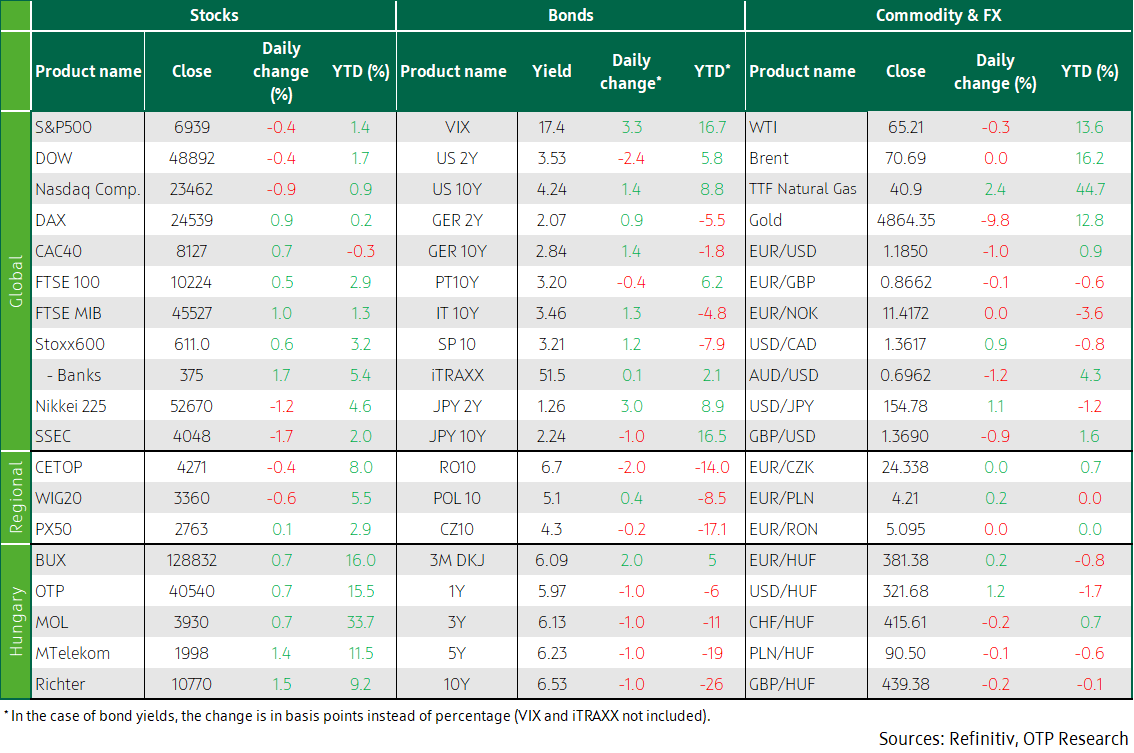
Germany’s DAX underperformed Western Europe’s stock indices last week. The STOXX 600 rose for the seventh month in a row. The eurozone’s economy grew stronger than expected. Hungary’s economy expanded by 0.7% YoY in Q4, according to raw data. Donald Trump n, US stock market indices declined on Friday. In December, US producer prices rose faster than thought. Ending the weakening at the start of last week, the dollar appreciated to 1.185 on Friday. US 10Y yield inched up last week, drawing near 4.25%. Crude oil surged by about 7% last week. Gold prices subside in the second half of last week. Partial government shutdown began in the USA, but is likely to last only a few days. This week’s highlights include January inflation data for the eurozone, the ECB’s rate-setting meeting, and key US employment data.
The eurozone’s economy expanded faster than thought
Losing 1.5%, Germany’s DAX underperformed Western Europe’s stock indices last week, mainly due to Thursday's weak performance and the plunge in SAP’s share price. However, the German index picked up 0.9% in Friday. Having increased by 0.6% on Friday, the STOXX Europe 600 closed last week 0.4% higher, marking its seventh consecutive month of gains. The UK’s FTSE 100 (+0.5%) and France’s CAC40 (+0.7%) also climbed higher on Friday.
Banking stocks (+1.7%) were top gainers in Europe. As the earnings season continued on Friday, Caixa bank’s share surged 6.7% as the Spanish bank had said its profit could rise this year and next. Swiss watchmaker Swatch also skyrocketed 13.4% after reporting 4.7% growth in second-half-year sales, at constant exchange rates. Germany’s Adidas jumped 3.9% after announcing a one-billion-euro share buyback, and reporting record sales for 2025. France’s Alten jumped 16.7% as the consultancy reported a smaller-than-expected organic decline for 2025. Shares of Signify, the world’s largest lighting manufacturer, nose-dived 17.2% as its annual results disappointed. Economic growth in most of the continent’s major economies surprised to the upside in the fourth quarter. In quarter-on-quarter terms, Germany (+0.3%), Spain (+0.8%), Italy (+0.3%), and the Netherlands (+0.5%) all surpassed expectations. Thus the eurozone economy expanded by 0.3% QoQ and 1.3% YoY, beating expectations. This brought the currency block’s 2025 growth rate to 1.5% – taking into account the trade and geopolitical tensions of 2025, this points to the resilience of European economies.
In January, the year-on-year harmonized inflation slowed to 2.5% in Spain and rose to 2.1% in Germany. In the eurozone, the unemployment rate eased by 0.1 percentage point, to 6.2% in December.
On Friday, Hungary’s KSH statistical office published its preliminary estimate on fourth-quarter GDP. Slightly missing expectations, the Hungarian economy rose by 0.2% from the previous quarter. The growth rate was 0.7% YoY, according to raw data. The seasonally and calendar-adjusted and reconciled data show 0.3% increase for full year 2025.
In the CEE region, Hungary’s BUX increased by 0.7%, Czechia’s PX50 upped 0.1%, while Poland’s WIG20 gave back 0.6%.
Donald Trump nominated Kevin Warsh for Fed Chair, US stock indices declined
On Friday, Donald Trump nominated Kevin Warsh to be the next Chairman, as Jerome Powell's mandate expires in May. Between 2006 and 2011, Kevin Warsh served as a member of the Fed's Board of Governors. During his previous tenure at the Fed, he was known as an inflation ‘hawk’ but now he is more supportive of Donald Trump’s interest rate cut plans. However, as a critic of quantitative easing, he promotes a comprehensive central bank regime change, including a reduction in the Fed’s balance sheet and bank deregulation. Investors will therefore have to consider how his former hawkish views square with President Trump’s push for much lower interest rates. It is important to note that even if he were to follow Donald Trump’s interest rate cut guidance, monetary easing is not guaranteed, as it is not yet clear how he would be able to secure majority support in the Board of Governors, and especially in the Federal Open Market Committee. In terms of initial reactions, US indices fell on Friday: the S&P 500 and the Dow Jones lost 0.4% each, and the tech-heavy Nasdaq Composite, which is more sensitive to the interest rate environment, slumped 0.9%. The latest producer price index may also have played a role in Friday's decline. U.S. producer prices rose at the strongest rate in five months in December, exceeding expectations, partly due to the pass-through of import tariffs. This suggests that inflation may pick up in the coming months and thus allow the Federal Reserve to keep interest rates unchanged for a while. Over the past week, the S&P 500 climbed 0.3% higher, while the Dow and Nasdaq edged down. Investors received megacaps’ flash reports mixed last week: it is becoming increasingly clear that the market will tolerate record capital spending only as long as earnings growth holds up.
The announcement of Kevin Warsh’s nomination and the higher-than-expected producer price index also gave support to the dollar. After the rapid dollar weakening at the beginning of the week, when the EUR/USD crossed 1.2, the pair returned to 1.185 on Friday. However, ending eight trading days of steady increase, gold price slightly decreased in Thursday’s volatile trading, and fell almost 10% on Friday. The price of crude oil surged more than 7% in the first four days of the week – partly due to the escalating US-Iranian relations and in part due to the production loss at the Tengiz oil field in Kazakhstan. However, the price of black gold stalled on Friday. The US is lifting some sanctions on Venezuelan oil, thus India may replace Russian imports with Venezuelan oil, according to news released at the weekend.
Another highlight of the past week was the Fed's rate decision on Wednesday and the subsequent press conference. The Fed left interest rates flat at 3.5-3.75, as expected. Chairman Powell said that the risks between inflation and full employment still exist, but have become more balanced. The market is still pricing in a total of 50-basis-point rate cuts by the end of 2026, but only after Jerome Powell’s chairmanship ends.
Another partial government shutdown began in the USA this past weekend. However, it currently appears that Democrats and Republicans have managed to agree on a framework, so although the shutdown has begun, it will likely last a few days only.
Advanced economies’ bond and currency markets reacted positively to Kevin Warsh's nomination
Developed economies’ bond and currency markets gave positive in reaction to Kevin Warsh's nomination: there was no significant increase in yields, despite several factors pointing towards higher yields. As Fed Chairman, Kevin Warsh may reduce the Fed's balance sheet. All relevant indicators of the US producer price index in December far exceeded expectations. Donald Trump's tariff war threatens Canada and South Korea again, and the US fleet is heading for Iran. In addition, stronger-than-expected GDP data came from Europe, while the eurozone’s unemployment rate unexpectedly fell to an all-time low of 6.2%. The direction was not clear in the extremely eventful week. The Fed left interest rates steady this time, the US 10-year yield rose trivially week-on-week, to around 4.25%, which is the lower quarter of its post-pandemic trading range. At the same time, in Europe, the 10-year bond yields of Germany, Italy and France declined by about five basis points compared to the previous Friday. The German Bund yield is at 2.85%, which is still not far from the top of its post-covid range.
The EUR/USD has had a very eventful week. The world's most important cross rate rose to a five-year high, trading above 1.2 in the middle of the week, amid speculation about coordinated intervention by the USA and Japan against the yen, Trump's renewed US tariff threats, concerns about US government shutdown, the president's apparent indifference to the weakening dollar, and worries about the independence of the Fed, while precious metals prices continued to surge. However, after announcement on the Fed’s next chairman, the dollar gained strength and appreciated massively on Friday, so the EUR/USD also returned to the previous Friday's pre-breakout level of 1.185, and the price of precious metals fell sharply.
On Friday, the CEE region’s currencies lost strength as the dollar strengthened. The forint weakened to 381.5, although the EUR/HUF sank below the two-year record level of 380 several times during last week. In a weekly comparison, the koruna and the zloty depreciated but the forint made slight gain among its regional peers, primarily because the MNB maintained its hawkish communication after January’s rate-setting meeting, where it left the base rate at 6.5%. Hungary’s long-term yields continued to sink, the benchmark yields eased by 1-2 basis points on Friday and by ten basis points on maturities of five years and beyond, throughout last week. The 10Y yield is declining towards 6.5%, which is the lower edge of its trading range in the past one year.
Today’s highlights
In Asia, sharp declines were seen this morning as markets were heading into the close. Japan’s Nikkei (-1.2%), Korea’s KOSPI (-4.6%), Hong Kong‘s Hang Seng (-3%), and China‘s SSEC (-1.7%) were all trading in the red.
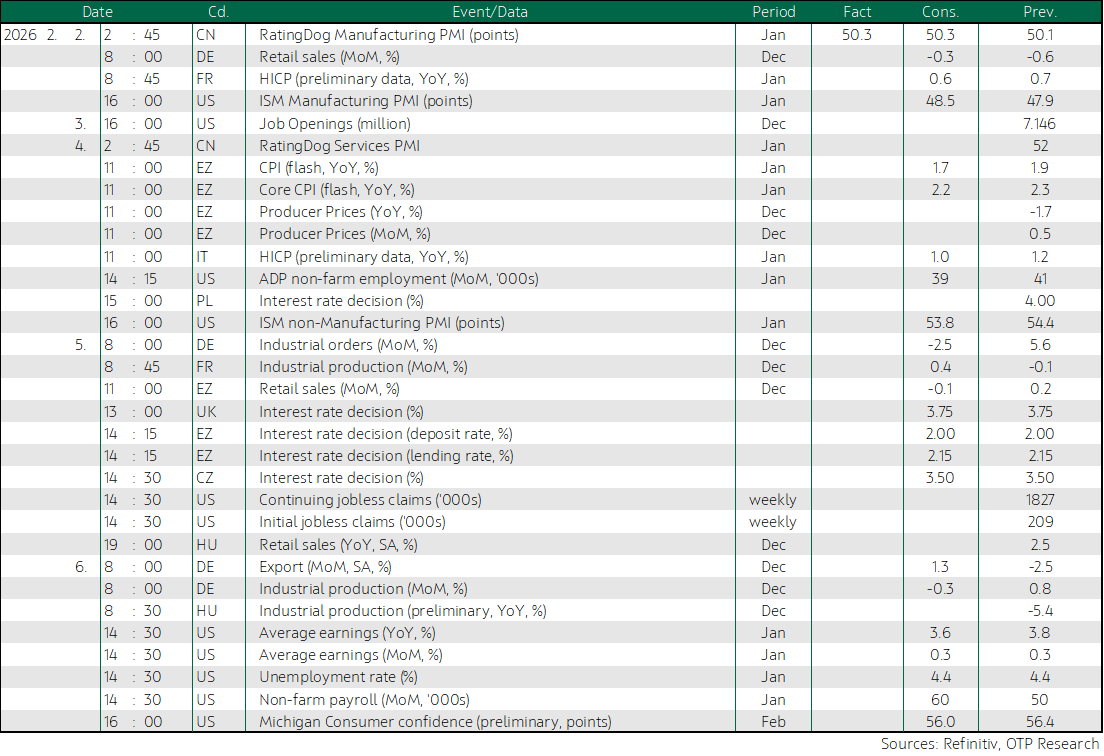
Today Germany releases retail sales data for December. Following CPI data from Spain and Germany, January inflation will be published in France, offering more accurate picture of how prices changed in the whole of the euro area. In the eurozone, January inflation will be released on Wednesday, one day before the European Central Bank's interest rate decision on Thursday. Based on market pricing and the broad consensus, the ECB is likely to leave interest rates unchanged on Thursday. However, the communication of the ECB’s decision-makers has shifted: while in December central bankers emphasized the upward inflation risks owing to high services inflation, last week some policymakers pointed out the downward inflation risks of the strong euro, even raising the possibility of an interest rate reduction. However, based on model calculations, even if the EUR/USD exchange rate rises closer to 1.2, the disinflationary effect is still negligible. In America, the ISM manufacturing data will be out today. Later in the week, the US employment data for January will be of particular importance. The unofficial ADP data will be released on Wednesday, followed by the official non-farm payrolls on Friday. The unemployment rate and earnings data will also be published on Friday. The data are expected to reflect Jerome Powell's opinion that the labour market, which has been deteriorating markedly since May of last year, may have stabilized. The University of Michigan's February consumer sentiment index will be out on Friday.
Palantir and Walt Disney, among others, will publish their earnings figures today. Alphabet, Eli Lilly, Novo Nordisk and Amazon will report this week.
In the CEE region, Czechia’s and Poland’s central banks hold interest rate-setting meetings this week. Hungary publishes December’s retail sales data on Thursday, and industrial production figures on Friday.
Early elections for Japan’s lower house began on Sunday. The results may reveal how well Prime Minister Takaichi can convert her high personal approval rating into votes for the currently ruling Liberal Democratic Party.
Get more out of your investments!
Global Markets Services
OTP Global Markets offers a broad range of services in the field of local and international money and capital markets.
Read morePrivate Banking Services
Personal care and expertise with OTP Private Banking, along with the knowledge, security, and innovations of a multinational banking group.
Read more