
OTP Morning Brief: AI valuation concerns weigh on global equity markets
Related content
OTP Morning Brief: US producer price index came in above expectations, yet the US 10-year Treasury yield still declined
Western European equities continued to advance despite ongoing pressure on the technology sector. Wall Street indices also rebounded, recovering some ground after Wednesday’s sell-off. Healthcare was the standout performer on both sides of the Atlantic. Eurozone industrial production declined by 0.5% month-on-month in August. In the US, the producer price index accelerated to 6.3%, delivering another upside surprise in inflation developments. US retail sales increased by 0.8% compared to August. The US 10-year Treasury yield declined by more than 10 basis points. The long end of the Hungarian government bond yield curve also declined by 7-9 basis points. In Hungary, August wage data will be released today, while in the US, September industrial production figures are due.
OTP Morning Brief: US CPI data came in above expectations
European equity markets advanced, supported by strong results from ASML and the outstanding performance of the healthcare sector. US equity markets came under pressure following higher-than-expected September CPI data. The annual CPI rate accelerated to 3.7%, driven primarily by a surge in gasoline prices, while core CPI rose by 0.3% month-on-month, supported by higher housing costs and rising transportation service prices. Oil prices rose amid escalating tensions in the Middle East and the impact of the IEA's oil market report. US Treasury yields retreated after an initial increase, driven by Fed commentary, while European bond yields generally moved higher. The US macro calendar will be busy today, with investors focusing on September retail sales and producer price index data, as well as the New York Fed Manufacturing Index, weekly jobless claims, and business inventories. August industrial production data from the euro area will be released today.
Western European stock markets were mixed on Wednesday, with the technology sector continuing to struggle. Tech valuation concerns still linger and weighed on US equity indices. Long-term treasury yields in the US and euro area barely moved yesterday. The EUR/USD remained above 1.17. Crude oil prices rebounded from near five-year low. The forint depreciated by nearly 1% on the day following the MNB's interest rate decision, longer yields fell. US inflation and weekly unemployment data will be today’s highlights, along with monetary policy decisions by the ECB, the BoE, and the Swedish, Norwegian, and Czech central banks. The MNB will present its latest inflation report today.
Equity markets were mixed in Western Europe, technology sector is still a drag
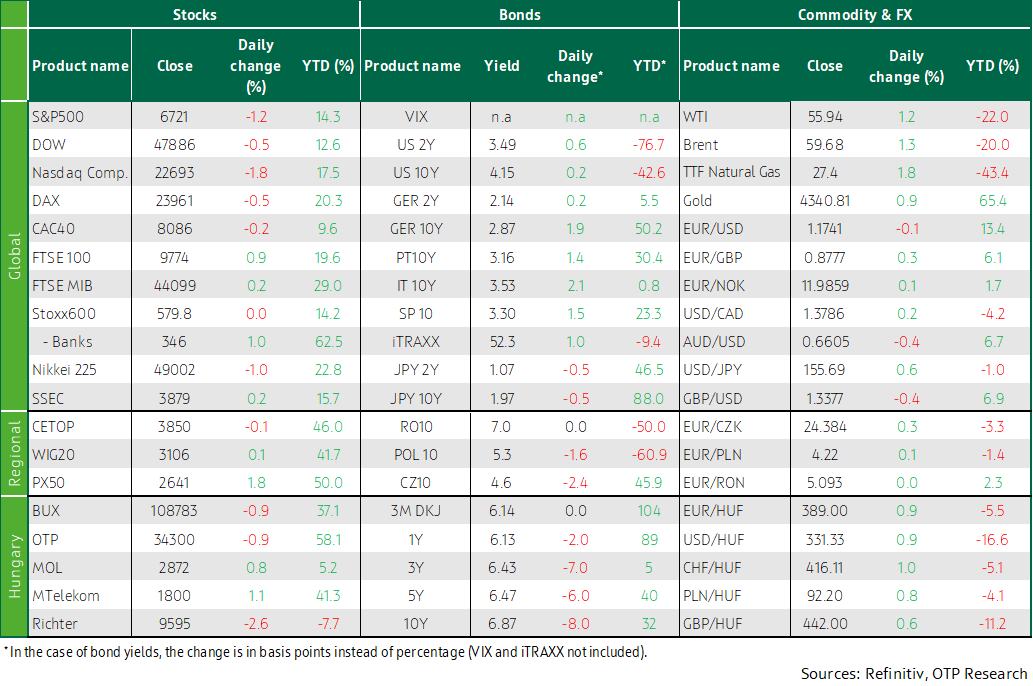
Key stock indices in Western Europe closed mixed on Wednesday: the Stoxx600 remained near above Tuesday's closing level, the DAX slipped 0.5% and the CAC40 fell 0.3%, while the FTSE100 rose 0.9%. In the UK, inflation data surprised to the upside, and growing expectations of an interest rate cut ahead of today's Bank of England meeting improved sentiment in the London stock market. However, the German Ifo index disappointed, deteriorating slightly against expectations of a slight improvement.
In terms of Stoxx600 sector indices, commodity-linked companies performed best after silver rose to record highs and gold prices edged higher. Banks also overperformed, with HSBC rising nearly 3% after previously hitting a record high and traders called attention to brokerage firms' imminent upgrade of the stock. Energy stocks also overperformed well, following the rise in oil prices after the USA imposed a blockade on Venezuelan oil tankers subject to sanctions. Shell added 1.2% and BP rose 0.7%. Tech stocks continued to struggle, with the technology sector index falling 1.7% and the largest players, ASML, BESI, and ASM International, losing 2-3.8%.
Among individual stocks, Bunzl fell 2% after the company forecast a slight deterioration in its operating margin for 2026. Serco was Wednesday's winner with a 7% rally, as the company expects better-than-expected results this year and next.
The main indices in the CEE region performed mixed yesterday, with the BUX underperforming with a 0.9% decline, while the WIG20 remained flat and the Prague index rose 1.8%. The BUX's weakness was largely due to the sharp decline of MBH, which accounted for four-fifths of Wednesday's trading volume on the BSE, with the bank holding's share price plunging 23%. 4iG closed 6% lower and Opus dropped more than 3%. Among Hungarian blue chips, Richter fell 2.6% and OTP declined 0.9%, which was partly offset by Mol's 0.8% and MTelekom's 1.1% gains. MOL announced that, according to their forecast, repair work at the Danube Refinery will be completed in the third quarter of 2026.
Sustainability and return concerns of AI-related investment weighed down US equities
The main Wall Street equity indices declined on Wednesday, with the Nasdaq Composite falling 1.8%, the S&P 500 dropping 1.2%, and the Dow edging 0.5% lower. Oracle plunged more than 5% after a report that Blue Owl Capital, the cloud provider's largest data center partner, did not support the USD10 bn deal for its next facility. Amazon ended the session 0.5% lower, with reports that the company is in talks to invest USD10 bn in OpenAI. Investors are concerned about the sustainability and return on all such spending. Chipmakers also had a weak day, with Nvidia falling nearly 4% and Broadcom declining 4.5%. The semiconductor manufacturers' SOX index dropped 3.9%. Alphabet lost more than 3%, with Reuters reporting that Google is working with Meta to break Nvidia's software advantage.
YouTube, owned by Google, announced that starting in 2029, the Oscars will be available for free worldwide exclusively on this platform and on YouTube TV. Other media news included Warner Bros Discovery's board of directors rejecting Paramount Skydance's hostile USD 108.4 billion bid in favor of Netflix's binding offer. Netflix shares rose 0.2%, while Paramount and Warner Bros shares fell 5.4% and 2.4%, respectively. Energy stocks rose along with crude oil prices after US President Donald Trump ordered a blockade of all sanctioned oil tankers arriving in or departing from Venezuela. Shares in ConocoPhillips and Occidental Petroleum both rose more than 4%. In addition to the energy sector, the non-cyclical consumer sector, raw materials and real estate also closed in positive territory.
Brent and WTI futures rose more than 1% on Wednesday, rebounding from their previous five-year low. In addition to measures against Venezuela, the US government is working on further extending sanctions against Russia if they does not sign a ceasefire agreement with Ukraine.
Developed bond yields barely moved on Wednesday. Hungarian longer yields declined, and the forint depreciated by nearly 1% in the wake of the MNB's interest rate decision on Tuesday
US and eurozone yields showed only slight movements on Wednesday, with the US ten-year yield remaining close to 4.15% and the ten-year Bund yield rising by 2bp to 2.87%. Investors were still digesting Tuesday's economic data in the US, delayed by the government shutdown, while awaiting today's release of November inflation figures, which have also key importance for interest rate expectations. Investors were somewhat reassured by Fed Governor Christopher Waller, often considered a "dove" in monetary policy, who said that the Fed still has room to cut interest rates due to the weakening labor market. The final November inflation figures for the eurozone were mostly in line with the preliminary figures, but the year-on-year index eased to 2.1%. The Q3 labor cost index and wage growth slowed more than expected, while Q2 data was revised slightly upward. The EUR/USD remained above the 1.17 level.
The HUF depreciated nearly 1% yesterday vs the euro, the US dollar, and also the Swiss franc. The EUR/HUF started the day below 386 in the morning, but the FX rate rate had crept above 389 by the end of the day. Yields fell in the secondary market for Hungarian government securities in Wednesday's trading in the wake of the MNB's interest rate decision on Tuesday. Yields with maturity over one year declined 6-8bp and the ten-year yield dropped 8bp to 6.87%. Demand was strong at Wednesday's auction of six-month T-bills, with bids covering more than three times the announced HUF 20 billion supply, prompting the ÁKK to raise the issue to HUF 30 billion. The average auction yield was 6.13%.
Today’s highlights
Valuation concerns in the global technology sector have spread to Asian stock markets, with most indices in the red this morning. Japanese indices slipped moderately, South Korean benchmarks declined more than 1%. The Hang Seng also slightly fell, while the Chinese stock market is mixed. The Shanghai Composite sank 0.2%, while the CSI300 Chinese blue chip index rose 0.5%. Equity futures predict a mixed opening for both Western European and US stock markets.
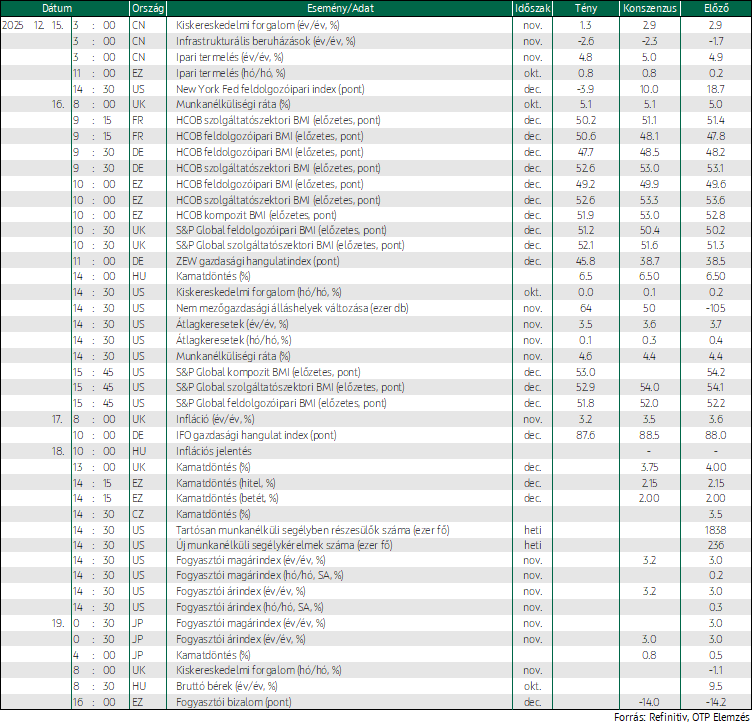
Today, like the rest of the week, will be packed with economic data and events. The ECB, the Bank of England, and the Norwegian, Swedish, and Czech central banks are holding interest rate meetings today. The market expects the Bank of England to cut interest rates by 25 basis points, especially after yesterday's CPI releases surprising to the downside; while the other central banks are not expected to change their key interest rates. Today, attention will turn to the November inflation and regular weekly unemployment data from the US.
In Hungary, the MNB will present its new inflation and growth forecasts in detail. It will also be worth keep an eye of MNB officials' messages. The ÁKK offers twelve-month T-bills worth HUF 20 billion and auctions 2032/B and 2034/A, in the value of HUF 50 and 15bn, respectively.
Get more out of your investments!
Global Markets Services
OTP Global Markets offers a broad range of services in the field of local and international money and capital markets.
Read morePrivate Banking Services
Personal care and expertise with OTP Private Banking, along with the knowledge, security, and innovations of a multinational banking group.
Read more