
The memory shortage may continue into next year
Related content
7.5% deficit is projected for 2026, and 5.2% for next year
7.5% deficit is projected for 2026, and 5.2% for next year, as the effect of previous tax cuts new spending measures build up, while one-off expenditures fall out in 2027.
Hungarian Equities - Technical Analysis
The BUX index broke its rising market structure last week, suggesting that the prolonged upward wave may have come to an end. MOL has also remained in correction phase since the dividend payment and has now fallen below the 5,000 level, leaving the next significant support considerably lower. Richter found support around 12,180, but no convincing reversal signal has been confirmed yet. Magyar Telekom continues to trade within an increasingly narrow range, with a high-momentum session likely needed to provide short-term direction. Opus remains in a downtrend. Rába is also moving within a broad trading range, although another upward wave could develop later if the necessary technical conditions are met.
The memory chip market has become one of the key bottlenecks in AI infrastructure. Growing model sizes and the proliferation of AI agents could further boost demand, while meaningful new supply is not expected to hit the market until late 2027. As a result, the tight market conditions may persist in the coming quarters. Although the sector remains cyclical, we believe the current cycle could be longer and stronger than previous ones, which, combined with low valuations, could present an attractive investment opportunity. In the second part of our series analyzing the fundamentals of the semiconductor sector, we examine the memory chip market.
Our previous analysis of the semiconductor sector is available here.
Over the past year, the memory chip market has stood out even within the semiconductor sector, becoming one of the bottlenecks in the deployment of AI infrastructure. AI-driven demand has created an extremely tight market environment, while the production of high-bandwidth memory (HBM) chips required for data centers demands 3–4 times more capacity than that of traditional memory products used in PCs and smartphones. Industry players have shifted a significant portion of their capacity to the production of higher-margin HBM chips, which has caused a shortage in the market for traditional memory products and driven their prices up several-fold.
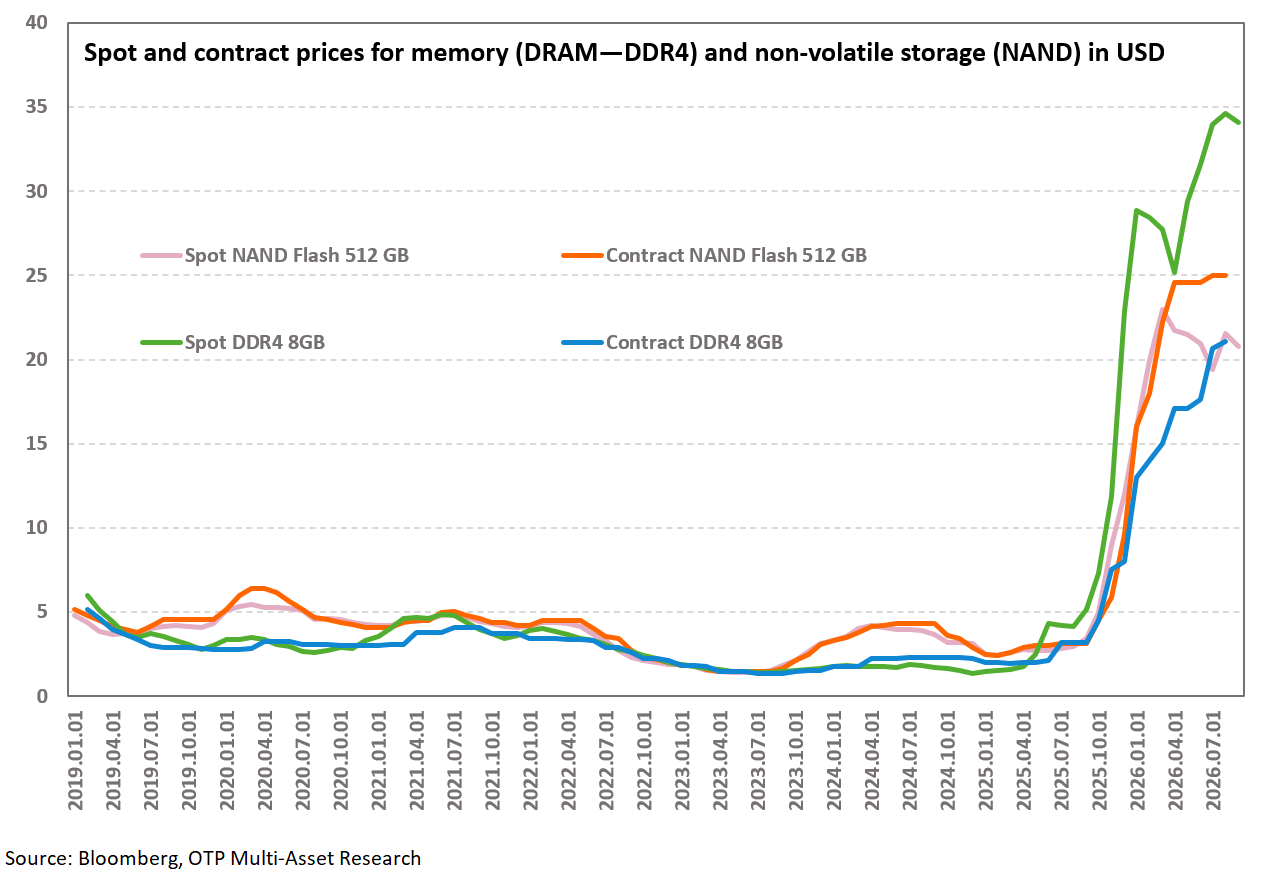
This strong demand is further fueled by the fact that AI models are constantly growing in size while performing increasingly complex tasks. This ultimately requires longer context windows, meaning that models must process and store ever-larger amounts of information simultaneously while performing tasks, which leads to increased memory requirements. In addition, high-bandwidth memory chips are required for fast computation, as they provide high data transfer speed, further driving demand for memory chips.
As long as major technology companies continue to invest heavily in AI infrastructure and the adoption of AI agents capable of performing more complex tasks continues at a rapid pace, no significant weakening in demand is expected in the memory chip market. Based on the current order backlog, strong growth could be sustained over the next 1 to 1.5 years, while significant new supply is not expected to hit the market until late 2027 or early 2028 at the earliest. However, ramping up new manufacturing capacity is expected to be time-consuming, so the memory shortage could become even more severe next year, and prices could rise even higher.
The memory industry is traditionally a highly cyclical sector, whose performance is primarily determined by current supply-and-demand conditions. Starting in 2028, supply may gradually catch up with demand, which could lead to a decline in memory prices and, consequently, a narrowing of margins for industry players. At the same time, the extent of this decline is expected to be less severe than in previous cycles, provided that the pace of AI-related investments remains sustained. In this case, the market could remain supply-constrained even in the longer term, while the supply shortage would ease only gradually.
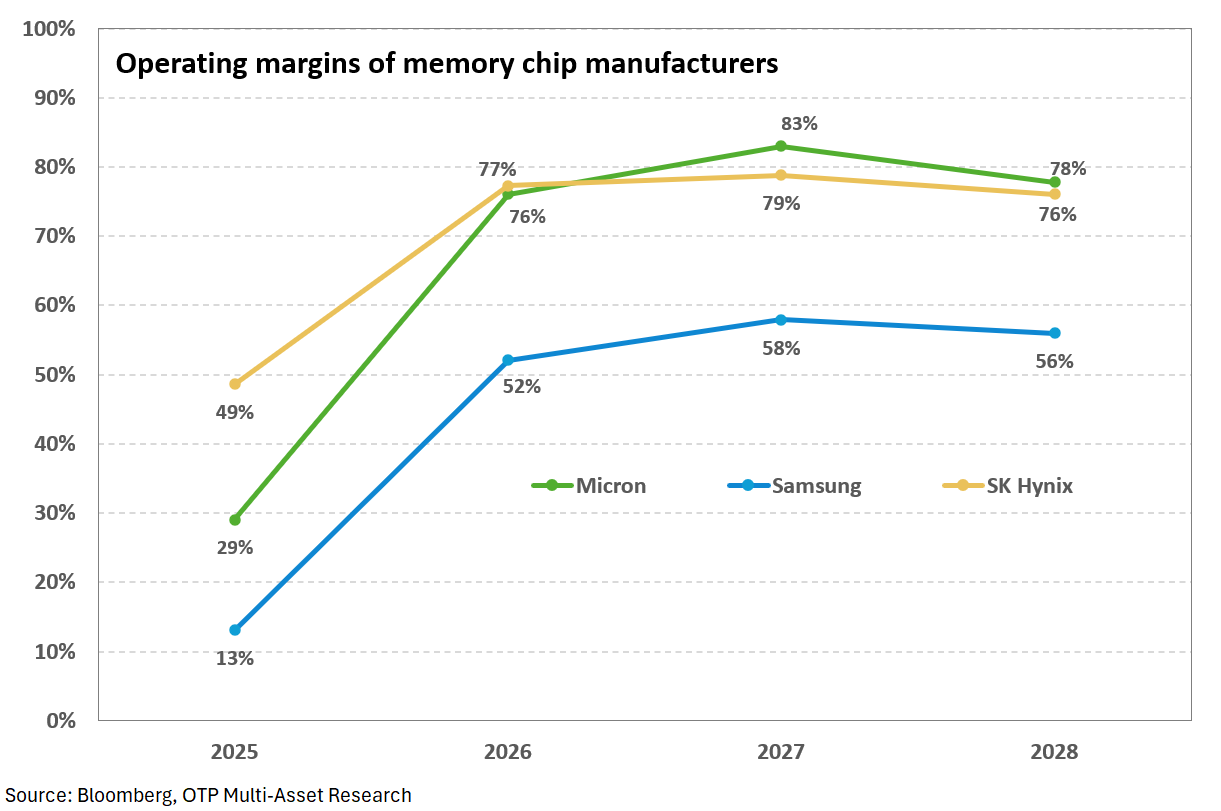
The extent of the extreme volatility experienced in previous cycles may be mitigated by the long-term — typically five-year — supply contracts entered into by memory chip manufacturers, which provide a higher floor for margins while improving revenue visibility. Nevertheless, the market continues to price the sector as an extremely cyclical industry: low forward P/E ratios of just 5–6 suggest that investors expect the cycle to be peaking. In our view, however, the current supply-and-demand dynamics are much more indicative of the middle phase of the cycle, which suggests the possibility of a longer and stronger cycle than in the past.
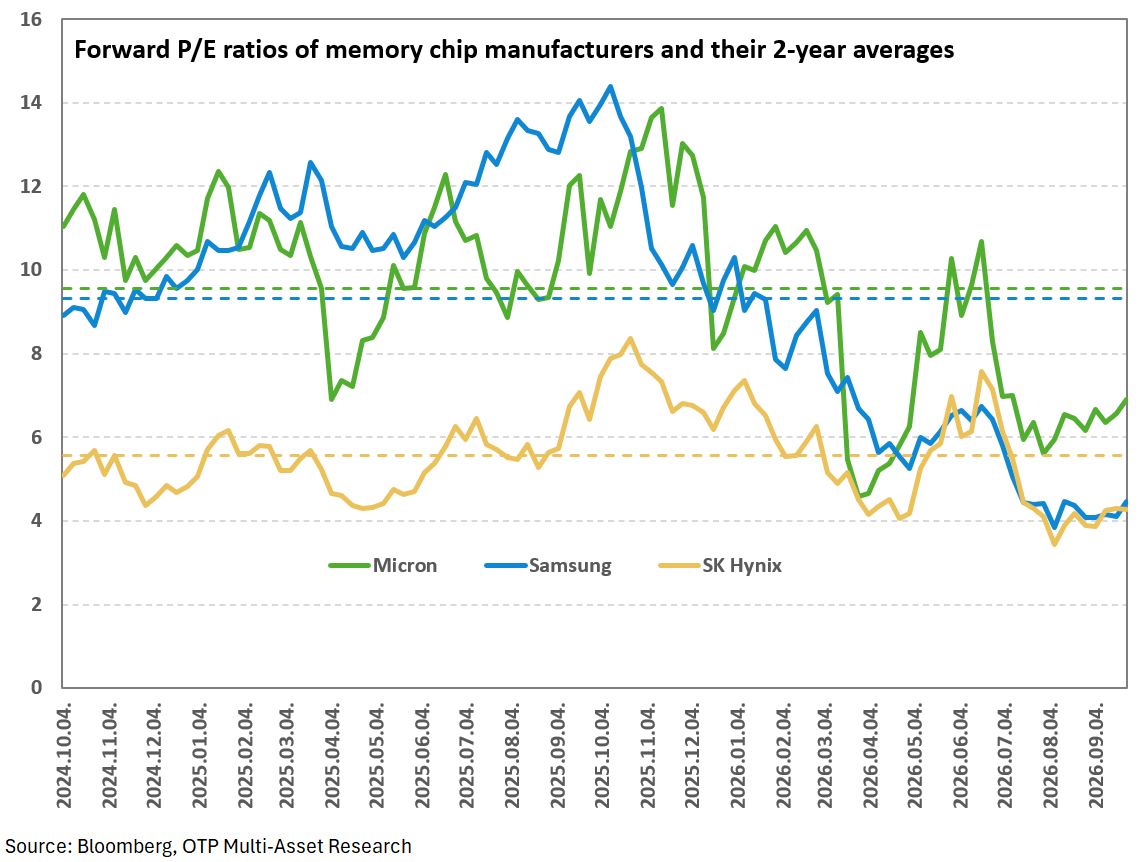
An acceleration in shareholder payouts could serve as an additional catalyst for the remainder of the year. In August, Samsung announced a nearly $80 billion shareholder return program that includes both share buybacks and dividend payments. In addition, the company committed to returning 50% of the free cash flow generated between 2024 and 2026 to its shareholders, while it may decide on any additional payments in January 2027. Its South Korean competitor, SK Hynix, also announced in August a nearly $29 billion share buyback program for this fall, while also modifying its capital allocation policy to enable it to return more than 50% of the free cash flow generated between 2025 and 2027 to its shareholders.
Micron Technology, the largest U.S. memory chip manufacturer, is expected to announce a similar shareholder benefit program at the end of the year; however, it is currently unable to do so for regulatory reasons. The company previously received government funding for its U.S. investments under the CHIPS Act, and as a condition of that funding, it agreed not to conduct any share buybacks for two years. This restriction expires on December 9, 2026, after which we expect Micron to follow the lead of its South Korean competitors and announce its own share buyback program. Such capital allocation moves could support the stock price while also improving earnings per share (EPS) expectations in the coming quarters. In the short term, however, the earnings report due after today’s market close could serve as the stock’s primary catalyst.
Risks
The industry is extremely sensitive to shifts in supply-and-demand dynamics, so the greatest risk is that the current demand-driven market will shift to one of oversupply in the coming years. Industry players have already announced significant investments that could double global supply by 2030. At the same time, if AI demand continues to grow at the current pace, it is by no means certain that the already announced capacity expansions will be sufficient for supply to meaningfully catch up with demand by the end of the decade. On the supply side, faster-than-expected capacity expansion by Chinese players — driven primarily by market-share-gaining goals — could pose a significant additional risk.
On the demand side, a slowdown in AI infrastructure investments remains the most significant risk—whether due to financing constraints or regulatory responses to security risks — as we detailed in our previous analysis. Furthermore, it cannot be ruled out that the slowdown in demand stems not from hardware but from software: algorithmic advancements and improvements in model efficiency could also reduce the memory requirements of AI systems. Technological changes of this nature are significantly more difficult to predict. At the same time, in our view, the memory chip market’s current strong fundamentals may continue to provide investors with adequate compensation for the risks mentioned above.
Get more out of your investments!
Global Markets Services
OTP Global Markets offers a broad range of services in the field of local and international money and capital markets.
Read morePrivate Banking Services
Personal care and expertise with OTP Private Banking, along with the knowledge, security, and innovations of a multinational banking group.
Read more